Welcome to Hyperion Records, a British classical label devoted to presenting high-quality recordings of music of all styles and from all periods from the twelfth century to the twenty-first.

Hyperion offers both CDs, and downloads in a number of formats. The site is also available in several languages.

Please use the dropdown buttons to set your preferred options, or use the checkbox to accept the defaults.
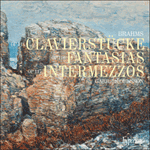
Click cover art to view larger version
Track(s) taken from CDA68116

Fantasias, Op 116

composer
1892

Sir Stephen Hough (piano)
Studio Master FLAC & ALAC downloads available
CD-Quality:
Studio Master:
CD-Quality:
Studio Master:
Recording details: May 2014
St George's Church, Brandon Hill, Bristol, United Kingdom
Produced by Tim Oldham
Engineered by David Hinitt
Release date: January 2020
Total duration: 20 minutes 47 seconds

Cover artwork: Interior, Strandgade 30 (1901) by Vilhelm Hammershøi (1864-1916)
AKG London
 

Other recordings available for download

Llŷr Williams (piano)
Garrick Ohlsson (piano)

Reviews

‘Listening to Hough, I was constantly delighted by the freshness of his phrasing, so different from many of his colleagues, yet never just for the sake of it. Few make the case for these elusive masterpieces as well as Hough’ (The Mail on Sunday)» More

‘One of the finest accounts of Brahms’s late piano works on record, one that stands head and shoulders above most contenders in an ever-growing catalogue … in his natural, unmannered freedom, Hough can be ranged alongside Radu Lupu … both join hands with the treasurable few Brahms recordings that have survived from Ilona Eibenschütz, friend of the composer who gave the private premieres of Op 118 and Op 119’ (Gramophone)

‘Stephen Hough’s profoundly poetic interpretation of Brahms’s piano works is an antidote to the self-indulgent sentimentality that has long dominated accounts of these works: a real palate-cleanser. As appropriate for a renaissance man like Hough, the release is a multi-sensory pleasure. From the cover to Hough’s booklet note to, of course, his sublime musicianship’ (Gramophone)

‘From the exciting Capriccio that opens the Op 116 set to the concluding grand Rhapsodie of Op 199, Stephen Hough is alive to the poetry, passion, sentiment and emotion that Clara Schumann described on receiving 11 of these late pieces from Brahms in 1892. The full-bodied sound of his Yamaha piano is well suited to these multi-faceted compositions that are more varied in mood than the title ‘late’ might suggest’ (Gramophone)

‘I was mesmerised by the veiled quality of sound and almost timeless approach to rubato that characterises his interpretations of the more introverted pieces, such as the E major Intermezzo, Op 116 No 4 and the B minor Intermezzo, Op 119 No 1. At the opposite end of the dynamic spectrum, Hough brings a powerful almost percussive edginess to turbulent pieces such as the D minor Capriccio, Op 116 No 1, the G minor Ballade, Op 118 No 3 and the extraordinarily defiant battle that rages through the Rhapsodie, Op 119 No 4. Most compelling of all, perhaps, is Hough's searingly intense and dramatic interpretation of the E flat minor Intermezzo, Op 118 No 6. There are undoubtedly many worthy recordings of this repertoire in the current catalogue, but Hough has something special to say about the music, and this recording certainly warrants an enthusiastic recommendation’ (BBC Music Magazine)» More
PERFORMANCE
RECORDING

‘He’s really made me reassess this music I thought I knew so well; nothing is taken for granted … Hough takes Brahms at his word with his tempo indications … there are ravishingly beautiful lullabies interrupted by outbursts of volcanic emotion, soulful introspection twisting into agonizing torment, and Hough’s playing melts into the recorded acoustic … I think, end-to-end, this is some of the most refreshing, surprising and emotionally fulfilling late Brahms I’ve heard in a modern piano recording … a New Year treat that will still, I think, be in some of the ‘best of the year’ lists in December’ (BBC Record Review)

‘Being Stephen Hough, he is playing with immense sensitivity, weighting phrasings and dynamics just so, never pushing too hard or too soft, always maintaining the intimate tone that Brahms’s private, sad musings need … thanks to composer and interpreter, this is never just a recital of beautiful music; it also offers precious consolation’ (The Times)

‘The four sets of piano works, Opp 116-119, form a kind of postscript to Brahms’s composing career, written when friends were dying and he was conscious of his own mortality. Minor keys predominate—13 out of 20—but the vigour of the youthful composer who impressed the Schumanns is still present in the Op 116 Capriccios, the Op 118 Ballade and the swan-song Op 119 Rhapsodie. Hough is master of all he surveys here, combining technical elan with deeply satisfying musical insights’ (The Sunday Times)

‘Hough calls these 20 pieces 'salon music to the nth degree' and says he does not imagine anybody else in the room with Brahms, just the composer alone at the piano. This makes his playing more intimate than most and he captures the strain of songful resignation very beautifully. The touching theme of the Intermezzo Op 116, No  5 (a repeated dying fall) is exquisitely voiced. The favourite, Intermezzo Op  118, No  2, is like a tender song without words. Most radiant of all are the Op  117 Intermezzos, glowing here with quietly rapturous colours’ (Financial Times)

‘Brahms referred to the three Op 117 Intermezzos as 'the cradle songs of my grief' and they form the backbone of this collection. Hough plays them lovingly and reflectively, with never a hint of false emotion. There is more muscle to be found in the 10 Op 116 Fantasias, especially in the agitated Capriccios, and the triumphant Rhapsodie which closes the Klavierstücke Op 18 set and this disc, and here Hough finds the right level of emotion and never overcooks the material … Hough guides us through this final chapter of piano works with an unerring sense of taste’ (Limelight, Australia)» More

‘Hough finds just the right sound to catch the music’s unruly emotions and its carefully crafted musical subtleties. Among this album’s many highlights are the amazing First Intermezzo of the third set, which comes across as a pure rush of energy, and the G minor Ballade, which takes on a massive granitic strength’ (The Telegraph)» More

‘I haven’t made specific reference to the performance of every one of the twenty pieces in this collection but I can assure readers that every single one of these late works receives an excellent and insightful performance. These piano pieces are as fine as they are concise and I found Stephen Hough completely convincing throughout his traversal of them. He seems to me to have captured the essence of every piece and his playing evidences great musical integrity and thoughtfulness. The recordings were made in two separate locations but the same engineer, David Hinitt, was at the controls for all the sessions. He’s done a first-rate job; the sound of the Yamaha CFX piano comes over very well indeed. Misha Donat contributes a valuable set of notes. This is a top-class survey of Brahms’ last compositions for solo piano’ (MusicWeb International)» More

‘Hough’s phrasing brings out the improvisational nature of many of these pieces, and his skill at clarifying what are frequently highly complex textures is quite exemplary. The breadth of his approach can be gauged by listening to the second and third pieces of the Op 118 set. The Intermezzo is marked to be played tenderly; it would be a challenge to find a pianist who responds to that indication more readily than does Hough here. The playing is, in many respects, straightforward and communicative, but the difference between the piano of the opening and the pianissimo of the repeat of the theme at the eighth bar is very affecting indeed. The opening of the following Ballade is marked energico. Hough’s brilliant staccato touch is just what is required … Hough’s playing has been beautifully recorded in two different venues. In addition to the pianist’s own short introduction, the booklet also contains an excellent listening guide by Misha Donat’ (MusicWeb International)» More

‘Hough—pianist, composer, painter, and prolific writer of great charm and intelligence—comes to these late Brahms works equipped with considerable brain-power, sensitivity, and a profound understanding of the composer. His interpretations are often moving, haunting, poignant, and simply beautiful … a most impressive Brahms recording’ (The Arts Fuse, USA)» More

‘It would be rash, and indeed irresponsible, to claim this recording as the best that Stephen Hough has ever made, or the best version of Brahms’ late piano pieces ever released. Yet Hough’s complete technical mastery, fresh musical insights, and deep stylistic sympathy constantly yield revelatory results … if you want all of Brahms’ late piano pieces together, Stephen Hough crowns the list. Hyperion’s engineering captures the sonorous impact of Hough’s Yamaha grand from bottom to top, thereby clinching this release’s reference status’ (Classics Today)» More

„Das äußerst feine Nuancieren, ein tief empfundenes Rubato, spontan wirkende Akzente, all das lässt diesen ‘Zeitvertreib im Dämmerlicht’ in herbstlichen Farben sowie einer Mischung von Resignation und Nostalgie sehr schön und für den Hörer auch sehr beruhigend werden. Ich muss weit in meiner Schallplattensammlung zurückgehen, um etwas ähnlich Bezauberndes zu finden. Am ehesten wohl zu Radu Lupu“ (Pizzicato, Luxembourg)
Fantasias, Op 116, is a curious title for a collection of pieces consisting of three capriccios and four intermezzos. Brahms had used the same labels of ‘capriccio’ and ‘intermezzo’—again to indicate a division between agitated and more serene pieces—for the individual numbers of a similar collection he had composed some fourteen years before; these earlier pieces had appeared under a more neutral banner as eight Clavierstücke, Op 76.

Brahms sent the Op 116 pieces to Fritz Simrock with the instruction that they should be issued in two volumes of three and four pieces respectively, though in view of the exceptionally strong unity underlying the set as a whole the composer’s desire to divide it in this way was surprising. The last number, like the first, is a stormy D minor capriccio; while at the centre of the collection stand three intermezzos in E major and minor which together may be construed as a form of slow movement. Moreover, the interval of the falling third is everywhere in evidence—not least, right at the beginning of the impetuous opening number. The sarabande-like theme of the melancholy A minor intermezzo which follows, with its fleeting, shadowy middle section, is again permeated by the same melodic shape.

The third piece, a passionate G minor capriccio with a grandiose trio section, functions as the scherzo of the set. Its initial phrase, which returns in an imposing augmented form to round off each of the two outer sections, is once more characterized by descending thirds; and the very same phrase returns in the decorated reprise of the following E major intermezzo’s main theme. The latter piece, which Brahms originally called a nocturne, is one of his most perfect miniatures, and an object lesson in how to fashion a deeply satisfying composition out of the greatest possible economy of means.

‘Andante con grazia ed intimissimo sentimento’ is the evocative tempo marking of the E minor intermezzo No 5. Its sighing two-note phrases, invoking strikingly dissonant harmony, at first give no hint of the music’s actual metre, which is revealed only in the more consolatory middle section. The E major penultimate piece, on the other hand, begins without any preamble in the style of a nostalgic, bittersweet minuet. Its theme is two-stranded, with a broad and expressive chromatic inner line surmounted by a series of stepwise descending phrases.

The concluding capriccio is in Brahms’s most agitated style, with the music’s restlessness reaching a peak in the middle section. The final bars recall the rhythm and harmony of the opening number, thereby bringing the collection full-circle.

from notes by Misha Donat © 2019

Fantasias, op.116, est un curieux titre pour un recueil de pièces composé de trois capriccios et quatre intermezzos. Brahms avait utilisé les mêmes intitulés de «capriccio» et «intermezzo»—une fois encore pour marquer une différence entre des pièces agitées et des pièces plus sereines—pour les numéros individuels d’un même recueil qu’il avait composé environ quatorze ans auparavant; toutefois, ces pièces antérieures avaient été publiées sous l’enseigne plus neutre de huit Clavierstücke, op.76.

Brahms envoya les pièces op.116 à Fritz Simrock en lui demandant expressément qu’elles soient publiées en deux volumes de trois et quatre pièces respectivement, mais au regard de l’unité d’une force exceptionnelle qui sous-tend l’ensemble de ces pièces, le désir du compositeur de les diviser de cette façon était surprenant. Le dernier numéro, comme le premier, est un capriccio tempétueux en ré mineur; alors qu’au milieu du recueil se trouvent trois intermezzos en mi majeur et mi mineur qui, réunis, peuvent être interprétés comme une forme de mouvement lent. En outre, l’intervalle de tierce descendante est omniprésent—en particulier juste au début du premier numéro impétueux. Le thème en forme de sarabande de l’intermezzo mélancolique en la mineur qui suit, avec sa section centrale rapide et mystérieuse, est à nouveau imprégné de la même forme mélodique.

La troisième pièce, un capriccio passionné en sol mineur, avec un trio grandiose, fonctionne comme le scherzo du recueil. Sa phrase initiale, qui revient sous une forme augmentée imposante pour parachever chacune des deux sections externes, est une fois encore caractérisée par des tierces descendantes; et exactement la même phrase revient dans la reprise décorée du thème principal de l’intermezzo suivant en mi majeur. Cette dernière pièce, que Brahms intitula d’abord nocturne, est l’une de ses plus parfaites miniatures et un exemple brillant de l’art de créer une composition des plus satisfaisantes avec la plus grande économie de moyens possible.

«Andante con grazia ed intimissimo sentimento» est l’indication de tempo évocatrice de l’intermezzo nº 5 en mi mineur. Ses phrases gémissantes de deux notes, invoquant une harmonie très dissonante, ne donnent au début aucune idée de la métrique réelle de la musique, qui se révèle seulement dans la section centrale plus consolante. L’avant-dernière pièce en mi majeur, quant à elle, commence sans préambule dans le style d’un menuet nostalgique doux-amer. Son thème se compose de deux éléments superposés, avec une large ligne interne chromatique expressive surmontée d’une série de phrases descendant progressivement.

Le capriccio final est écrit dans le style le plus agité de Brahms, l’agitation de la musique parvenant à un sommet dans la section centrale. Les dernières mesures rappellent le rythme et l’harmonie du premier numéro, faisant ainsi revenir le recueil à son point de départ.

extrait des notes rédigées par Misha Donat © 2019
Français: Marie-Stella Pâris

Fantasien, op. 116, ist ein merkwürdiger Name für die Sammlung, die aus drei Capricci und vier Intermezzi besteht. Dieselben Titel—sie sollten zwischen erregten und ruhigeren Stücken unterscheiden—hatte Brahms vierzehn Jahre zuvor für eine ähnliche Sammlung benutzt; dieser allerdings, seinem Opus 76, hatte er den neutraleren Gesamttitel Clavierstücke gegeben.

Brahms hatte die Stücke op. 116 Fritz Simrock übersandt mit der Anweisung, sie in zwei Heften mit drei und vier Stücken herauszubringen; ein Wunsch, der erstaunt angesichts der großen Einheitlichkeit, die der Sammlung als Ganzer zugrunde liegt. Das letzte Stück ist, wie das erste, ein stürmisches Capriccio in d-Moll; in ihrer Mitte stehen drei Intermezzi in E-Dur und e-Moll, die zusammen so etwas wie einen langsamen Satz bilden. Hinzu kommt allenthalben das Intervall der fallenden Terz—nicht zuletzt ganz am Anfang des heftig bewegten ersten Stücks. Das im Sarabandenrhythmus gefasste Thema des melancholischen a-Moll-Intermezzos mit seinem flüchtigen, verschatteten Mittelteil, das darauf folgt, ist ebenfalls von diesem melodischen Motiv geprägt.

Das dritte Stück, ein leidenschaftliches Capriccio in g-Moll mit auftrumpfendem Trio-Abschnitt, fungiert im Ganzen der Sammlung als Scherzo. Seine Eingangsphrase, die am Ende der Außenteile jeweils in eindrücklich augmentierter Form wiederkehrt, ist abermals von fallenden Terzen durchzogen; und die gleiche Phrase kehrt in der verzierten Reprise des Hauptthemas im anschließenden E-Dur-Intermezzo wieder. Dieses Stück, von Brahms ursprünglich „Nocturne“ genannt, ist eine seiner vollkommensten Miniaturen und zugleich ein Lehrstück, wie ein in sich perfekt gerundetes Stück in äußerster Ökonomie der Mittel komponiert werden kann.

„Andante con grazia ed intimissimo sentimento“ lautet die suggestive Tempobezeichnung der Nummer 5, des Intermezzo e-Moll. Seine zweitönig seufzenden Phrasen, die auffallend scharfe Dissonanzen auslösen, lassen das Metrum der Musik zunächst im Unklaren; erst im tröstlicheren Mittelteil wird es offenbart. Das vorletzte Stück in E-Dur andererseits hebt ganz ohne Einleitung als ein nostalgisches, bittersüßes Menuett an. Sein Thema besteht aus zwei Hauptzügen, einer breiten und ausdrucksvoll chromatischen Innenstimme, überwölbt von einer Reihen schrittweise absteigender Phrasen.

Das abschließende Capriccio ist im Stil äußerster Erregung gehalten; im Mittelteil kommt die Ruhelosigkeit der Musik auf ihren Höhepunkt. Die letzten Takte erinnern in Rhythmus und Harmonik an das erste Stück und schließen damit den Kreis der Sammlung.

aus dem Begleittext von Misha Donat © 2019
Deutsch: Friedrich Sprondel
Other albums featuring this work

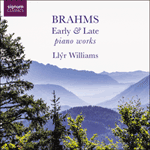
Brahms: Early and late piano works
Studio Master: SIGCD9162CDs Download onlyStudio Master FLAC & ALAC downloads available
Brahms: Late Piano Works
Studio Master: CDA68226Studio Master FLAC & ALAC downloads available
Eileen Joyce - The complete Parlophone & Columbia solo recordings
APR75025CDs Download only
Manía
Studio Master: SIGCD935Download onlyStudio Master FLAC & ALAC downloads available
Myra Hess - The complete solo and concerto studio recordings
APR75045CDs Download only
Waiting for content to load...