Welcome to Hyperion Records, a British classical label devoted to presenting high-quality recordings of music of all styles and from all periods from the twelfth century to the twenty-first.

Hyperion offers both CDs, and downloads in a number of formats. The site is also available in several languages.

Please use the dropdown buttons to set your preferred options, or use the checkbox to accept the defaults.

Label: Hyperion
Recording details: June 2014
Westminster Abbey, London, United Kingdom
Produced by Adrian Peacock
Engineered by David Hinitt
Release date: September 2015
Total duration: 10 minutes 31 seconds

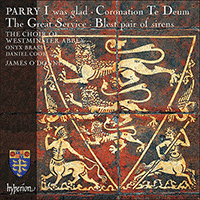
Cover artwork: Heraldic tile from the floor of the Chapter House at Westminster Abbey.
Copyright © Dean and Chapter of Westminster
 

Reviews

‘The Choir of Westminster Abbey give solid, well-crafted performances … Onyx Brass play very well, with a wide range of dynamics, and many listeners may welcome their contribution … certainly, listeners can enjoy the dignity and grandeur of the sounds of choir, organ and brass ringing around the historic spaces of Westminster Abbey’ (Gramophone)

‘It's difficult to resist the spine-tingling monumentalism of the performance’ (BBC Music Magazine)» More
PERFORMANCE
RECORDING

‘Throughout, the artistry of James O'Donnell with his excellent choir, sub-organist Daniel Cook and Onyx Brass make an indelible impression, and Cook's virtuosic performance of the Fantasia & Fugue in G shows that he is at one with the Abbey's magnificent instrument’ (Choir & Organ)» More

‘This seems to me a highly rewarding release of the highest quality, deserving investigation by all interested in cathedral music. It’s a testament to the long experience and fine music-making James O’Donnell has brought to London audiences, from Westminster Abbey, Westminster Cathedral and the Proms, and from his recitals around the UK and the rest of the world. It has certainly given me enormous pleasure over the past three weeks’ (Audiophile Audition, USA)» More

‘The work that truly sends shivers up and down the spine in this programme is the anthem 'I Was Glad', written for the coronation of Edward VII in 1902 and sung at every coronation since It is not merely the grandeur of the piece that is so impressive but also the fact that Parry’s choral part-writing and his glorious shifts of harmony create such a stirring, vibrant, awesome majesty of sound, enhanced here by both organ and Onyx Brass’ (The Telegraph)» More

‘The performances on this disc achieve the highest standards. The sound is excellent; the choir is well focussed and ‘present’ while the organ is reported thrillingly … a magnificent disc’ (MusicWeb International)» More

‘Here is brainpower in abundance: supreme choral singing, combining beauty and power of tone with a sense of line and direction that comes from an intelligent awareness of what the music is all about. No mere going through the motions here, and the trebles, in particular, display a similar maturity of music thought that belies their young ages. Quite outstanding in every way’ (Elgar Society)» More

‘The choir performs as if born to this music and an excellent solo quartet for the Magnificat emerges from its ranks, including a treble solo of great clarity by the young Alexander Kyle’ (The Whole Note, Canada)» More

'Het Westminster Abbey Choir brengt de hymne naast andere befaamde koorwerken van Parry' (Kerknet.be, Belgium)» More

Other recommended albums

Waiting for content to load...
Blest pair of sirens received its first performance by the Bach Choir under the baton of Stanford at the St James’s Hall on 17 May 1887. Admiration for the work had already begun to stir during the rehearsals, not least from Sir George Grove who, as Parry recalled, ‘jumped up with tears in his eyes and shook me over and over again by the hand and the whole choir took up the cue’. At the performance it was, to use Parry’s words, ‘quite uproariously received’ and the composer was greeted with shouts from the audience. A work to mark the year of Queen Victoria’s Golden Jubilee, it was the Bach Choir’s first commission, and one that could not have been more auspicious for English choral music. Parry’s brilliant neo-Baroque concerto structure, thrilling eight-part counterpoint and yearning melody are a perfect match for the Pindaric structure of Milton’s ode At a Solemn Music and the assonance and scansion of the English language. Moreover, in this work Parry achieved an entirely personal fusion of his enthusiasms for Wagner (evident in the paraphrase of Die Meistersinger at the opening) and Brahms with a distinctly English style characterized by the use of a higher diatonic dissonance prevalent in the language of S S Wesley and Stainer.

from notes by Jeremy Dibble © 2015

Waiting for content to load...