Welcome to Hyperion Records, a British classical label devoted to presenting high-quality recordings of music of all styles and from all periods from the twelfth century to the twenty-first.
Hyperion offers both CDs, and downloads in a number of formats. The site is also available in several languages.
Please use the dropdown buttons to set your preferred options, or use the checkbox to accept the defaults.
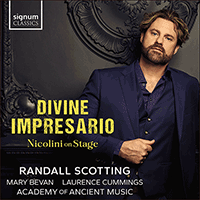


With arias by Riccardo Broschi, Francesco Gasparini, Handel, Porpora, Francesco Mancini, Attilio Ariosti and Giovanni Antonio Giay, this album triumphantly explores the world so dominated by Nicolò Grimaldi—the Italian castrato known simply as Nicolini. It’s a world further brought to life in the immaculately researched and illustrated accompanying booklet.

Nicolini’s status as a performer of singular excellence soon became known throughout Europe and England. A fledgling enterprise with a mission to perform Italian opera in London had to have this hot-ticket headliner for their first Haymarket season in 1708. Together, Sir John Vanbrugh, the manager and architect of the new Queen’s Theatre in London, and Charles Montagu, the Earl of Rochester and then the Queen’s Ambassador to the city of Venice, wagered they could lure Nicolini across the English Channel. With a three-year contract and the exorbitant offer of a £1,000 salary—an amount that would have taken a skilled tradesman of the time thirty years to earn—they succeeded in signing this eminent soprano castrato to their enterprise.
Nicolini was not the first Italian castrato to perform in England; several lesser singers had made the journey in the 1680s and 1690s without much acclaim. What set him apart were his exceptional gifts for dramatic portrayal, a voice of notable beauty and nuance, and his incomparably fortunate timing. Arriving in England in the autumn of 1708 and premiering on stage in mid-December with Scarlatti’s Pirro e Demetrio, he encountered a London audience hungry for Italian opera. By all accounts, he sang brilliantly, becoming an international superstar almost overnight. Opera historian Angus Heriot claims that during these years, Nicolini was ‘perhaps more than any other single person responsible for the popularity of Italian opera in England’.
First-hand accounts from the time make clear that Nicolini’s charisma and success on stage stemmed not only from his considerable musical talent, but also from his exceptional acting. Since opera’s inception, the unique challenge it has posed for performers is the demand—from audiences, managers, and composers alike—that they be able to sing and act convincingly. In Nicolini’s lifetime few operatic performers, castrati or otherwise, succeeded in meeting this high bar, but he advanced the art form in ways that continue to echo through the centuries. Soon after the singer’s star turn in Pirro e Demetrio, the editor, critic, playwright, and notorious opera sceptic Richard Steele published an enthusiastic review of Nicolini’s performance in The Tatler, going so far as to praise his acting over the current leading English actors of the day:
For my own part, I was fully satisfied with the sight of the actor, who, by the grace and propriety of his action and gesture, does honour to the human figure. Every one will imagine I mean Signor Nicolini, who sets off the character he bears in an opera by his action, as much as he does the words of it by his voice … Our best actors are somewhat at a loss to support themselves with proper gesture, as they move from any considerable distance to the front of the stage; but I have seen the person of whom I am now speaking enter alone at the remotest part of it, and advance from it with such greatness of air and mien as seemed to fill the stage, and at the same time, commanded the attention of the audience with the majesty of his appearance.
Steele perceived that, more than any other singer in London’s history to date, Nicolini had succeeded at bringing together the two separate timeframes of operatic performance, the time of singing and that of acting. In his performances, the two appeared to advance in complete concurrence, like twin hands on the two perfectly synchronised clocks in Leibniz’s celebrated metaphor for the simultaneous operation of matter and minds. In opera, the performer’s body must unite these two times into a single living art, both embodied and ensouled. Within Steele’s observations, the theatre historian Joseph Roach has detected a new ‘point of view’, an emerging sensibility enacted in the castrato’s stage presence and endorsed by The Tatler: namely, the view ‘that acting is a Fine Art, like painting, architecture, or music’.
As Roach describes it, Nicolini cultivated this view early on, during his conservatory studies in Naples, where training for young singers combined the rigorous and holistic study of vocal technique, harpsichord performance, musical composition, theory and counterpoint, acting exercises, declamation (including posture and gesture), and ‘letters’, an all-encompassing term for classical literature and history. Vocalists of the era were expected to become virtuosic in the original sense of that term, acquiring and demonstrating knowledge across the broadest spectrum of artistic and academic topics. At that time, the diva performer needed also to be a virtuoso scholar. A castrato’s genius had to unfold both through his command of ‘letters’, the kind of scholarly knowledge that would allow him to compose or adapt operatic libretti, as well as through his mastery of vocal technique and the expected ornamentation of musical performance.
Nicolini’s talents in these diverse areas made him especially congenial to Vanbrugh’s Haymarket opera company. Vanbrugh’s design for the Queen’s Theatre combined, for the first time in England’s history, a modern proscenium archway with a dedicated playing space for an orchestra. Opening in 1705, with overly-resonant acoustics that frustrated actors in spoken verse drama, its auditorium proved better for singers of the newly fashionable Italian opera. With this favourable performing environment and a shining endorsement in The Tatler, Nicolini helped to further the operatic vogue.
Building on his academic training, the virtuoso would not rest content with merely headlining the Haymarket operas as primo uomo singer. He also collaborated on their productions as a libretto adaptor, staging coordinator, and consultant on season repertoire. In some cases, he even provided the musical scores for the works to be performed, having brought them from Italy. He courted scandal with his 1710 appearance in the leading role of Francesco Mancini’s Idaspe fedele—in a much-discussed stage turn, he was featured in a snug, flesh-coloured costume simulating nudity for a scene of onstage gladiatorial combat with a lion. He also likely adapted that opera’s libretto to best suit his theatrical and musical strengths for London performances.
This production and Nicolini’s nude scene captured attention, both in the pages of Addison and Steele’s The Spectator, and among the theatregoing elites of the time, including Lady Mary Wortley Montagu whose private letters describe with enthusiasm the ‘great gallantry’ of Nicolini’s performance. The lion-fighting scene from Idaspe (‘Mostro crudel che fai?)—recorded on this album in a musical setting of the libretto not by Mancini, but by Riccardo Broschi—cemented Nicolini’s position in London and abroad as magnetic stage performer, daring impresario, and talk-of-the-town.
Today, Nicolini is perhaps best remembered for his collaborations with George Frideric Handel, who arrived to London in 1711. Handel’s Rinaldo of that year featured Nicolini in the title role, as did his Amadigi di Gaula of 1715. These operas have bequeathed to us some of the singer’s most enduring musical moments, four of which are included here in this album-length tribute to the great castrato. Scotting’s work in preparing this recording is a project decidedly in Nicolini’s spirit, combining the virtuosity of historical erudition and research with a consummate performer’s gifts and expertise in early music repertoire.
Alongside beloved arias and duets like ‘Cara sposa’, ‘Venti turbini’, and ‘Crudel tu non farai’ from Nicolini’s two Haymarket projects with Handel, here Scotting provides glimpses into the castrato’s wide-ranging work with less remembered composers of the era like Gasparini, Ariosti, and Giaj. The prevailing taste of the 1710s and 1720s—the great heyday of opera seria in London, and with it the last vestiges of the English Restoration’s heroic dramas—are strongly evidenced in these selections. We catch glimpses of Nicolini arrayed in an assortment of epic guises—knights, generals, princes, kings, heroes, all caught variously in states of grief, supplication, boastfulness, sincerity, and desire. Amid this array of baroque character types, we can view Scotting and Nicolini together in their shared dual-focus, admiring the impresario both as a virtuosic scholar and a virtuosic artist of the stage.
In 1742, a decade after Nicolini’s death, his contributions to opera were still held in high esteem. While in a celebrated 1723 treatise on vocal technique and operatic performance the castrato and noted voice teacher Pier Francesco Tosi questioned whether ‘a perfect Singer can at the same time be a perfect Actor’; it was John Ernest Galliard, the 1742 English translator of Tosi’s treatise, who felt compelled to include a footnote answering Tosi’s original question. He asserted to the British readership that ‘Nicolini, who came the first time into England about the Year 1708, had both Qualities, more than any that have come since. He acted to perfection, and did not sing much inferior’. Even more impressively, Nicolini’s extraordinary style of performance was remembered and beloved in the cultural imagination until at least the end of the eighteenth century, when the British music historian Charles Burney published his four-volume General History of Music (1776-1789), describing the humbly-born Neapolitan castrato who rose to conquer the stages of Europe as ‘the first truly great singer who had ever sung in our theatre’.
Joseph Cermatori © 2026
Today, Nicolini is best remembered for the music Handel wrote for him, yet the castrato’s world was so much larger. He sang for an astonishing range of composers, all of whom wrote arias that captured his dramatic range and vocal brilliance. Many of the works recorded here haven’t been heard since Nicolini’s lifetime and reviving them has been a thrilling process of rediscovery.
Perhaps the quality that makes Nicolini most compelling is how far he was willing to go in the service of theatrical storytelling. Nowhere was this more apparent than in his many returns to the stage as Idaspe, a role he sang in various productions where he became a ‘lion tamer’. London audiences were electrified by the scene in Mancini’s Idaspe fedele in which he slays a ‘live’ lion onstage; it was one of the city’s most talked-about theatrical moments. Addison’s Spectator joked about the revolving cast of lion actors; eyewitnesses marvelled at Nicolini’s bearing in a flesh-coloured costume; and the public demanded encores of the combat, forcing the lion to ‘come back to life’. At one point, as guests of Queen Anne, four Native American Indian chiefs attended this opera starring a portly castrato in a nudesuit pretending to fight a lion, while singing in a refined soprano register. The spectacle must have been a real head-scratcher for them! Our album offers this famed scene from Idaspe with ‘Mostro crudel che fai?’ in the music of Riccardo Broschi, as well as the delicate ‘È vano ogni pensiero’ from Francesco Mancini’s setting of the opera, hopefully revealing a glimpse of how Nicolini could wrestle monsters and still sing with incomparable elegance.
For me, stepping into this repertoire is a kind of conversation across time, with Nicolini, but also with the idea of what it means to be an impresario today. Like him, I’m drawn to music-making that is dramatically committed. In recording this music, I sought to channel the intensity for which Nicolini was famous and to honour his legacy as the divine impresario: defined by an ambition for opera to be more than just dazzling technique, but also a captivating and emotional experience.
Randall Scotting © 2026