Welcome to Hyperion Records, a British classical label devoted to presenting high-quality recordings of music of all styles and from all periods from the twelfth century to the twenty-first.
Hyperion offers both CDs, and downloads in a number of formats. The site is also available in several languages.
Please use the dropdown buttons to set your preferred options, or use the checkbox to accept the defaults.
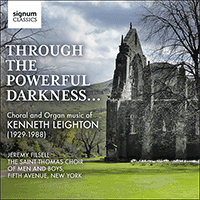


A major exploration of Kenneth Leighton’s choral and organ music, this album includes three of Leighton’s Mass settings—Missa Christi, Missa Sancti Thomae, and the organ Missa de Gloria—alongside rarely heard anthems such as O God, enfold me in the sun, Of a rose is all my song, and Adventante Deo. Balancing youthful brilliance with profound spirituality, these performances illuminate Leighton’s distinctive voice: harmonically bold, contrapuntally rich, and deeply rooted in the English choral tradition.

All my music, instrumental as well as vocal, is lyrical, and that is due to my upbringing as a chorister. My whole background is choral church music—the deep and exciting experiences of music that I had were in Palestrina and the Messiah … I find in religious-mystical-visionary ideas the most exciting stimuli for composition … some sort of spiritual attitude is behind most of my work.
(Kenneth Leighton, Musical Times, 1989)
Born in Yorkshire, Kenneth Leighton’s musical training began in the choir stalls of Holy Trinity Church, Wakefield. Although a child of innate musical talent, his family background made the affording of a formal musical education a challenge. Nevertheless, at the age of 9, he was offered a choristership at Wakefield Cathedral where, along with singing daily choral services, he received a strong musical formation. Wakefield was a ‘High-Church’ English cathedral, and Leighton was exposed to both Victoriana and an eclectic repertory of earlier sacred music which included Sarum chant and a high volume of English and continental polyphony. As is indicated above, he attributed his later success as a composer to early musical experiences at the cathedral.
At Queen Elizabeth’s Grammar School, Wakefield, Leighton broadened his musical knowledge and was encouraged to dabble in composition by teachers who had noted his emergent talent. He thus penned a significant number of pieces before going up to Queen’s College, Oxford, to read Classics. During undergraduate years, Leighton’s musical talents were noticed by the then organist of Magdalen College, Bernard Rose, who took on the young Leighton as a private student, tutoring him through the Bachelor of Music course. Taking two sets of Final Examinations, Leighton graduated from Oxford with the highest marks in both Classics and Music in 1951. Rose had introduced him to Finzi in 1949 whilst a student, and Finzi became a good and supportive friend, helping to secure a number of early Leighton performances. Finzi also introduced him to Vaughan Williams, yet on leaving University, Leighton was already distancing himself from a distinctive and perhaps pastorally-directed English musical tradition.
Leighton was awarded a Mendelssohn Scholarship in 1951 (when any reputation he had would have rested principally on the Symphony for Strings (1949), and some early piano pieces), providing funds permitting travel to Rome to study with the influential modernist Italian composer Goffredo Petrassi. According to Leighton’s contemporary Peter Maxwell Davies, Petrassi was an exacting tutor who taught principally by questioning and interrogating students on the musical logic of their compositions. Whilst relatively little is known about Leighton’s year in Rome, he plainly got on well with Petrassi, for they remained in touch for several years thereafter. He developed there a keen interest in the music of Dallapiccola, and indeed in the music of the formative Second Viennese School, preparing a lecture on dodecaphonic music ('a subject that interests me greatly', he wrote to his mother in January 1953) during which he had planned to play a piece or two of Schoenberg.
On return from Italy, Leighton enjoyed a burgeoning reputation, with Leopold Stokowski directing the premiere of Primavera Romana (1951), and Jacqueline du Pré appearing as a soloist in a performance (1965) of Veris Gratia (conducted by Finzi’s son, Christopher). Leighton came to hold a succession of academic posts from this time onwards, most notably at Worcester College, Oxford, the University of Leeds, and then at the University of Edinburgh (close to the northern landscapes which he loved), where he was Reid Professor of Music between 1970 and 1988. Despite the administrative burden of such roles, Leighton adored teaching, and whilst he found time to compose a significant corpus of music before his untimely death at the age of 58, this was a time when he deserved to be in the prime of artistic life. As with many composers who have left us prematurely, one wonders what music might have appeared in the years of dotage, particularly as there is a striking maturity to Leighton’s late voice (Earth, sweet earth, Op 94, and the Four Romantic Pieces for piano, Op 95).
Leighton’s daughter Angela (a noted academic and Professor of English Literature at Cambridge) wrote movingly of her father’s last days in her memoir Spills (Carcanet Press 2016). In it she refers to a late glimpse of religious sensibility:
By the time [his throat cancer] was diagnosed in spring 1988, there were only months to live. During those months he finished what he was composing, put his manuscripts—more than a hundred opus numbers—in order, and maintained a silence about what he was feeling. In those hard months, first in the hospice and finally at home again, I talked to him mostly about poetry: the poets he loved and had set: Patrick Carey, Traherne, Donne, Herbert, Hopkins, in a lifetime of writing for the voice. His was a deeply literary sensibility, as I knew from having helped him find texts for his third symphony: Thomas Browne, Shelley, Barrett Browning—texts that became, in his hands, a touching reflection on what I myself had written. I now own his copy of my book on Elizabeth Barrett Browning, given to him only a couple of years before. There I had written about Aurora Leigh as the disinherited or orphaned daughter who wakes to a world of stones, all gravestones, after the death of her father. The only mark that Kenneth had made, under his name on the title page, was ‘page 132 etc’—pointing precisely to those pages about the father’s death. Finding it after he died seemed to open a conversation across the stars—a conversation of uncanny premonition on his part, perhaps reproach, perhaps encouragement—which I could then only answer into thin air. The day before he died, I offered to read some of the psalms out loud. He nodded, and signalled 121: ‘I will lift up mine eyes unto the hills’—the line he was fond of quoting when we walked together in the Highlands. I read first that one, then went on to another. But suddenly he waved his hand at me to stop. Enough, he croaked. Enough of that. It was a gesture full of the old defiant Kenneth—religious up to a point, as he was, naturally, but then impatient of things pious, churchy. He didn’t want prayers; he wanted poetry. So I returned to Hopkins. It was he who constituted our last ‘conversation’, holding apart our two necessary, nearly unbearable silences—but also, in a sense, holding them together. And the next day, when he was too far away either to see or speak to me, I went on talking and reading to the ear that is, we are told, the very last of our senses to go. It has probably not quite gone from me, yet.
Over the course of his life, Kenneth Leighton developed a truly individual compositional style, which he described as one always being ‘tempered by common sense’. At its heart lies the distinctive ‘logic’ of counterpoint, first experienced as a chorister at Wakefield Cathedral, and skillfully nurtured later by both Rose and Petrassi. An apt description of Leighton’s compositional voice can be found in the epilogue of Adam Bink’s monograph on his musical style:
Leighton is never reckless within his composition. Everything is measured, as well as having meaning and an appropriate place within a work, which also supports its sound structural policy…and an acute sense of musical economy. Nothing can ever be taken for granted or underestimated in Leighton’s music. The careful sense of integrity and a reverence for form and traditional techniques within his musical language is poignant, but ultimate satisfaction within a work is rarely gained easily. Leighton’s music is crammed with music material, invention, and eventually revelation. He presents a real and present challenge to any listener to process works that are conceived with the maximum intelligence and intellectual creativity that Leighton poured into every composition.
(Binks, 2007)
Leighton’s spirituality was perhaps unconventional, for although raised in the choirstalls of Wakefield Cathedral, he identified readily as agnostic, and was never a member of the church during his adult years. The irony of his having arguably been ‘pigeon-holed’ as a composer of liturgical choral music may not be lost on us today, but such a musical profile was catalysed by the 1956 publication of Lully, lulla, composed whilst still at Oxford. This exquisite and charming carol motivated a continuous stream of commissions from churches and cathedrals on both sides of the Atlantic.
Although Leighton’s liturgical music is harmonically gritty, its individuality, elegance, veracity of voice-leading, and uncompromising contrapuntal integrity makes it aurally compelling and spiritually poignant. Whilst his organ music is oft-played, his choral and organ music together represents but a small part of his compositional output, and the volume of piano, chamber, and orchestral works Leighton created is remarkable for its outstanding quality. A widespread absence of it on contemporary chamber and orchestral programs is to be mourned, and it may be no exaggeration to suggest that he is one of the most under-appreciated British composers of the twentieth century, a genuine renaissance of his lesser-known music being arguably overdue.
The fulcrum of this recording is formed by three of Leighton’s eleven Mass settings (ten for choir, and the Missa de Gloria for solo organ), which are today perhaps largely neglected. Individual movements of the Organ Mass have received periodic exposure, but the two choral settings here are rarely heard. The Missa Christi (1988) was commissioned by Christ Church Cathedral, Indianapolis in the US for the 150th anniversary of its consecration. Composed in the last year of Leighton’s life, he wrote on the manuscript that it was ‘my last setting of the mass’. Whilst this may have indicated something of a Mozart Requiem-esque presaging of his death from cancer in August that year, it is more likely that, having previously composed nine settings of the Mass Ordinary, he felt he had little more to say on the subject (Leighton did not assign this Mass an opus number). The Missa Christi, set to the American Prayer Book form of the text (and without a sung Creed), is a challenging work for executants, and its premiere on 12 June 1988 was, by all accounts, disappointing. A former Christ Church chorister recently told this writer that the setting was, owing to its difficulty, seldom performed, and had pejoratively been nicknamed ‘Missa Screechy’. It is nonetheless a classic example of Leighton’s mature style, with the Kyrie, Gloria, and Sanctus all characterized by a rhythmic drive, customary contrapuntal veracity, and a harmonic insistence, perhaps with healthy spiritual irony, on the diabulos in musica (augmented fourth). The Benedictus opens with an almost unmeasured baritone solo leading into an undulating section of imitation, resolving with a seductive, beautiful pianissimo ‘Hosanna’—one contrasting starkly with that of the preceding Sanctus. The Agnus Dei, still marked by the diabulos in musica, is luxuriously contrapuntal with a dynamic build-up ending with a lyrical cry for peace. A jarring sforzando chord in the organ part then resolves to another augmented fourth-inflected dissonance to end Leighton’s final Eucharistic testament. Did this represent musically for Leighton, a late life skirmish betwixt heaven and hell?
In many English cathedrals, Leighton’s first setting of evening canticles, Collegium Magdalenae Oxoniense, is well-known. They were commissioned in December 1957 by Leighton’s undergraduate tutor Bernard Rose, Organist of Magdalen College, Oxford, and it is unclear as to when the work was completed and premiered. Apocryphally, Dudley Moore (Magdalen’s then-organ scholar, and later a renowned satirist and actor) was the organist for the first performance. The Magnificat is a contrapuntal tour-de-force with sections of text broken up by organ interludes, and as is common in many evening canticle settings, the Gloria Patri forms a recapitulation of the opening. The ending is a series of cataclysmic, downward cascading phrases on the words 'world without end. Amen …' and forms a favoured technique of Leighton’s which featured in a number of his later choral works (it also appears in the Gloria of the Missa Sanctae Thomae). Leighton himself wrote of the Nunc Dimittis: “The quiet opening sung by the choir contains the melodic and harmonic features of the movement as a whole. The main section consists of a single sustained paragraph in which the contrapuntal lines are constantly expanded, and a rising tension results from an ever more complex interplay between voices and organ. The words 'to be a light' are insisted on in a gradual build up (using material from the Magnificat), but the climax is not reached until a final cadence on organ alone. The Gloria Patri, in complete contrast, is a light dance-like section ending with a mystical treatment of the words ‘world without end. Amen’.
Set me as a seal is the unaccompanied and concluding ‘chorale’ of Leighton’s cantata Columba mea, Op 78. Commissioned by the John Currie Singers & Orchestra in 1978, the complete work sets a selection of texts from the Song of Songs, and this exquisite final movement for choir, tenor and treble soloists is intensely beautiful in its harmonic and textual expediency. In a similar a capella but more extended manner, Of a rose is all my song sets a mediaeval English devotional text dedicated to the Blessed Virgin Mary. Written in 1970, it consists of a lengthy dialogue between seductive whole-tone melodic strands (framing once again the diabulos in musica) sung by a treble soloist, and full choir strophic-style passages.
A number of anthems on this recording were written for parish churches which once possessed cathedral-style music programs. O God enfold me in the sun is one, and was composed in 1967 in response to a commission from the church of St Philip & St James, York, for its centenary celebrations. Now firmly in the contemporary evangelical tradition, this church nowadays appears some distance from the liturgical and musical traditions for which Leighton wrote his anthem. Setting words by Jacqueline Froom, it is an outstanding example of Leighton’s prowess at word-painting, with the sun’s brilliant and blazing light permeating the work’s harmony, texture, and dynamics. Adventante Deo was commissioned in 1970 by Barnet Parish Church and their then organist, David Patrick—a favoured pupil of Harold Darke. It sets an advent poem by John Addington Symonds about the Second Coming of Christ. Harmonically ‘gritty’, it nonetheless comprises moments of great beauty amidst the prevalent grandeur and terror.
If one were curious as to what Leighton’s response might have been to the genre of a cappella close-harmony, one could look no further than the lower-voice settings of Three Psalms, Op 54. Dating from June 1968, these portions of Psalms 42, 23, 98, and 149 were commissioned by the Baccholian Singers of London, a men’s vocal quintet active in London during the mid to late twentieth century, receiving their premiere on 23 October 1968 in Holy Trinity Church, Brompton. Arguably, these are challenging to sing one-to-a-part and, as such, they are presented here with full ensemble. Like as the hart is an intense, even angry, setting of the psalmist’s frustration at God’s absence. The Lord is my shepherd, with its gentle 6/8 time signature, brings a bucolic expression of the text, whilst O sing unto the Lord is joyful and dance-like. The initial section here features long drawn-out trills, something of a hallmark of the music of James MacMillan, one of Leighton’s illustrious protégés at the University of Edinburgh.
The West Riding Cathedrals’ Festival had commissioned Leighton in 1968 for the Festival Fanfare for organ, and in 1977 it requested what became the Sequence for All Saints, Op 75. This was first performed on 14 October 1978 in Wakefield Cathedral—where Leighton had been a chorister—by the combined cathedral choirs of Bradford, Sheffield and Wakefield. It sets the Propers for the Feast of All Saints over the course of five movements. The Introit’s unison pianissimo ‘C’ flowers outwards into a classic Leighton chord of gentle dissonance, recalling many similar instances of the technique in his more familiar Preces and Responses. The ensuing dramatic acclamation ‘Gaudeamus’ (let us rejoice) is thus heightened. A joyful dance exhorting the faithful to ‘Rejoice and praise the Lord’ precedes a return to the opening’s heavenly mist. The Gradual’s sonorous baritone solo (O fear the Lord) induces choral responses of ‘Alleluias’ which build to intensive cries. The opening trebles-only lyricism in the Offertory meanders around the holy places’, the abode of the ‘God of Israel’, and the Communion sets the text The souls of the righteous, purified by the Lord in the fire, with an image painted by organ interludes of elaborate figuration. The Finale recreates much of the opening movement but concludes with a bold, congregational rendition of Isaac Watts’ classic hymn Give us the wings of faith. The descant here in the final verse has been humbly added by Jeremy Filsell.
The second part of this recording juxtaposes two further Mass settings of Leighton, the choral Missa Sanctae Thomae (1962), and his magnum opus for organ, the Missa de Gloria (1980). The Missa Sanctae Thomae was commissioned by the Friends of Canterbury Cathedral to mark the octocentenary of the Consecration of St Thomas Becket as Archbishop of Canterbury. It is a setting of the Communion Service with text from the 1662 Book of Common Prayer, and was heard for the first time at Canterbury sung by the choir under the direction of Gerald Knight.
As is so often the case with Leighton’s music, the Missa Sanctae Thomae is a masterclass in thematic usage and development. The short ascending melodic motif sung by the trebles at the outset of the Kyrie Eleison serves as a melodic foundation for the entire setting, a motto idea which undergoes various transformations, augmentations, and diminutions. The melodic ascent of the motif is reflected in the work’s counterpoint, its harmonic profile invoking ever-rising modulations, the arch-shaped structure of individual movements, and thus the setting at large. The Mass is set chiefly in the Lydian mode—giving perhaps an overarchingly mysterious and authentic medieval aura (was Leighton perhaps evoking the musical soundscape of Becket’s consecration 800 years earlier?). The Kyrie presents the germinal head-motif in the home key of G—one which Leighton will constantly approach, yet largely deny the listener. Ingeniously, every measure of this opening movement contains the motif both at different pitches and in different voices.
In the setting of the BCP Communion Service, the Gloria in Excelsis comes at the end of the work, for it was briefly deemed theologically appropriate as a hymn of thanksgiving for the Sacrament of Holy Communion. Whilst Leighton thus placed his Gloria at the conclusion of the published work, it is juxtaposed here in its customary place alongside the more conventional sequence found in the Missa de Gloria. The head-motif first heard in the Kyrie finds a certain recapitulatory apotheosis here, re-exposed in various guises. At the words ‘For thou only art Holy’ the head-motif reaches its full flowering, and begins a gradual motivic, dynamic, and harmonic crescendo towards the contrapuntal climax—in E major—at ‘Amen’.
Perhaps the toughest text with which any liturgical composer has to wrestle is the Credo—because of its repetitive and non-narrative nature. Leighton’s setting is suitably economical here, and follows the ‘missa brevis’ principle in which the composer does not repeat words. It is musically energetic and, even in its quietest sections, features a rhythmic drive which, after various harmonic twists and turns, lands finally in the home key of G.
The opening of the Sanctus contains an effective demonstration of how a slow, undulating melodic motif of simply two notes can be of great harmonic and dynamic drive without the alteration of tempo or note value. ‘Holy, holy, holy’ builds towards a strong conclusion, heralded by the firm, martial declaration of ‘heaven and earth are full of thy glory’ from the trebles, before the full choir offers a rousing ‘glory be to thee, O Lord most high’. A slow, lilting version of the germinal head-motif in triple-time dominates the Benedictus. As in the Sanctus, however, this gradually grows in harmonic and dynamic intensity before the movement concludes with a grandiose ‘Hosanna in the highest’.
The Agnus Dei is indebted to the Nunc Dimitis of Leighton’s early setting of evening canticles, and significant parts of the organ interjections here appear verbatim. It is a slow-moving movement with weeping dissonances at the words ‘have mercy upon us’. This is no doubt informed by similar phrasings in the masses of William Byrd and his contemporaries—a style of music which had spoken so deeply to Leighton as a young chorister.
The Missa de Gloria, Op 82 was completed in March 1980 to mark the first Dublin International Organ Festival. Subtitled the Dublin Festival Mass, it was premiered in St Patrick’s Cathedral, Dublin, by Gerard Gillen in June of that year. Leighton composed sporadically for the organ, beginning in 1964 with the Prelude, Scherzo, and Passacaglia, Op 41, and nine works followed, most of which are relatively small in scale. At thirty-five minutes in length, the Missa de Gloria is both Leighton’s magnum opus for the instrument and, by his own admission, his first work based entirely on plainchant.
In seven movements, the Missa de Gloria freely utilizes elements from the twelfth-century Sarum plainchant for Easter Day. Whilst Leighton clearly marks where the representation of sections of text and chant come throughout the score, the chant itself is rarely overt, and is seamlessly integrated into the musical style. The ‘organ-mass’ is a curious genre, but one which developed from the need to provide accompaniment to the Extraordinary Form of the Roman Rite, where clergy would say the Mass sotto voce. With its origins in the liturgy of the medieval church, the genre reached a high-point in eighteenth-century France with the organ-masses of François Couperin and his contemporaries. This present recording seeks to reflect, to a degree, that milieu with the various organ movements of the Missa de Gloria functioning as reflections on the movements of the Missa Sanctae Thomae. Despite its Sarum plainsong themes, the Missa de Gloria provides a neat counterpoint to the more mediaeval and modal sound world of the choral setting. The 2020 pandemic and the resulting absence of choral provision at Saint Thomas Church gave Jeremy Filsell the opportunity to present the Missa de Gloria as an organ-mass during a livestreamed Solemn Eucharist.
Dark, gloomy, and brooding, the freely-composed Kyrie (without direct plainchant reference) serves as a prelude of sorts to the rest of the work, perhaps suggestive of the three women arriving at the tomb on that first Easter morning. It is rich in counterpoint and builds in harmonic intensity. The Gloria is quite the opposite, and replete with resurrection joy. It begins, in Leighton’s words, with ‘introductory fanfare-like sections’ followed by a toccata, based on the plainsong theme. A soft coloratura of the plainchant follows before the toccata figurations resume. The movement concludes with a fugal, plainsong-based coda forming an ‘Amen’.
The statements of plainchant themes are clear in the Credo. In a calm and meditative movement, Leighton calls for frequent changes of registration, and the chant, in his words, ‘speaks for itself and becomes increasingly more decorated’, with meanderings on the plainsong being improvisatory in nature.
As with the Gloria, the Sanctus is joyous, beginning with a flourish before entering a ‘soft and dancelike’ (KL) portion quoting the plainchant ‘Pleni sunt caeli gloria tua’. The Benedictus is a ‘slow and mystical’ (KL) polytonal duet, before the dance returns at ‘Hosanna in excelsis’.
A poignant and exquisite Agnus Dei precedes the final movement, a thrilling paraphrase of the chant as a closing dismissal: Ite Missa Est—‘Go forth, the Mass is ended’. It is, in Leighton’s words, a ‘brilliant toccata with a massive acclamation’. A highly virtuosic tour-de-force, it plays the part on this recording of a spectacular postlude to the Missa Sanctae Thomae.
Alleluia, Amen is a festival anthem commissioned the same year as the Missa Sancti Thomae (1962) to mark the 50th anniversary of the church of St Nicholas Radford, in Coventry, England. It is thus the third anthem on this recording originally commissioned by an ‘ordinary’ parish church reflecting a contemporaneous parish musical aspiration and ability found perhaps more rarely within today’s ecclesiastical environs.
The original (Victorian) church of St Nicholas, Radford was destroyed by Luftwaffe bombs the same night as was, famously, the city’s great mediaeval cathedral (14 November 1940), but a new church was erected by modernist architect Richard Twentyman in 1957. Although blessed with a compelling acoustic, the new church came in the heyday of modernist concrete structures (as did virtually all of blitzed central Coventry), and was plagued by both poor post-war building materials, and extensive asbestos wall lining. Saint Thomas Church’s current Director of Music grew up in Coventry, and as a teenager, periodically practiced on the Nicholson organ in St Nicholas—perhaps inspired more by the church’s favorable acoustic than by the uncertain distinction of its organ. However, the 1950s church structure had become untenable and unsafe by the early 2000s, and in 2025 it was finally demolished. It is thus perhaps a rather sombre late twentieth-century tale in which a church once commissioning a foremost composer of the day to provide commemorative music for its choir is now sadly sans music, having awaited the wrecker’s ball after just 60 years.
In the manner of a repeating Alleluia, Leighton’s splendid anthem is formed by incessant and cascading bell-peal-like motifs, punctuated only by the briefest appearance of a Revelation text (‘Salvation and glory be unto the Lord our God’). Most affecting perhaps is the hushed start, and the equivalent close—of a text for which one might anticipate an ebullient, dazzling response. However, perhaps the post-war story of St Nicholas Radford itself is inadvertently encapsulated in this musical setting.
Maks Adach and Jeremy Filsell © 2026
with insights generously offered by Professor Angela Leighton (Research Fellow at Trinity College, Cambridge), and Dr Robert Leighton (Senior Lecturer in European and Mediterranean Archaeology, University of Edinburgh)