Welcome to Hyperion Records, a British classical label devoted to presenting high-quality recordings of music of all styles and from all periods from the twelfth century to the twenty-first.
Hyperion offers both CDs, and downloads in a number of formats. The site is also available in several languages.
Please use the dropdown buttons to set your preferred options, or use the checkbox to accept the defaults.
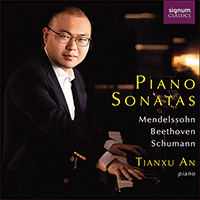

Central to this recording from Tianxu An is a focus on the composers’ detailed markings, including dynamics, pedalling, and phrasing, and on how these shape interpretation in performance. Recorded in 2024, the release presents An’s considered engagement with this repertoire and his interest in its intellectual rigour and expressive breadth.

When I first envisioned this album, my foremost intention was to perform several sonatas composed by German composers. Entitling such a collection “German Sonatas” might sound somewhat simplistic, however, if not wholly redundant. After all, the sonata tradition lies at the heart of classical music and, if we set aside debates over whether traditional sonata form has been fundamentally deconstructed, remained central to the piano repertory well into the 20th century. So too was that form largely established by four “Austro-German” composers: Haydn, Mozart, Beethoven and Schubert, each with German and Austrian musical heritage and professional associations with Vienna. One could easily claim this tradition as the mainstay of European classical music.
The selection of works on this album, however, deliberately avoids the “Austrian” part of that equation. Beethoven, despite his years in Vienna, arguably lacks the elegance and refinement characteristic of the “Viennese” style, the very quality that distinguishes the piano music of Mozart and Schubert from that of Beethoven, Mendelssohn, Schumann and Brahms. That distinction, to my ear, becomes clear in contrasting the Vienna Philharmonic with the Berlin Philharmonic: the former marked by its noble elegance of tone and taste, the latter emphasising seriousness and intellectual depth. For me, it is precisely this Germanic rigour, which I personally admire and deeply respect, that forms the underlying logic of the three sonatas on this album.
Each of these works departs from the traditional classical model as exemplified by Haydn and Mozart up to middle-period Beethoven. Composed within a span of just 26 years, these three sonatas reveal how each composer forged a distinctive path. On a structural level, Beethoven’s Op 78 (written in 1809) consists of only two contrasting movements, while the sonatas by Mendelssohn (composed in 1826) and Schumann (completed in 1835) retain the usual four movements while altering specific details: where Mendelssohn sets the second movement as a scherzo and the third as a slow movement, Schumann reverses that order.
That the window of creation for these pieces was so compressed makes their trajectory in 19th century musical development all the more astonishing, I did not, however, take that chronology into account in my programming. Rather, their order here is based on musical considerations. Compared to the later works, Beethoven’s sonata is concise and refined, suitable as a kind of “intermezzo”. Also, the key relationships between the Beethoven and Schumann works, in F sharp major and F sharp minor respectively, create a tonal polarity enhanced by their proximity. Of the three, Mendelssohn was the youngest (at age 17) when he composed his Sonata in E major, and a sense of freshness and discovery is everywhere apparent, a natural yearning for life blowing into the heart like a gentle and refreshing breeze. It was the perfect point to begin this pianistic journey.
Mendelssohn’s Sonata in E major has only a handful of recordings in existence, despite being in my view notably richer in substance than his other piano sonatas in G minor and B flat major. The work deserves to be performed more frequently, and its inclusion here is in large part to correct that imbalance. On a purely musical level, the poetic phrasing and pastoral character of the first movement are self-evident. The second movement Minuet sparkles with intellectual wit and a distinctive sense of humor, though this requires rhythmic precision, along with a light and agile touch and careful shaping of phrasing and voice-leading on the performer’s part. The third movement (my personal favourite of the entire work) fuses the character of a recitative with intricate polyphonic writing. My interpretation of this movement, with many passages freed from bar-line constraints, seems to evoke Molly Bloom’s unpunctuated monologue from Joyce’s Ulysses. Amid a stream of wandering thoughts, the two choral-like Andante passages arrive like moments of epiphany, offering a kind of “redemption” as one of the most profoundly introspective moments I have ever heard. The fourth movement puts Mendelssohn’s compositional virtuosity on full display, its development section overflowing with surplus energy. Although some phrases verge on the redundant, the driving and upward-striving force it carries is so moving that I am firmly convinced this is music that only youth could convey, whether on the page or in performance.
Regarding Beethoven’s sonata, I have less to share in terms of personal reflection, though it has drawn the attention of many others. One of the composer’s most cherished works, it was dedicated to the Countess Thérèse von Brunswick, Beethoven’s student often suspected as his “Immortal Beloved”. If so, the playful nature of the second movement strikes me as somewhat unexpected, even incongruous. What moves me most about this sonata is its use of F sharp major—a rarity not only for Beethoven but within the entire piano literature. This key carries a noble, awakening quality, suffused with a sense of leisurely ease. This work’s serene and poised atmosphere stands in stark contrast to the intense conflicts presented later by Schumann.
Schumann’s Piano Sonata No 1 in F sharp minor can undoubtedly be described as “monumental”, though its status as one of his benchmark compositions remains debatable. In essence, it reveals Schumann’s youthful struggle with large-scale structures and his difficulty in developing musical ideas in a coherent and balanced manner, which explains why most of his piano masterpieces—Carnaval, Op 9, Kinderszenen, Op 15, Fantasiestücke, Op 12—are presented in the form of “character pieces.” This sonata, composed during Schumann’s period of then-unrequited longing for his future wife Clara Wieck, was published anonymously, “dedicated to Clara by Florestan and Eusebius.” Though both of these fictional alter egos are vividly expressed, my interpretation tends to focus on the fiery fervour of Florestan, revealing Schumann’s impulsive and unrestrained passion, particularly in the first and fourth movements. Each of those movements arguably exhibit some redundant qualities: the development section of the first could be more concise, while the fourth repeats its thematic material excessively. To address this, I shape these passages with a long, overarching breath in mind, allowing the phrasing to flow across bar lines and unify the structure emotionally. In the fourth movement, for example, the passage spanning measures 85-160 unfolds as an emotional odyssey, beginning in confusion, descending into despondency, rising with a glimmer of hope, culminating in outright frenzy. While analytically divisible into smaller segments, this passage can also be shaped into an uninterrupted emotional whole.
Beyond these “redundant” traits, the transitions between the theme and the intermezzo in the third movement, along with the sudden appearance of the recitative at measure 167, feel somewhat abrupt. Here, the performer must be capable of swift character shifts and deliberate control over breathing and rubato. Nevertheless, the emotional intensity of this work is astonishing, bearing witness to the fervor and entanglement of Schumann’s “secret love” so sincerely that the music, despite its structural imperfections, remains profoundly moving and unforgettable.
The experience of recording is entirely distinct from performing live for a concert audience, and in the case of this album the process has been immensely instructive. The characteristic rigor associated with German composers compelled us to ponder deeply the meaning of every expressive marking. While I believed I had prepared thoroughly, the recording session itself revealed nuances in the score I had not previously considered with sufficient depth.
I am especially grateful to recording producer Stephen Johns, whose keen ear and insightful judgment provided consistently positive and resolute feedback. Following his suggestion, my interpretation of the third movement of the Schumann became much more light-footed—a refinement with which I am very pleased. Regarding the recitative within the same movement, his observation of its connection to the finale of Beethoven’s Ninth Symphony offered profound inspiration.
In crafting this recording, I made a conscious choice to emphasise the dramatic effect of certain details. This decision stemmed from the consideration that a recording, as a purely auditory art form, demands a heightened level of expressiveness. Whether this approach strikes the right balance or ventures a little into excess, I gladly leave to the opinions of the listeners.
Tianxu An © 2026
