Welcome to Hyperion Records, a British classical label devoted to presenting high-quality recordings of music of all styles and from all periods from the twelfth century to the twenty-first.
Hyperion offers both CDs, and downloads in a number of formats. The site is also available in several languages.
Please use the dropdown buttons to set your preferred options, or use the checkbox to accept the defaults.
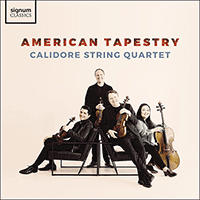

A vibrant continuum of American artistry—a sound world both richly diverse and deeply unified in spirit—inviting us to enjoy a panoramic portrait of American musical expression across the 20th and 21st centuries.

The album opens with Samuel Barber’s (1910-1981) String Quartet Op 11, composed between 1935 and 1936, while the composer was in Europe as the recipient of the prestigious Rome prize. The Pro Arte Quartet performed a provisory version at the American Academy in Rome in 1936, however, Barber continued to revise the outer movements until 1943, when the Budapest String Quartet gave its official premiere at the Library of Congress. The heart of Barber’s string quartet is its inner movement, marked “Molto adagio”, which Barber himself described as, “a knockout!” Barber orchestrated this movement, calling it Adagio for strings. Following Toscanini’s premiere with the NBC Symphony Orchestra in 1938, the piece enjoyed more mainstream success than any other American twentieth-century classical work. In the quartet, the Adagio movement emerges as an other-worldly interlude between two more earthly outer movements. The very brief finale, attacca to the adagio and marked “Molto allegro (come prima)”, reintroduces the musical DNA from the first movement and acts as a coda to the quartet, waking us out of our heavenly slumber and bringing us back down to earth.
While Barber chafes against his neo-Romantic, distinctively American aesthetic tendencies in the outer movements as he grapples with a more modernist harmonic language, in the Adagio, he uses, what music theorist Matthew BailyShea describes as a “deliberately archaic sound, with Renaissance-like polyphony and simple tertian harmonies” and a “chant-like melody”. The immense success of the Adagio overshadowed that of Barber’s other works. In a 1978 interview, Barber said, “they always play that piece. I wish they’d play some of my other pieces”. He would have been pleased to find it restored to its original context in his string quartet on this beautiful album.
Wynton Marsalis (b1961) draws on the rich, multifaceted musical heritage of his native New Orleans in his string quartet At the Octoroon Balls, an epic suite in seven movements. The title refers to formal social gatherings held in New Orleans in the late eighteenth and early nineteenth century, where white Creole men mingled with and sought romantic relationships with Octoroon (free, one-eighth black) women. Of these events, Marsalis said, “A ball is a ritual and a dance. Everyone was in their finest clothing. At the Octoroon Balls there was an interesting cross-section of life. People from different stratums of society came together in pursuit of pleasure and fulfillment. The music brought people together.” The quartet was commissioned by the Chamber Music Society of Lincoln Center for Jazz at Lincoln Center in the mid-nineties, and current CMS artistic director Wu Han introduced the Calidores to this work. They have recorded the inner three movements on this album. “Creole Contradanzas”, celebrates the musical cross-pollination that took place between New Orleans and Havana at the beginning of the twentieth century, when ferries connected the two cities, and musicians travelled between them to perform. The Contradance had been imported to the New World from Europe; in Cuba, Spanish music mixed with African rhythms, yielding the Habanera, or Cuban contradanza, which enjoyed immense international popularity.
The next movement, tragically entitled “Many gone”, laments the trauma of slavery and the lives lost to it. The movement begins with a hymn-like chorale, which Marsalis instructs should be played in a moaning manner, followed by a soulful, cadenza-like cello solo, punctuated by musical comments from the other instruments, on which Marsalis has marked unspoken lyrics of an imagined spiritual. The cello cadenza becomes more rhythmic and lively, almost groovy, before the opening hymn-like material returns, followed by a folksy viola solo, marked “chant like a field holler”. The soulful cello solo returns, followed by four beats stomped out by the viola before a whimsical rhythmic pattern repeats until it fades into oblivion, concluding this magnificent and haunting movement.
The fifth movement, “Hellbound Highball”, is a jazzy depiction of a train bound for hell that occasionally stops and starts, chugging, grinding to a halt, and starting up again. This movement is a feat of virtuosity; Marsalis’s compositional brilliance comes through in the way he uses the string instruments to depict sounds of the train engine, bells, horns, breaks and doppler effect.
John Williams (b1932) originally composed With malice toward none for Steven Spielberg’s 2012 biopic, Lincoln, as Abraham Lincoln’s theme. The music is simple but profound in its folk-like nobility. The title comes from Lincoln’s closing remarks in his second inaugural speech:
With malice toward none with charity for all with firmness in the right as God gives us to see the right let us strive on to finish the work we are in to bind up the nation’s wounds, to care for him who shall have borne the battle and for his widow and his orphan—to do all which may achieve and cherish a just and lasting peace among ourselves and with all nations.
Lincoln’s powerful prayer feels ever-more-urgent in our turbulent world. After Marsalis’s “Many gone”, Williams, whose music so perfectly captures the spirit and integrity of Lincoln’s message, reminds us again that the work begun is far from done. This is a world premiere recording of William’s string quartet version of With malice toward none, which he arranged for the Calidore String Quartet.
There is a poignant symmetry to this album, bookended by two major string quartet works composed in the years around World War II and with two contemporary works by primarily non-strictly-classical composers at its heart. The short work by Williams acts as a prelude to Korngold’s third string quartet, an often overlooked masterpiece of twentieth century chamber music, which concludes this marvellous album.
Erich Korngold (1897-1975) was in some ways the father of great American film music and was instrumental in steering the classical music world towards the “golden Hollywood sound,” the signature warm, polished, shimmery aesthetic of the Hollywood orchestras.
Before coming to Hollywood in 1933 to collaborate with Max Reinhardt on a production of A Midsummer Night’s Dream, Korngold was a superstar composer in Europe, adored by the Viennese public and admired in his youth by the likes of Mahler, Richard Strauss and Puccini. He had a penchant for writing opera—his 1920 opera, Die Tote Stadt, was a huge success, and when he came to Hollywood, he was able to transfer his knowledge and experience of composing dramatic music for the stage to doing so for the screen with naturalness and flair; he was an immediate sensation, eventually becoming the most influential and best-paid composer in Hollywood.
Korngold travelled annually from Vienna to Los Angeles for his film projects until 1938, when the Anschluss made his family instant refugees, and he permanently relocated them to California just in time.
Deeply depressed by World War II, Korngold vowed not to compose concert music again until Hitler was defeated. In December of 1945, he surprised his wife with his String Quartet No 3 in D major, dedicated to Bruno Walter, a fellow Jewish émigré to Los Angeles. The quartet was premiered by the Roth Quartet. Korngold’s wife was relieved and wrote, “Erich had come back to himself.”
The first movement, in sonata form, opens with a descending chromatic motive based on the interval of the seventh. The movement has a slippery harmonic quality and morphs seamlessly between dark, atonal, lyrical chromaticism and a purer, sweetly singing tonal romanticism.
The angular, witty “pointillism” of the second movement Scherzo was inspired when, in 1944, Korngold observed the headlights of nightshift airplane workers’ cars making their way from Los Angeles to the Lockheed factory in North Hollywood in 1944, causing him to exclaim, “This will be Hitler’s end!” The movement’s lush, almost saccharin trio that uses material from Korngold’s recently composed film score to Between Two Worlds, his favorite of all his film scores, is a warm contrast to the playful but somewhat dystopian atonal quicksand scherzo.
The E flat minor third movement, “Sostenuto. Like a folk tune”, opens with the melancholy love theme from the 1941 film The Sea Wolf, built on ascending fourths. Korngold returns to the tense chromatic intervals of the first movement in a heated middle section, but instead of slithering downwards, this time they ascend insistently and triumphantly, in a seeming effort to break free until they arrive at the opening thematic material, the quasi-folk tune, now with tremendous intensity in the stratospheric register of the first violin. Eventually the darkness of the sevenths returns, but the tension releases, and the tender atmosphere of the opening returns. Now, the theme goes through a harmonic transition to brighter key areas, accompanied by contrapunctal pizzicati before unravelling back in the subdued four-part E flat minor choir of the opening.
The finale, “Allegro – Allegro con fuoco”, is the first satisfying D major of the quartet. There is something Stravinsky-esque in the folksy, neo-classicism of the joyous Allegro con fuoco (they were both living in Los Angeles at the time). In the second theme, Korngold uses material he had composed for Devotion, a film about the Brontë sisters completed in 1943, but not released until 1946, one year after the completion of this string quartet. After a brief allusion to the atonal first theme of the first movement, the quartet concludes with a resounding, purely tonal emphatic D major.
With this exquisite program, the Calidore String Quartet demonstrates that the American sound is in fact more patchwork quilt than tapestry: Distinct, colorful pieces, each with their own stories, miraculously make up a cohesive, coherent and unified whole.
Elicia Silverstein © 2026
Samuel Barber’s String Quartet in B minor, Op 11, anchors the album with its emotional immediacy and lyricism. Composed in 1936, it reflects a youthful yet timeless voice — deeply Romantic yet grounded in clarity and restraint. The famous Adagio at its heart has long transcended the concert hall to become an unofficial national anthem of mourning, a space for reflection and shared humanity. This work has become inextricably linked to our collective musical identity.
The movements we chose from Wynton Marsalis’s At the Octoroon Balls—Creole Contradances, Many gone, and Hellbound Highball—embody the cultural and musical richness of his native New Orleans. Together, these movements trace an arc from dance to song to unbridled motion, revealing the quartet’s ability to morph from the singular to the collective voice. Creole Contradances explores rhythmic interplay and cultural hybridity through exuberant, dance-like gestures; Many gone transforms the ensemble into a deeply expressive, almost vocal entity, evoking spirituals and laments from the African American tradition; and Hellbound Highball closes with virtuosic rhythmic drive, conjuring the speed and spirit of a quintessentially American landscape. In this sequence, Marsalis captures the dialogue between the written and the improvised, the classical and the vernacular—an artistic freedom that lies at the heart of the American spirit.
The second half of the album pays tribute to the profound impact of film music on the American musical imagination. As a quartet formed in Los Angeles, we naturally gravitated toward the work of two of its greatest masters: John Williams and Erich Wolfgang Korngold.
We had the good fortune to meet John Williams at a celebration of life for his dear friend André Previn. After hearing us perform on that occasion, we asked if he might write something for this album. He graciously agreed and provided us with a poignant arrangement of “With malice toward none” from the film Lincoln. A musical heir to Korngold, Williams channels the language of Hollywood into something profoundly human. His score captures the dignity and moral gravity of American ideals as embodied in the tireless leadership of President Abraham Lincoln.
Erich Wolfgang Korngold’s String Quartet No 3 stands as a bridge between continents. A Viennese prodigy turned Hollywood pioneer, Korngold brought Old World craftsmanship to the new art of film scoring, shaping the sound of cinematic romance and heroism for generations. His pioneering approach effectively established the “golden sound” of Hollywood—a sound aesthetic that continues to influence string playing to this day. Composed in 1945 after years in the film industry, this quartet brims with lush harmonies and sweeping gestures inflected with a modern sensibility—a composer reclaiming his concert voice through the lens of his American experience.
American Tapestry reflects our belief that American classical music is not a single style but a dialogue among many voices—lyrical and rhythmic, traditional and modern, intimate and cinematic. Each work on this album reveals a facet of our shared identity, and together they remind us that America’s story, like its music, is one of constant reinvention.
Calidore String Quartet © 2026