Welcome to Hyperion Records, a British classical label devoted to presenting high-quality recordings of music of all styles and from all periods from the twelfth century to the twenty-first.
Hyperion offers both CDs, and downloads in a number of formats. The site is also available in several languages.
Please use the dropdown buttons to set your preferred options, or use the checkbox to accept the defaults.
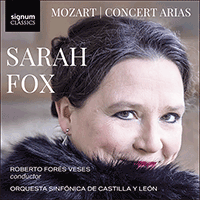


Spanning Mozart’s career, Sarah Fox’s imaginative Mozart programme includes early experiments in the genre as well as mature interpolations created for the mighty operas as their casts changed: showcases all for Mozart’s gifts of expressive vocal writing and orchestral colour.

No one could accuse Leopold Mozart, perpetually frustrated with his lot in Salzburg, of underselling the precocious music talents of Wolfgang and his older sister Nannerl. In June 1763 the family set out in their own carriage on a European grand tour arranged by Leopold to showcase his children’s prowess to an adoring public, and perhaps also to realise vicariously his own thwarted ambitions. Having conquered Munich, Brussels and Paris, the Mozarts moved on to London in April 1764, where Wolfgang displayed his innate theatrical flair by improvising operatic arias on contrasting moods to the astonished scholar Dr Daines Barrington. In the same spirit, Leopold Mozart relates how people would offer Wolfgang a random text by Pietro Metastasio—doyen of eighteenth-century librettists—which he would then set ‘with the most amazing rapidity’.
After a fifteen-month stay in England the Mozart family travelled via Lille and Antwerp to The Hague. It was here, in October 1765, that the nine-year-old Wolfgang (though the wily Leopold knocked a year off his age!) composed his first concert aria for soprano, ‘Conservati fedele’, K23. He revised it the following January, possibly for a performance before Princess Carolina of Orange-Nassau. The text, like that of K78 and K79, comes from Metastasio’s Artaserse, set first by Leonardo Vinci in 1730 and subsequently by dozens of composers including Gluck and Johann Christian Bach. Wolfgang may even have heard Thomas Arne’s English setting, Artaxerxes, in London. Mandane, sister of the Persian Prince Artaxerxes, bids a farewell to her banished lover Arbaces in an aria lightly accompanied by strings and marked by touching shifts between major and minor.
The other two arias to texts from Artaserse were probably composed in The Hague shortly after ‘Conservati fedele’. Gender-bending was routine in opera seria; and in both K78 and K79 the soprano takes a male role. Like K23, ‘Per pieta’, K78, sung by Prince Artaxerxes to his beloved Semira, is an example of the aria amorosa, designed primarily to display a singer’s beauty of tone and powers of cantabile. Artaxerxes’ gently ornamental vocal line is supported by an orchestra of oboes, horns and strings.
In the scena ‘O temerario Arbace!’ … ‘Per quel paterno amplesso’, K79, Mozart writes a duet for one: a confrontation between Arbaces and his father Artabanus, who has framed his son for the murder of Xerxes which he himself committed. The aria is prefaced by Mozart’s first orchestrally accompanied recitative, with the strings as dramatic commentators—a modest foretaste here of glories to come. Scored for oboes, bassoons, horns and strings, the slow triple-time aria is graced with flurries of coloratura that are expressive rather than showy. Both K78 and K79 were among the Mozart arias performed at a Milan soirée held by Count Firmian, the Austrian governor of Lombardy, in March 1770, during the composer’s triumphant first Italian tour.
These three pre-pubescent arias—written primarily as exercises in the Italian operatic style—already reveal the boy’s command of the contemporary musical lingua franca. For true individuality, though, we must wait until the late 1770s and 1780s, when Mozart composed a raft of magnificent concert arias and ‘insertion’ numbers for friends and professional colleagues. When Figaro was successfully revived in Vienna in August 1789, the original Susanna, Nancy Storace, had returned to London. Her replacement, Adriana Ferrarese, who also happened to be librettist Lorenzo Da Ponte’s mistress, was an altogether grander, more flamboyant singer, with attitude to match. (In his Memoirs Da Ponte uncharitably recalled his former mistress’s ‘impulsive, violent disposition, rather calculated to irritate the malevolent rather than win and retain friendships’.) Probably at Ferrarese’s request (command?) Mozart composed two new solos for her, of which the virtuosic ‘Al desio di chi t'adora’ replaced the pastoral serenade ‘Deh vieni non tardar’ in Act Four. Darkly coloured by basset horns, French horns and bassoon, the new aria—in the fashionable form of the two-section rondò—seems less suited to the character of Susanna than to Fiordiligi in Così fan tutte, the role which Ferrarese would premiere early in 1790.
In 1778, during his prolonged stay in Mannheim, Mozart informed the Elector Carl Theodor, ‘To write an opera is my dearest wish.’ That opera for the Mannheim court—which had meanwhile decamped to Munich—was to be Idomeneo, rè di Creta, commissioned in the late summer of 1780 and premiered at François de Cuvilliés’ exquisite theatre in Munich on 29 January 1781, two days after Mozart’s twenty-fifth birthday. While there are no contemporary accounts of the opera’s three performances, the composer’s reported recollections suggest that they were warmly received.
Mozart revived his first operatic masterpiece just once, for a semi-staged performance in Prince Johann Adam Auersperg’s Palace in Vienna in March 1786, with a largely amateur aristocratic cast. In Munich the role of Idomeneo’s son Idamante had been taken by the novice soprano castrato Vincenzo dal Prato, never Mozart’s favourite singer (‘He has to learn his part like a child’, he lamented to his father). Castrated barons were not an option. Accordingly, for the Viennese performance Mozart rewrote the role of Idamante for a tenor, Baron Pulini, transposing his existing music and providing two new numbers: an alternative love duet for Idamante and the Trojan Princess Ilia, and a new scena con rondò at the start of Act Two. This comprises an elaborate recitative (‘Non più! Tutto ascoltai) and an aria with obbligato violin (‘Non temer, amato bene’) in two parts, the first suavely lyrical, the second counterpointing bouts of violin virtuosity with Idamante’s increasingly passionate avowals of love.
The soprano Aloysia Weber is famous above all as Mozart’s first love. He met the seventeen-year-old Aloysia in Mannheim, en route to Paris, in the winter of 1777-78. He quickly became her musical mentor, and even hatched plans to travel with her to Italy and launch her stage career there—to Leopold Mozart’s predictable horror. The plans, and a potential affair, came to nothing. By the time Mozart returned from Paris in the autumn of 1778 Aloysia had been engaged by the court theatre in Munich. She then joined the National Singspiel in Vienna and in 1780 married the court painter and actor Joseph Lange.
Swallowing his rejection, Mozart remained on friendly terms with Aloysia after his own move to Vienna in June 1781. He wrote the ‘homage’ aria ‘Nehmt meinen Dank’, scored for a small orchestra of oboes, bassoons and strings, in April 1782, four months before his marriage to her younger sister Constanze. While Mozart’s other arias for Aloysia display her famed coloratura prowess, in ‘Nehmt meinen Dank’ the soprano expresses her thanks to her patrons in the audience (we’d now call them sponsors) in music of serene simplicity.
In ‘Ch’io mi scordi di te’ Mozart fuses the aria and the piano concerto, two genres in which he was supreme. He composed this beautiful scena early in 1787 as a parting gift for the Italian-English soprano Nancy Storace, the first Susanna in Le nozze di Figaro, noting in his thematic catalogue: ‘Für Madselle Storace und mich’. Mozart lifted the text from the scena for Idamante, K490 (Track 5), which he had composed for the performance of Idomeneo in the Auersperg Palace the previous year. Cast in the form of an emotionally charged recitative (in which the piano is silent) followed by a two-part aria (Andante-Allegretto), ‘Ch’io mi scordi di te’ seems an intensely personal work. Nancy Storace was renowned for her charm and dramatic expressiveness rather than her vocal virtuosity. Fitting the costume to the singer, as ever, Mozart wrote for her a scena of unique chamber-musical intimacy that interweaves voice and piano against the mellow orchestral sonority of clarinets, bassoons, horns and strings.
Nancy gave a farewell concert in the Kärntnertor Theatre on 23 February 1787, shortly before she and her brother Stephen returned to England. Although no reports of the programme survive, we can guess that Mozart partnered her in ‘Ch’io mi scordi di te’. It was whispered in Vienna that the relationship between composer and soprano went beyond the merely professional. While these rumours were almost certainly baseless, the scholar Paul Hamburger had a point when he described ‘Ch’io mi scordi di te’ as ‘the most mature love-letter ever written in music’.
Mozart created the final number on this disc, ‘Vado, ma dove?’, for the soprano Louise (Luisa) Villeneuve when she played Madame Lucilla in a 1789 revival of Martín y Soler’s comic opera Il burbero di buon cuore (‘The good-hearted curmudgeon’). Early the following year Villeneuve created the role of Dorabella in Così fan tutte. A favourite of the Viennese public—and evidently of Emperor Leopold II, who was spotted ogling her from the royal box—Villeneuve was admired for what one reviewer dubbed ‘her sensitive and expressive acting and her artful and beautiful singing’. Dorabella suited her to perfection. The fast-spending Lucilla has just learnt that her husband Giocondo is about to be imprisoned for debt. In ‘Vado, ma dove?’ she gives vent to her agitation in an Allegro powered by restless syncopations, then entreats the god of love to guide her in a sensuous Andante sostenuto coloured by clarinets and bassoons.
Richard Wigmore © 2026
Just like the Piano Concertos, his Concert Arias were written throughout his whole life and it is fascinating to hear how his music developed from his brilliance as a child prodigy through to the remarkable works of his later years … if only he had lived twice as long!
When people think of Mozart’s works for singers, I think their minds are immediately drawn to the operas, and possibly the great C minor Mass alongside the Requiem, but not necessarily to the Concert Arias which continue to be somewhat lesser known. I have always wanted to record some of them and so it was a privilege to make this recording.
As well as including the first and last arias he wrote for soprano (Conservati fedele and Vado, ma dove?) I particularly wanted to include two others. Firstly, Al desio di chi t’adora. Although written as an interchangeable aria for “Deh vieni, non tardar” in Le nozze di Figaro, it works magnificently as a stand alone aria and I love it for its very unusual scoring, in particular the sound of the basset horns. It is an instrument you don’t hear very often and Mozart wrote for it more than just about any other composer.
Secondly, the great Ch’io mi scordi di te?. Given my love of the Piano Concertos (and of the piano in general) it is the best way I can celebrate that by singing alongside the instrument. I was so thrilled when my great friend and colleague, Malcolm Martineau, agreed to come along and record it with me and I am eternally grateful to him for everything.
In addition to Malcolm, I would like to thank Jesus Herrera, Lucrecia Colominas and all those at the wonderful OSCyL Orchestra who made this recording possible. And finally, a special thank you to Robert Forés Veses; I am indebted to him for his patience, time and generosity, without which, this recording could not have happened.
Sarah Fox © 2026