Welcome to Hyperion Records, a British classical label devoted to presenting high-quality recordings of music of all styles and from all periods from the twelfth century to the twenty-first.
Hyperion offers both CDs, and downloads in a number of formats. The site is also available in several languages.
Please use the dropdown buttons to set your preferred options, or use the checkbox to accept the defaults.
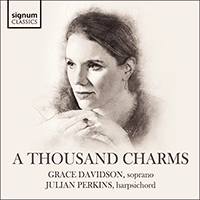

Many of the songs here have been favourites of the early music vocal scene for decades, and listening to this richly varied new programme it is not hard to see why: timeless delights.

The strophic song was the simplest type of seventeenth-century vocal music, often not far removed from the hymn. Indeed, Campion’s devotional song Never weather-beaten sail, with its perfect fusion of words and music, has become a popular hymn in modern times; Campion, a poet and a musician (and a doctor by profession), seems to have set his own lyrics. Author of Light, also strophic, is rather more complex, with a melodic line mirroring the inflections of speech and illustrating the words with appropriate musical images—a type commonly called declamatory song today. Thus the rising chromatic fourth at the end cleverly illustrates ‘mists and darkness’ in the first verse and ‘sharp pains and grief’ in the second.
The declamatory song, always in a grave duple time, was the main vehicle for settings of serious poetry throughout the seventeenth century. Pelham Humfrey’s famous setting of John Donne’s A Hymn to God the Father is a superb example, with the three verses of Donne’s poem given separate declamatory settings. Humfrey, as Master of the Children of the Chapel Royal between 1672 and his early death in 1674, would have taught the young Henry Purcell, and Purcell dutifully included it with several of Humfrey’s other devotional songs in the collection Harmonia sacra (1687), which he edited for the publisher Henry Playford. This is the version recorded here, but it is startlingly different from one preserved in an earlier manuscript, and may therefore be Purcell’s reworking and modernisation of Humfrey’s original setting.
In the 1680s and 90s the declamatory idiom was diluted by a fashion for suave melodic writing in patterns of flowing quavers with bursts of Italianate semiquavers where required. Excellent examples are Purcell’s second setting of Henry Heveningham’s If music be the food of love (which alludes to the first line of Orsino’s speech at the beginning of Twelfth Night), published in The Gentleman’s Journal in June 1692, and John Blow’s Sabina has a thousand charms’, published in (and probably composed for) his song collection Amphion Anglicus (1700). Both are strophic but fall into two sections, like an almand. Purcell’s Ah! How sweet it is to love is another beautiful example of the type. It is notable for the way Purcell develops the motif setting the first phrase of the text as an equal dialogue between the voice part and the bass. It was written for a revival of John Dryden’s heroic play Tyrannic Love, probably in the autumn of 1694. John Eccles’s comic song Belinda’s pretty, pleasing form is similar in its pattern, but with the breathless words of the two verses each given appropriate patter-like music. It was written for a lost play, Women Will Have Their Wills, evidently put on shortly before 1700 at the Lincoln’s Inn Fields Theatre, where Eccles was the leading composer.
Songs using minuet rhythms were also popular in Restoration England. Two examples come from Purcell’s dramatic opera The Indian Queen, composed in the last months of his life and based on an earlier play by Sir Robert Howard and John Dryden. I attempt from love’s sickness to fly comes from Act III, in a masque-like sequence in which aerial spirits try to console the Mexican Queen Zempoalla after she has received a dire prophecy of her fate. It is Purcell’s most perfect example of a song using the rondeau pattern, with a recurring theme and two contrasted episodes. They tell us that your mighty powers comes from Act IV, and is a conventional two-section minuet with two verses, each followed by an instrumental ritornello.
Blow’s Lovely Selina, also in minuet rhythm, is a fine example of a song on a ground bass, in this case the passacaglia—four notes descending from tonic to dominant. It was sung in Act IV of Nathaniel Lee’s tragedy The Princess of Cleve to entertain the princess in a bower, probably in a production put on at the Dorset Garden Theatre in 1682; it was published the following year. The serene Evening Hymn is justifiably one of Purcell’s most famous ground-bass songs. It is the first piece in Harmonia sacra, and was probably composed specially for the collection. Setting a poem by William Fuller, Bishop of Lincoln (one of Purcell’s favourite authors of devotional verses), it uses an elaborated five-bar version of the passacaglia, but with several graceful modulations. At one point towards the end Purcell uses his favourite device of introducing part of the ground bass in the voice part in imitation with itself. Last but not least, Sweeter than roses is a superb example of the popular double-barrelled type of song: an Italian recitative-like passage with beautiful written-out ornamentation leads to a minuet-like section in the fashionable trumpet idiom, illustrating the words ‘What magic has victorious love!’. Purcell wrote it at the end of his life for the tragedy Pausanias, not produced until after his death.
Moving to the eighteenth century, Thomas Arne’s famous setting of Ariel’s song Where the bee sucks, there lurk I was written for a revival of the Restoration version of The Tempest at Drury Lane, probably in 1746. The owl’s cry is amusingly portrayed by repeated notes in the accompaniment, originally played by a flute. Arne’s beautiful setting of Sleep, gentle Cherub from his oratorio Judith (1761) is an essay in the serene manner of Handel’s Where’er you walk, though it was sung by Judith to lull the Assyrian general Holofernes into a drunken sleep before beheading him. Handel’s Semele (1744) is an adaptation as an oratorio of William Congreve’s opera libretto Semele, originally set by John Eccles. Of the three extracts recorded here, the justly famous O sleep, why dost thou leave me? is sung by Semele as she wakes from sleep in Act II, having dreamed of being united with Jupiter. It is accompanied only by continuo, doubtless played on the harpsichord by Handel himself in the original performances. My racking thoughts comes in Act III as Semele is beset by anxiety over her relationship with Jupiter, beautifully portrayed by a nagging dotted figure in the accompaniment. Finally, Semele sings the minuet-like I ever am granting to Jupiter later in Act III as she urges him to reveal himself as a god, an action that will inevitably consume her.
Julian Perkins’s choice of solo pieces illustrates the changing nature of English harpsichord music. Following the example of Restoration copyists and collectors, he has assembled a four-movement Suite in D minor from Purcell’s keyboard music. It begins with two movements taken from the Choice Collection of harpsichord suites published by Frances Purcell in 1696. An elaborate and serious almand using the style brisé (broken-chord) idiom derived from French lute music, predominantly in noble dotted rhythms, is followed by a faster and shorter triple-time corant, also with style brisé textures. The almand is subtitled ‘Bell-Barr’ in the 1696 publication, suggesting that Purcell wrote it for his pupil Annabella Howard (wife of Sir Robert), who had a country retreat in the hamlet of that name near Hatfield in Hertfordshire. The third movement is an expressive saraband, found in an early eighteenth-century manuscript now in Cardiff, and the suite ends with an arrangement of the hornpipe in rondeau pattern from Purcell’s theatre airs for a revival of Aphra Behn’s play Abdelazer (1695)—a piece made famous in the twentieth century as the theme of Benjamin Britten’s Young Person’s Guide to the Orchestra. By the time Thomas Arne published his VIII Sonatas or Lessons in 1756, the French-style suite had been abandoned in favour of the Italianate sonata, though again with a decidedly English accent. Sonata No 5 in B flat major consists of just two movements, a common pattern at the time. A slow minuet-like movement leads by way of a brief flourish to a lively ‘Gavotta’, whose rapid changes of texture and sonorous octaves in the bass evoke orchestral music.
Peter Holman © 2026