Welcome to Hyperion Records, a British classical label devoted to presenting high-quality recordings of music of all styles and from all periods from the twelfth century to the twenty-first.
Hyperion offers both CDs, and downloads in a number of formats. The site is also available in several languages.
Please use the dropdown buttons to set your preferred options, or use the checkbox to accept the defaults.
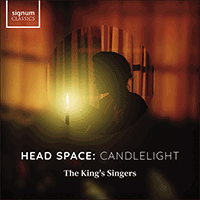

Fourteen tracks (well, thirteen, if you don’t count the Cage …) of artful tranquillity, the age-old incantations of Compline plainchant enveloping a sequence of old and new as darkness descends and night draws in.

This first volume in our Head Space series is themed Candlelight. It takes as its inspiration the ancient church liturgy—the context in which lots of beautiful and reflective choral music has been written. Church music is very close to our hearts as performers, as it was in this tradition that most of us grew up and learned our trade, and in which our group was originally formed. The church service central to this Candlelight release is that of compline: the final service of the day in the Catholic rite—performed as darkness descends and night draws in. It’s a service which asks God for protection and comfort through the night, and it evolved in a period when getting safely through each night was by no means a given. The service was traditionally full of plainchant melodies: single-line hymns, psalms, responsories and antiphons which gradually developed, over centuries, into a sacred repertoire which was the uniting soundtrack to an often-disunited church. Some of the most famous of these compline plainchant melodies feature in this recording, helping to create a musical continuum which leads us in and out of other more complex or substantial works.
The first of these is In manus tuas Domine, whose text is based on Psalm 31: ‘Into thy hands, O Lord, I commend my spirit’, in which we hear three lower voices chanting together. The final one, which closes the album, is the compline antiphon Salva nos Domine vigilantes: ‘Save us, O Lord, waking, and guard us sleeping’, in which we hear just Julian singing as a solo cantor. Track 2 is the compline hymn Christe qui lux es et Dies. Robert White (c1538-1574) wrote several settings of this hymn, all of them in the ‘alternatim’ style which intersperses plainchant and harmonised choral verses. Robert White worked as organist at Westminster Abbey, and Ely Cathedral and was one of the most influential and skilled English composers of his generation. The simplicity of even the choral verses—comprising only block chords—creates an entrancing effect which would have been perfect for the cathedral or chapel acoustics where it was first performed. In all of these pieces of chant, and indeed in other works on the recording, the pace of music is inherently governed by the patterns and rhythms of breathing, with regular pauses punctuating the sound, allowing time for the cantor to draw breath, allow the echo to disperse, before beginning the next phrase. This breath-led pacing is a running theme through lots of the material on Candlelight.
Dotted throughout the track list are four of Orlando Gibbons’ (1583-1625) Song settings. In 1623 the poet and theologian George Wither published ‘The Hymnes and Songs of the Church’—hymn texts for various points of the church calendar. For several of these texts, Gibbons composed two-part music—a melody and bass line—which could be used to sing Wither’s texts. Fleshed-out four part versions of these Gibbons compositions have become a staple part of the hymn repertoire of the Anglican church, and are beloved for their simplicity and beauty. We decided to include four Songs, but without words, as musical sorbets in which the beauty of the lines could cleanse the palette with gentle vocalisations and the breathing rhythms inherent in each phrase and each new verse. For two of these—Song 1 and Song 20—we were joined by the cornettist Jeremy West, who adds quasi-improvised obligato lines (constructed by composer Timothy Roberts) which weave in and out of Gibbons’ original melodies with the distinctive character of the 16th-century wind instrument.
Anna Thorvaldsdottir’s (b1977) hymn, Heyr þú oss himnum á, offers a modern expression of the same contemplative ideals found in Compline. The Icelandic text, ‘Hear us in heaven’, evokes the theme of nighttime prayer for protection. As with her much-celebrated film and television music, Thorvaldsdottir’s setting responds not with overt emotion but with spaciousness, stillness, and understatement. Long, sustained vocal lines are underpinned by slow-moving harmonies and subtle shifts in texture. In the context of Head Space, it's gently overlapping, strophic structure encourages a kind of musical mindfulness: expansive, repetitive and slow enough almost to alter the listener’s sense of time. Judith Bingham’s (b1952) Ave virgo sanctissima is a through-composed setting, allowing the text to unfold in a single arc, with a brief reprise of the opening material as the piece draws to a close. Bingham’s work inhabits the same sonic and spiritual space as chant—but here reimagined through a contemporary harmonic lens, and her distinctive octatonic voice. The text is an ancient Latin paean of praise to the Virgin Mary, similar to Edvard Grieg’s Ave maris stella, and Parsons’ Ave Maria that come later on this album. Arvo Pärt (b1935) wrote Zwei Beter—or ‘Two Prayers’—for the Hannover Mädchenchor in 1998, setting a parable spoken by Jesus in the Gospel of St Luke. The zealous and pompous prayer offered by the pharisee, set in a much more simple two- and three-part musical language, sits in stark contrast to the short prayer of the pub landlord. The landlord admits he is a sinner and asks forgiveness, and is the one who returns home blessed. Pärt’s musical style makes effective use of stillness and silence, with marked moments of pause punctuating sweeping melodic lines or homophonic block textures. The text also has a perfect home on Head Space, inviting us—as it does—to accept and live with our imperfection.
O Euchari is a monodic composition by the 12th-century abbess, poet and mystic Hildegard von Bingen (1098-1179), and it provides a vital link in the arc of this album. It bridges the drama of Bingham or Pärt and the silence of Cage’s 4’33”, by returning to a single unaccompanied melodic line. The text honours St Eucharius and is full of the rich, visionary imagery typical of Hildegard’s poetry. As the musicologist and conductor Christopher Page notes, Hildegard’s music stretches the musical language of plainchant to its expressive limits, with long phrases, wide intervals, and highly distinctive melodic shapes. O Euchari steps outside of the rhythmic framework of ensemble singing and instead follows the natural cadence of a solo voice. In our performance, countertenors Pat and Eddie combine to create a shared high voice. In the narrative of Candlelight, it gently brings the listener back from harmonic complexity into a purer kind of musical contemplation—preparing the ear for the silence that follows. The atmosphere of stillness and consciousness in what we nowadays call mindfulness, is perfectly captured in an experimental work by the American avant-garde composer John Cage (1912-1992): 4’33”. He wrote it in 1952, and its concept is both groundbreaking but also incredibly simple. The performer makes no intentional sound for the duration of the piece (which may, or may not, be 4 minutes and 33 seconds: indeterminacy was a compositional tool for Cage). Performances of the work often highlight how absolute silence is rarely possible; when performing or listening to the piece, our awareness of the world around us—even of the noises of our own bodies and the buildings we’re in—become tantamount to music. Whilst live performances of the piece often activate the ears and the eyes of listeners, we hope that in this recording we might activate your imagination too. As you listen, we invite you to be aware that the six of us were standing in candlelight, at nighttime in an otherwise empty church, close to our microphones, as the audio was captured. There is—we hope—a comforting immediacy to the experience of listening, knowing that we were present too in that same period of silence, observing whatever incidental sounds you too may notice. Taking us from silence back into sound is the delicate opening phrase of Robert Parsons’ (c1535–1572) Ave Maria—one of the finest and most famous examples of mid-16th-century English polyphony. It sets the Latin text of the ‘Hail Mary’ in five-part counterpoint, with each new phrase introduced imitatively across the voices. Parsons spent part of his career as a Gentleman of the Chapel Royal (succeeding William Byrd there) before his untimely death by drowning in 1572. The texture of Ave Maria is carefully balanced, with each new line emerging and receding until the unfolding of the final ‘Amen’ which is surely one of the expressive pinnacles of Elizabethan church music.
Edvard Grieg’s (1843-1907) Ave maris stella is a setting of the Marian hymn ‘Hail, Star of the Sea’, which dates from the 8th century and was traditionally sung at the service of Vespers (which comes before Compline in the daily cycle). It alternates between rich, low sonorities and floated phrases led by the upper voices, creating a texture that feels both grounding and elevated. Its strophic form demarcates the verses of the text, making it a comfortable bedfellow for the other strophic hymns and songs on this record. For all of us in the group, Ave maris stella has long been a favourite which we’ve known since childhood.
Our hope is that, whether you listen to it in order or not, this sequence of music is beautiful in its own right, but also creates an atmosphere and a rhythm which enables a compline-like moment of reflection and calm.
The King's Singers © 2026