Welcome to Hyperion Records, a British classical label devoted to presenting high-quality recordings of music of all styles and from all periods from the twelfth century to the twenty-first.
Hyperion offers both CDs, and downloads in a number of formats. The site is also available in several languages.
Please use the dropdown buttons to set your preferred options, or use the checkbox to accept the defaults.
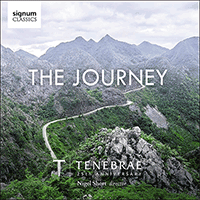

Nurturing new music has always been central to Tenebrae’s identity. This recording made to mark the choir’s 25th anniversary interweaves established works by Eric Whitacre, John Tavener and Max Richter with exciting new commissions from Joby Talbot, Joanna Marsh, Jason Max Ferdinand and Sarah Henderson.

This programme pauses at that junction, taking the journey itself as its theme. What does it—or can it—mean to journey? Where might we arrive, who might we meet, and what might we learn along the way? We encounter journeys between worlds, quests for the elusive and the always-beyond-reach, emotional and spiritual journeys as well as those through physical landscapes. We set forth and return home again and again.
Is a journey ever complete? Jason Max Ferdinand’s Journey—the first of Tenebrae’s 25th anniversary commissions—suggests not. The steady tread gives it the feel of a hymn, its harmonies a gospel feel at times, but there’s also a sense of marching song—of music forging forward, come what may—to this short anthem which hopes that, ultimately, we can all come together to “sing the darkness into light”.
Purcell’s anthem Hear my prayer, O Lord supplies the starting point for Bob Chilcott’s elaboration My prayer. The original short work—tantalisingly, probably a fragment of a larger work either unfinished or lost—is a masterpiece of concision. A rising minor third and a rising scale with a little chromatic catch in its throat are the sole elements, amplified with gradually greater intensity and scope. In Chilcott’s hands we hear Purcell’s theme battling through denser textures, caught in loops of repetition, truncated or inverted. The original is at once recognisable and lost in a musical hall of mirrors.
Our journey is then drawn to earth, among Wordsworth’s crowd of daffodils. Sarah Henderson, winner of Tenebrae’s inaugural Undiscovered Voices competition, pairs two texts in her Wanderers: Wordsworth’s ecstatic, lyrical encounter and Kahlil Gibran’s meditation from The Prophet. Each is self-contained: two experiences of solitude that don’t so much dialogue as run in parallel—separate, together. There’s brilliance in the Wordsworth setting (which begins in a freewheeling soprano solo), tugging impatiently against bar-lines, desperate to draw the rooted stability of the chordal Gibran into a dance. It succeeds, briefly, but the paths soon diverge again. The ending sees the ensemble finally at rest; only the restless solo soprano still in motion, setting out once again on her wanderings.
Some journeys have no fixed destination. Yeats’ The Song of Wandering Aengus has a fairy-tale quality: a quest for beauty, magic and love that remains tantalisingly out of reach. Joby Talbot (whose Path of Miracles has been such a defining collaboration in the choir’s history) lets the words sit uppermost in a wonderfully translucent, concise setting. Talbot’s world is rhythmically ordered and controlled, but gives way at moments of magical transformation to triplets that seem to bend time and space, capturing the strange wonder of an encounter and quest that haunts a lifetime.
Robert Burns’ love poem tells an age-old story: a girl is in love with one man, her father would rather give her to another—one “with land”. But she is determined, and will only marry her “gallant weaver”. James MacMillan’s supple setting The gallant weaver is all radiance and freshness thanks to its split soprano parts, who dovetail and echo and twine, soaring high like swallows above the more sustained lower voices. Their filigree ornamentation, nodding to Gaelic folk-music, creates a delicious friction with the slower-moving music below. A happy outcome is never in doubt in music of infinite spaciousness and calm.
“In the midst of life we are in death”: Kerensa Briggs’ Media vita celebrates the blurred lines of life and death in a deceptively simple four-part anthem, whose measured homophony and consonant directness becomes deliciously blurred and smudged by unexpectedly bluesy harmonies. The “sea-change” of death is captured in the luscious strangeness of the harmonic progressions, with more than a nod to Messiaen’s O sacrum convivium, which captures the mystery of the Eucharist by similar means.
Max Richter’s On the nature of daylight has had many incarnations. Originally conceived for five strings as part of the composer’s 2004 The Blue Notebooks, an album protesting the invasion of Iraq, it has since been reworked for various forces, and re-used in different soundtracks, most recently Chloe Zhao’s film Hamnet. We hear it here arranged for wordless eight-part voices by Geoff Lawson. The lower four voices establish the repeating cycle of four chords that underpin the whole work, acting as a ground bass over which the two soprano parts weave and loop an endless melody, gradually drawing the altos into their rippling, dovetailing textures.
“As I set out to write ‘When David heard’ I decided that my first and most principal musical motive would be silence.” Composed for a mentor whose son had been killed in a car accident, Whitacre’s When David heard is an exercise in restraint, a not-outpouring of grief all the more powerful for refusing to release the howling tension at its core.
A single line from the Old Testament encompasses a vast tragedy. The story of King David, whose son Absalom is killed, is familiar from settings by Tomkins and Weelkes, but Whitacre’s approach to this tradition of formal lament is one of deconstruction. Traditional elements are fragmented, shattered, cut short; silence hangs in the air between gambits, phrases again and again prove to be blind corners, dead ends. At the centre of the work is an 18-part cluster chord built up through the voices from bottom to top. Repeated nine times to the words “my son” before any softening resolution is offered, it’s the pillar around which the whole work is built: grief—unchanging and unchangeable, absolute and unyielding.
The musical journey to heaven takes many different paths. Giving up earthly ties is an almost reluctant process in Emily Dickinson’s Going to Heaven!. The third work on this disc commissioned to mark Tenebrae’s 25th anniversary, Joanna Marsh’s setting continues her collaboration with the choir following the success of carol In Winter’s House. It opens with lilting, outdoorsy ease—a folk-song polished up in eight parts, but still retaining its informal, dancing spirit. The poet’s initial jauntiness and informality pulses through the rhythmic writing, but is stilled into more contemplative, questioning spirit in the final verse as doubts creep in. The poet’s thoughts turn to those she has left “in the ground”, and the music follows—swapping the thick, affirmative, collective texture for a simple melody in the bass, its only accompaniment a hum.
Taken from Tavener’s eight-hour, all-night vigil The Veil of the Temple, the short anthem Mother of God, here I stand is so audaciously, so exquisitely simple as to defeat musical analysis—its power is all in performance. Two strophic verses sustain a hushed meditation, direct and familiar as any folksong, a small, still point of contemplation at the heart of a musical epic.
Alexandra Coghlan © 2026
This programme brings together music that unfolds patiently and purposefully—music that invites the listener into a place of quiet but active reflection. Threaded through established works by Eric Whitacre, John Tavener and Max Richter are new commissions from Joby Talbot, Joanna Marsh and Jason Max Ferdinand, alongside Sarah Henderson’s winning piece from Undiscovered Voices: our inaugural composition competition. Nurturing new music has always been central to Tenebrae’s identity, and it feels especially fitting, in our anniversary season, to extend that tradition by placing new works in dialogue with music that has already found its place in the choral landscape. I hope choirs enjoy discovering and performing these new works as we have, and that they will become embedded in the choral canon and live on far beyond us as musicians.
Many of the pieces on this album speak directly of wandering, passage, or transformation; others suggest these ideas more subtly. What unites them all is an inward quality—a sense that the music is less about arrival and more about the journey. This is music that rewards attentiveness, and I really feel the more you listen to this music, the more you hear each time.
After 25 years of making music with Tenebrae, I am more aware than ever of the significance of this milestone. I have been incredibly lucky and privileged to have had such amazing people to work with, right from the very beginning when Tenebrae was co-founded with Barbara Pollock. Without the friendship, encouragement and support from Barbara and so many others I would not be writing these words, and Tenebrae would not now be embarking on its near 50th recording. To every single one of them, I extend my heartfelt thanks. I hope they, and you, our audiences, will continue this journey with Tenebrae far into the future. I hope this album offers listeners rest and restoration, and that it reflects something of Tenebrae’s ongoing journey: rooted in precision and clarity, and always imbued with an overriding passion for the music, from us the performers and for you, the listeners.
Nigel Short © 2026