Welcome to Hyperion Records, a British classical label devoted to presenting high-quality recordings of music of all styles and from all periods from the twelfth century to the twenty-first.
Hyperion offers both CDs, and downloads in a number of formats. The site is also available in several languages.
Please use the dropdown buttons to set your preferred options, or use the checkbox to accept the defaults.
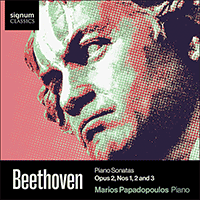

These three sonatas from early on in Beethoven’s career show the composer assimilating the forms established by Mozart and Haydn as a preparation for the wonders which were to follow.

However, these three sonatas—the first with a Mozartian feel, the other two more Haydnesque—were not the first Beethoven had written. At least four earlier efforts are known, the first three of which being the ‘Electoral’ sonatas (Kurfürstensonaten) composed in Bonn when Beethoven was 12, encouraged by Neefe and published, without an opus number, by Bossler on 14 October 1783 and dedicated to Elector Maximilian Friedrich (hence their title). They are now referred to as WoO47 (Werke ohne Opus).
All three ‘Electoral’ sonatas are couched in the Haydn and Mozart norm of three movements. Between March and May 1787 Beethoven travelled to Vienna for two weeks and met Mozart (by some reports played for him too) and he hoped later to return to be taught by Mozart. Unfortunately, Beethoven didn’t get back to Vienna until early November 1792, almost a year after Mozart’s sad demise (and just a month before Beethoven’s father died). He started studying with Haydn soon after, although his numerous two, three and four-part counterpoint exercises that are still extant, complete with Haydn’s corrections, did not really inspire Beethoven. Later he claimed he ‘never learned anything’ from Haydn and certainly refused the older composer’s request to use the phrase ‘pupil of Haydn’ on his first published works. With Haydn called back to London from early 1794, Beethoven continued his studies both with Johann Albrechtsberger and Antonio Salieri.
From this time comes his work on the three Op 2 sonatas. Typical of many composers he was not averse to using themes from earlier, unpublished works. Here it is specifically music written in 1785 for his Piano Quartet WoO36 No 3 that is found in both the second movement of Op 2 No 1 and the opening movement of Op 2 No 3.
Perhaps as a deliberate break from both Mozart and Haydn and also his own earlier efforts, he chose four movements for all three of these sonatas. In this, he may have found more in the way of example in the sonatas by Muzio Clementi, let alone his distinctive assimilation of the ‘Mannheim Rocket’ in the very opening bars of the F minor Sonata, with its staccato ascending phrase, although—just as equally—it could be an allusion to the finale of Mozart’s Symphony No 40 in G minor, K550.
But, then again, there is no question that this is Beethoven. Each sonata starts with a musical quip, one of Beethoven’s trademark motifs which he worked hard on in sketches and from which he developed his themes. The rising crotchets of No 1 end in a turn, a phrase that is immediately repeated, then ‘foreshortened’ to just repeat the turn (again twice). In the case of the second sonata, it is almost the reverse pattern: an up-beat quaver to a crotchet before a demisemiquaver descent for both hands, again repeated and followed by a descending crotchet phrase in octaves. A similar ‘foreshortening’ of the opening phrase opens the third sonata—here missing the two staccato crotchets that initially follow the opening minim, semiquaver and quaver pattern. Out of all of these Beethoven fashions high motivic tension, all the more effective in all three sonatas by all being marked piano to open.
The opening Allegro of Op 2 No 1 is the tersest of the three (the whole sonata is the most concise of them). It is followed by an F major Adagio (all the movements are in F) taken from the Piano Quartet he had written at only 15, a Mozartian cavatina which is in sonata form without the development, so that the exposition moves directly into the recapitulation. Only in the following Minuet, which alternates F major and F minor, is the mood broken by sudden vehement fortissimo running quavers. In subtler vein, such running quavers then characterise the more flowing Trio.
The Finale opens at a gallop, with left-hand rocking triplets adumbrating all but seven bars of the repeated exposition, in marked contrast to the calmer central section, marked sempre piano e dolce, which is gradually infiltrated by the triplets, to the final, headlong, plunge. Beethoven keeps the minor key to the very end, perhaps leading the way for the 19th-century’s avowed romantics (Chopin’s, Schumann’s and Liszt’s sonatas are all in minor keys).
In contrast to the Allegro of No 1, the Allegro vivace of No 2 seems much more leisurely, which is in part to do with its mellower second theme and a fuller working out of all sections. The slow tread of the left-hand’s semiquavers pointing to the chorale theme of the Largo appassionato occasionally gives way to a softer quaver flow, matching the D major tonality and giving the movement a noble mood, turning to the minor for a powerful fortissimo version of the theme before ending in a more innocent mood.
Although Beethoven had used a Scherzo in the first two of his three piano trios Op 1, here he uses the more abstract development from the original dance-inspired minuet for the first time in a sonata. The rising semiquaver cell is used as a building block contrasting with the minor-key build up of both right-hand crotchets and rippling quaver accompaniment in the Trio. The finale is also the first of Beethoven’s piano sonata rondos, with five effortlessly varied versions of the main theme separated by contrasting episodes, especially the spiky triplets of the minor key central section. There is a final scurry up the keyboard to melt back into the main theme, restored to the major to end as the marking demands, ‘graciously.’
More expansive still is the Sonata in C—so epic a structure that in its first movement coda Beethoven even writes a cadenza more expected in a concerto. Following the opening quip are first a welter of semiquavers that melt into more consoling running quavers, features that repeat until the wide-ranging rippling passage that precedes the cadenza, after which fortissimo crotchets, quavers and semiquavers—rising and falling in broken octaves—bring the movement to its emphatic close.
The Adagio starts in the remote key of E major, but soon turns to E minor with a baroque-like rocking pattern that is almost a permanent feature thereafter, save for two fortissimo passages that later punctuate the movement before its hushed close. There is a fugal element in the overlapping parts of the Scherzo, later being bogged down in the minor key and seemingly finding it difficult to emerge back in C major. The Trio, with its rising and falling triplets, almost themeless in their ebb and flow, makes one final descent before the repeat of the Scherzo which by now plucks up the courage to jump to a coda to end, albeit quietly, in C, despite D flats in the bass.
The cheeky upward triplet flight of the first theme of the finale takes playful hold even amidst the onslaught of broken descending triplets, and a calmer dotted crotchet theme with its syncopated phrase acts as punctuation. Over, and under trills at the end, it is the cheeky theme that is instructed to ralentando but is also allowed to spring back at full speed for the rush to the end.
Nick Breckenfield © 2026
