Welcome to Hyperion Records, a British classical label devoted to presenting high-quality recordings of music of all styles and from all periods from the twelfth century to the twenty-first.
Hyperion offers both CDs, and downloads in a number of formats. The site is also available in several languages.
Please use the dropdown buttons to set your preferred options, or use the checkbox to accept the defaults.
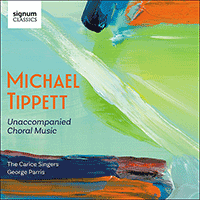


The explanation lies partly in his musical imagination, which worked slowly and on a large scale, and partly in the fact that he withdrew some thirty early compositions, major works for choir among them, that he believed either immature or overtly political. Short or occasional pieces, he admitted, were “not altogether my cup of tea, really”; family money allied to a frugal lifestyle meant that, even before late-arriving success brought large fees, he never needed to churn them out for cash. An atheist since childhood, he did not follow contemporaries such as the Herberts Sumsion or Howells into the world of Anglican church music. And he had an idiosyncratic view of word-setting, tending to think that great verse is put into unhelpful competition with great music.
With the exception of Lullaby, which captures him in the middle of a major stylistic shift, Tippett’s choral music encapsulates the glories of his first maturity, characterised by a rhythmic invention and contrapuntal skill indebted most of all to composers of the sixteenth and seventeenth centuries. As a student at the Royal College he had found the syllabus narrow, Teutonic, and inattentive to the Renaissance and Baroque, which he discovered instead through constant if irreligious attendance at church services. His own slow-forming voice employed the contrapuntal weave of Renaissance polyphonists such as Byrd or Tallis; the word-painting and imitation of English madrigalists (Wilbye, Morley, Gibbons); and the melismas and cascades of Monteverdi, swagging a single syllable across numerous notes. But his love of jazz and blues, and of modern composers from Bartók to Stravinsky, ensures that his vocal writing, spiced with crunchy harmonies, irregular accents and unexpected intervals, flicking at short notice from counterpoint to homophony to passages of unison, is never mere Renaissance pastiche.
The Five Spirituals are from his oratorio A child of our time (1939-41), a universalised retelling of the assassination of a Nazi official by Herschel Grynszpan, a young Jewish refugee, and the subsequent Kristallnacht pogrom. The structure of the oratorio is based on Handel’s Messiah but the spirituals, conceived as an expression of collective suffering, are in parallel to the use of Lutheran chorales in Bach’s Passions. Their inclusion, at a time when the Nazis had banned “Negermusik”, sent a clear political message. The oratorio, begun when Tippett was thirty-four, is only the fourth work of his official catalogue. Written for no commission or fee, it was not performed until 1944; in 1957, at the request of his publisher, he arranged the spirituals into a suite for unaccompanied choir.
Tippett sourced the spirituals from the influential compilations and arrangements by James Weldon Johnson, a black American writer and activist; in all five cases Tippett retains the key signature of Johnson’s arrangements, treating the music almost as found material. “Steal away” is a conclusion to the first, scene-setting, part of the tripartite oratorio; “Nobody knows” (discarding the standard melody in favour of what Johnson called the “rare version”) presages Grynszpan’s turmoil and the assassination. These first two spirituals are, in their choral arrangements, more-or-less lifted direct from the oratorio; the remaining three are reworked to include lines from the orchestral parts, not least in “Go down, Moses”, a spiritual of “anger” at the violence of Kristallnacht. Both “By and by” and “Deep river”, in their contrasting moods, yearn for a better world, a reminder that they emerged from an oratorio written by a pacifist composer during the height of the Blitz.
One of the choirs at the premiere of A child of our time was from Morley College, the adult education college in South London where Tippett was director of music from 1940 to 1951. Against the odds and in the face of wartime danger and hardship, he fashioned a department of historic significance, restoring permanently to the repertoire much Tudor and Baroque music. He made the first recording of Thomas Tallis’s motet for eight five-part choirs, Spem in alium, and organised the British premiere of Monteverdi’s Vespers of 1610. The influence of such music sounds clearly in his Two Madrigals, which were composed, for the Morley Choir, in 1942, either side of his tribunal as a conscientious objector. Refusing to comply with the tribunal’s conditions would lead to Tippett’s imprisonment the following year, but the madrigals speak of nothing but ebullience, as if insisting from the depths of war on the joy of music and the natural world.
The pair somehow got reversed in most catalogues and recordings but are here restored to their rightful sequence, with “The windhover” followed by “The source”, allowing for Gerard Manley Hopkins’s tumbling and rapturous evocation of a falcon’s flight (catnip for a composer intent on madrigalian word-painting) to be followed by the radiant conclusion of Edward Thomas: “the triumph of earth”. (Thomas’s poem, written in 1915, likewise transcends the war from which it emerged and in which its author would die.) Hopkins was an influence on Tippett musically, with his conception and use of “sprung rhythm”, a term for a metre imitating the rhythm of natural speech, with marks on certain syllables to indicate the stress. Tippett coined “sprung rhythm” in its musical sense, referring to marked irregular accents, of which there are plenty here, at odds with the regular rhythmic pulse, note-groupings paying little heed to barlines. “The windhover” is a busy crowd (even jumble) of ideas and motifs chasing one another out of the way; the music settles with the more cohesive lyricism of “The source” and its life-affirming conclusion with that most Purcellian of words, “triumph”.
Plebs angelica (1943/4) is one of Tippett’s few forays into religious music, commissioned (but not, in the end, premiered by) the choir of Canterbury Cathedral. Setting a medieval Latin lyric with his name (“O Michael”) neatly embedded at its centre, Tippett wove his web of counterpoint across two four-part choirs, antiphonally placed, a rare homage to the religious Renaissance polyphony—Venetian as well as Tudor—that had been so integral to his own voice.
The weeping babe was a contribution to A Poet’s Christmas, a 1944 radio broadcast on the BBC: carols were commissioned from a number of eminent composer–poet duos (Benjamin Britten and W H Auden; Lennox Berkeley and Francis Cornford). Tippett was given a text by Edith Sitwell and their union produced the only lasting piece of the group. The weeping babe is essentially a nativity carol, and one that began his long and fruitful relationship with the BBC Singers. Its piercing and bitter harmonies recognise the text’s foreshadowing of the crucifixion, eschewing festive sentiment. The music is dedicated to the memory of Bronwen Wilson, a lodger in a rental cottage he owned, who was killed in an air-raid while trying to protect her newborn daughter. A keening soprano emerges from the choral texture to sing the child to sleep and mourn its knowledge of human grief.
Dance, clarion air (1952), was another contribution to a composite sequence, A Garland for the Queen, to which poets and composers contributed part-songs to celebrate Elizabeth II’s coronation, emulating a project mounted for Elizabeth I. Tippett asked Christopher Fry, his long-time friend and by then a leading playwright, for a text. This was a curiously royalist move from a one-time Trotskyist, but this modern madrigal speaks not of coronational pomp but of the 1950s mood of renewal and rebirth: a new Elizabethan Age. It is more typically madrigalian than the settings of Hopkins and of Thomas, its four distinct sections responding brilliantly to the sounds and images of Fry’s consciously Shakespearian text. Scored for five-part choir with distanced semi-chorus, it is full of dancing rhythms, fanfares and imitations. Nearly a minute’s music is fashioned from the first three words alone, as the singers, treated almost as brass instruments, build the chord of “Dance” note by note, dandle it, and then embark upon the echoing peals to which Tippett sets “clarion”. The final section, a slow-building aubade, precedes its resolution with the momentary dissonance of the “English cadence” typical of Tudor madrigalists.
The Four Songs from the British Isles (1957) emerged from the same period of post-war renewal. These were a commission, from Bremen Radio, for a festival of European folksong. Tippett picked a song from each British country to demonstrate “that English, Irish, Scottish, Welsh are to this day different peoples”. In contrast to the simplicity of the spirituals, the arrangements of the four songs are complex and intricate, and they proved too much for the German choir. Tippett had to wait two years for the premiere, which was eventually given in France, by the London Bach Group. He chose the British folk song “Early one Morning” for its “tender and pure” line; the Scottish entry was originally to have been “Over the Sea to Skye”. Copyright problems necessitated a replacement and “Over the Sea…” was not rediscovered or performed until 2002. Its replacement, “Poortith Cauld” (Cold Poverty), has a text by Robbie Burns fitted to a traditional Scots tune (“Cauld kail in Aberdeen”). “Gwenllian” is a lullaby for a thirteenth-century Welsh princess, and the song with which Tippett’s arrangement plays the most fast-and-loose, adding an introduction, interlude and coda in a typically Tippettian “sprung rhythm”, of 5/8 irregularly interleaved with 2/4.
“Lilliburlero” is a curio in the line-up, for being a British approximation of Irishness rather than the thing itself. In the 1950s the tune, used by John Gay in The Beggar’s Opera, was thought to be by Purcell (it is now believed to have originated as an Irish jig). Tippett was devoted to Purcell and had adapted and performed The Beggar’s Opera, but his selection hardly bolstered his plan of displaying Ireland’s unique musical culture. The text (written by a British MP in 1686 to deride the appointment of an Irish Catholic as Lord Lieutenant) is a British parody of Irish dialect, referring to “Brother Teague” (“a name for an Irishman, chiefly derogatory and offensive”, Oxford English Dictionary). It attracted Tippett “for being nearer German than English” and therefore easier for his German youth choir to sing. In this recording an alternative eighteenth-century text has been used for the two verses (dating from the song’s first use in Ireland as an army drinking-song), with the original given in the sleeve booklet. The point of “Lilliburlero” is the rambunctious ninety-second interlude of high spirits it provides to the Four Songs, the scherzo in what is essentially a quadripartite symphonic sequence in miniature.
That Lullaby (1959) postdates the songs by just two years is evidence of the transformative effect on Tippett’s compositional style of his second opera, King Priam (his own adaptation of the Iliad, begun in 1958). Its war-torn terrain led him to thinner textures, astringent harmonies, less counterpoint, and a mosaic of contrasting non-developing units. The words for Lullaby (mentioning Helen of Troy) are by W B Yeats, to whom Tippett was devoted, and for whom he twice broke his self-imposed rule against setting great poetry to music. The complete text is allotted to a counter-tenor in a jaggedly lyrical, even coloratura, solo part. Around the soloist other singers (as if providing a piano accompaniment orchestrated for five solo voices) form a corona of echoes and fragments, only hinting at a tonal framework (between E flat and A), illuminating details, examining words or even syllables for their sonic rather than semantic value—although there is still a hint of madrigalian word-painting in the evocation of Yeats’s running deer.
The return of the countertenor voice during the twentieth century was mainly thanks to Tippett’s discovery of Alfred Deller, for the tenth birthday of whose consort Lullaby was written (the premiere was in early 1960, at the Victoria & Albert Museum). Tippett first heard Deller singing as a lay clerk at Canterbury Cathedral and soon invited him to perform as soloist at Morley and for radio broadcasts, marking the first time that such a voice had been widely heard in England since the seventeenth century (and restoring much Baroque repertoire to its original pitch). It was Tippett’s suggestion that Deller call himself a countertenor, a word then long out-of-use. It is an odd and sad fact that, bar a cameo in a late opera, Lullaby is his only contribution to the countertenor repertoire. Composed when he was sixty-one, it was his last, and arguably most significant, work for unaccompanied choir; in it he can be heard fashioning the methods and techniques of the large-scale masterpieces—The Vision of Saint Augustine, The Mask of Time—that were to follow.
Oliver Soden © 2026
This project would not have been possible without the help and generosity of many individuals. Huge thanks must go to all of The Carice Singers’ trustees and supporters, especially those who joined our Tippett Circle, and to the Michael Tippett Musical Foundation. I am also extremely grateful to Oliver Soden, Sally Groves, and the team at Schott Music for their expertise and support towards this project, and Oliver for providing the notes in this booklet, offering an invaluable overview of these works. Our Producer Adrian Peacock and Engineer David Hinitt were the ‘dream team’—grateful thanks must go to them, and finally also to all the singers involved in this recording, who I am most of all indebted to for realising the delights, peculiarities, and subtleties of this music with such skill and dedication.
George Parris © 2026