Welcome to Hyperion Records, a British classical label devoted to presenting high-quality recordings of music of all styles and from all periods from the twelfth century to the twenty-first.
Hyperion offers both CDs, and downloads in a number of formats. The site is also available in several languages.
Please use the dropdown buttons to set your preferred options, or use the checkbox to accept the defaults.
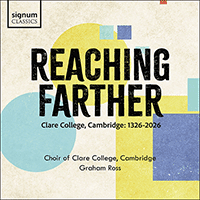


In 2026 the College celebrated its 700th anniversary, and this album brings together just some of the very many works that have been written for the Choir of Clare College over recent years by both leading composers of the day and younger composers who have honed their craft whilst studying with me and others at Clare. Many of the works on this album were commissioned by me and the College over the last two decades, and many receive their premiere recordings here. They are grouped here into five categories: introits; canticles; anthems; festive motets; and prayers.
In 2016 I commissioned Haec dies from Matthew Martin, now my colleague next door as Precentor and Director of College Music at Gonville and Caius College. In addition to setting the words of the Gradual for Easter Sunday, it also includes the Verse for Easter Tuesday. Rhythmic, brassy fanfares for organ and voices alike alternate with passages of quieter, smoother contrapuntal vocal lines, whilst the accompaniment continues with a pulsating rhythm. The work closes with hushed upper-voice Alleluias, and a vanishing organ part that descends in strict time.
In 2021 I commissioned Vivek Haria, then an undergraduate at Gonville and Caius College, to write an introit for the Choir. Lord, I cry unto thee was his response, sparingly setting words from Psalm 141 that seemed particularly apt at what was at the time the height of the COVID-19 pandemic, when our music making was severely limited by government restrictions. The composer dedicates his score to ‘all my fellow students, choirs and congregations as we continue to be tested in these difficult times’.
Luca Zucchi graduated from Clare College in 2024, where he read Music and held a Choral Scholarship. His Drop, drop, slow tears was written in 2025, marking the 400th anniversary of Orlando Gibbons that year, and one can perhaps draw similarities between the two composers’ settings in terms of the use of largely homophonic writing. Zucchi’s musical palette here, however, is more sumptuous and highly expressive, with chromaticism used to great effect both melodically and harmonically.
Ayo Bankole was Organ Scholar at Clare from 1961 to 1964. A gifted organist, pianist and composer, he returned to his native Nigeria in 1966, but his life was cut tragically short at the age of 41 when he and his wife were murdered at home by his half-brother in 1976. Many of his surviving works are a fusion of Nigerian and western styles, as heard in Òrìşà bí òfun kò sí, a setting of a Yoruba proverb which lightly explores bitonality in its setting for double-choir upper voices. So little of his music is published in Africa, and it was something of a mission of mine to track it down: I eventually succeeded after contact with various institutions in Lagos. 50 years on from his tragic death, this first recording by the Choir of his alma mater is perhaps the Requiem at Clare that Ayo Bankole never had.
Canticles form the backbone of our thrice-weekly choral services in the 18th-century College Chapel at Clare, and over the course of three years a Choral Scholar at Clare can expect to perform around 200 different settings of the Magnificat (the Song of Mary) and the Nunc dimittis (the Song of Simeon). I find it constantly fascinating how so many composers have approached these two unchanging texts with their own individual voices, with each new setting further invigorating the canon. French-British composer and soprano Héloïse Werner read Music at Clare and held a Choral Scholarship in the Choir from 2010 to 2013. I commissioned her Magnificat in 2023 as part of the College’s 50th anniversary of co-education, and her Nunc dimittis in 2026 for the College’s 700th anniversary. The Magnificat is fast paced, with bubbling and highly-energetic articulated writing framing a calmer central section with a soprano solo. Much of the text setting is hocketed with interlocking parts between the voices, which themselves freely alternate between unpitched whispering and pitched notes. Perhaps listeners can detect an influence of Magnificat I by Clare’s former Composer-in-Residence, Giles Swayne, who taught her at Cambridge. In the Nunc dimittis component parts of the Latin text are drawn out: the first letter resonating ‘like a bell’ before the vowel emerges and then eventually the full word. Individual syllables work their way across the voices before a calm homophonic passage then accelerates into a subtly different reprise of the latter part of the Magnificat’s Gloria.
I waited a long period of time before composing my own setting of the canticles, two texts that I knew inside-out from the very many settings that I admire from so many other composers. My Clare Service, written during an enjoyable week in the summer of 2024 for the Choir for a BBC Radio 3 broadcast that year, explores the more tender side of Mary in the Magnificat, with a fragile melodic fragment in the opening organ accompaniment serving as the nucleus for much of the musical material of both canticles. The Nunc dimittis is very slow, with Simeon’s old voice depicted by a solo bass over a repeating chordal sequence. The Gloria fizzes at first, but returns to the tender material in its more delicate close.
Thomas Alban began his academic studies in Music at Clare in 2024, with a Choral Scholarship. His unaccompanied double-choir Nunc dimittis won the 2025 Clare College Carol Composition Competition, premiered at our Advent Carol Service that year. Small chromatic motifs are repeated in each voice as the texture builds. Short plainsong-like passages for two often mirroring solo voices give way to occasional flashes of rhythmic drive, but the overall mood is one of mystery.
The earliest works on this album are the Magnificat and Nunc dimittis in A by former Clare Organ Scholar William Denis Browne, who fought and died at Gallipoli with fellow war poet Rupert Brooke. Composed in 1911 when a student at Clare, the largely homophonic music builds in both canticles to a fine climax in the doxology.
Giles Swayne’s The Dug-Out started life in 1967 as the last song in the composer’s cycle The Kiss for tenor and piano on poems by Siegfried Sassoon, who studied law and history at Clare from 1905 to 1907. Swayne then arranged the work for choir and organ in 2007 when Composer-in-Residence at Clare, adding an introduction and epilogue in which a solo trumpet plays The Last Post.
American Nico Muhly has a long-standing relationship with Clare College. His first work in Cambridge was a set of canticles co-commissioned by Girton and Clare Colleges in 2005. I asked Nico to supply an anthem to commemorate our 700th birthday in 2026. The composer writes ‘Clare College forms a fundamental part of my relationship with this music and tradition, and I always enjoy the miraculous continuity of this institution in my life. I’ve written loads of music for them, and it was the meeting-place between me and many of my lifelong friends’. Reaching farther sets a compendium of 16th-18th century texts by Thomas Traherne, Thomas Seaton, and Geffrey Whitney, cast in two Parts framed by an Introduction and Coda, celebrating what it means to learn and study, and to be at university.
Two festive motets are included here. Rocking is an exquisite miniature from John Tavener’s Christmas sequence, Ex Maria Virgine, commissioned by the Choir of Clare College who gave the first complete performance in the presence of the composer in 2008. We commissioned The Magi from Cecilia McDowall for the 50th anniversary of co-education at Clare, which sets a new text by Nicholas Dakin, first broadcast in an Epiphany Carol Service on BBC Radio 3 in 2023.
Three prayers set by Clare College alumni bring our programme to a close. Now the day is over by Joshua Pacey, who read Music at Clare and held a Choral Scholarship from 2013 to 2016, sets a text by another Clare alumnus, Rev’d Sabine Baring-Gould who came up to Clare in 1852 and who went on to write hymns including Onward, Christian Soldiers. This gentle hymn-like setting was commissioned by Choir & Organ for the Choir in 2020. Lighten our darkness is a setting of the Third Collect from the Order for Evening Prayer by Simon Hall who read Philosophy at Clare from 2022 to 2025. Simon contacted me to ask if he could show me his piece. I played it through to him at the piano and made a few brief suggestions, but could already tell that it was a remarkably accomplished score for someone who admitted they had never written for voices before. A few weeks later we premiered the work in Chapel, and it has since happily entered our repertoire. A Clare Benediction was written by former Clare Director of Music John Rutter at the request of his successor Timothy Brown for a closing item at concerts on the Choir’s forthcoming tour of the United States. ‘It seemed to me that a gentle blessing would be appropriate—I wrote the words as well as the music’, the composer writes. It has since been performed by choirs around the world, and I always programme it at the close of our annual Graduation Service, performed at the precise moment that our undergraduates end their time at Clare, begin their new chapters, and form part of the remarkable journey that so many others have taken during the last 700 years.
Graham Ross © 2026