Welcome to Hyperion Records, a British classical label devoted to presenting high-quality recordings of music of all styles and from all periods from the twelfth century to the twenty-first.
Hyperion offers both CDs, and downloads in a number of formats. The site is also available in several languages.
Please use the dropdown buttons to set your preferred options, or use the checkbox to accept the defaults.
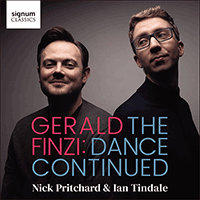


Marking 70 years since the death of Gerald Finzi, established duo partners Nick Pritchard and Ian Tindale reunite for a collection of works for tenor and piano, including five new unpublished songs from the Bodleian Library.


Ian Tindale has had a similarly long-term fascination with Finzi. ‘The first complete song cycle I performed as an undergraduate was Earth and Air and Rain, and that was the moment when I realised just how good this partnership of Finzi and Hardy was: the poetry spoke to me, and the way Finzi responds to it is just perfect.’ No wonder, then, that this duo was keen to mark the composer’s 125th birthday with their own celebratory take on the three cycles, two of which similarly unite Finzi with Hardy. The two men never met, though Finzi paid a princely £9 to acquire Hardy’s walking stick in 1938, when the poet’s library was sold at auction a decade after his death.
We begin with Till Earth outwears, edited and published by Howard Ferguson and Joy Finzi in 1958. As with several of Finzi’s song collections, a posthumous assembling was needed of the many songs still unprinted as the composer wrote and revised past numbers to plan perfect sequences: Finzi cycles are frequently an act of time travel in this way.
The introduction of ‘Let me enjoy the earth’ unfurls its petals slowly in a manner utterly distinctive to this composer (who, as Nick and Ian observe, was not a pianist or singer—‘which is unusual in a song composer’!). Finzi’s keyboard writing is built of contrapuntal lines which twist and turn like woven threads. This is a song of delight, a speaker aware of his own insignificance and yet unbowed by it—until a single aching crunch in the final line. ‘In years defaced’ is a sadder tale, of love and hope now over and gone. ‘The Market Girl’ takes us back in time a decade from these first numbers, from 1936 to 1927, and begins altogether more simply before building to a wry conclusion in its final line; while ‘I look into my glass’ seems to look to late Schubert, the speaker’s heart throbbing painfully through the second and third stanzas of Hardy’s bitter poem.
Finzi set ‘It never looks like summer here’ one bitter February day in 1956. Reading through old sketches that evening, he discovered a much earlier draft he’d made of the poem’s first line: ‘The line written today had the same shape and falls as the previous germ and was obviously the completed idea after twenty-odd years,’ he observed. ‘If one doesn’t live long enough one can’t complete the hundreds of musical lines waiting final shape.’
We leap back in time to 1929 for ‘At a lunar eclipse’. Here, Ian notes, ‘in the stargazing numbers, the compass expands and we hear the low and the high in very exposed writing for voice and piano’. And what of the vocal writing? ‘His text setting is so natural, you never have to work at lifting it,’ Nick marvels. ‘That makes it all the more immediate. And he almost always sets challenging texts. When you read some of his chosen poems, you think: how can you make musical sense of this?! But he does … and it’s completely magical.’ This opus concludes with ‘Life Laughs Onward’, a bittersweet musing on the passing of time and its rightness.
Next comes our duo’s unique contribution to the Finzi discography: a clutch of five early songs, written when the composer was in his teens and early twenties. These songs remain unpublished and exist in manuscript only, preserved at the Bodleian Library in Oxford. Nick and Ian had the opportunity to study and select this clutch of five, which are presented here as premiere recordings. ‘These five spoke to us,’ Ian explains. ‘It’s not Finzi in full form yet, but I think it gives us a new slant on where he started—and setting some different poets as well, which was particularly appealing.’ Days too short of 1925 takes a poem by Welshman W H Davies, and is a sprightly number with a less-than-fully metabolised sense of folksong in its leaps and bounces. This is followed by two texts from Padraic Colum, a leading figure in the Irish Literary revival of the late nineteenth and early twentieth centuries. A Cradle Song is sweetly understated, the voice rising and falling above a sequence of slow-stepping chords. Finzi was just eighteen when he wrote it. Then come The terrible robber men, swaying and swaggering with bloodthirsty delight.
Rondel sets the words of Geoffrey Chaucer, and it’s possible that the text also inspired Finzi’s antiquated courtly writing here, full of crunching false relations. The wistful English hills is, Ian points out, ‘a real sister setting to ‘Only the wanderer’ from Oh fair to see: they’re very closely related, motivically and thematically.’
The first of Finzi’s tenor Hardy cycles, A Young Man’s Exhortation, was written in the late 1920s and published in 1933, just a few months after Finzi’s marriage to Joy Black. The opening number is a glowing hymn to the joy of the moment, painted with exuberant lyricism and aching dissonances at the intimations of mortality. ‘Ditty’, Ian and Nick agree, is a dense, knotty number that takes some untangling despite its unprepossessing title; whilst ‘Budmouth Dears’ is a rollicking number of smartly strutting soldiers beaming at the beauties on the town’s esplanade. Hardy’s obsession with the artist rendered anonymous by history is spelled out in ‘Her Temple’—and thoughts of future days also dominate ‘The Comet at Yell’ham’, the distant comet twinkling, alien and beautiful, high in the piano.
Finzi provided Latin subtitles for the two halves of A Young Man’s Exhortation, taken from Psalm 90. The first five are headed ‘In the morning it flourisheth, and groweth up’; the five still to come bear the quotation ‘In the evening it is cut down, and withereth’. The young man gives way to an older figure: a greying cidermaker who may be Finzi himself (he famously cultivated around 300 species of rare apple trees) in ‘Shortening Days’, and a tale of love and regret in ‘The Sigh’. ‘Former Beauties’ has a strikingly angular, emptied-out beginning, which Finzi tenderly fills to bring memories of fair young women back to vivid life. ‘Transformations’ is a song of praise for all things changing, and the power and vigour of rebirth, giving way to a melody sung from beyond the grave in ‘The Dance Continued.’
Our album closes with Oh fair to see, the cycle with the widest historical ambit of any of Finzi’s published collections, taking us from the early 1920s to the very last song he wrote. And this time we hear not just from Hardy, but a raft of other poets whom Finzi admired.
Hardy has the first word in ‘I say “I’ll seek her side”’, the account of a brash but nervous lover; while ‘Oh fair to see’ itself is a poem by Christina Rossetti, whose poetry provided the inspiration for Finzi’s opus one, Ten Children’s Songs. This song dates from 1921, as does Edward Shanks’s lyric of summer love, ‘As I lay in the early sun’. ‘Only the wanderer’ is Finzi’s only setting of poetry by Ivor Gurney, a man he never met but whose music and verse he adored, as this sensitive balancing of light and darkness demonstrates so clearly.
Edmund Blunden and Finzi were colleagues, who collaborated on a choral work in the late 1940s. Here we find a heartbroken Blunden in ‘To Joy’: the song’s title, so perfect for Finzi’s wife (the song was written shortly after their first meeting), is a reference to Blunden’s baby daughter, who died at just forty days old. The poet was present to hear both this song and ‘Harvest’ at the Finzis’ home in July 1957, at the first soirée to be held there—ten months after the composer’s death.
Last of all comes Gerald Finzi’s final song, ‘Since we loved’. As Finzi helped Gurney’s music find its way into the world after his death—and as Howard Ferguson and Joy Finzi would do the same for Gerald—so the poet Robert Bridges, author of this text, worked to publish posthumously the poetry of Gerard Manley Hopkins. His is a song of love burning brightly, and the joy such a transformation might bring. A new generation, then, goes forward with youth and life and hope as the cycle closes … and so the dance continues.
Katy Hamilton © 2026