Welcome to Hyperion Records, a British classical label devoted to presenting high-quality recordings of music of all styles and from all periods from the twelfth century to the twenty-first.
Hyperion offers both CDs, and downloads in a number of formats. The site is also available in several languages.
Please use the dropdown buttons to set your preferred options, or use the checkbox to accept the defaults.
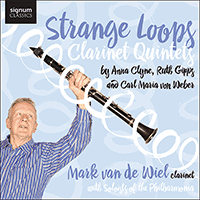


Three works spanning over two centuries of chamber music and beinning with Anna Clyne’s Strange Loops, written in 2020 and exploring repeating and transforming musical patterns. Ruth Gipps’s Rhapsody is a single-movement work highlighting the clarinet’s lyrical and colouristic qualities, and here leads into Carl Maria von Weber’s virtuosic Clarinet Quintet, composed for Heinrich Baermann.

We very much enjoyed our recording sessions in the Lady Stringer Studio at the impressive new Garsington Studios on the Wormsley Estate, the first commercial recording made there. Many thanks to Garsington Opera and to the Philharmonia for their help, also to Anna Clyne for her advice on Strange Loops and to Oliver Janes for his advice on the Gipps edition and for providing the programme note.
Anna Clyne Strange Loops
I am a Strange Loop is a book by Douglas Hofstadter, examining in depth the concept of a strange loop to explain the sense of “I”. The concept of a strange loop was originally developed in his book Gödel, Escher, Bach. He writes:
“In the end, we are self-perceiving, self-inventing,
locked-in mirages that are little miracles of self-reference.”
In Strange Loops I explore musical loops—motifs and gestures that repeat, morph, modulate and recapitulate in various guises. At the heart of this piece is a sense of playfulness and yearning—inspired by the creative process in isolation. I composed Strange Loops during the lockdown during COVID in 2020.
Anna Clyne
Ruth Gipps Rhapsody Op 23
Ruth Gipps (1921-1999) was a remarkable British composer, conductor and oboist whose music combines effortless lyricism with muscular, confident craftsmanship. Written in the early part of her career and dedicated to her husband, clarinetist Robert Baker, the Rhapsody Quintet reflects Gipps’ gift for long melody and her instinctive understanding of instrumental colour.
Composed in a single, continuous movement, the work unfolds freely rather than following a strict formal design, true to its rhapsodic title. Sweeping, song-like themes are passed between the instruments, often set against rich, warmly textured accompaniments. Moments of calm give way to more urgent, rhythmically driven passages, creating a sense of ebb and flow. Folk-like melodies become infectious before subsiding and ultimately leaving the clarinet alone with a memory of pastoral song.
Throughout the piece, Gipps balances expressive lyricism with flashes of dramatic intensity, allowing each instrument space to shine while maintaining a strong sense of ensemble dialogue.
The Rhapsody Quintet is a fantastic example of Gipps’ distinctive voice: romantic in spirit, bold in character, and deeply communicative. It stands as a reminder of her significant contribution to twentieth-century British chamber music and her ability to write music that speaks directly to performers and audiences alike.
Oliver Janes
Weber Clarinet Quintet
The first three great clarinet quintets, by Mozart, Weber, and Brahms (of course still occupying the medal positions as I write), were each inspired by the playing of a great and individual clarinet soloist, in Weber’s case the great virtuoso Heinrich Baermann. His flexible approach to tone production, along with his hugely accomplished technique, and recent developments in the design of the clarinet, enabled Weber to stretch virtuoso clarinet writing and extremes of expression. His ten-keyed Griesling and Schlott clarinet made Weber’s rapid chromatic writing feasible. Playing this quintet on our modern 17 keyed instruments still holds its challenges, though! As far as the quartet is concerned, while Weber showcases the clarinet as a soloist in his quintet to a far greater extent than Mozart or Brahms, the quartet writing is by turns characterful, energetic and expressive, with its own sprinkling of virtuosity. Weber’s, not to mention Baermann’s, busy schedule meant the quintet’s composition was spread over several years, 1811-1815, the Rondo being completed just the day before the premiere, which I’m sure Baermann took in his stride.
The first movement begins quietly with the quartet, perhaps with Mozart’s model in mind, but lyricism is soon interrupted by the dramatic turbulence we might expect from Weber, and demanding virtuosity soon comes to the fore. The second movement Fantasia, a wide ranging aria, explores a darker and more expressive world, moving from inward lyricism to heroic statements, and contains two celebrated passages of two rapid chromatic scales, played loudly and then as a distant echo, to show what Weber and his friend Baermann were able to achieve together in virtuosity and dynamics. The third movement’s title Menuetto has the rug immediately pulled from under it with the qualifying words Capriccio and Presto. It’s a high spirited, talkative scherzo, tossing ideas between the instruments, with a contrasting long-lined Trio section intervening. The Rondo finale, using the rarer marking Allegro Giojoso (not a misprint!), is a virtuoso galop, a thrilling ride ending in cascades of triplets, although not before lyricism has reappeared with a long and searching melody.
Mark van de Wiel © 2026