Welcome to Hyperion Records, a British classical label devoted to presenting high-quality recordings of music of all styles and from all periods from the twelfth century to the twenty-first.
Hyperion offers both CDs, and downloads in a number of formats. The site is also available in several languages.
Please use the dropdown buttons to set your preferred options, or use the checkbox to accept the defaults.
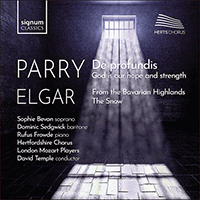


This album brings together major choral works by Hubert Parry and Edward Elgar. Parry’s De profundis, a large-scale setting of Psalm 130, and God is our hope and strength are both here recorded for the first time. Elgar is represented by the intimate partsong The snow and the charming From the Bavarian highlands, capturing the personal and lyrical side of his art.

In 1891, his first Three Choirs commission from outside his ‘locality’ of Gloucester arrived from Hereford, and for this he chose the Latin words from the Vulgate of Psalm 130, De profundis. Parry conducted De profundis at Hereford on 10 September 1891. One critic averred: ‘Men of varying taste and judgment conceded to one another that, in its way, a great thing had been born into the world.’ This acclaim was affirmed by repeat performances by the Highbury Philharmonic and at the Leeds Festival in 1892, though the work was somewhat eclipsed later by the popularity of Parry’s new oratorio, Job, at Gloucester. Parry conducted the work in Cambridge in March 1899 and at the Birmingham Festival in October 1900. In the audience was Vaughan Williams who, as a student of Parry, had known the work since its inception. An ardent advocate of the piece (as was Adrian Boult, Hugh Allen and Gerald Finzi), he chaffed at its later neglect and was dismayed when it did not figure in the 100th anniversary of Parry’s birth in 1948. ‘It seems to me to be a scandal,’ he wrote to Boult, ‘that during the Parry celebrations his finest work, De profundis, should not be done. I wrote to Atkins of Worcester about it. He says it is beyond them. Obviously it is a job for the B.B.C. Please insist on its being done, and soon.’ Boult obliged, somewhat belatedly, with a BBC broadcast on 5 April 1949. After 60 years of neglect it was revived in its original version in 2022 by David Temple, Hertfordshire Chorus, London Orchestra da Camera, and soloist Sarah Fox in a performance at St Albans Cathedral.
The deeply penitential text of De profundis is imbued with darkness and despair at the admission of man’s sinfulness, yet the psalmist, with the knowledge of God’s capacity for infinite forgiveness, concludes with the anticipation of hope and redemption. It was a theme Parry, ever the contemplative, agnostic intellectual, explored repeatedly throughout his choral music. The orchestral introduction in G minor, initiated by the woodwind, evokes a shadowy sense of desolation confirmed by the entry of the strings, in the form of a sedate, ruminative march, a style-form Parry had used so effectively in the second part of Judith. The first two verses of the psalm, as the opening chorus, provide a marked contrast to the prelude’s solemn dignity, and are chorally a tour de force. Having proved his remarkable technique as a contrapuntist in the eight-part choral textures of Blest pair, Parry sought to go one step further in De profundis with three four-part choirs, couching the first verse (‘De profundis clamavi’) in a luminous F sharp major, where the choirs are treated antiphonally, and the more extrovert polyphonic second (‘exaudi vocem meam’) in D major. This virtuoso exposition is juxtaposed with a more tranquil section for solo soprano (‘Fiant aures tuae intendentes’), also in D major, and concludes the text of verse two. Numinous in its liquid lyricism, it has much in common with Judith’s first emotional aria (‘Though into the valley of the shadow of death’). Verses four and five form the basis of a second substantial choral episode in B flat major. Again Parry returns to his twelve-part choral sonority, but this time, in an energetic sonata design. Retaining its disposition of twelve parts, the chorus is now divided into two antiphonal choirs of six voices in which the first subject (‘Sustinuit anima mea in verbo’), more homophonic and muscular, is contrasted with the intricate imitative counterpoint of the second (‘Speravit anima mea in Domino’). An impressive developmental expansion achieves its apogee in the Neapolitan, C flat major, before the uplifting event of the truncated recapitulation (on a dominant pedal) and an unexpectedly hushed conclusion. This yearning choral paean is surely Parry at his most spiritually elevating and looks forward (in the same key) to the Coronation anthem I was glad (1902) and the splendour of the 1911 Coronation Te Deum.
A second aria, more pastoral in character (‘A custodia matutina’) follows in E flat major which makes considerable demands on the soloist’s upper range. This gentle, more dance-like quasi-baroque interlude (which anticipates A Lady Radnor Suite of 1894) leads directly into the buoyant finale (‘Apud Dominum misericordia’) in which, by way of an orchestral transition, effects a key change from E flat to G major for the ample, energised fugue (‘Et ipse redimet Israel’). As if to affirm his mastery of counterpoint, Parry builds up his choral sonority incrementally to twelve parts before triumphally incorporating the soprano soloist in a closing paragraph thrillingly infused with that powerful matrix of diatonically dissonant harmony, a true hallmark of the composer’s distinctive English voice and one which so many of his later contemporaries sought to emulate.
Parry’s anthem, God is our hope and strength, a setting of Psalm 46, was commissioned by George Martin (a colleague at the Royal College of Music) and the Chapter of St Paul’s Cathedral for the cathedral’s 259th anniversary of the Festival of the Sons of the Clergy on 24 April 1913 (where the music was customarily performed by organ and orchestra), was considered the high point of the service. A classic example of Parry’s robust choral architecture, comparable with the eight-part sonorities of Blest pair and the processional drama of I was glad, the anthem was soon forgotten. On 14 June 1971 it received its first broadcast performance with the BBC Chorus under Peter Gellhorn with George Thalben Ball at the organ (and repeated in September 1976), but was not heard again until August 2018, when it was revived with organ accompaniment to mark the centenary of Parry’s death at a BBC Choral Evensong at the Charles Wood Summer School under David Hill with Philip Scriven (organ). Conceived on a grand scale, God is our hope and strength was composed for double choir, baritone, orchestra and organ, continuing the ‘Indian summer’ of Parry’s late choral works such as the Coronation Te Deum of 1911 and the Ode on the Nativity of 1912. After the evocative orchestral prelude in F major, which gradually builds to a first imposing climax, the chorus’s first entry (a reworking of the opening orchestral theme) begins quietly before a confident crescendo to the ‘Allegro’ (‘a very present help in trouble’). This instigates a big-boned opening paragraph in which the immensity of God’s power in nature (in verses 2 and 3 of the psalm) is vividly depicted. At the conclusion, F major returns with a restatement of the opening choral theme. This makes way for a second choral departure (‘The heathen make much ado’) in which the initial tonal turbulence is stilled by a telling shift to E flat major (‘But God hath shewed his voice’), and, more significantly, to A flat major (by way of the pictorial chromaticism of ‘the earth shall melt away’) as the ground is prepared for the baritone’s more dramatic arioso (‘O come hither’). A flat is subsequently quitted for D flat as a group of five soloists, accompanied by the second choir, subdue the tumult of the baritone’s declamatory manner with the famous words ‘Be still, and know that I am God’. From this comforting moment emerges the double choir in a sumptuous passage of sonorous counterpoint in D flat (‘I will be exalted among the heathen’). And with effortless legerdemain, F major is restored for the final verse of the psalm (‘The Lord of Hosts is with us’) where imitation and antiphony combine in an exhilarating apotheosis of Bachian fluency and spiritual transcendence.
In collaboration with his wife, Alice, Elgar completed his two partsongs, The snow and Fly, singing bird, fly, Op 26, for female voices, two violins and piano in 1894. The sombre demeanour of The snow likens the fleeting cold exterior of the human condition (in E minor) to the inner warmth of the enduring soul (in E major). The composer evidently retained a fondness for these songs and scored them for a small orchestra in December 1903 in anticipation of their first hearing at Queen’s Hall on 12 March 1904. Alice also provided texts for Scenes from the Bavarian highlands, Op 27, adaptations of the southern German Volkslieder style and texts which suited the local Bavarian dances known as Schnadahüpfler. They were written during one of several holidays they spent at the Villa Bader, a guesthouse run by Henry Slingsby Bethell and his wife in Garmisch Partenkirchen, an Alpine region bordering Austria, in 1894. Elgar constructed an attractive choral suite of partsongs with piano which he dedicated to the Bethells and was first sung by the Worcester Festival Choral Society under his direction on 21 April 1896. That year he orchestrated them and later selected the first, third and last as Three Bavarian Dances for orchestra which August Manns conducted at the Crystal Palace in October 1897. These delightful miniatures—‘The Dance’ (Sonnenbichl), ‘False Love’ (Wamberg), ‘Lullaby’ (In Hammersbach), ‘Aspiration’ (Bei Sankt Anton), ‘On the Alm’ (True Love, Hoch Alp) and ‘The Marksmen’ (Bei Murnau)—in their portrayal of favourite scenes and towns, recapture something of the joy and wellbeing of the young Elgar couple in the years before the composer’s fame launched him into the forefront of British romantic music.
Jeremy Dibble © 2026
Like most classical music listeners, my first encounter with Parry was Jerusalem, followed closely by I was glad and Blest pair of sirens. This extremely limited experience was changed fairly recently, in 2019, when conductor William Vann asked me to prepare my Crouch End Festival Chorus for a performance and recording of Parry’s Judith. This was followed in 2022 with another recording, this time Parry’s Prometheus unbound. I was overwhelmed with the drama, beauty and sheer quality of these works.
Following the resumption of ‘live’ music post-COVID, I was looking for a challenge for my Hertfordshire Chorus and came across—via the English Heritage Music Series, based in Minnesota USA—Parry’s work De profundis from 1891. Through the amazing work by Matthew W Mehaffey and Dave Fielding, beautiful new scores and learning materials were made available to us for a performance in 2022. This was a real challenge as the work itself is in 12 parts, with each movement having a different combination of those parts. The performance itself was decent enough especially given the proximity to the pandemic BUT what it did for me was to enhance my admiration and passion for Parry’s music.
The next step was to plan a recording of this work and so I looked through other Parry pieces on the EHMS website and found God is our hope and strength from 1913. With the help of the useful audio file, I totally fell for this stunning work which has now become part of this new recording.
One of the most impressive aspects of Hertfordshire Chorus is that, as well as being a top-class choir, they also perform with such passion, drama and musical intelligence. In 2024, we performed with our excellent pianist—Rufus Frowde—Elgar’s From the Bavarian highlands and this, coupled with Elgar’s The snow completes what is a joyous collection of beautiful works. The Parry works are being recorded for the first time, and I hope that other choirs will take on this hugely neglected repertoire and have as much fun as we did in the recording sessions.
David Temple © 2026