Welcome to Hyperion Records, a British classical label devoted to presenting high-quality recordings of music of all styles and from all periods from the twelfth century to the twenty-first.
Hyperion offers both CDs, and downloads in a number of formats. The site is also available in several languages.
Please use the dropdown buttons to set your preferred options, or use the checkbox to accept the defaults.
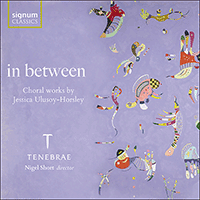


Jessica Ulusoy-Horsley is a British-Swiss composer who explores in her compositions the thresholds between cultures, languages and spiritual traditions to fascinating effect. These recent large-scale works are distinguished by their depth and beauty.

The title piece, in between, was inspired by hearing a Tenebrae concert that transported me to another realm. The “revelation” of the piece’s dedication refers both to the piece itself then, and to Nigel’s remarkable ensemble—a revelation in themselves of what is possible and where music can take us to. My hope is that this recording offers moments of expansion, joy, hope, catharsis, healing, solace, mystery, and possibility to you, the listener.
Working with Tenebrae on this recording has been a privilege and a great pleasure. Their artistry brings my works to life with extraordinary clarity and depth. Their disciplined, luminous sound— unafraid of stillness—allows the music to move beyond the page into that “in between” space where meaning emerges. I am deeply grateful to Nigel Short for his inspirational insight, rare energy and attention to detail, to the singers, to Camilla, Mike, Jacob, Eleanor, Steve and to everyone involved in bringing these pieces from the page to the album.
The cycle Engelsmusik—of which nos. 1–3 are recorded here—was inspired by Wolfgang W. Müller’s book, Musik der Engel (Music of the Angels). Part of a long tradition of angelic music, from Hildegard to Messiaen, these works explore the spaces between sound and silence, between the human and the transcendent. Here, as the angelic visions say, “time stands still”: sound becomes a doorway that opens onto other levels of consciousness.
colours of light’s sound is based on a phrase by the great 13th-century Sufi mystic and poet, Rumi (Jalāl al-Dīn Muḥammad Rūmī/ جلال الدین محمّدرومی ): “In your light I learn how to love.” This fragment is repeated and gradually extended—to dream, to live—until, suddenly, individual colours from the spectrum of light flash into the musical texture. Beginning with blue as “the heavenly colour” (“die himmlische Farbe”), Wassily Kandinsky’s characterisations of several colours, as set down in his book Über das Geistige in der Kunst (On the Spiritual in Art), permeate the second half of the piece.
in between: “for Nigel Short and Tenebrae: a revelation”, focuses on sound, silence, and the threshold between them. Many questions remain suspended—is it the sound or the silence of the opening that is “unseen, unspoken”?—yet it is in the questioning that we often come closer to the essence than in any attempt at an answer.
en theō (ἐν θεῷ) enters a broader soundscape but with similar themes: here, too, we are led to what lies “between the breath” or “in the pause”. The expansive Greek phrase, “ἐν θεῷ μανθάνω φιλεῖν”; (In the divine, I learn how to love), echoes Rumi from no. 1 of the Engelsmusik (whilst sounding entirely different in Greek). The phrase unfolds into wide, 22-voice (re-)iterations of the en theō motive. At the work’s apex, the solo basses suddenly release into silence, leaving us with “just the turning, the endlessly endless turning”.
My large-scale composition, The 99 Names, is shaped by the tradition of invoking divine attributes through recitation, a practice of particular importance in the Sufi tradition. During the first Covid-19 lockdown, I found myself with Neil Douglas-Klotz’s Sufi Book of Life, which offers reflections and meditations on each of the 99 Names (of God/Allah). I drew on other sources and chants as well, but Neil’s book opened an extraordinary pathway into the Names and a living relationship with them. Setting the Qur’anic Names in Arabic allows brief explorations of each aspect of the divine, while the full cycle gestures toward the vastness we often reduce to our own measure—reminding us that God really is great(er): Allāhu akbar ( الله أكبر ). The 99 Names are interspersed with three of the Beatitudes from the Gospel of Matthew in Aramaic, the resonances and breadth of the two languages forming the heart of the work. Moving beyond the confines of any single tongue, the piece invites the listener into a realm that goes beyond tradition. Musical harmonies are fused and blended, amplifying the acoustic character of the space and inviting the listener into a transcendent realm. The frequent changes of meter help create a sense of timelessness—for ultimately, time is only a construct of this world.
In his book Über die Liebe (On Love), the late Benedictine monk and Zen master, Willigis Jäger, describes a meditation practiced at his spiritual centre, in which the words Shalom and Salām are repeated in alternation. The practice struck a chord with me—or, more precisely, several chords—as harmonies emerged for the alternating words. These formed the basis of Imagine everyone’s your child, the first piece in the cycle of peace. Beyond the word “imagine” and its sentiment, there is nothing of John Lennon in the music, yet his extraordinary legacy lingers: the single word cannot be sung without conjuring his presence. During composition, the work gained a tragic resonance in light of events in Israel and Gaza.
I have always been drawn to that which unites us rather than that which divides us, and here the proximity of the Hebrew and Arabic words for “peace” opens a door to connection—despite everything. Within this space, we can find spiritual solace and musical healing from the conflicts of our day, both external and internal. The central section of the piece uses the Latin phrase, Dona nobis pacem (Grant us peace), as an accompaniment, interwoven with interjections inspired by another Rumi phrase: “Sunlight looks a little different on this wall.” In this section, cowbells from the canton of Thurgau enter, adding layers of consonance and dissonance, of nature versus art, and prompting reflection on the ideals of peace linked with my second home, Switzerland.
“Far beyond all notions of believing and unbelieving there is a plain” takes another visionary Rumi text as its point of departure: Set without meter, the opening phrases invite the performers to tune into the surrounding space—a contemplative quality often missing in our daily lives. In the second section, the music moves into simple duple time, where the harmonic pattern (“peace in our lives”) gradually grows in complexity through overlapping layers of sound. The natural resonance of the performance space is “sung into” by the repetitions and layering, blurring the boundaries between score and acoustics. It is here that the seeds of human and beyond-human possibility emerge, transporting listeners to another plane of being. Indeed, the contrast—and sometimes chasm—between the imagined beautiful and the unimaginably awful is what gives the cycle of peace much of its poignancy and power.
The work is dedicated to my great artist friend Frère Marc (1931–2024) of the Communauté de Taizé. Marc and I maintained a rich artistic dialogue. He gave me the first picture reproduced here after the premiere of The 99 Names, and one of his final works, featuring text from Isaiah 60, inspired the French section of the plain (written after his death). When we first met, Marc explained that he had chosen his religious name at his profession not after the Evangelist, but after the painter Franz Marc. Had I heard of Franz Marc? When I told him I had written my doctorate on the Blue Rider Almanac, edited by Wassily Kandinsky and Franz Marc, it sparked the beginning of a deep friendship. Marc would surely have been delighted and amused that, as serendipity would have it, this album brings together the artists Wassily Kandinsky and Frère (rather than Franz) Marc.
Blesséd are the peacemakers, the third piece in the cycle, pays homage to peacemakers everywhere, setting the first half of the seventh Beatitude (Matthew 5:9). Whether in the seventh Beatitude, in the timeless expanse Rumi evokes as “the plain beyond believing or unbelieving”, in the overlapping voices declaring “peace in our lives”, or in the different viewpoints from which sunlight can be viewed, this music both comforts and challenges. It calls listeners to reflection, to connection, and to hope. At its heart, the work is a plea for peace—not merely as an ideal, but as a shared human task, expressed and brought to life through sound.
I live with a piece intensely for many months, while no one else has heard a single note. Then, when I may have forgotten parts of it and am immersed in something new, I am suddenly plunged back into that sound world as performers bring my work to life. In that moment, we—all of us, performers and listeners—enter a shared soundspace. What an incredible experience of coming together. Every performance is different. Each shared performance creates a unique bond among all who inhabit that sound world. For me, composing and performing are ultimately about this shared experience.
Thank you for opening this album and joining us on this journey.
Jessica Ulusoy-Horsley © 2026