Welcome to Hyperion Records, a British classical label devoted to presenting high-quality recordings of music of all styles and from all periods from the twelfth century to the twenty-first.
Hyperion offers both CDs, and downloads in a number of formats. The site is also available in several languages.
Please use the dropdown buttons to set your preferred options, or use the checkbox to accept the defaults.
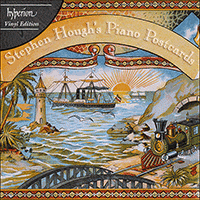

Sir Stephen Hough picks favourite songs and tunes from around the world, re-imagining them for solo piano in deft new arrangements: acts of homage to the countries he has come to love over a lifetime of travelling and performing.
Stephen writes: ‘Postcards suggest many things for me: travel, of course, greetings sent across the seas, “wish you were here”; but also writing to someone from home, a few words often meaning more than they say.’
Mastered by Sidney Claire Meyer at Emil Berliner Studios, this 180g LP is part of Hyperion’s 2026 Vinyl Edition. For the CD or download version of this album—both of which additionally include further works by Rachmaninov, Chaminade and Williamson, and the Passepied by Léo Delibes—please » Click here.

Mary Poppins turned sixty in 2024. The Sherman brothers (Richard and Robert) were commissioned by Walt Disney to write the words and music for the 1964 film based on the novels by P L Travers and starring Julie Andrews (her feature-film debut) and Dick Van Dyke. The much-loved songs they wrote are now part of the fabric, winning two Academy Awards in 1965: one for Best Original Music Score, the other for ‘Chim chim cher-ee’, voted Best Song. The Mary Poppins Suite was commissioned for the pianist Lang Lang and his 2022 album The Disney Book. Deftly decorated and using every trick of the transcriber’s art, the three titles are emblematic of Hough’s sophisticated and witty palette, the final title swooping in and out of Beethoven, Weber, Rimsky-Korsakov, Stravinsky and others to exhilarating effect.
Abram Chasins (1903-1987), the New York-born son of Russian immigrants, was at the heart of musical America for over six decades as a composer, pianist, pedagogue, writer and (most famously, perhaps) broadcaster. His best-known work, ‘Rush hour in Hong Kong’, from 3 Chinese Pieces (1925), became popular for a while. Each of his 24 Preludes, Opp 10-13, composed in 1928 is dedicated to a different friend or family member. The Prelude in E flat minor, Op 12 No 2, with its elegiac Russian theme, is the most often played. Chasins used it as the theme music for his ‘Piano Pointers’ broadcasts in the 1930s.
Rachmaninov himself recorded his transcription of Fritz Kreisler’s ‘Liebesleid’ (‘Love’s sorrow’) in 1921. It is the second of three Alt-Wiener Tanzweisen (‘Old Viennese dances’) written by the great Austrian-American violinist and published in 1905, the others being ‘Liebesfreud’ (‘Love’s joy’) and ‘Schön Rosmarin’ (‘Lovely Rosemary’). ‘Liebesleid’, with its wistful, yearning theme, tinged with regret, is a nostalgic look back at not only love’s sorrows, but also old Vienna.
Rachmaninov also made recordings (both disc and piano roll in 1929) of his arrangement of The flight of the bumblebee from Rimsky-Korsakov’s opera The Tale of Tsar Saltan. It is a paraphrase of the final episode of Act 3 Scene 1 when the magic Swan-Bird changes Prince Gvidon Saltanovich (the Tsar’s son) into an insect so that he can fly away to visit his father (who does not know that he is alive). Rachmaninov excises Rimsky’s central section and foreshortens the beginning and end to fashion a perfect (if challenging) end-of-recital bonne bouche. Clearly, beneath the composer’s solemn public demeanour lurked a lighter side.
Sir Stephen follows this transcription with half a dozen of his own. He has always cast his net far and wide for inspiration and for the first two here alights on a pair of Asian composers. Deng Yu-Hsien (1906-1944) was a Taiwanese Hakka musician who composed many well-known Hokkien songs (Taiwanese Hokkien being one of the national languages in Taiwan). Spring breeze prelude is a companion to the same composer’s Pining for the spring breeze heard on Stephen’s earlier album The Stephen Hough Piano Collection.
Aka tombo (sometimes ‘Akatombo’ or ‘Akatonbo’) means ‘red dragonfly’ in Japanese. It is the title of one of the most famous of all Japanese children’s songs. The words were written in 1921 by Rofu– Miki, the music in 1927 by Ko–saku Yamada. It fits Stephen Hough’s theme admirably, being described as ‘a nostalgic depiction of a red dragonfly seen at sunset by an infant carried on an older sister’s shoulder’.
With contemporary operas failing to provide the melodic material for transcriptions and paraphrases as they did so effectively in the nineteenth century, Hough and others have logically turned to stage musicals and films to continue the tradition. The further three Disney song transcriptions that follow were, again, commissioned from Hough for Lang Lang’s Disney recording. This trio, though, is taken from comparatively recent films. Disney’s multi-award-winning animation film Frozen (2013) grossed over $1.28 billion worldwide, making it the highest-earning animated film of all time until the remake of The Lion King overtook it in 2019. Do you want to build a snowman? is sung by Anna as she tries and fails to persuade sister Elsa to spend time with her as children, teenagers and adults.
Mulan (1998) is another Disney animation, a fantasy action drama based on the legend of Hua Mulan, a Chinese folk heroine. Lea Salonga sang the original version of Reflection, written and produced by composer Matthew Wilder and lyricist David Zippel. Christina Aguilera recorded a version of the song in 1998 which became her debut single.
Remember me, from Coco (a Pixar animation for Disney, 2017), is by the same song-writing team (Robert Lopez and Kristen Anderson-Lopez) as Frozen, though the film score was composed by Michael Giacchino. The story is set in Mexico and tells of a twelve-year-old boy named Miguel who is accidentally transported to the Land of the Dead, where he seeks the help of his musician great-great-grandfather to return him to his family and reverse their ban on music.
Sir Stephen remains in Mexico for his arrangement of Cielito lindo, a folk song (or copla) bearing a title that is unknown in the English-speaking world but with a tune and chorus in 3/4 that are instantly recognizable across the globe. Indeed, it is usually known by its refrain: ‘Ay-ay-ay-ay’. ‘Cielito’ means ‘sweetie’; ‘lindo’ can be translated as ‘pretty’. The original lyrics are by Pablo Santos (1871-1924), the music by his fellow countryman Quirino Mendoza y Cortés (1862-1957).
There are various forms of the copla, a type of Spanish popular song usually about the downtrodden or marginalized in society. One of these forms is the copla andaluza (Andalusian copla) or canción andaluza which neatly links to the next selection: Andaluza (also known as ‘Playera’), the fifth and best-known of the twelve Danzas españolas by Enrique Granados (or Pantaleón Enrique Joaquín Granados Campiña, to give him his full name). Granados, Falla and Albéniz were the Spanish composers responsible for the establishment of a modern Spanish school of music that reflected the country’s indigenous dance, song and character. The Danzas españolas were published in 1889 and brought Granados international recognition, though only Nos 4 (‘Villanesca’) and 7 (‘Valenciana’) were given titles by him. The others were supplied by the publisher.
Wilhelm Kempff (1895-1991), the great German pianist, teacher and composer, wrote a number of Bach transcriptions (which he recorded) and an arrangement of Handel’s Minuet in G minor, HWV434/4. Played at the conventional minuet tempo (crotchet = c70), it preserves its stately character. Played much slower (as here), it becomes an elegiac lament, surely one of the most sublime gems of the piano’s literature.
The music of Cécile Chaminade has long been out of fashion, sneered at by the snootier critics as mere salon music, by which they mean short pieces from the late nineteenth century of well-crafted, melodic music of no great depth. In recent years (and rather gratifyingly, since Stephen Hough has had a lifelong affection for her work and included it on several earlier albums) there has been a marked revival of interest in Chaminade’s music. Not the least of its merits is that audiences love it. Of Chaminade’s roughly 400 compositions, about 200 were for the piano alone. Among the most popular during her lifetime—and her music sold in huge quantities—was Les sylvains, variously translated as ‘The fauns’ or ‘The woodland spirits’. It first appeared in 1892. The yearning melancholy of its first subject is contrasted by the quicksilver, iridescent second idea in the minor key. Les sylvains was one of the seven pieces Chaminade herself recorded in November 1901, the first female composer ever to record her own music and among the first piano recordings made by a woman.
Australian Malcolm Williamson, Master of the Queen’s Music from 1975 until his death, wrote comparatively little piano music (it all fits comfortably on to three compact discs). Among it are five sets of Travel Diaries: Impressions of famous cities for pianoforte written between 1960 and 1961 for teaching purposes: Sydney, Naples, London, Paris and New York. From the last of these Stephen Hough has chosen the softly lyrical Broadway (Midnight), redolent of Gershwin and Irving Berlin.
Sibelius, best known for his monumental, brooding symphonic works, wrote a great deal of piano music, little of it widely played or familiar. The sparkling little Étude in A minor has become popular in recent years, a delightful end-of-concert dazzler. The thirteen pieces of Sibelius’s Op 76 were written between 1911 and 1919 and published in 1922.
Nature boy if not one of the greatest songs from the American songbook is certainly among the most otherworldly. It was made famous by Nat King Cole who made the first of its many subsequent recordings in 1948 (it remained one of Cole’s own favourites). It was written by a man born George Alexander Aberle (1908-1995), also known as George McGrew and to his friends as ‘ahbe’. He adopted, with others, a proto-hippie way of life in the 1940s, changed his name to eden ahbez (always writing and spelling it in lowercase letters) and wrote this partly autobiographical song while living in a cave near Palm Springs. ‘There was a boy, / A very strange, enchanted boy, / They say he wandered very far, / Very far, over land and sea …’
Turning to Mother Nature for the last three pieces: Edward MacDowell’s To a wild rose was once ubiquitous—effective, charming, well within the capability of the average amateur, and by far the best-known work of its composer. It is the first of his ten Woodland sketches.
The same description could be applied to Vogel als Prophet, the seventh of Schumann’s nine short linked Waldszenen (‘Forest scenes’) written between Christmas Eve 1848 and New Year’s Day 1849. While the other little tone poems have relatable titles like ‘Hunters on the lookout’, ‘Friendly landscape’ and ‘Wayside inn’, ‘Vogel als Prophet’ (‘Bird as prophet’ or ‘Prophet bird’) is arcane. The only bird that is believed, from ancient times, to possess a prophetic gift to foretell the future or bring good luck is the cuckoo. If that is Schumann’s prophet bird, its cry is very well hidden.
Although he wrote symphonies, concertos, tone poems and chamber music numbering 132 separate works, it is by Rustle of Spring that Christian Sinding’s name is remembered. The piece enjoyed enormous popularity for decades and was once the aspiration of every young pianist. Easier to play than it sounds—though not easy to play well—it is now rarely heard in the concert hall. It is the third (and only one ever played) of Sinding’s Six Pieces, Op 32, composed in 1896.
Jeremy Nicholas © 2026
Mary Poppins erreichte 2024 ihr 60. Jubiläum. Die Gebrüder Sherman (Richard und Robert) hatten von Walt Disney den Auftrag erhalten, Text und Musik für den Film von 1964 zu schreiben, der auf den Romanen von P. L. Travers basiert und in dem Julie Andrews (ihr Spielfilmdebüt) und Dick Van Dyke die Hauptrollen spielen. Die beliebten Lieder der Shermans sind heute Teil des Films und wurden 1965 mit zwei Oscars ausgezeichnet: einer für die beste Originalmusik, der andere für „Chim chim cher-ee“, das zum besten Song gewählt wurde. Die Mary Poppins Suite wurde für den Pianisten Lang Lang und sein 2022 erschienenes Album The Disney Book in Auftrag gegeben. Die drei Nummern, die wirkungsvoll und nach allen Regeln der Transkriptionskunst eingerichtet sind, repräsentieren Houghs raffinierte und witzige musikalische Palette, wobei die Schlussnummer Beethoven, Weber, Rimskij-Korsakow, Strawinsky und andere mit erheiternder Wirkung ein- und ausblendet.
Abram Chasins (1903-1987), der in New York geborene Sohn russischer Einwanderer, stand als Komponist, Pianist, Pädagoge, Schriftsteller und (vielleicht am berühmtesten) als Rundfunksprecher mehr als sechs Jahrzehnte lang im Zentrum der Musikszene Amerikas. Sein bekanntestes Werk, „Rush hour in Hong Kong“, aus den 3 Chinese Pieces (1925), war eine Zeit lang populär. Seine 1928 komponierten 24 Preludes, op. 10-13, sind jeweils einem Mitglied aus seinem Familien- und Freundeskreis gewidmet. Sein Prelude in es-Moll, op. 12 Nr. 2, mit seinem elegischen russischen Thema ist das am häufigsten gespielte. Chasins verwendete es in den 1930er Jahren als Titelmusik für seine Sendung „Piano Pointers“.
1921 nahm Rachmaninow selbst sein Arrangement von Fritz Kreislers Liebesleid auf, die zweite der drei 1905 veröffentlichten Alt-Wiener Tanzweisen—die anderen sind „Liebesfreud“ und „Schön Rosmarin“. „Liebesleid“ ist mit seinem wehmütigen, sehnsüchtigen und von Reue geprägten Thema ein nostalgischer Rückblick nicht nur auf Liebeskummer, sondern auch auf das alte Wien.
Rachmaninow spielte auch seine Bearbeitung von dem Hummelflug (sowohl auf Schallplatte als auch auf Klavierrolle im Jahr 1929) aus Rimskij-Korsakows Oper Das Märchen vom Zaren Saltan ein. Es handelt sich dabei um eine Paraphrase der Schlussepisode von Akt 3 Szene 1, in der der magische Schwanenvogel den Prinzen Gwidon Saltanowitsch (den Sohn des Zaren) in eine Hummel verwandelt, damit er wegfliegen kann, um seinen Vater zu besuchen (der nicht weiß, dass er lebt). Rachmaninow streicht Rimskij-Korsakows Mittelteil und verkürzt den Anfang und das Ende, und schafft so einen perfekten (wenn auch anspruchsvollen) Leckerbissen als „Rausschmeißer“ am Ende eines Konzerts. Unter dem feierlichen öffentlichen Auftreten des Komponisten hielt sich offensichtlich eine leichtere Seite versteckt.
Sir Stephen lässt dieser Transkription ein halbes Dutzend seiner eigenen folgen. Er hat seine Fühler stets weit ausgestreckt, um sich inspirieren zu lassen, und ist bei den ersten beiden hier vorliegenden Stücken bei zwei asiatischen Komponisten fündig geworden. Deng Yu-Hsien (1906-1944) war ein taiwanesischer Hakka-Musiker, der viele bekannte Hokkien-Lieder komponierte (taiwanesisches Hokkien ist eine der Nationalsprachen Taiwans). Spring breeze prelude („Frühlingsbrisen-Prélude“) ist ein Schwesterstück zu Pining for the spring breeze („Sehnsucht nach der Frühlingsbrise“) desselben Komponisten, das auf Houghs früherem Album The Stephen Hough Piano Collection zu hören ist.
Aka tombo bedeutet „rote Libelle“ auf Japanisch. Es ist der Titel eines der berühmtesten japanischen Kinderlieder. Der Text wurde 1921 von Rofu– Miki und die Musik 1927 von Ko–saku Yamada geschrieben. Es passt hervorragend zu Stephen Houghs Thema, der es als „nostalgische Darstellung einer roten Libelle bei Sonnenuntergang, die von einem Kleinkind auf der Schulter seiner älteren Schwester getragen wird“ beschreibt.
Da die zeitgenössischen Opern nicht mehr das melodische Material für Transkriptionen und Paraphrasen liefern, wie sie es im 19. Jahrhundert so erfolgreich taten, haben sich Hough und andere logischerweise an Musicals und Filme gewandt, um die Tradition fortzusetzen. Die folgenden drei Bearbeitungen von Disney-Songs wurden wiederum von Hough für Lang Langs Disney-Aufnahme in Auftrag gegeben, stammen allerdings aus vergleichsweise aktuellen Filmen. Disneys mehrfach preisgekrönter Animationsfilm Frozen (2013) spielte weltweit über 1,28 Milliarden Dollar ein und war damit der erfolgreichste Animationsfilm aller Zeiten, bis er 2019 von der Neuverfilmung vom König der Löwen überholt wurde. Do you want to build a snowman?“ („Möchtest du einen Schneemann bauen?“) wird von Anna gesungen, als sie vergeblich versucht, ihre Schwester Elsa zu überreden, Zeit mit ihr zu verbringen—sowohl im Kindes-, Jugend- als auch Erwachsenenalter.
Mulan (1998) ist ein weiterer Disney-Animationsfilm, ein Fantasy-Action-Drama, das auf der Legende von Hua Mulan, einer chinesischen Volksheldin, basiert. Lea Salonga sang die Originalversion von Reflection, geschrieben und produziert von dem Komponisten Matthew Wilder und Texter David Zippel. Christina Aguilera nahm 1998 eine Single-Version des Liedes auf, die ihre Debütsingle wurde.
Remember me aus Coco (ein Pixar-Zeichentrickfilm für Disney von 2017) stammt von demselben Songwriter-Team (Robert Lopez und Kristen Anderson-Lopez) wie Frozen, wobei die Filmmusik jedoch von Michael Giacchino komponiert wurde. Die Geschichte spielt in Mexiko und handelt von einem zwölfjährigen Jungen namens Miguel, der versehentlich in das Land der Toten transportiert wird, wo er seinen Ururgroßvater, ein Musiker, um Hilfe dabei bittet, ihn zu seiner Familie zurückzubringen und deren Musikverbot aufzuheben.
Sir Stephen bleibt in Mexiko, um sein Arrangement von Cielito lindo darzubieten—ein Volkslied (bzw. eine Copla) mit einem Titel, der hierzulande eher unbekannt ist, dessen Melodie und Refrain in 3/4 aber auf der ganzen Welt sofort erkannt werden. Tatsächlich ist es meist durch seinen Refrain bekannt: „Ay-ay-ay-ay“. „Cielito“ bedeutet hier so viel wie „Liebling“ und „lindo“ kann mit „hübsch“ übersetzt werden. Der Originaltext stammt von Pablo Santos (1871-1924), die Musik von seinem Landsmann Quirino Mendoza y Cortés (1862-1957).
Es gibt verschiedene Formen der Copla, eine Art spanischer Volkslieder, die meist von den Unterdrückten oder Ausgegrenzten der Gesellschaft handeln. Eine jener Formen ist die Copla andaluza (andalusische Copla) oder Canción andaluza, die passend in die nächsten Stücke hinüberleitet: Andaluza (auch bekannt als „Playera“), die fünfte und bekannteste der zwölf Danzas españolas von Enrique Granados (oder Pantaleón Enrique Joaquín Granados Campiña, um seinen vollständigen Namen anzugeben). Granados, de Falla und Albéniz waren die spanischen Komponisten, die für die Begründung der modernen spanischen Schule verantwortlich waren, welche den einheimischen Tanz, Gesang und Charakter des Landes widerspiegelt. Die Danzas españolas wurden 1889 veröffentlicht und brachten Granados internationale Anerkennung ein, wobei er nur seiner Nr. 4 („Villanesca“) und Nr. 7 („Valenciana“) Titel verlieh. Die anderen Nummern erhielten ihre Namen vom Verleger.
Der große deutsche Pianist, Lehrer und Komponist Wilhelm Kempff (1895-1991) fertigte eine Reihe von Bach-Transkriptionen an (die er auch aufnahm), sowie eine Bearbeitung des Menuetts in g-Moll aus Händels Suite für Tasteninstrument, HWV434. Im herkömmlichen Menuett-Tempo (Viertel = ca. 70) gespielt, bewahrt es seinen würdevollen Charakter. Wenn es deutlich langsamer gespielt wird (so wie hier), wird es zu einem elegischen Lamento, sicherlich eines der erhabensten Juwelen der Klavierliteratur.
Die Musik von Cécile Chaminade ist schon lange aus der Mode gekommen und wird von den hochnäsigen Stimmen unter Kritikern als bloße Salonmusik belächelt, womit kurze Stücke des späten 19. Jahrhunderts mit schön ausgestalteter, melodischer Musik ohne großen Tiefgang gemeint sind. In den letzten Jahren jedoch, nicht zuletzt dank Stephen Hough, der Chaminades Oeuvre schon sein ganzes Leben lang schätzt und es bereits auf mehreren früheren Alben aufgenommen hat, ist das Interesse an der Musik der Komponistin deutlich gestiegen—zudem ist sie auch beim Publikum sehr beliebt. Von den rund 400 Kompositionen Chaminades waren etwa 200 für das Klavier bestimmt. Zu den populärsten Werken zu ihren Lebzeiten—die sich auch in großen Mengen verkauften—gehörte das 1892 erstmals erschienene Les sylvains (zumeist als „Die Faune“ oder „Die Waldgeister“ übersetzt). Die sehnsüchtige Melancholie des ersten Themas wird durch das flirrende, schillernde zweite Motiv in Moll kontrastiert. Les sylvains war eines der sieben Stücke, die Chaminade selbst im November 1901 aufnahm. Sie gehörte nicht nur zu den ersten Pianistinnen, die Tonaufnahmen machten, sondern war auch die erste Komponistin, die ihre eigene Musik einspielte.
Der Australier Malcolm Williamson, Master of the Queen’s Music von 1975 bis zu seinem Tod, komponierte vergleichsweise wenig Klaviermusik (sie kann bequem auf drei CDs untergebracht werden). Darunter befinden sich fünf Zyklen von Travel Diaries: Impressions of famous cities for pianoforte („Reisetagebücher: Eindrücke berühmter Städte für Pianoforte“) die zwischen 1960 und 1961 für Unterrichtszwecke geschrieben wurden: Sydney, Neapel, London, Paris und New York. Aus dem letzten hat Stephen Hough das sanft lyrische Broadway (Midnight) ausgewählt, das an Gershwin und Irving Berlin erinnert.
Sibelius, der vor allem für seine monumentalen, grüblerischen symphonischen Werke bekannt ist, hat auch viel Klaviermusik geschrieben, die nur wenig gespielt wird und kaum bekannt ist. Die glänzende kleine Étude in a-Moll ist in den letzten Jahren populär geworden und eignet sich besonders als strahlendes Schlussstück am Ende eines Konzerts. Die 13 Stücke von Sibelius’ op. 76 entstanden zwischen 1911 und 1919 und wurden 1922 veröffentlicht.
Nature boy gehört, wenn nicht zu den größten Liedern des amerikanischen Songrepertoires, so doch zu den jenseitigsten. Berühmt wurde es durch Nat King Cole, der 1948 die erste von vielen nachfolgenden Aufnahmen machte (es blieb eines von Coles Lieblingsliedern). Es wurde von einem Mann geschrieben, der als George Alexander Aberle (1908-1995) geboren wurde und später auch als George McGrew, bzw. unter seinen Freunden als „ahbe“ bekannt war. Zusammen mit anderen ging er in den 1940er Jahren zu einer Hippie-ähnlichen Lebensweise über, änderte seinen Namen zu eden ahbez (stets kleingeschrieben) und komponierte das teilweise autobiographische Lied, als er in einer Höhle in der Nähe von Palm Springs lebte. „There was a boy, / A very strange, enchanted boy, / They say he wandered very far, / Very far, over land and sea …“ („Es war einmal ein Junge, / ein sehr seltsamer, verzauberter Junge, / sie sagen, er sei weit gewandert, / sehr weit, über Land und See …“)
In den letzten drei Stücken geht es von dem Naturjungen zu Mutter Natur: Edward MacDowells To a wild rose („An eine wilde Rose“) war einst allgegenwärtig, wirkungsvoll, charmant, für den durchschnittlichen Laien durchaus realisierbar und das bei weitem bekannteste Werk des Komponisten. Es ist die erste seiner zehn Waldskizzen.
Ebenso könnte man auch den Vogel als Prophet beschreiben, die siebte von Schumanns neun kurzen, zusammenhängenden Waldszenen, die zwischen Heiligabend 1848 und Neujahr 1849 entstanden. Während die anderen kleinen Tondichtungen Titel wie „Jäger auf der Lauer“, „Freundliche Landschaft“ und „Herberge“ tragen, ist der „Vogel als Prophet“ geheimnisvoll. Der einzige Vogel, dem von alters her eine prophetische Gabe zugeschrieben wird, um die Zukunft vorherzusagen oder Glück zu bringen, ist der Kuckuck. Wenn das Schumanns Prophetenvogel ist, dann ist sein Ruf sehr gut versteckt.
Obwohl er 132 Sinfonien, Solokonzerte, Tondichtungen und Kammermusikwerke geschrieben hat, ist Christian Sinding vor allem dank seines Frühlingsrauschen („Rustle of Spring“) bekannt geworden. Das Stück erfreute sich jahrzehntelang großer Beliebtheit und war einst der Spielwunsch eines jeden jungen Pianisten. Es ist leichter zu spielen als es klingt—auch wenn es nicht leicht es, es gut zu spielen—, doch heutzutage im Konzertsaal nur noch selten zu hören. Es ist das dritte (und einzige jemals gespielte) der Sechs Stücke op. 32, die Sinding 1896 komponierte.
Jeremy Nicholas © 2026
Deutsch: Viola Scheffel
‘Postcards’ suggest many things for me: travel, of course, greetings sent across the seas, ‘wish you were here’; but also writing to someone from home, a few words often meaning more than they say, or even intend. Someone once told me that he’d posted a flurry of postcards to the woman he was dating, one loving word on each cardboard rectangle. They can contain profound poetry (a sonnet fits comfortably within the borders), or wit and whimsy, whether subtle or raucous … all on one oblong card.
This album has examples of all of these genres, from the miraculous mystery of Schumann’s ‘Bird as prophet’, its arpeggios as the swing of wings through the forest; to a more urban avian sentiment in my arrangement of the Sherman brothers’ ‘Feed the birds’. And then the piece whose title is almost too long to fit on a postcard, from the same Disney film …
Stephen Hough © 2026