Welcome to Hyperion Records, a British classical label devoted to presenting high-quality recordings of music of all styles and from all periods from the twelfth century to the twenty-first.
Hyperion offers both CDs, and downloads in a number of formats. The site is also available in several languages.
Please use the dropdown buttons to set your preferred options, or use the checkbox to accept the defaults.
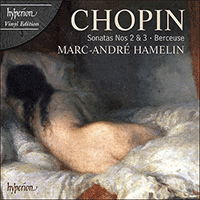

The great Marc-André Hamelin turns his attention to two mainstays of the Romantic repertoire: Chopin’s Piano Sonatas Nos 2 and 3. The results are simply staggering: playing of matchless brilliance and consummate artistry, stunningly recorded. The sonatas are completed by one of Chopin’s greatest single-movement works: the Berceuse in D flat major. We think this is one of the most authoritative and important Chopin discs to have appeared in recent years—an unmissable release.
Mastered by Sidney Claire Meyer at Emil Berliner Studios, this 180g LP is part of Hyperion’s 2026 Vinyl Edition. For the CD or download version of this album—both of which additionally include the two Op 27 Nocturnes and the mighty Barcarolle in F sharp major—please » Click here.

It is possible, for example, to analyse the first movement as a sonata form with the inverted reprise that is so characteristic of Chopin (compare the Ballades). But equally it is possible to hear it as a double cycle where figurative patterns are followed by cantilenas. Moreover, just as Nocturnes are embedded in the first movement in this way, so another Nocturne is trapped within the scherzo and yet another haunts the middle section of the funeral march. In neither of these inner movements does the central song feel like a natural outgrowth of the flanking sections. It remains remote from them, strengthening our impression of a series of contrasted, relatively self-contained musical worlds juxtaposed rather than smoothly joined. And in this reading the notorious finale assumes the character of a baroque-like Étude or Prelude (compare Nos 14 and 19 from the Op 28 Preludes). This in no way diminishes the powerful affective quality of the sequence, where the funeral march yields first to the detached, otherworldly song of its ‘trio’, and then to the disintegrative, harmonically elusive, and purposefully insubstantial finale. But it does reinforce (in a positive way) the gist of Schumann’s observation. The components of this work are formally separated, albeit thematically linked.
The Piano Sonata No 3 in B minor, Op 58, works rather differently. It was the last of Chopin’s three piano sonatas, written in 1844 during the years of his full maturity as a composer, and in contrast to the ‘Sonate funèbre’ it moves closer to conformity with both the formal and the generic archetypes of what was already becoming recognized as German sonata-symphonic thought. It is as though having come to terms with the four-movement sonata in Op 35, approaching it obliquely by way of the familiar ‘Chopin genres’ of the early 1830s, the composer now felt able to tackle this weighty genre on its own terms. This is apparent in the close-knit motivic argument—the developing variation—of the first movement, and in the measured tread—late Beethoven, late Schubert—of the slow movement. There are some parallels with Op 35, including the sequence of the inner movements where the scherzo precedes the slow movement, and again the inverted reprise of the first movement, but in most respects the two works are poles apart. The outer movements point up the contrast. There could be nothing further from the elliptical, understated finale of Op 35 than the grandiloquent sonata rondo with which Op 58 races, or rather gallops, to its bravura coda. This at least is a more conventional way to end a sonata! As for the first movement, this presents us with a much more closely argued thematicism than its counterpart in Op 35. The principal theme is strong and distinctive, but it is quickly broken down into motivic-contrapuntal working in a process of continuous development and transformation that then characterizes much of the movement. Considerable heads of tension are built up by this process, both in the exposition and in the development, and it is the function of the Nocturne-like second theme—one of Chopin’s happiest inspirations—to resolve them.
A few months before he completed the B minor Sonata, Chopin put the finishing touches to his Berceuse, Op 57. The original title was Variantes, and this describes its final form rather well: a set of sixteen short variations on an ostinato ground (there is a sketch of the work that lays this structure out rather graphically, even numbering the ‘variantes’). Another interesting detail here is that Chopin originally intended to plunge straight into the melody, and only added the two-bar genre-defining introduction at a late stage, quite possibly at the moment he changed the title from Variantes to Berceuse. In some ways the work functions rather like a set of baroque ‘divisions’, but this scarcely does justice to the highly original treatment of the ornamental line. The key point is that the curve of complexity (ever more rapid filigree) remains divorced not just from the underlying harmonic progression (a simple repeating cycle) but also from the dynamic shape (a stable level, remaining in low dynamics throughout). What is original here is that the shape of the music—its sense of departure and return—is created almost entirely through texture and sonority. It is not hard to see why Debussy was so interested in the music of Chopin.
Jim Samson © 2009
Es ist zum Beispiel möglich, den ersten Satz als Sonatenhauptsatzform mit umgekehrter Reprise, die für Chopin so charakteristisch ist, zu analysieren (vgl. auch die Balladen). Ebenfalls kann man hier jedoch einen Doppelzyklus heraushören, in dem auf Figurationsmuster Kantilenen folgen. Und genauso wie Nocturnes in den ersten Satz eingefügt sind, so ist noch ein Nocturne im Scherzo eingefangen und ein weiteres spukt durch den Mittelteil des Trauermarschs. Weder in dem einen noch im anderen Innensatz entwickelt sich das zentrale Lied auf natürliche Weise aus den es umgebenen Passagen. Es ist gewissermaßen distinkt und so verstärkt sich der Höreindruck, dass es sich hier um eine Reihe von verschiedenartigen, relativ eigenständigen, nebeneinander gestellten musikalischen Welten handelt und nicht eben ineinander übergehende Passagen. Mit dieser Interpretation im Hinterkopf nimmt das berüchtigte Finale den Charakter einer barockähnlichen Etüde oder eines Préludes an (vgl. Nr. 14 und 19 aus den Préludes op. 28). Dies schwächt die stark affektive Eigenschaft der Reihenfolge keineswegs; hier wird der Trauermarsch zunächst von dem losgelösten, jenseitigen Lied des „Trio“ fortgeführt, und dann von dem aufgelösten, harmonisch schwer fassbaren und absichtlich substanzlosen Finale. Hier findet sich, allerdings in positiver Weise, das Wesentliche von Schumanns Beobachtung wieder. Die Bestandteile dieses Werks sind formal getrennt, aber thematisch miteinander verbunden.
Die Klaviersonate Nr. 3 in h-Moll, op. 58, ist ganz anders aufgebaut. Es ist dies die letzte der drei Klaviersonaten Chopins, die alle 1844 entstanden, als er als Komponist seine endgültige Reifeperiode erreicht hatte. Anders als die „Sonate funèbre“ ist diese Sonate dem formalen und generischen Archetyp des sich bildenden deutschen Sonaten- und Symphoniekonzepts näher. Es scheint, als ob er nach der viersätzigen Sonate op. 35, in der er sich der Sonatenform verdeckt und über „Chopin Genres“ der frühen 1830er Jahre genähert hatte, sich nun in der Lage fühlte, dieses gewichtige Genre offen anzugehen. Dies wird nicht nur in der eng gearbeiteten Motivik, der sich entwickelnden Variation, des ersten Satzes deutlich, sondern auch im gemessenen Schritt—später Beethoven, später Schubert—des langsamen Satzes. Es gibt einige Parallelen mit op. 35, wie etwa die Reihenfolge der Innensätze, wo das Scherzo dem langsamen Satz vorangeht, und auch die umgekehrte Reprise des ersten Satzes, doch davon abgesehen trennen diese beiden Werke Welten. Die Außensätze zeigen die Kontraste besonders deutlich auf. Nichts könnte sich von dem elliptischen und absichtlich schlicht gehaltenen Finale von op. 35 mehr unterscheiden als das hochtrabende Rondo, mit dem op. 58 auf seine Bravur-Coda zuprescht. Es ist dies jedenfalls eine konventionellere Art und Weise, eine Sonate zu Ende zu bringen. Im ersten Satz finden wir eine deutlich stringentere Thematik vor als im Pendant von op. 35. Das Hauptthema ist kräftig und markant, wird jedoch schnell in ein motivisch-kontrapunktisches Geflecht geleitet, was dann in einen fortwährenden Entwicklungs- und Transformationsprozess übergeht, der den Satz dann weitgehend dominiert. In diesem Prozess bauen sich sowohl in der Exposition als auch in der Durchführung beträchtliche Spannungspunkte auf, und es ist die Aufgabe des nocturneartigen zweiten Themas—einer der schönsten Einfälle Chopins—diese aufzulösen.
Wenige Monate bevor er die h-Moll Sonate fertigstellte, beendete Chopin seine Berceuse, op. 57. Der ursprüngliche Titel des Werks lautete Variantes, was auch die endgültige Form passend charakterisieren würde: es handelt sich um einen Zyklus von 16 kurzen Variationen über einen Ostinato-Bass (es ist eine Skizze des Werks überliefert, in der die Struktur deutlich angegeben ist und wo die „Variantes“ sogar durchnummeriert sind). Ein weiteres interessantes Detail hierbei ist, dass Chopin ursprünglich direkt in die Melodie eintauchen wollte, und erst später die zweitaktige, genreverleihende Einleitung anfügte, möglicherweise geschah das zum selben Zeitpunkt, als er auch den Titel von Variantes zu Berceuse änderte. In mancherlei Hinsicht ist dieses Werk mit barocken Figurationen vergleichbar, doch wird das der hochoriginellen Behandlung der verzierten Linie kaum gerecht. Das entscheidende Charakteristikum ist, dass die Komplexitätskurve (immer schneller und filigraner) nicht nur von dem darunter liegenden harmonischen Fortschreiten (ein schlichter, sich wiederholender Zyklus) sondern auch von der dynamischen Gestalt (ein stabiler Pegel, der durchweg niedrig bleibt) völlig getrennt bleibt. Was hierbei so originell ist, ist, dass die Gestalt der Musik—der Eindruck von Aufbruch und Rückkehr—fast ausschließlich durch Struktur und Klang erzeugt wird. Es ist nicht schwer nachzuvollziehen, warum Debussy sich so für die Musik Chopins interessierte.
Jim Samson © 2009
Deutsch: Viola Scheffel