Welcome to Hyperion Records, a British classical label devoted to presenting high-quality recordings of music of all styles and from all periods from the twelfth century to the twenty-first.
Hyperion offers both CDs, and downloads in a number of formats. The site is also available in several languages.
Please use the dropdown buttons to set your preferred options, or use the checkbox to accept the defaults.
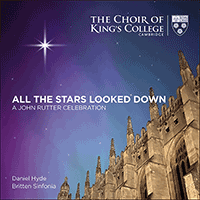


Recorded in the beloved Chapel of King’s College Cambridge, this album includes beautiful orchestral arrangements of Christmas carols by Sir John Rutter alongside a selection of carols by the great choral composers who have influenced him. Woven throughout the album are works that are especially meaningful to the choir and the album’s title track, Rutter’s All the stars looked down, is dedicated to the memory of Sir Stephen Cleobury.

All the stars looked down
I wrote this in 2023 in memory of Sir Stephen Cleobury, at the request of the Lords Taverners, who give a charity choral concert every Christmastide. In 2023 the choir was the Holst Singers, conducted by Stephen’s brother Nicholas Cleobury, which gave me a welcome opportunity to pay musical tribute to Stephen whom I had known ever since he was an undergraduate organ scholar at St John’s College. G K Chesterton’s text seemed especially apposite—and how lovely that a line of his text gives this album its title.
Child in a manger
For listeners of a certain age, the lilting Celtic folk-like melody of this carol will forever be associated with Eleanor Farjeon’s poem Morning has broken—either remembered from singing at school assembly or from hearing the 1971 Cat Stevens recording, which came just six years too late for the author to hear it. It seemed to me that there was no reason not to write a Christmas text to this delightful tune, opening it up for enjoyment at the Christmas season.
Sans Day Carol
This folk carol first appeared in print in the 1928 Oxford Book of Carols, where it was said to have been collected from the singing of a Mr Beard in the Cornish village of St Day in the early years of the twentieth century. The text belongs to a whole family of holly-and-ivy carols, but the tune has a lilt all of its own, and seemed to lend itself to arranging with some decorative woodwind accompaniment. I first recorded my arrangement in 1968, and it is often performed just with organ accompaniment, but I have always felt it really comes into its own in its original orchestral guise.
O holy night
This Christmas song (it was first a solo song) has a colourful history. The original French text (Minuit, Chrétiens) was written in 1847 by a Provençal wine merchant named Placide Cappeau, who had been asked to make a poetic contribution to a local Christmas pageant. Writing the text on a journey to Paris, he showed it while there to the renowned opera and ballet composer Adolphe Adam, who immediately set it to music. It was performed on Christmas Eve that year, and soon became a widespread success, especially in the United States in the familiar English translation by the Unitarian minister J S Dwight. The anti-slavery sentiments expressed in the final verse were enough to get the carol banned in southern states (has any other Christmas carol ever been banned, I wonder?) and it could not be broadcast by radio stations there until the Civil Rights movement took hold. Oddly, despite overwhelming popularity in the rest of America, O holy night was little-known in Britain until it was popularised by a Pavarotti recording made in 1976, since when, according to various polls, it has overtaken Silent night as the nation’s favourite Christmas carol. My choral arrangement adheres closely to the original melody and its accompaniment.
All bells in paradise
Carols from King’s, the BBC television programme filmed in advance but shown on Christmas Eve, has a distinct character of its own that has always set it apart from the live Festival of Nine Lessons and Carols, also broadcast on Christmas Eve—on radio—but the two events are often confused with each other. In 2012, Sir Stephen Cleobury invited me to compose a new carol for the televised programme, an invitation I was honoured to receive, having already composed two carols at different times for the radio Nine Lessons and Carols. Given that this new carol was to form part of an occasion I had never previously written for I asked Stephen what he wanted the new carol to sound like, and his characteristically kind and encouraging reply was ‘like you’. I took the title line of the text from the fifteenth-century Corpus Christi Carol, but the rest of the text is my own invention. The music has the verse-and-refrain structure characteristic of medieval carols, though the idiom is not, I think, at all medieval; others must judge whether it does sound like me.
Silent night
What more can possibly be written about this much-loved carol? It’s worth taking a look at the original version, with guitar accompaniment, dating from 1818—it is in The New Oxford Book of Carols. What we have is a lilting, Ländler-like melody, reminiscent of Schubert (who was alive and writing in 1818)—with a text that paints a picture of the Nativity scene such as it might have been portrayed by a minor artist of the Biedermeier era. Paintings in this style are still to be found in many an Austrian or South German church. In a way, Silent night has moved forward in history for each generation of arrangers and audiences—somewhere along the way it picked up the climactic top note absent in the original—and I have placed it in a later era than the one when it was written, somewhere at the end of the nineteenth century—Mahler or Strauss, perhaps? The orchestral postlude after the final verse came about simply because I did the arrangement of the carol, in the 1980s, for a television programme in which it was the final item, and a 40-second postlude was called for to let the end credits roll. I admit I was pleased that Daniel Hyde, when making this recording, was insistent that the postlude should be included.
Hereford Carol
A conflation of several folk carols, not all from Herefordshire, this endearingly rustic retelling of the Christmas story was first published in 1920 as one of Twelve Traditional Carols from Herefordshire under the editorship of Vaughan Williams and Ella Mary Leather, and reprinted in the 1928 Oxford Book of Carols. Christopher Robinson’s arrangement captures the spirit of the original in more extended form, and I was delighted to have been invited by him and Daniel Hyde to recast the organ accompaniment for orchestra.
Dormi, Jesu
This is the second of the two carols I was invited by Stephen Cleobury to compose for the Festival of Nine Lessons and Carols (What sweeter music, dating from 1987, was the first), but for reasons I can’t now recall I believe it was first performed as part of the televised Carols from King’s service in 1998 and included in the Festival of Nine Lessons and Carols in later years. The text juxtaposes the Latin original (of unknown origin, discovered by Samuel Taylor Coleridge in 1798) with Coleridge’s own poetic English translation. The music has, I would say, a lullaby-like character, with the verse-and-refrain structure that is common to many carols. Many a choir (though not, I hasten to say, King’s College Choir) has been challenged by the rather mystical harmonies on the final page where the music fades away into sleep.
Nativity Carol
As Debussy famously and rather unkindly remarked of Stravinsky’s early ballet score The Firebird, you’ve got to start somewhere. The Nativity Carol was the earliest of my surviving compositions to be written—I was sixteen or seventeen at the time—and to see the light of print—about four years later, when Sir David Willcocks recommended it for publication, along with a batch of several other early efforts of mine. Listeners will have no difficulty spotting the (unconscious) reference to one of Elgar’s Enigma Variations in bars 7-9 of the melody.
What sweeter music (No 1 of Five Meditations for Orchestra)
The idea of making orchestra-only transcriptions of some of my short choral pieces came from a record company in 2003. At first sceptical, I was won over by the thought that, free of the specific meanings and references of a text, listeners could allow their imaginations to roam at will as they heard the music. What sweeter music derives from the carol I wrote for King’s College Choir in 1987. As with the other items in the set, I have stayed close to the choral original.
Candlelight (No 3 of Five Meditations for Orchestra)
This is a fairly literal transcription of my Candlelight Carol, composed in 1984 for a choir in Pittsburgh. The text reflects on the scene in the Bethlehem stable.
John Rutter © 2025
The music on this album is chosen to reflect the extraordinary talents and the effortless musical modesty of John Rutter in this his 80th birthday year. John writes about his own works below, and those tracks not written by him have been chosen given their very close connections with John through a variety of Cambridge Colleges and The Bach Choir. As an early mentor to John, David Willcocks is heard here in three of his best known congregational carol arrangements; usually sung each year by over a thousand people packed into the chapel at the Christmas Eve Festival of Nine Lessons and Carols, they are heard here in their arrangements for choir with brass and organ. Hark! the herald angels sing and O come, all ye faithful are probably the two best-known descants by David, the latter thrilling audiences world-wide with the glorious ‘Sing choirs of angels’ and *that* chord in the final verse for ‘Word of the Father’; lesser-known but equally captivating is the arrangement of Unto us is born a son, especially with the caustic harmonies in verse three signalling King Herod’s rage and fury.
Showing deep respect for, and as a nod to, the highest levels of compositional technique and mastery which John Rutter has set as the gold standard for decades, four short carols interweave amongst John’s offerings, their associations to King’s and to John highlighting the close bond which we enjoy. Sir Philip Ledger succeeded Willcocks as Director of Music in 1974, and it was many years after his retirement that he gifted A spotless rose to Sir Stephen Cleobury and the King’s Choir. Beautifully crafted and capturing perfectly the ethereal sound of the chapel, it sits alongside David Hill’s perfect miniature arrangement of Away in a manger. Sir Stephen Cleobury’s contribution to the Christmas legacy at King’s was huge, and when he succeeded Ledger as Director of Music in 1982, he immediately instigated an annual carol commission which continues to this day. Whilst Stephen’s work did not involve much of his own original composition, he did from time to time make arrangements of carols, and I found his unfinished orchestration of Walford Davies’s setting of O little town of Bethlehem whilst clearing out old files in the choir library; written in Stephen’s recognisable pencil manuscript, I took the unfinished work and fleshed out the string parts a little, whilst making alterations and adjustments to include the wind instruments heard here. And in some of my own tentative first steps in arrangement, encouraged and guided by John, the Sussex Carol is heard here in a little-known version by Ralph Vaughan Williams which I scored up for strings; I can’t help thinking this version as Vaughan Williams made it must have been known to Willcocks and served as inspiration to the latter’s own version of the carol.
We wish John a very happy birthday and we thank him for all that he has done for choirs and choral music across the world. His craftsmanship and his modesty have been an inspiration to us all, and it has been our pleasure to celebrate just a small selection of his output here this year.
Daniel Hyde © 2025