Welcome to Hyperion Records, a British classical label devoted to presenting high-quality recordings of music of all styles and from all periods from the twelfth century to the twenty-first.
Hyperion offers both CDs, and downloads in a number of formats. The site is also available in several languages.
Please use the dropdown buttons to set your preferred options, or use the checkbox to accept the defaults.
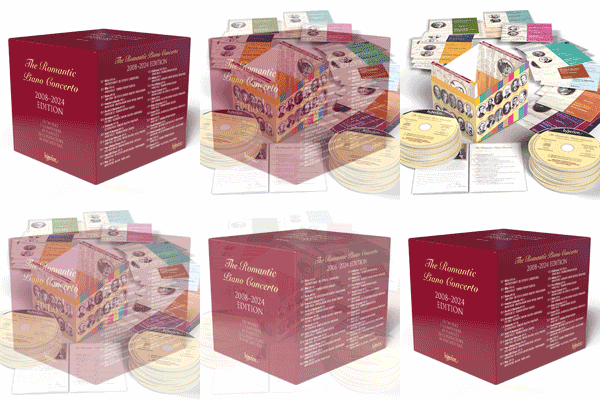


To trace the Romantic piano concerto’s evolution, it may be helpful to view the genre through its historical context. The first ever concertos came out of the Baroque period, beginning at the end of the seventeenth century. It was Vivaldi whose nearly 600 solo concertos standardized the three-movement fast–slow–fast template which in turn influenced J S Bach, the inventor of the keyboard concerto. As the ‘Classical’ concerto took shape in the late eighteenth century, Mozart not only demonstrated how a piano and orchestra could co-exist as equal partners, but also suffused his mature concertos with distinct and decidedly non-formulaic personalities. Beethoven further expanded the form’s time-scale and expressive possibilities.
In fact, many of the Classical concerto precepts held forth into the Romantic era. Classical concertos almost always begin with a lengthy first movement introduction, where the orchestra establishes its identity through its own themes. The piano soloist’s entrance provides a dramatic interruption. As the solo and ensemble forces interact, their contest of musical wills often culminates in a cadenza for the soloist. The remaining movements usually allow the composer more freedom, whether in a slow movement’s respite or a finale’s confrontational exuberance. With Romantic concertos, however, soloists decisively moved centre stage and have remained there since.
It’s hard to pinpoint exactly what the very first Romantic Concerto was, or to credit any one composer for ushering in this new era. Indeed, one could even cite Mozart’s D minor Concerto K466 as a stylistic precursor, for the work’s darkly evocative contours unquestionably resonate in the turbulent opening of Brahms’s piano concerto in the same key. Johann Nepomuk Hummel’s concertos (mostly from the 1830s) could easily have fitted into the Hyperion series, for this composer’s fusion of structural rigour and digital flamboyance represents a plausible missing link between Classicism and Romanticism. Yet the same can be said for most of Ignaz Moscheles. In his once-popular Third Concerto, for example, you get the expected elegance and decorum, but also the pungent and declamatory brass interjections in the slow movement that look ahead several decades. And Chopin’s two concertos unquestionably ushered in a new era of pianistic ingenuity, where new sonorities, figurations and modulatory patterns intermingled to unprecedented, often startling effect. Formally speaking, however, they follow Classical conventions, and the orchestra primarily functions as a backdrop. For craft, substance and palpable orchestra/soloist repartee, I personally would nominate Carl Maria von Weber’s Konzertstück as the most durable bridge between these eras, as well as his excellent yet vastly underrated pair of piano concertos.
The question, then, is why concertos of an acknowledged master like Weber continue to be ignored in the concert hall? Or what causes nineteenth-century concertos that were well-regarded in their time to disappear from the active repertoire? One has to remember that the tides of fashion come in waves, or the waves of fashion come in tides. Throughout the history of Western music, certain works and genres reach a tipping point, and when their popularity runs its course, they fall into obscurity and out of favour. Think of the rise and fall of mid-eighteenth-century French grand opera, or the specialized Melodrama genre combining spoken word poetry with piano or orchestral accompaniment.
Yet there are improbable and welcome comebacks. Small labels in the early LP era had success resurrecting long-forgotten Baroque and Renaissance composers, spilling over into the period-performance movement that prevails today. Regarding the Romantic piano concerto, I vividly remember the flurry of public performances and festivals in the late 1960s and early 1970s, along with advocates like Raymond Lewenthal, Jorge Bolet and Earl Wild, plus my downstairs neighbour Mary Louise Boehm, who championed Amy Beach decades before anyone else. The Vox and Genesis labels also churned out lots of neglected piano repertoire, albeit with variable results.
But let’s take a few works as examples. Published in 1847, Adolf von Henselt’s Concerto in F minor was premiered by no less than Clara Schumann, with Felix Mendelssohn conducting. Although the work owes much to Chopin’s concerto in the same key, it occupies a different world, replete with massive and elaborate keyboard textures that test one’s stamina, plus unrelenting leaps and taxing stretches for average sized hands (Henselt was known for his prodigious left-hand extensions). It also has beautiful and communicative themes, such as the first movement’s second subject. Yet the piano part is often more difficult than it sounds (the opposite holds true for Liszt’s two concertos). Only a handful of modern-day pianists have braved its challenges on disc. Will today’s emerging keyboard talents who usually bank their careers on the repertoire’s ‘greatest hits’ decide that Henselt’s aesthetic rewards are worth paying the physical dues?
Likewise, if Rachmaninov hadn’t come along to compose his Second and Third Concertos, Xaver Scharwenka’s First and Anton Rubinstein’s Fourth (coupled in this series in Marc-André Hamelin’s brilliant performances) may well have remained standard fare. Both feature great tunes, colourful orchestration and formidable yet manageable solo writing. Do these works match Rachmaninov for originality and sheer palpitation? No, they don’t. But they remain highly effective and memorable. So are the numerous shorter pieces for piano and orchestra sprinkled throughout Hyperion’s series. Yet most concert programmers want longer and bigger fare, which is why such works fall by the wayside outside of the recording studio. It’s not often that you encounter Saint-Saëns’s ‘Wedding Cake’, Pierné’s Scherzo-Caprice, Chaminade’s Concertstück or even Chopin’s Krakowiak on subscription concerts, let alone the unusually succinct and delightfully effervescent Henri Herz concertos, or even Rimsky-Korsakov’s compact and appealing (but 14-minute-long) Piano Concerto in C sharp minor. In fact, Arthur Rubinstein wanted to record the latter, as well as the aforementioned Rubinstein D minor, but never got around to them.
Interestingly, some of the most ambitious and symphonically oriented concertos emerging in the later nineteenth and early twentieth centuries were not necessarily virtuoso vehicles, first and foremost. The Brahms concertos are the most obvious cases in point, due to their imposing breadth and seriousness of purpose. Tchaikovsky’s Second Concerto falls into this category. The case of this composer’s far more popular Piano Concerto No 1 is more complex. Because it’s usually treated as a show-off display piece in competitions and gala concerts, one easily loses sight of the music’s essentially balletic nature, and of how carefully the solo and orchestral parts are integrated.
Lofty intentions loom large throughout the dense and craggy Reger and Pfitzner concertos, both of which a noted colleague of mine infamously disparaged as ‘chromatic sludge’. Interestingly, Busoni’s concerto, the largest and most ambitious of all ‘concerto-symphonies’ (and the only one featuring a male chorus) has gained unexpected traction on disc and in concert over the past decade or so. This would have been unthinkable in Busoni’s time. And although Moszkowski’s B minor Concerto is nowhere near so ‘event worthy’ as Busoni’s, its 54-minute duration, four-movement structure and strong symphonic profile belie this composer’s reputation for writing salon fluff. The Paderewski concerto has comparable staying power. Other good fusions of large-scale symphonic thinking and unabashed piano display are to be found in Joseph Marx’s Romantisches Klavierkonzert, the Wilhelm Stenhammar and York Bowen concertos, and the Arthur Bliss concerto famously premiered by Solomon.
Having lived with this series since its inception, perhaps I was most surprised when I encountered certain composers of the French school ‘playing against type’, by which I mean composers largely known for their work in other genres managing to turn out wonderful pieces for piano and orchestra. Massenet, for example, was the big opera man of his time, but his 1902 concerto is no less generous with ear-catching melodies (incidentally, it’s one of the few major-key concertos that ends in the minor mode). Lightweight though it may be, Reynaldo Hahn’s 1930 concerto brilliantly mirrors the composer’s gift for song, but without words, obviously. Who knew that Gounod wrote such rich, harmonically interesting works for pedal piano and orchestra? In fact, all of Gounod’s piano music is invitingly idiomatic. And for those who primarily know Charles-Marie Widor for his virtuosic organ oeuvre, his intriguingly Schumann-esque F minor Piano Concerto will catch you off guard, while his Second Concerto is basically César Franck in modern clothing, and that’s a compliment.
To be sure, listeners will gravitate more to certain composers and works than others, yet looking back on Hyperion’s 35-year Romantic Piano Concerto journey, one cannot deny the series’ uncompromising vision and consistently high production values, from procuring the scores to selecting the pianists, from coordinating the venues and orchestras to commissioning the annotations. What is more, the Romantic Piano Concerto series helped draw attention to some of the greatest pianists of our own time, all of whom show up with not just their usual excellence and professionalism, but also with an open-mindedness and unswerving commitment to the cause, making the best possible case for this music.
Jed Distler © 2027
Um zu verstehen, wie das romantische Klavierkonzert entstand, ist ein Blick in die Geschichte der Gattung dienlich. Die ersten Konzerte überhaupt finden sich im Barock, gegen Ende des 17. Jahrhunderts. Mit seinen fast 600 Solokonzerten war es Vivaldi, der die Satzfolge schnell–langsam–schnell als Norm einführte; das wiederum beeinflusste J. S. Bach als Erfinder des Tastenkonzerts. Als im späten 18. Jahrhundert das „klassische“ Konzert Gestalt annahm, zeigte Mozart nicht nur, wie Klavier und Orchester zu gleichberechtigten Partnern werden konnten; er gab den Konzerten seiner Reifezeit auch unverwechselbare Persönlichkeiten ohne alles Formelhafte. Beethoven erweiterte Umfang und Ausdrucksgehalt der Form.
Viele Grundsätze des klassischen Konzerts hielten sich in die Romantik hinein. Klassische Konzerte fangen stets mit einer längeren Einleitung im ersten Satz an, in der das Orchester sich mit eigenen Themen etabliert. Der Eingang des Klaviersolisten wird zur dramatischen Unterbrechung. Das Gegenüber von Solo und Ensemble, ihr Wetteifern um Vorherrschaft gipfelt häufig in einer Solokadenz. Die übrigen Sätze erlauben dem Komponisten zumeist mehr Freiheit, sei es im langsamen Satz als Ruhepause oder im streitlustigen Überschwang eines Finales. Mit den Konzerten der Romantik allerdings rückten die Solisten entschieden mehr in den Mittelpunkt, ein Platz, den sie seither nicht mehr aufgegeben haben.
Es ist schwierig, das erste romantische Klavierkonzert zu bestimmen oder den einen Komponisten, der diese Ära eingeläutet hätte. Als Stilvorläufer könnte man Mozarts d-Moll-Konzert KV466 aufrufen, das in seiner dunklen Empfindungswelt fraglos noch im stürmischen Beginn von Brahms’ Klavierkonzert in derselben Tonart nachhallt. Mike Spring wies zurecht darauf hin, dass Johann Nepomuk Hummels Konzerte, großteils in den 1830er-Jahren entstanden, gut in die Hyperion-Reihe gepasst hätten; kann Hummels Verbindung von formaler Strenge und technischer Extravaganz doch als Brücke zwischen Klassik und Romantik gelten. Das gleiche könnte man auch über vieles von Moscheles sagen. So vermittelt uns sein einst beliebtes 3. Klavierkonzert alle Eleganz und Haltung, die wir erwarten; die schneidenden Blechbläser-Einwürfe im langsamen Satz allerdings weisen um Jahrzehnte in die Zukunft. Ohne Frage eröffneten die beiden Chopin-Konzerte eine neue Epoche pianistischen Erfindungsgeistes, in der neue Klangfarben, Figurationen und harmonische Modulationen sich zu nie dagewesenen, oft bestürzenden Wirkungen verbanden. In formaler Hinsicht folgen sie allerdings klassischen Konventionen, und das Orchester dient hauptsächlich als Hintergrund. Nach kompositorischem Können, Gewicht und greifbarem Schlagabtausch zwischen Solist und Orchester halte ich persönlich das beliebte Konzertstück von Carl Maria von Weber für die belastbarste Brücke zwischen den beiden Epochen; das gleiche gilt für seine beiden hervorragenden, weithin unterschätzten Klavierkonzerte.
Warum werden also Konzert anerkannter Meister wie Weber im Konzertsaal so beharrlich ignoriert? Woran liegt es, dass einst vielgespielte Konzerte des 19. Jahrhunderts aus dem Konzertrepertoire verschwanden? Dabei müssen wir das gezeitenhafte Auf und Ab der Mode bedenken. Die gesamte Geschichte der westlichen Musik hindurch kamen Werke und Gattungen an Kipppunkte; und war es mit ihrer Beliebtheit einmal vorbei, so sanken sie hinab ins Dunkel des Vergessens. Man denke nur an die Grand Opéra Frankreichs oder das Melodram, das gesprochene Dichtung mit Klavier- oder Orchesterbegleitung kombinierte.
Doch gibt es auch das unerwartete, aber willkommene Wiedersehen. In der Frühzeit der Schallplatte hatten kleine Labels Erfolg mit vergessenen Komponisten aus Renaissance und Barock, was sich bis heute in der Szene historisch informierter Aufführungspraxis fortsetzt. Was das romantische Klavierkonzert angeht, erinnere ich mich lebhaft an Konzerte und Festivals in den Sechziger- und frühen Siebzigerjahren und an Fürsprecher wie Raymond Lewenthal, Jorge Bolet, Earl Wild und meine Nachbarin Marie Louise Boehm, die sich Jahrzehnte vor allen anderen für Amy Beach starkmachte. Auch die Labels Vox und Genesis produzierten vergessene Klaviermusik in großer Menge, wenn auch in wechselnder Qualität.
Blicken wir auf einige Beispiele. Die Uraufführung des f-Moll-Konzert von Adolf von Henselt, 1847 veröffentlicht, spielte keine Geringere als Clara Schumann, und Mendelssohn dirigierte. Zwar ist das Stück in Vielem Chopins Konzert in derselben Tonart verpflichtet, doch kommt es aus einer anderen Stilwelt: wuchtige und dichte pianistische Schreibweise, die Kraft und Ausdauer fordern, sowie erbarmungslose Sprünge und Griffspannweiten; Henselt war berühmt für die Spannweite seiner Linken. Dazu enthält es schöne und sprechende Themen, etwa das zweite Thema im ersten Satz. Doch ist der Klaviersatz häufig schwieriger, als er klingt—das Gegenteil von Liszts beiden Klavierkonzerten. Nur wenige Pianisten haben sich an Einspielungen gewagt. Wie sollen die jungen Tastenstars von heute, die vor allem auf die Erfolgsstücke des Repertoires setzen, zu dem Schluss kommen, dass Henselts Klavierkunst der Mühe wert ist?
Ebenso kann man sagen, dass Xaver Scharwenkas erstes und Anton Rubinsteins viertes Klavierkonzert—in Marc-André Hamelins glänzender Interpretation auf einer Folge dieser Serie gekoppelt—vielleicht bis heute im Standardrepertoire wären, wenn Rachmaninow nicht seine Klavierkonzerte Nr. 2 und 3 geschrieben hätte. Bei Scharwenka wie Rubinstein finden sich herrliche Melodien, farbige Orchestrierung und schwierige, aber dankbare Solopartien. Reichen sie in Originalität und emotionaler Wucht an Rachmaninow heran? Nein—und dennoch sind sie wirkungsvoll und einprägsam, ganz wie die vielen kürzeren Stücke für Klavier und Orchester, die in die Hyperion-Reihe eingestreut sind. Im Konzertsaal begegnet man nicht oft Saint-Saëns’ „Wedding Cake“, Piernés Scherzo-Caprice, Chaminades Concertstück oder gar Chopins Krakowiak, ganz zu schweigen von den ungewöhnlich straffen und herrlich quirligen Konzerten eines Henri Herz oder auch Rimsky-Korsakows knappem und sympathischem, nur viertelstündigem cis-Moll-Konzert. Artur Rubinstein wollte es gerne aufnehmen, ebenso Rubinsteins erwähntes d-Moll-Konzert, doch dazu kam es nicht.
Interessant ist, dass einige der Konzerte mit dem höchsten sinfonischen Anspruch nicht gerade als virtuose Schlachtrösser gelten. Offenkundig zählen dazu die beiden Brahms-Konzerte mit ihrer breiten Formanlage und ihrem hohen kompositorischen Anspruch. Auch Tschaikowskys zweites Klavierkonzert gehört hierher. Bei seinem weitaus beliebteren ersten ist die Lage verwickelter. Weil es oft bei Wettbewerben und Galakonzerten als Brillierstück herhält, gerät leicht aus dem Blick, wie sehr es vom Ballett her gedacht ist und wie sorgfältig Solo- und Orchesteranteil aufeinander abgestimmt sind.
Über den zerklüfteten Konzerten von Reger und Pfitzner dräut ihr hoher Anspruch; beide bezeichnete ein bekannter Kollege als „chromatischen Brei“. Das Konzert von Busoni, das breiteste und anspruchsvollste von allen „sinfonischen Konzerten“—und das einzige, in dem ein Männerchor zum Einsatz kommt—, taucht interessanterweise in den letzten zehn Jahren häufiger in Aufnahmen und Konzertprogrammen auf. Und auch wenn Moszkowskis h-Moll-Konzert nicht annähernd so aufsehenerregend ist wie Busonis, straft es mit 54 Minuten Dauer und deutlich sinfonischer Prägung doch all jene Lügen, die den Komponisten als Schöpfer plüschiger Salonmusik abtun. Vergleichbar groß angelegt ist das Paderewski-Konzert. Weitere Beispiele für sinfonische Breite und unverstellte Tastenvirtuosität sind das Romantische Klavierkonzert von Joseph Marx, die Konzerte von Wilhelm Stenhammar und York Bowen sowie das Konzert von Arthur Bliss, dessen Uraufführung bekanntlich Solomon spielte.
Hatte ich diese Serie von Anfang an verfolgt, so überraschte mich am meisten die Begegnung mit einigen französischen Komponisten, die außerhalb ihres Fachs schrieben und trotzdem herrliche Stücke für Klavier und Orchester hervorbrachten. So war Massenet zu Lebzeiten Inbegriff des Opernkomponisten, doch sein Konzert von 1902 steckt voller eingängiger Melodien und ist zudem eines der wenigen Dur-Konzerte, die in Moll enden. Bei aller Leichtfüßigkeit lässt Reynaldo Hahns Konzert von 1930 glänzend dessen Gabe zum Lied erkennen, wenn auch natürlich ohne Worte. Wer hätte gedacht, dass Gounod so hörenswerte, harmonisch gehaltvolle Musik für Pedalflügel und Orchester geschrieben hat? Überhaupt zeigt Gounods Klavierschaffen einen anziehend persönlichen Ton. Und wer Charles-Marie Widor nur als Schöpfer virtuoser Orgelmusik kennt, den wird sein f-Moll-Konzert mit seinem schumannesken Ton überraschen, während sein zweites Klavierkonzert gewissermaßen Franck in modernem Gewand ist—in durchaus positivem Sinn.
Sicher werden manche Zuhörer mehr zu diesen, manche zu anderen Komponisten und Werken neigen. Doch lässt sich im Rückblick auf die 35-jährige Reihe The Romantic Piano Concerto nicht abstreiten, wie kompromisslos sie ihr Ziel verfolgte und wie hochwertig die Folgen produziert wurden, vom Auffinden der Partituren zur Solistenauswahl, vom Koordinieren der Aufnahmeorte und Orchester zur Vergabe der Begleittexte. Mike Spring erwähnt dies und vieles mehr in seinem so ausführlichen wie lebendigen und inhaltsreichen Text zur ersten Box. Überdies hat die Reihe den Blick auf Pianisten gelenkt, die zu den besten unserer Zeit gehören. Alle widmeten sich ihrer Aufgabe nicht nur mit ihrem ganzen Können und ihrer Professionalität, sondern auch voller Offenheit und unbeirrbarer Hingabe. Das macht sie zu den denkbar besten Fürsprechern dieser Musik.
Jed Distler © 2027
Deutsch: Friedrich Sprondel
The sessions were guided by legendary producer Andrew Keener, who has subsequently become a close friend as we have collaborated across scores of recordings. His skill, musicianship, diplomacy and tenacity are rightly renowned. In fact, the all-round fantastic teamwork of each and every project is a hallmark of the entire Romantic Piano Concerto series.
Galvanizing all the disparate elements across recording sessions—and then enabling all the individually crucial cogs to run smoothly—falls to the conductor. It’s a role I have always cherished. The conductor needs to assimilate the personality of each new concerto, guided each time by the solo pianist chosen by the Hyperion team, and then has to communicate that powerfully to the orchestral musicians.
Bringing unfamiliar repertoire back to global appreciation via CD (or indeed via streaming and download) is a privilege for musicians: we get to make unfamiliar compositions feel and sound like music we all know and all need. Hyperion always assembled a team of exceptional calibre which meant that the result always exceeded the sum of its parts, time and again.
Martyn Brabbins
The life of a concert pianist can sometimes seem like a rather random stream of one-off events where you have to adapt at high speed to new concert halls, pianos, acoustics, conductors, orchestras and audiences, and then move on, sometimes with gruelling travel, to the next new set of parameters. With recording, by comparison, you can hope to work with one of your favourite instruments, excellent orchestras, acoustically appropriate halls or studios and all the arrangements that give you a fighting chance to put down a performance somewhere near the perfection which all musicians strive to achieve. It can also offer projects which give more flow, structure and purpose to a career in music. These days, the resultant recordings can remain available indefinitely and take on a life of their own, reaching corners of the planet you have never travelled to, and prompting reactions from people you would otherwise never meet.
Given the easy access now to the multitude of recordings available, it has become viable also to record many lesser-known composers, and fill in the extraordinary history, interplay and influences between them. Just as you can find hidden gems and near-masterpieces by unknown painters in art galleries all over the world, so it is with composers and music, and the vast spectrum of music appeals in different ways to the myriad ears that increasingly listen to it in our modern highly connected lives.
Mike Spring, the founder of the Romantic Piano Concerto series and expert in the repertoire, has already described how my relationship with Hyperion started with a complete Rachmaninov solo cycle, and how a dove-tailed relationship with Chandos Records delayed my involvement in the project for some time; but once we did get going with the Moscheles Piano Concertos, the ball started rolling fast. Looking back from my point of view, many happy coincidences, which could not have been planned or predicted, led to the efficient pattern of recording we were able to adopt for the eighteen discs which the Tasmanian Symphony Orchestra and I then undertook for Hyperion ‘down under’.
First, major developments were taking place in computer-type-setting of music at that time, and the arrival of the Finn brothers’ amazing Sibelius system was a complete game-changer. Up to this point, if you could get hold of the parts of rare and historic compositions in the first place, they might be written in old notation, incomplete, unclear, difficult to handle and have numerous mistakes in them which could be tricky to check in advance as there were usually no full scores available. This could cause all sorts of problems during recording sessions, and the time wasted in sorting them out might understandably lead to tension and frayed nerves. Secondly, digital editing had come of age; none of the ‘splicing’ of high-speed tapes and sticking sections together with sellotape that was the norm when I was young.
Thirdly, my career had, by this time, taken me very happily down the track of conducting and directing from the keyboard, and I had a number of mid-size orchestras around the world with whom I worked very regularly in this capacity. Not least of these, though certainly the most distant from my London home, was the Tasmanian Symphony Orchestra—one of the Australian Broadcasting Corporation’s stable of first-class radio orchestras. It was with them that I recorded most of my contribution to the RPC cycle. From the first moment of our thirty-six year relationship, something clicked between us, and we enjoyed many interesting projects together, including a TV documentary about Ravel’s Mother Goose which won a Gold Medal in New York. They are as quick and committed as London orchestras at reading and absorbing new music, fantastically responsive, and, whilst their string section is basically the size of a chamber orchestra, they have always had a terrific, varied and powerful sound, and could also increase numbers when required. I loved going to Tasmania, an extraordinarily beautiful island, and found there the ideal circumstances for concentrating on the heavy workload that these visits always entailed, including, as they did, symphony concerts with the TSO and other orchestras around Australia.
The set-up, once we started to record, was also perfect, given the back-up of the ABC facilities, their excellent sound engineers, Andrew Dixon and Veronica Vincze, studios, research and library resources—John O’Carroll, the TSO librarian, did invaluable work over a number of years putting scores on computer for us. The management team and CEOs of the orchestra were all wonderful. They changed over the years, but the enthusiasm for the project was never lost and it was given priority attention, most especially by David Garrett, who first made it possible for us to use the TSO and produced the first two discs, and Simon Rogers, who was Artistic Administrator during the majority of the recording years.
Directing from the keyboard was a pre-requisite for this project, testing though it is, because finding conductors who would be free, on the same continent, and willing to learn unusual scores and spend time with me preparing the work, would make the whole process too cumbersome and difficult. Fortunately for me, the inspiring Hyperion team of Ted Perry, Mike Spring and later Simon Perry, Ted’s son, encouraged me to direct the performances myself, even as the repertoire began to get more and more demanding in terms of both the number of notes I was playing, and the size and contribution of the orchestra.
The fourth piece of good fortune was that Ben Connellan, one of the top sound engineers in the UK with whom I had already worked often, was willing to come down with me each year, with Hyperion’s blessing, to help oversee everything, from making sure the sound was exactly right, to producing the sessions and editing the final disc back in Britain. He was a tower of strength and helped, when necessary, in putting scores on computer and generally making sure that everything was up to schedule in the long preparation processes. He also came to love Tasmania as I do, and to look forward, as we all did, to our work there.
There is a final fifth item that helped enormously, and that was the invention of the ForScore App for use on a large iPad, which I could use in place of paper scores. Not only did that make it easy for me to transfer material electronically from the Sibelius App, and update whenever necessary, but, thanks to the Bluetooth pedals, I was able to manage my own page-turns with my foot. This was vital, since a page-turner between me and the orchestra on any side would have been impossible in terms of sightlines for everybody (I faced into the orchestra with the lid off the piano).
All these converging elements enabled me to cope with the heavy demands of the process, from choosing scores with Mike Spring, to editing at great length and in great detail the computer scores, passed instantaneously to and from Australia, correcting all the wrong notes and adding bowings, unifying dynamics, and markings that would help save time … and finally to learning the hundreds of thousands of notes in the piano parts.
I can say that, almost without exception, I came to love all the works we recorded. I found myself constantly amazed at how the composers of the time wrote and performed such virtuosic music for an instrument that, looking back, was still in its early stages of development, and had nothing of the power, availability and reliability of the modern grand piano. The situation with orchestras was extremely patchy too, so these works would often only get performances as solo pieces with the orchestral tuttis transcribed into the piano part. Moreover, these composer/performers were trying to build the world of public performance, which we now enjoy, outside of the palaces and courts of the eighteenth-century, and to write music that appealed and drew people in, not just in Europe but overseas as well (Herz, for instance, was apparently the first European pianist of any significance to tour America in 1846 and he remained there for five years).
It has given me and all the team involved so much joy to commit these works to disc as part of the RPC series, and my profound thanks go to all those who have helped in making it possible.
Howard Shelley © 2027