Welcome to Hyperion Records, a British classical label devoted to presenting high-quality recordings of music of all styles and from all periods from the twelfth century to the twenty-first.
Hyperion offers both CDs, and downloads in a number of formats. The site is also available in several languages.
Please use the dropdown buttons to set your preferred options, or use the checkbox to accept the defaults.
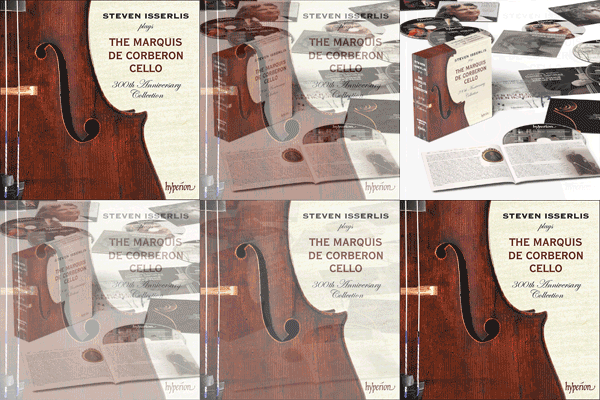


Two generous, comprehensive and scholarly booklets present all the original album notes alongside special essays. In the first of these, My life with the Marquis, Steven Isserlis opens our eyes to the challenges, obstacles, and myriad joys of tramping the globe with such a priceless instrument. Historian Rowena Anketell then presents a fascinating account, The real Marquis de Corberon, of this particular instrument’s history and its journey after its first owner, from whom it takes its aristocratic name, fell victim the French Revolution’s guillotine. At the Royal Academy of Music gives insights into the challenge of owning a priceless instrument while ensuring its unique voice can remain heard around the world rather being than stuck behind a glassy museum case. And that’s all in addition to 10 CDs of the most gorgeous cello music.

Pierre-Philibert-Catherine de Bourrée (born 1746), the first Marquis de Corberon, was a soldier, a member of the Gardes françaises (not a diplomat as is sometimes reported: that was his younger brother, Marie Daniel, who was posted to the Russian court of Catherine the Great). But he was also an enthusiastic amateur viola player, at the centre of musical life in Paris in the last years of the Ancien Régime. He was one of the founding members in 1781 of the masonic Loge de l’Olympique de la Parfaite Estime, which gave twelve concerts a year to an audience of subscribers, several of which took place in the Tuileries Palace. The Loge commissioned Haydn’s ‘Paris’ Symphonies (Nos 82-87) which they performed in the presence of Queen Marie Antoinette; Pierre-Philibert played in the first desk of violas. Rather touchingly, after he was arrested in 1793, the Marquis continued to play and entertain in very different surroundings (albeit now apparently on the violin rather than viola). Claire (later Duchesse) de Duras, a fellow prisoner at Chantilly and fortunate enough to survive the Revolution, recalled in her memoirs: ‘What is almost impossible to understand, unless you witnessed it, is that you could hear the prisoners playing instruments and singing in chorus … while, apart from the guillotine, we were threatened with perishing by fire and water … We strolled on the third floor on the lead terrace; Mademoiselle de Pons played the piano accompanied by the violin of Monsieur de Corberon, an officer in the French Guards who was guillotined, and pleasantly held the attention of the strollers.’
What happened to the cello after the Marquis, who is presumed to be one of its first owners, was guillotined in 1794? This is something of a mystery and no clear picture emerges. According to one source, Pierre-Philibert was the owner of not one but seven Stradivari (including a viola of 1717 now belonging to the Portuguese state), but this has not been verified. There are extensive lists of instruments taken by the Revolutionaries, but this cello does not feature among them. An inventory for the sale of the family estate in December 1794 mentions ‘a harpsichord with its music stand valued at one hundred livres’ and ‘three cases and four violins valued together at twenty-four livres’—but again no cello. Perhaps it was somehow smuggled out? His seventeen-year-old son and heir Armand (1777-1794) also perished by the guillotine and it was the surviving son Daniel-Jean-Charles (1780 -1868) who inherited the title. Daniel was later the dedicatee of the Trois melodies pour le violoncelle avec accompagnement d’orgue expressif by Alexandre-Pierre-François Boëly (1785-1858). Could the cello have somehow made its way into Daniel’s hands and been the instrument for which the Trois melodies were written? We may never know the answer.
From Loeb to Isserlis
The next certain attribution of the Marquis de Corberon is to the French cellist Jules-Léopold Loeb (1852-1933), soloist at the Orchestre de l’Opéra de Paris and later cello professor at the Paris Conservatoire. Interestingly, given Steven Isserlis’s well-known affinity with the music of Gabriel Fauré, Loeb was the dedicatee of the Élégie and gave the first performance of it with the composer at the piano at the Société nationale de musique in December 1883. He also created the cello parts of Saint-Saëns’s Piano Trio No 2 in 1882 and the revised version of Fauré’s Piano Quartet No 1 two years later. A contemporary wrote of the ‘beautiful sonority’ of his playing and ‘the elegance of his style’; it is very possible that the instrument on which he played at those premieres was the Marquis de Corberon.
The cello then passed to the German cellist Hugo Becker (1863-1941), described by Hans von Bülow, who played trios with him and Joseph Joachim, as the only cellist ‘who plays with virility’ (although the famous Russian cellist Gregor Piatigorsky describes the sound rather less flatteringly in his Memoirs). Becker sold it in 1907 to a Mr Chapman, for his daughter Elizabeth.
In 1960 the cello was bequeathed to the Royal Academy of Music, who offered the use of the instrument to the Canadian cellist Zara Nelsova (1918-2002) for her lifetime. It is possible that this was always the intention. Audrey Melville, the previous owner, had served on a committee which had helped Nelsova as a child, and they met in London years later. In an interview Nelsova related that in 1960 she had received a letter (actually written in 1953 but to be delivered posthumously) in which Melville indicated her wishes for Nelsova’s future involvement with the cello.
It seems fitting that the Marquis de Corberon should now be played by Zara’s own friend, Steven Isserlis. As she once said: ‘All cellists adore each other … We all know how difficult the instrument is, how much we’ve gone through to master it. This knowledge and appreciation makes us very close.’
Rowena Anketell © 2026
Actually, two aristocratic beings: in later years, Zara would become a good friend, whom I saw a few times when she visited the Royal Academy of Music (to which her cello actually belonged); once when she participated (at my invitation) in the chamber music seminar in Prussia Cove, Cornwall; and on several occasions in New York, where she lived for the last years of her life. One thing happened at Prussia Cove that in retrospect was prophetic: Zara was playing Dohnányi’s string trio at a house concert; after the first movement, my bestest friend (since I was 16), the cellist David Waterman, turned to me and announced: ‘That’s the cello for you’. (I had no idea at that point, of course, that one day the Marquis would fall into my evil hands.) My two final visits to Zara in New York also remain with me. She was then suffering, alas, from her final illness. On the first occasion, she was lying in bed—with the cello lying next to her. On both visits, we had really wonderful talks. She was such a special person—and musician. Her playing was unique—a glorious sound, an unassailable technique and an overflowingly warm heart. No wonder that she was the favourite cellist of Ernest Bloch, and many others. Her recording of Bloch’s Schelomo with the composer conducting remains a benchmark.
I first started playing on a Stradivarius around 2000, when I acquired the De Munck (or Feuermann) cello on loan from the Nippon Music Foundation of Japan. It was a picturesque instrument, smaller than the standard model, delicately shaped and covered with varnish of a radiant reddish-brown. The quality of the sound was beautiful, of course—but perhaps more of a light (if powerful) tenor than a basso profundo. When, around 2009, the Royal Academy offered me the loan of the Marquis de Corberon (or Nelsova) Strad, I had the chance to play the two cellos side by side. The differences between them were as striking as those between two siblings of whom it is hard to believe that they emerged from the same womb. Two utterly different souls, in fact, as far apart in tonal qualities as in looks. The Marquis is on the large side, of a dark rich brown hue; the essential timbre is of a romantic bass. Well, perhaps it’s not surprising that he’s larger and deeper-voiced; after all, he’s had four more years to grow and for his voice to break—these things can make a difference.
I fell in love with the Marquis—impudent commoner that I am—at first touch; and have remained so ever since. I have only to think of a colour and the Marquis produces it. The only thing that he refuses to countenance (I think of the Marquis as a ‘him’, not merely because of his name, but also because of the depth of his voice) is being hit—as in, say, the first Shostakovich concerto; perhaps, having suffered through his eponymous owner being guillotined, he has an understandable fear of violence (and possibly of violins too—fair enough). So for works involving percussive playing, I usually take to my other cello, which is set up with steel strings. (These are the sort of strings that are most widely played today, having gradually taken over the musical world since the Second World War; but I, being a dinosaur, still prefer mostly to play on natural strings, made from sheep gut, which were in universal use when the great instruments of the past were made. Apart from the mellower sound and the more—to my mind—organic style of playing they encourage, the lower pressure they exert is much healthier for old instruments. I like to imagine that the Marquis is grateful that I don’t cover his face with four lines of barbed wire.)
The visual beauty of the great instruments is such that they could with some justification be kept as museum exhibits; but to deny them their voice would be nothing less than cruel. These instruments want to vibrate freely, to sing with their hearts and souls (or soundposts—the Italian word for soundpost is ‘anima’, the same word as for soul). I am so glad that the Marquis, along with most of his surviving siblings, is in use as an active concert instrument; it’s as it should be. Of course there are, admittedly, down sides to having the care of such a treasure. Travelling with him is not without its stresses, to put it mildly; the responsibility would drive me mad were I to allow myself to think about it too often. And, like most aristocrats, he is demanding: he insists on sitting in the window seat on planes; he sulks, and refuses to talk to me, if we arrive somewhere and the humidity or temperature are too high or too low; and he requires frequent medical attention. But when he’s happy, and that unique sound of his is ringing out freely, these worries fade into insignificance. I look down at him, and it really seems that he is smiling at me through his f-holes. At that point, nothing else in the world matters; making music with the Marquis feels like the ultimate joy.
Steven Isserlis © 2026