Welcome to Hyperion Records, a British classical label devoted to presenting high-quality recordings of music of all styles and from all periods from the twelfth century to the twenty-first.
Hyperion offers both CDs, and downloads in a number of formats. The site is also available in several languages.
Please use the dropdown buttons to set your preferred options, or use the checkbox to accept the defaults.


Past and present elide in Jan Sandström’s memorable arrangement of Es ist ein Ros’ entsprungen. The Swedish composer heads back to 1609 and Michael Praetorius’s four-part setting of the old German hymn, slowing it down so the tune seems to stretch out into time and space, suspended in a cloud of harmony. A small first choir sings the hymn tune, while a second choir, in eight parts, layers up a wordless bed of sound. The effect is spellbinding.
For its Choral Inspirations project of 2019, the vocal ensemble Sonoro invited six composers to respond to a choral classic, aiming to create accessible but not simplistic works that would encourage amateur choirs to sing contemporary music. The result is a treasure trove including Cheryl Frances-Hoad’s atmospheric Bogoroditse Devo (‘Rejoice, O virgin’). The opening undulating motif, which rolls through the whole carol, echoes a musical idea from Rachmaninov’s setting of the same text in his All-Night Vigil.
Frances-Hoad isn’t the only composer in this programme to have taken a musical seed from one piece and transformed it into another. During the early twentieth century, the folk singer, archivist and composer John Jacob Niles was travelling the Appalachian Mountains, collecting music—the US counterpart to the English folk song collectors. While in the town of Murphy, North Carolina, he heard a girl named Annie Morgan singing the single line of a song. She repeated it seven times, in exchange for quarters. Niles left, in his own words, with ‘three lines of verse, a garbled fragment of melodic material—and a magnificent idea’. These alchemized to become I wonder as I wander, a Christian folk hymn, often sung at Christmas, that’s caught the attention of musicians as varied as Barbra Streisand and Luciano Berio. It is a song of solitude and serenity, of open skies and spiritual wonder. Andrew Carter’s arrangement for unaccompanied choir was first performed in the 1980 Festival of Nine Lessons and Carols from King’s College, Cambridge.
As one of the editors of the English Hymnal of 1906, Vaughan Williams invited his friend Gustav Holst to contribute several hymns, including In the bleak mid-winter. Based on Christina Rossetti’s eponymous poem, first published in 1872 under the title A Christmas Carol, Holst’s setting captures the humble spirit and introspective mood of the text. He called his hymn tune Cranham, after the Gloucestershire village his grandparents lived in, and which he made his own home for a while.
Two visionary English artists centuries apart meet in The Lamb, Sir John Tavener’s 1982 setting of William Blake’s 1789 poem from the collection Songs of Innocence and Experience. It is a carol to be performed ‘with extreme tenderness—flexible—always guided by the words’, says Tavener, and was written for his nephew Simon’s third birthday. According to the composer, it took just fifteen minutes to write, while being driven by his mother from South Devon to London. The anthem addresses the ‘little lamb’, who turns out to be the Lamb of God.
Franz Gruber was also writing at pace when, in 1818, he was asked by Father Joseph Mohr to set his poem Stille Nacht for Midnight Mass—later that day. Perhaps speed can be the mother of invention, as Gruber succeeded in style, and the carol remains a popular favourite. The arrangement by Steven Grahl, Director of Music at Trinity College Cambridge, begins with the tenors intoning one note, like the tolling of a bell, which develops into a gentle rocking motion as the other voices join in. The altos also take a starring role in a heavenly central section, for which the music modulates into a brighter key.
The peal of bells shapes the Carol of the bells, with its staccato ostinato theme, ding-dong accompaniment and final chiming bass note to play us out. The carol was written by the Ukrainian composer Mykola Leontovych in the first years of the twentith century and is based on a motif from traditional Ukrainian folk music. Shchedryk, to give its Ukrainian title, was originally a new year’s carol, associated with springtime. It was first heard in Europe in 1919 and the US in 1922. The Americans took the carol to their hearts and in 1936 composer Peter Wilhousky wrote English lyrics for the music and arranged it for orchestra, its melody reminding him of handbells. Ever since, it has been linked indelibly to Christmas.
O leave your sheep is a 1962 carol by Kenneth Leighton, who did much to preserve and bring up to date the British church music tradition. Here he turns to a traditional French carol text, translated into English by Alice Raleigh, and tune, known as Quittez pasteurs. His rich, radiant arrangement expresses the text’s message of reassurance and love, leading to a majestic peroration in which kings are urged to bring myrrh, frankincense and gold to the baby Jesus.
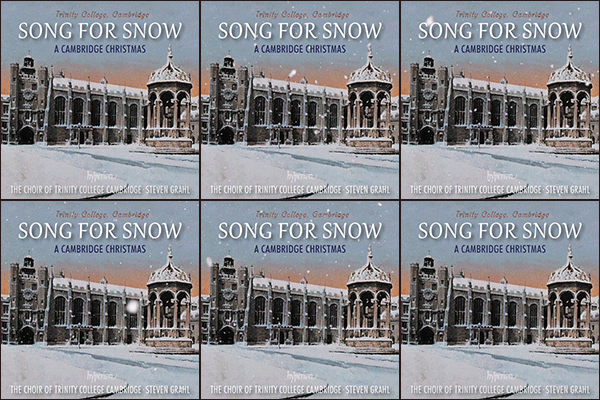
We’re given a child’s view of winter in Florence Price’s Song for snow, a setting of a poem by Elizabeth Coatsworth, a prolific and popular twentieth-century American children’s author. Over a simple, sometimes onomatopoeic piano accompaniment, her unfussy vocal lines capture the innocent joy of being outside in a snowy landscape filled with the sound of sleigh bells.
Long, long ago is one of two unaccompanied carol-anthems Howells wrote for the Lady Margaret Singers, a student choir in Cambridge, in 1950 (the other is Waiting for snow). As the title suggests, there’s a yearning quality to the piece, expressed in Howells’s flexible phrases and rich harmonies, as we look back to Christ’s birth in Bethlehem. The text, full of imagery, was written in 1940 by John Buxton when he was a prisoner of war in Bavaria and published in 1944 in the collection Such Liberty. Howells also harked back to his own past with his choice of the hybrid carol-anthem, looking back two decades to his popular Three Carol-Anthems, including A Spotless Rose.
We move seamlessly from a timeless present to the past in Sally Beamish’s In the stillness (2007), which sets an original text by Katrina Shepherd. There’s a naturalness to both words and music that is immediately appealing, painting a picture of a candlelit church in the fresh white snow. Over the course of the carol, we’re transported to a stable and a cradle, and to that precious moment of anticipation before a child is born.
‘Candlelight, angel light, firelight and star glow’ flicker too in Sir John Rutter’s Candlelight Carol, written in 1984 for the Church of the Assumption in Pittsburgh. Rutter was inspired by Geertgen’s Nativity at Night oil painting of circa 1490, in which the Virgin Mary gazes down at the baby Jesus with great love, angels and shepherds in the background. With both words and music by Rutter, the Candlelight Carol is one of his characteristically heartfelt and deft creations.
Joining the rich seam of contemporary carols inspired by the past is Francis Pott’s Balulalow, a gem written in 2009. The British composer sets a sixteenth-century text attributed to James, John and Robert Wedderburn, which has also been set by John Gardner and Peter Warlock. The music is warm and heartfelt, with a soprano solo soaring above, ideal for a ‘balulalow’, or Mary’s lullaby to Jesus.
Where Pott offers comfort, Errollyn Wallen’s Peace on earth explores unease. The haunting mood of this 2006 carol is set up by the pianissimo piano ostinato, over which unfolds a unison vocal line of simple beauty, beginning almost mid-conversation with the line ‘And snow falls down on me’. Wallen wrote her own text, which is full of sharp images and punctuated by an incantatory three-note refrain stating the carol’s central message and plea for ‘Peace on earth’.
Piers Connor Kennedy is both composer and singer, and in January 2025 joined The King’s Singers as a low bass and its 29th member. His Hym worship we now borne so fre was commissioned in 2024 by Wells Cathedral Choir, where Kennedy was once a choral scholar, and draws on a fifteenth-century text. His contemporary-meets-medieval carol is both, as its performance markings suggest, spritely and cheeky, with fa-la-las and rhythmic games giving it an irresistible energy.
The prolific English composer and pianist Elizabeth Poston led a double life, working as a secret agent during the Second World War. Employed by the BBC, she sent coded messages in music across Europe to the resistance. Clues about this role remain tantalizingly scant, and instead she is best remembered for Jesus Christ the apple tree, her setting of an anonymous eighteenth-century English text, published in The Cambridge Hymnal in 1967 and first broadcast from King’s College Cambridge that same year. It is a disarmingly simple carol yet, in the words of friend and fellow composer Malcolm Williamson, ‘perpetually unpredictable … and radiantly rich’. He continued: ‘After one has performed it a few times the unpredictability vanishes and one says, “But of course! It had to be like that!”’
Dancing angels sang In dulci jubilo to a German monk one Christmas Eve in the fourteenth century, or so the legend goes. Heinrich Suso, known as the ‘Servant of the Eternal Wisdom’, wrote down the carol, which has been arranged many times over the centuries since, including as here by Robert Lucas Pearsall, an English amateur composer. His double-choir setting retains a dancing feel, while he translates the German portions of the macaronic text into English.
With her new setting of Away in a manger, Lucy Walker turns away from the simple innocence of the two well-known settings, beloved of school nativities. Instead, the British composer intends to offer ‘a darker interpretation of the carol’, reflecting ‘the sometimes-forgotten humility and darkness of the nativity scene’. It opens with the hum of a lilting lullaby, balances dark and light in its harmonies and melodies throughout, and ends with a sense of hope.
The programme concludes with another carol by Cheryl Frances-Hoad. Good day, Sir Christemas! was commissioned in 2015 for the readers of BBC Music Magazine, and has a ‘fabulous jauntiness’ to it, in the composer’s own words. Her text is from the Selden Carol Book, with the fifteenth-century English modernized by Eleanor Parker. ‘The main thing with this carol is to have fun’, says Frances-Hoad. ‘I imagine the beginning (and all of the ‘Good day’ passages) to be the singers welcoming not just Sir Christemas but each other.’ It’s a case of merriment all round.
Hyperion Records Ltd ©