Welcome to Hyperion Records, a British classical label devoted to presenting high-quality recordings of music of all styles and from all periods from the twelfth century to the twenty-first.
Hyperion offers both CDs, and downloads in a number of formats. The site is also available in several languages.
Please use the dropdown buttons to set your preferred options, or use the checkbox to accept the defaults.
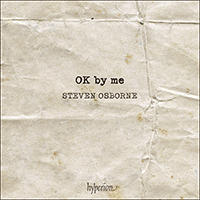


I’ve played most of these pieces as encores, but not all. If I only put my actual encores on this disc, the collection would be a rather sleepy affair. Playing the piano is hard, and when I get to the encore I want to be able to relax, hence almost all my regular encores being on the slow side. There’s another reason—I love the communion with an audience that intimate pieces can create. Introspection is my natural territory, and I’m happy to play to that strength.
Try as I might, I could not create a track order which was coherent both for audio and text, so I’ve allowed the orders to diverge. All the titles below have track numbers included to make them easier to find. With that, let’s begin.
I was born in West Lothian, Scotland, to a pharmacist mother and a civil engineer father, with an older brother and a golden retriever puppy to complete the nuclear family. Music started to obsess me from a young age. One of my earliest memories is of mum’s musical jewellery box, complete with twirling ballerina; it had a magic which Liadov’s Musical Snuffbox (track 4) beautifully captures.
As a toddler, my world was already becoming centred around our living room’s towering upright piano. I loved picking out nursery rhymes by ear, stretching up to play keys I couldn’t even properly see. I would run to the piano as soon as I woke up (maybe 4.30 or 5am). My poor dad would appear bleary-eyed and escort me back to my oh-so-boring bed. Eventually came the dreaded note on the piano, requesting I refrain from playing before 7am. I was a good but frustrated boy for those early hours …
I started piano lessons at the age of 4 and I’m told I made quick progress, racing through A Dozen a Day and other instruction books. I don’t remember much about this, though one memory is very vivid—my teacher asking me to simultaneously play one hand loud and the other soft. What a challenge for my little brain! I can still remember the feeling of struggle and then the pleasure of mastery.
There was a lot of music at home with many an evening spent listening to records, often musicals. I loved Oklahoma! especially. My parents enjoyed classical music too. I remember one day my mum hearing the radio and commenting, ‘That sounds like Dvořák’. I was mystified how she could tell. Both my parents played piano, and my brother Kenneth and I would listen with pleasure as they duetted together. Bach’s Sheep may safely graze (track 2) was one of my favourites. Dad also improvised, simple and heartfelt. Kenneth played cello, alongside listening to punk and heavy metal. Eventually my parents decided the piano and the TV had to be segregated, so they split the living room in two with heavy sliding doors, allowing Beethoven and Coronation Street to coexist.
When I entered Edinburgh’s St Mary’s Music School at the age of 10, I felt like Harry Potter arriving at Hogwarts: I’d found where I belonged. It was a ramshackle place with only forty students, and I was greatly inspired by the staff. Chief among them were my piano teacher Richard Beauchamp, a very humane and musical man; my gently anti-establishment physics teacher Christine Soane, who once encouraged us to put a brick through our TVs; and the head of music Nigel Murray, who conducted the school orchestra with huge enthusiasm and periodically took us hillwalking in the Scottish Highlands. All became lifelong friends.
It’s common for budding music students to develop a little repertoire of party pieces that get wheeled out for extended family, little concerts and the like. The most significant of these for me was Grieg’s Butterfly (track 3) which figures in many pre-teen memories. I once had to perform it on an unfamiliar piano, and when I reached the final note, the lowest note of the piano, it was a whole tone flat. Apparently my face was a picture. I was asked at 24 hours’ notice to play for a local Richard Clayderman concert and I prepared the Grieg, only to be told the next day that they’d changed their mind. I wept, and my lovely schoolmates comforted me. The piece also figured in my first TV appearance at the age of 9, playing for the Scottish cartoon show Glen Michael’s Cavalcade. Glen asked me who my favourite cartoon character was and I answered ‘Bugth Bunny’. ‘OK great’ he answered, ‘now let’s have some Daffy Duck’. I was not impressed.
One of my fellow students at St Mary’s was the pianist and composer James Clapperton. At a school lunchtime concert four of us premiered his charmingly titled We Are The Dead for two pianos and two percussionists, the latter playing a bunch of metal objects James had found in a junkyard. The climax was a two-minute improvised cadenza with the instruction to play ‘as many notes as loud as possible’. As fun as that was, it belied the subtle depths that would soon emerge when his music started absorbing Scottish folk idioms. Haar (track 7) was one of his first pieces in this vein.
I was very aware of my Scottishness as a child. What does it mean to viscerally feel oneself a certain nationality? It’s a very difficult question. I just knew that I felt a subtle but deep pleasure in my roots. At 16 I went with my two-piano partner, David Horne, to the St Magnus Festival in Orkney. The stunning, stark beauty of the main island was unforgettable, especially watching the midnight sunset from Skara Brae. There was a glitch in our concert. Having left the sheet music for the encore in Edinburgh we had to make do with a faxed copy, but the flimsy 1987 fax paper started falling off the piano during the performance which led Sir Peter Maxwell Davies to leap up from the front row and hold it in place for us, much to everyone’s amusement. Maxwell Davies was a wonderfully maverick figure, reflected in an almost unbelievable compositional range, from the anarchic Eight Songs for a Mad King to the simple Scottish Farewell to Stromness (track 8).
Once I reached 15, my piano teacher felt I would benefit from a different style of teaching, and so I started studying with Renna Kellaway at the Royal Northern College of Music in Manchester, travelling down every couple of weeks until I finally became an undergraduate student there. Renna was an astute musician and very generous with her time, and she gave me the technical tools I needed to make the transition from student to professional. However, we often argued about interpretative details. My crowning moment of disagreement came very early. I had learned Beethoven’s ‘Waldstein’ sonata for the Orkney trip mentioned above, and was captivated by the very long pedals that Beethoven wrote for the last movement theme, creating an amazing blur effect. Renna was not convinced, and did her utmost to get me to change the pedal more often than Beethoven indicates, saying, ‘It just doesn’t work on modern pianos!’ (Modern pianos are more resonant than those of Beethoven’s time, making the blur more pronounced.) I refused to budge. When the review of the concert specifically mentioned how wonderful the pedalling was, I triumphantly brought it to my next lesson. Renna, bless her, just laughed.
I wasn’t only studying at the RNCM. My parents had persuaded me to apply for the joint music degree between the RNCM and Manchester University, so I’d have more options if the performing didn’t work out. I was tired after high school and apprehensive about having to work so hard, but I reluctantly agreed. What an important decision that was. My professor there was Ian Kemp, best known as a Berlioz and Tippett scholar, and his musical outlook had a profound impact on me. He made such a clear connection between analysing music and experiencing its emotional meaning. He was one of the deepest and most intelligent musicians I ever encountered but he wore his knowledge very lightly. When learning Brahms’s Piano Concerto No 2, I was confused by the initial tempo marking ‘allegro non troppo’ (‘fast but not too much’), because the opening is often played slowly, with portentous chords lumbering up the piano. When I asked him what he made of the seeming discrepancy, Ian suggested ‘Maybe the piano chords are just a nice noise’. It was a beautifully simple way of capturing an insightful idea.
My Improvisation on the final chord of Sir Michael Tippett’s The Ice Break (which is an actual improvisation, track 15) is the best I could do to pay tribute to Ian and all the other teachers who have influenced me. I must add three further names: Arnaldo Cohen, a wonderful pianist and teacher who helped me explore the ergonomics of piano playing; Robert Mann, for many years the 1st violinist of the Juilliard String Quartet, who with a single sentence could give me material to chew on for a year or more e.g. ‘The only thing your performance lacked was wildness’; and Charles Rosen who told me the greatest thing I ever heard about interpretation: ‘Nothing’s happening here, so don’t do anything.’
One of the greatest joys of the music profession is working with one’s colleagues. Sicilienne (track 13, traditionally—if erroneously—attributed to Maria Theresia Paradis) is a piece which I loved playing with my very first musical partner, my brother Kenneth. I must confess that for a long time I was not a good collaborator. Even in my late 20s I remember a friend’s utter exasperation when I kept ignoring his timing. Simply put, I didn’t have much curiosity about others’ musical viewpoints. Pianists can be an insular bunch—we spend so much time on our own. Once I realized that there are many different ways of approaching music I had much more fun playing with others, and I also started learning from their playing. For example, Alban Gerhardt helped wean me off rigid metronomic precision; my wife Jeannie introduced me to the speech-like qualities of melody; Paul Lewis’s rhythmic characterization was inspiring; Christian Tetzlaff’s subtlety blew my mind. I’ve found this borrowing of others’ strengths happens more easily when there’s a sense of trust during rehearsals, and perhaps that’s no surprise because it requires significant vulnerability to accept that some of your musical instincts might be superficial.
Working with conductors is a very particular kind of collaboration. Stories of huge conductor egos proliferate in classical music lore, but happily I have very rarely come across such figures. In fact, the issue I more commonly experience is conductors simply deferring to whatever I want. While it can be a sign of generosity, sometimes I fear it betrays a lack of interest in the concerto. I’d much rather conductors fight for their point of view so that we can find the best possible compromise together. I always learn something when this happens.
From time to time a student will ask me how to build a career, and it’s a hard question for me to answer because as a student I was absolutely not ambitious. I loved learning repertoire but it hardly occurred to me that I should be planning for what might happen when I left college. So I was lucky that someone else was doing this thinking for me. I entered the Clara Haskil competition at Renna’s suggestion, and I won! The next competition, in Dublin, resulted in a first-round elimination. This was clearly a bizarre error. When the same thing happened in the Rubinstein competition, reality started to dawn. Van Cliburn yielded the same depressing result. Then I won Naumburg. It all felt very random at the time, and now—having sat on numerous competition juries—I realize that to a degree it was. Juries very often find themselves to be hopelessly divided once the results become known.
Luck figures in many ways during a musician’s career. One of my happiest strokes of luck was playing Poulenc’s Novelettes (tracks 18-20) at a recital in Luton. An attendee reported back to the Wigmore Hall’s William Lyne, who was in the middle of planning a Poulenc gala, and so started a long association with one of the most wonderful halls in the world. In fact, I had already played at the Wigmore aged 10, auditioning for the Martin Scholarship Fund to help raise the music school fees. I’d never played on a great piano in a world-class hall before and I was so shocked by the incredible sound that I almost stopped playing after the first note.
Another stroke of good fortune was Hyperion Records’ sales and marketing manager, Mike Spring, noticing I’d played Mackenzie’s Piano Concerto at the Edinburgh Festival in 1998. He invited me to record it. I hesitated because it meant learning another barely known concerto as the coupling, but my manager told me ‘If you don’t agree to this then you’re an idiot because they’ll ask someone else and you’ll have missed your chance’. I’m forever grateful for that intervention. Mike is a true pianophile and I’ve learned a lot from him about piano playing and repertoire. Doucet’s wonderfully irreverent Isoldina (track 9) was one of his suggestions.
When I started recording for Hyperion I was extremely focused on the precision of small musical details, but this changed after a pivotal moment, listening to the first edit of my Musorgsky/Prokofiev album. I was surprised to find it boring, because I remembered feeling very engaged during the recording sessions. I soon figured out that my attempts to get the interpretation perfect during the sessions had robbed the music of raw feeling. For the first time, I got seriously involved in the editing process and requested more of the earlier, less perfect takes. I was much happier with the resulting album, which changed my priorities in subsequent recordings.
This illustrates a theme I see in my musical development over the decades, the movement from perfectionism to engagement. When I was younger, I was terribly preoccupied with doing things the ‘right’ way. I would ask myself questions like ‘Is this the right speed?’, as if there were some external law to be obeyed. I think this rigidity started to loosen because of improvising. It was a slow process which started with playing jazz transcriptions in my teens. I particularly enjoyed Bill Evans, Art Tatum and Oscar Peterson. Then came a college obsession with Keith Jarrett, whose album Vienna Concert (track 23) was the inspiration for one of my most beloved encores. Jarrett famously would improvise entire concerts from scratch, and inspired by this towards the end of my college days, I plucked up the courage to improvise a little in public. Renna tried to dissuade me because she thought people would think I was weird, but to no avail. I remember clearly that moment seated at the piano just before I started, having no idea what I was going to play and suddenly finding an idea pop into my head, and then as I played, another, and another. It was a wonderful experience.
Years of improvising changed my relationship to music. As Charles Rosen observed, a piece of music doesn’t exist as a monolith: it emerges in time, moment by moment. Improvising put me intimately in touch with this sense of emergence, with what music wants to do, so to speak. The shift felt a bit like moving from being an observer to being a protagonist. Once I had digested how music could capture the most fleeting shifts in feeling as I improvised, classical scores opened up for me in a new way, and I felt their emotional and structural fluctuations much more vividly.
Over the years I’ve given many workshops on improvising, and once I even taught it for a semester at the University of Connecticut. Very often students are nervous. There are many ways to help reduce the self-consciousness, but their sense that they are doing something alien is striking, because improvising is such a natural human faculty. Look what happens when you put a young child in front of a piano. The tragedy is that this innate, joyful creativity is often suppressed through dogmatic teaching or self-censorship. I think the musician who never creates their own music is a bit like a person who only speaks words written by others. It’s almost impossible to conceive of the latter, so why does the former seem so natural? Certainly, from a historical point of view, it’s strange: Bach, Beethoven and Mozart would have been very surprised by the idea of a musician who didn’t improvise at all.
One day while I was improvising, the melody of my piece OK by me (track 1) emerged fully formed and I rushed to write it down before I forgot it. Creativity may indeed be ten percent inspiration and ninety percent perspiration, but how do we account for that ten percent? I can only offer the beginning of an idea. I recall various late night conversations with friends, feeling full of trust and discovering thoughts and feelings in myself that I hadn’t been able to articulate before. I suspect that a similar openness underlies moments of spontaneous creativity. It doesn’t feel like thinking, but rather a knowing in one’s body which spills out. I’ve occasionally tried composing over the years, but no amount of effort has led to anything I liked as much as this simple melody which emerged unsought in a moment of relaxation.
In 2003 I was offered three concerts playing Gershwin’s Rhapsody in Blue with the Singapore Symphony Orchestra. That seemed like an awfully long way to go to play seventeen minutes of music so I said I’d go if they flew me business class. I think this may be the only diva-ish stance I’ve taken in my entire career. Of all the good fortune I’ve had, their agreement was certainly the most significant. I used to do an improvised introduction to the Gershwin and so after the first rehearsal I went to apologize to the clarinettist for preempting her opening entry (that iconic glissando swoop). Jeannie told me months later that when she saw me approach, she thought to herself, ‘Oh boy, here comes the soloist to impart his wisdom’. Happily I didn’t do that and as I write we’ve been married almost twenty-two years. We play recitals together which have included Gershwin’s Three Preludes (tracks 10-12). And Jeannie deserves a second piece—Schumann’s song Widmung (‘Devotion’, track 14) which I played for her as an encore on our first anniversary. I made my own arrangement because I find Liszt’s version rather tasteless. If you’re telling someone how much you love them, so much showing off seems a little indelicate, and a lot un-Scottish.
A few words on the occupational hazards of being a pianist.
It’s solitary, so it helps if you enjoy your own company.
There can be a lot of jet lag. Once I had to play a concert in Japan having had virtually no sleep for 48 hours because every time I was ready to sleep I had a rehearsal.
One’s hearing can take a beating. I’ve had tinnitus since my mid twenties as a result of regularly practising in too small a room. (The sound at a pianist’s ears can reach over 100dB.) I found this very upsetting at first, but once an audiologist told me that the only real problem with tinnitus is the stress caused by fixating on it, I made my peace.
There are hand injuries. I’ve had my fair share over the years, mostly minor, often due to over-practising, and by now I have a good idea what to do when they happen. A fringe benefit of injuries is that they have forced me to learn to do the physical work of note-learning in my head, which has saved a lot of time. Any journey can be practice time. The worst injury was when I ran out of the house to catch the bin lorry, slipped on the ice, and broke a finger. That was a bad day.
There are lousy pianos, one of which was unbeatably awful: an antipodean specimen that literally sounded like it had metal tacks in all the hammers. Playing Prokofiev on it would have been bad enough, but the repertoire was that most gentle and lyrical of pieces, Beethoven’s Piano Concerto No 4. I have two secret weapons against bad pianos. First, I have a mediocre piano at home, which means almost all pianos I play in concert are better than mine and therefore give me at least some pleasure. Secondly, I wear earplugs which partly obscures instrumental inadequacies and helps me focus on the music. I still hear everything, just quieter.
Finally, there are nerves. It’s a bit of a taboo subject, but I know many colleagues who, like me, have had to deal with this issue. One day in my late twenties I was suddenly afflicted with an acute fear of memory lapses. It was an awful experience. I gradually recovered myself, but an unthinking trust was broken. At times that loss has been very painful, but working on the underlying anxieties has enabled me to connect to music in a much richer way, which feels like excellent compensation. I wouldn’t say I’ve fully cracked the issue, but with the help of some skilful therapists I’ve amassed a good collection of tools which help me restore balance when things get shaky. I find Rachmaninov can be fertile ground for anxiety. The physical patterns don’t feel natural to me, but because I adore the music I try to get as comfortable with the flurry of notes as I can. His transcription of Kreisler’s Liebesleid (track 5) seems to me the perfect transcription—subtle, colourful, imaginative, and unselfconscious.
The power of music to inspire devotion is remarkable. Since I reached up to the keys as a toddler I have been obsessed, by the piano itself, and then by a long and developing list of composers. First it was Beethoven, the ‘Pastoral’ symphony and ‘Moonlight’ sonata being particular favourites. Then in my early teens, Ravel, whose music I devoured. Next came Steve Reich. My poor mum hated when I listened to Reich’s music because she found its endless repetitions a torture. I like Meredith Monk’s Railroad (Travel song) (track 21) partly for its echoes of Reich’s harmonic language. Thereafter Messiaen, Schubert, Rachmaninov, Debussy, Tippett and Sibelius. There are many other composers I love, but these are the ones who tug deepest at my soul. I must also mention Joni Mitchell, a joyous music college discovery. How can a single voice combine such perfection and such wild freedom? If I want musical comfort, her songs are often the place I turn. My version of A case of you (track 22) was a response to a promoter requesting something Canadian as an encore.
But why do I love these particular composers the most? Why are Bach, Mozart and Brahms, three obvious omissions, not as essential for me, even though I love their music and obviously all three are greater composers than Tippett? I could offer half-explanations, but in the end there’s something mysterious about how the implicit depths of a particular piece or composer speak to our subconscious. It’s similar to who we fall in love with—why this person and not that? In both situations there is some psychological fit which can’t be fully analysed. Learning a new piece of music often feels to me like a love affair: there’s intense desire, obsessive rumination, great pleasure and openness in interacting with the music, and ultimately a desire to dive deep into its emotional reality and become one with it. Sometimes for career or curiosity I choose to learn music I don’t have that intense love for, but those works are the exception. One obsession which surprised me was Schumann’s Romance in F sharp major (track 6). Schumann is a composer with whom I have an ambivalent relationship, but recently this Romance got deep under my skin and I had to learn it. Why now? I have no idea. Another recent infatuation was Keith Jarrett performing his tune My song (track 16), which I transcribed after months of compulsive listening. Playing it for the first time felt almost like touching something sacred.
It’s probably my puritan Scottish roots talking, but I have no interest in music which is merely pretty or charming. Instead, I’m drawn to music which is emotionally and technically complex. Sometimes I lament this, as I struggle to learn the thickets of notes of my latest obsession, and I rarely have much free time in my practice schedule. So when promoters ask to customize programmes I try to limit such alterations as much as I can. Years ago, one promoter said a recital needed to contain some Prokofiev to reflect the festival theme, and having nothing else remotely in my fingers, I cheekily offered to include just a little Prelude (track 17). He accepted the programme and then complained after the recital about the prelude’s brevity, which felt a little unfair: the clue is in the title, after all.
If I hadn’t been a musician, I think I might have followed my dad into some engineering field—I love exploring how things work. Little gives me more pleasure than solving some trivial household appliance glitch. Over the years I’ve explored the mechanics of practising, interpretation and mentality quite extensively, and it means I not only enjoy the learning process, I also love teaching. I’ve had very few of my own students, but for a long time have held visiting positions at the Royal Conservatoire in Glasgow and Royal Academy in London.
A common issue for students is constant tension, even when playing a single note. Maybe this isn’t surprising since neuroscientists cite piano playing as one of the most complex activities a human brain can perform. It’s easy to get overwhelmed and succumb to generalized tension. The remedy is to practise slowly and mindfully, but this can be painful because then the music doesn’t sound like what the student wants to hear. I’ve found that getting in touch with the physical pleasure of playing efficiently can help students settle into slow practice. On the other hand, I’ve taught many students more physically gifted than me. I’ve even taught a couple who could learn pretty much anything in a week, though I struggle to conceive how that is possible.
Beyond the technical work comes a crucial question: how does one explore what the music means? When I listen to piano competitions, I often hear competitors who to my ears play well but not meaningfully. Sometimes I suspect I’m hearing their teacher’s ideas; sometimes the player seems to be straining to make ever more expressive points without a sense of context; sometimes there’s simply a sense of disengagement.
I think the starting point for a young musician has to be a trust that their own feelings about music are important. This can be daunting, especially when such an attitude is not encouraged by their teacher. How does a student dare put their relatively immature ideas forward when there are so many superlative recordings of the core piano repertoire? But the nettle has to be grasped, for without a belief that their instincts matter, they won’t pay much attention to their responses to the music they are playing, and the visceral communication which grabs an audience will likely be missing. My experience sitting on competition juries has led me to value honest immaturity far above fake profundity.
As a teacher I always try to help students connect with what any given piece of music means to them. There are various ways of approaching this: I might encourage them to sing and move to the music, getting their whole body involved; I might help them create a story that ties together the different elements of the piece; I might do some analysis with them to help them internalize the piece’s shape; I might explore improvising with them. It’s an inexact science, for the process of developing one’s own musical convictions is more intuitive than rational. There is a simple question I very often ask students: ‘What does this bit of music feel like?’ There’s no right answer, but when they allow themselves to connect to their instinctive response, that’s generally when I hear the music come alive. I think that joyful self-expression is one of the most important foundations of a happy musician, and to this end, I believe teachers should receive a student’s disagreement not with displeasure but with delight.
I look back over my student days and career, and see how at different times each of these approaches I use with students enabled a leap forward in my own engagement with music. Digesting what a piece of music means involves balancing the character of each element against the larger shape. I might have an instinct that some melody feels a certain way, only to find I can’t make that feeling fit what comes before or after. So there’s a subtle process of trying to bring all the elements of a piece into coherent relationship, which creates a broader sense of meaning. For example, as I see it the C major finale of Beethoven’s 5th symphony would mean something different if the first movement of the piece were in C major, not C minor—it would be less triumphant. Once on the beach in San Francisco I watched a man create an ad hoc sculpture by precariously placing four or five large-ish stones on top of each other. He minutely adjusted the balance points between the stones for several minutes until the miraculous moment when he removed his hands and this unfeasible tower remained standing on its own. I found that process very evocative of interpretative exploration. It’s possible to find a balance between the elements of a piece of music which makes them suddenly seem to coalesce into a single organism. It’s wonderful when this happens: it feels like flying. When I find this conviction, I feel confident that my playing will communicate.
But how does my conviction connect with the listener? How does music bridge the gap between us? It’s a complex and much-debated question, involving not only the nature of music, but also some deep aspects of our biology and psychology. However, I think it’s clear that part of the answer must lie in our neurobiological capacity to attune to one another’s emotional states. For this attunement to happen in a musical context requires those performing to find coherent feeling and meaning in the music. When it really works, and there is rapt attention during a performance, some deep psychic needs are met—the need for safety, for connection, for stories, for transcendence.
In the end, my performances are an attempt to convey an experience of meaning, that subtle yet potent knowing in our bodies that we are connected to something that is nourishing our emotional lives. I recall a handful of concerts given by others that stay with me years later for their sense of meaning. I can’t know what others take from my concerts and recordings, but certainly my own emotional life has been transformed by my immersion in this most wonderful of art forms, capable of giving voice to our deepest joys, sorrows, fears and hopes. Spending my life sharing music with you, and experiencing together the remarkable human capacity to feel, is a privilege beyond words.
To Simon Hughes and Sheila McCullough, my first teachers, to Chris Tennant, Angela Sulivan and Emma Sweetland, my managers over the years, to Ted and Simon Perry, Dominic Fyfe and Barry Holden at Hyperion Records, to Andrew Keener, Stephen Johns, Simon Eadon and Dave Hinitt, who have produced or engineered so many of my albums, to all the promoters who have invited me, to the very many wonderful musicians I’ve had the privilege of working with over these decades, and of course to everyone who has come to my concerts, listened to my recordings, and encouraged me that what I’m doing is meaningful, thank you all from the bottom of my heart.
For mum and dad.
Steven Osborne © 2026