Welcome to Hyperion Records, a British classical label devoted to presenting high-quality recordings of music of all styles and from all periods from the twelfth century to the twenty-first.
Hyperion offers both CDs, and downloads in a number of formats. The site is also available in several languages.
Please use the dropdown buttons to set your preferred options, or use the checkbox to accept the defaults.
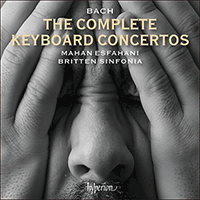


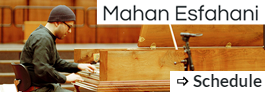
Mahan Esfahani’s mammoth project to record the complete keyboard works of Bach reaches a new high point with The Complete Keyboard Concertos. At every stage in the series Esfahani has sought to challenge long-held assumptions about the composer we seek to know. By teaming up with the Britten Sinfonia, he dispels any assumptions that the harpsichord might be seen as an ‘ancient’ instrument, eschewing period instruments in favour of modern ones.
In his typically scholarly but engaging liner notes Esfahani writes of Bach the trendsetter putting the keyboard front and centre in a concerto for the first time. In addition to his roles as harpsichordist and director, Esfahani adds a compositional feather to his cap with the first recording of his own reconstruction of the “lost concerto” No 8 (BWV1059), once available only as a small fragment.


Indeed, everything about the surviving autograph materials of the keyboard concertos suggests the activity of a composer who took great pride in these specific works as an outward-facing, ‘public’ manifestation of his artistic personality. Not least amongst the singular characteristics of the concertos—which Bach virtually invented as a genre, the modern concerto having been mainly the province of various string and wind instruments—is that they represent the speciality of the Bach family as solo keyboard players for whom keyboard composition was the realm in which to express their most profound musical ideas in an essentially abstract space, in contrast to the bulk of their professional composition which was for ecclesiastical and courtly usage.
The tendency of solo keyboard composition to reflect vocal or orchestral textures that could be recreated by the player in intimate communication with himself and a small group of listeners in a chamber setting thus was upended by Bach’s re-imagining of the harpsichord as an instrument in equal dialogue with an ensemble. As the amateur connotations of keyboard music had connections with the emerging middle class or Bildungsbürger, the elevation of the normally humble accompanying keyboard to the status of soloist was a socially provocative act. Suggesting this is by no means far-fetched or an example of the worst excesses of ‘new’ musicology; as Volker Scherliess has shown, there is a significant body of commentary linking music and politics in the works of baroque music theorists (Volker Scherliess, “musica politica”, in Festschrift Georg von Dadelsen zum 60. Geburtstag, ed. Thomas Kohlhase and Volker Scherliess, Neuhausen-Stuttgart: Hänssler Verlag, 1978, 270-83). Rather than being works on the periphery of Bach’s output, the harpsichord concertos represent a remarkable innovation on the part of the composer to redefine instrumental music against the backdrop of changing social aspects of music consumption. It is fundamentally impossible to understand the concertos without appreciating their social context in this respect; as Alexander Pope tells us: ‘The proper study of Mankind is Man.’
In these concertos, complex keyboard figuration and clever interaction with the instrumental ensemble thus can be heard and appreciated for the striking displays of virtuosity best shown to advantage in public concerts. As with many sets of six in which Bach compiled his other instrumental works, there may even be a sort of narrative being traced over the course of BWV1052 to 1057. The first concerto is in D minor, reminiscent of many a seventeenth-century instrumental collection opening in Dorian mode, and harmonically is relatively conservative with the ensemble textures recalling the consort style of an earlier generation. This is nonetheless the concerto with the most audacious virtuosity for the harpsichordist, perhaps an indication by Bach that his new instrumental genre is firmly planted in both the traditions of the past and the adventurousness of a new age. The first movement of BWV1053 in E major is often essentially a duo between harpsichordist and first violin which gives way to arias both slow and fast in the second and third movements. In contrast to the previous concerto, there is accordingly a greater blurring between the formal elements of Vivaldian concerto form wherein the solo part avoids repeating ritornello material; Bach solves this problem by quoting ritornello material in the first violin alone above the harpsichord’s various solo passages. BWV1054 in D major demonstrates keyboard virtuosity in a light different from that of the D minor’s dark rumblings, with leaps all over the keyboard attesting to the Protean quality of the harpsichord to sing and dance in equal measure.
Then we come to a sort of synthesis of styles in the latter three concertos. The bright energy of the A major concerto BWV1055 derives its sunny demeanour from the interplay between soloist and ensemble along with an exuberantly cantabile solo part (a combination of qualities from BWV1053 and 1054). As with the D minor, the F minor concerto BWV1056 is dark and brooding, but this character develops against the backdrop of an essentially classical texture for the piece throughout with the ensemble part written in a way that maximizes lightness and clarity. And with the sixth concerto in F major BWV1057, Bach shows us that the harpsichord can compete and indeed flourish as soloist in a fully orchestral ensemble with wind instruments. That this concerto essentially reimagines what was a violino concertato part in the fourth Brandenburg Concerto (BWV1049) compiled some two decades earlier is no coincidence, as the Brandenburg Concertos would presumably have been known within the stylistic discourse of the collegium musicum whose members would accordingly have marvelled at the composer’s way of lending the same sort of virtuosic power and clarity to the harpsichord. It also may be Bach’s way of alluding to the extraordinary range of styles found in the earlier collection.
An incomplete second collection?
At some point in the 1740s Bach seems to have again decided to prepare a new collocation of concertos of which we have only one complete concerto (BWV1058, using the same material as the A minor violin concerto BWV1041) and a fragment now catalogued as BWV1059. That both of these concertos were based on pre-existing material—much like five of the six ‘canonic’ concertos BWV1052–1057—surely was no obstacle to the project being finished. It may be that the abortive quality of the second set has some relation to Bach’s having given up the directorship of the collegium musicum for which he most likely had compiled the six original concertos in the first place. Indeed, the general thrust of Bach’s compositional activity in the last decade of his life suggests an increasing lack of interest in ‘public’ music in favour of more esoteric trends, as represented by such works as the second volume of the Well-Tempered Clavier (1744), the Musikalisches Opfer (BWV1079, 1747) and Die Kunst der Fuge (BWV1080, circa 1748-50). Interestingly, the known repertoire of the collegium also included at least one harpsichord concerto by the young C P E Bach, who by the mid-1740s was indeed composing and performing many keyboard concertos at the Prussian court in Potsdam. Could it be that J S Bach, after having brought a wholly new genre into the world, decided to take a step back as more modern tastes prevailed on his home turf?
In the same manuscript as BWV1058, Bach wrote a few bars of an orchestral introduction scored for cembalo concertato and four-part strings with the curious addition of oboe doubling the first violin part. For unknown reasons, the piece breaks off after eight bars, right before the entrance of the solo. Thus we are faced not with a ‘lost’ piece but rather with a rare instance in the Bachian literature of an unfinished one, though one can strongly assume that the concerto would have been closely modelled on the opening organ sinfonia with the same ritornello material (albeit with three oboe parts!) from the cantata Geist und Seele wird verwirret, BWV35 (1726). As with the sinfonias in BWV146 and 169 (see below) the organ part in BWV35 has virtually only an active right-hand part and bare minimum in the left hand. Thus, following Bach’s way of re-using earlier sinfonia material in BWV1052 and 1053, I have composed a left-hand part and added countermelodies and other bits of material in the solo oboe. For the third movement, I have amplified the material from an additional sinfonia for the same forces in BWV35.
Completion of the fragment BWV1059 has been assayed by a number of other harpsichordists, most notably Igor Kipnis and Gustav Leonhardt in the 1960s and, more recently, the English harpsichordist Steven Devine. Each of these is wonderful in its own way, and so I humbly contribute my own solution to the problem of the ‘lost’ concerto in a wholly collegial manner. The Leonhardt recording I have found of particular interest in that he essentially proposes not an implicit scenario of one that Bach would have performed but rather one that simply fills out lost material—hence the second movement, which will never be known and thus is in both his (and my) version se placet (in other words, a keyboard improvisation) followed by a Phrygian cadence in the ensemble. What Leonhardt’s motivations were is not clear, but for my own part I can say that a work such as Luciano Berio’s Rendering (1990), based on a fragment of an incomplete symphony by Schubert, is as much an inspiration as anything by Bach. In both cases, the intriguing energy of the work derives its transcendence from what Giordano Montecchi called the ‘emptiness of what was “not done”.’
The residue of unquestioned wisdom
An aspect of the keyboard concertos often greatly misunderstood is that of the existence of so-called ‘original’ versions of most of the music, not least the violin concertos BWV1041 and 1042 which correspond to the keyboard concertos BWV1058 and 1054, respectively. What Christoph Wolff refers to in his study of Bach’s Leipzig instrumental music as ‘re-shaping’ provides a more helpful context for understanding these correspondences than the unquestioned idea that the keyboard concertos represent somehow less authentic or indeed even less idiomatic versions of earlier works. Likewise, the fact that the autograph performing parts for BWV1041 for violin date to the first few years of Bach’s collegium activity (in other words, the early 1730s!) shows that it is unwise to definitively posit the violin form of the concerto as being more original than the keyboard one (BWV1058). A working hypothesis in which the keyboard concertos are an integral part of the development of Bach’s orchestral style is thus more in keeping with what is suggested by the documentary evidence at hand and sidesteps the covert values suggested by a hierarchy of originals versus so-called ‘transcriptions’, which in any case BWV1054 and 1058 are not.
In the case of BWV1052 and 1053, the earlier versions are in fact organ sinfonias found in cantatas, namely BWV146 and 169, respectively, both of which date from 1726/27. These of course predate the harpsichord concerto versions and are composed with an eye to maximizing the clarity of the material at the organ. Thus, the melodic material is more or less unencumbered by the sorts of left-hand material and counterpoint which would enliven the harpsichord but transform the sustaining power of the organ into mush. That this material is ‘violinistic’ is a fair enough point, but so are practically all the sinfonias featuring organ obbligato by Vivaldi (e.g., RV541, 542, 779, etc.) and Handel (e.g., La Resurrezione, 1708). By the logic of those who refuse to accept the originality of any work at the keyboard with violin figuration, these works are also somehow in need of musicological rescue by way of rediscovering lost models. One is tempted to say, rather, that violinistic figuration is the locus classicus of the Baroque in general.
The nineteenth-century Bach scholar Philipp Spitta, a valuable source for a sort of Bach commentary free from the influence of over-repeated commonplaces that incessantly plague Bach reception, viewed the keyboard concertos through the lens of a greater appreciation for the composer’s use of material throughout his career in different contexts:
These works are, we may say, clavier compositions cast in concerto forms, which have gained, through the co-operation of the stringed instruments, in tone, parts and colour … We shall see that Bach followed out to its extreme consequences the idea of making the clavier the predominant part in a concerto. The germ of this idea may be traced in these compositions [BWV1054 and 1058], even in their original state as violin concertos. For that Bach undertook their re-arrangement merely because he did not care to write new clavier concertos is an assumption utterly contrary to his character and is disproved even by the large number of these re-arrangements. No doubt he felt that the style of his violin concertos was so much moulded by his clavier style that their true nature could only be fully brought out in the shape of clavier concertos. It cannot be denied that many details, and notably cantabile passages, lose in effect in the clavier arrangement; but as a whole we must regard them as new and higher developments, rather than arrangements.
The moot question of superior versions aside, Spitta’s appreciation of these concertos is particularly meaningful in the context of Bach’s own solo harpsichord arrangements of violin concertos by Vivaldi and other composers (BWV972-985) and, of course, the Concerto in the Italian Style, BWV971. In the latter work in particular, Bach’s habit of fleshing out textures with thoroughbass harmonies and animated counter-material exploits the keyboard’s power to evoke the orchestra whilst having the sort of clarity and flexibility that only execution on a solo instrument can achieve. The resulting dialectical outcome is one wherein concerto as a genre becomes a form applied to a solo instrument. As far as the ensemble concertos are concerned, the natural contrast of the plucking mechanism of the harpsichord with the sound of bowed strings only intensifies the distinct quality of the solo part within Bach’s typically ornate scoring. Rather than being the sort of keyboard concertos wherein the soloist is pitted against an ensemble, these are works wherein each component plays in cooperation with the others.
Another concerto?
Alongside the eight concertos BWV1052-1059, we have included the Triple Concerto in A minor for flute, violin, and solo harpsichord BWV1044 bearing an attribution to J S Bach by the Berlin conductor and music teacher Carl Friedrich Zelter in a mid-eighteenth-century manuscript prepared by the Bach pupil Johann Friedrich Agricola (D-B Mus. ms. Bach P249) and likewise in a roughly contemporary set of parts copied out by Johann Gottfried Müthel, another Bach student. The first and third movements of this concerto are based on an earlier Praeludium and Fuga in A minor, BWV894, whereas the second movement is a transcription and amplification of the slow movement of the third trio sonata for organ BWV527.
At the risk of pre-empting a study of this concerto that I plan to publish in a peer-reviewed journal at some point in the future, for a long list of reasons I strongly believe this work in its concerto form to not be by J S Bach, but it is a piece of such refinement and so strongly attests to the power of the Bach Legacy in the generation after his death that I found it impossible to ignore. It is likely that, from the perspective of his pupils, Bach was the author of the concerto in that he was the progenitor of the original material, but this is a discussion beyond the scope of these remarks. What is relevant to the present project is that BWV1044 is fundamentally a treatise of sorts from the Bach Circle that contributes to the development of the genre established by Bach himself.
Over the course of a number of performances of this and the fifth of the Brandenburg Concertos, which shares virtually the same scoring sans one ripieno violin part, our shared experience with the wonderful flautist Tom Hancox was such that I felt BWV1044 to be an integral part of the project as a whole.
Performance issues
For a long time I was inclined to perform the Bach concertos as orchestral works, that is to say with ensembles of ten to even twenty players depending on the hall and other acoustic considerations. I still do this as I see no reason to deprive the mainstream concertgoer of such music simply out of antiquarian anxieties, but ultimately I feel they make their maximum impact on record with an ensemble of one player to each part and the bass line taken up by both violoncello and contrabass. This was indeed the way we performed them throughout many concerts with members of the Britten Sinfonia over the years and most notably during the 2023/4 season at London’s Wigmore Hall when we presented all of the concertos in three concerts. These performances were enlivened by the addition of a guest performer, the lutenist Lynda Sayce, who provided expert and inspiring continuo realizations throughout.
That I should avail myself of one aspect of performance practice in this regard but use modern instruments is neither an error of judgment nor a wilful picking and choosing from the past. Since I have been active in the public realm, with a couple of notable exceptions virtually all of my engagements have been with players of modern instruments. And when not playing Bach I have played a great deal of modern and experimental music which of course is scored for modern instruments. Having lived with my instrument (which by no means have I ever seen as ancient) from the perspective of someone who has experienced a wide range of music, it thus seems natural for me to embrace the opportunity of presenting what I wish to say about the Bach concertos with modern instruments. It may well be that future engagements with period instrument ensembles can foster performances on a level as meaningful as the ones that I achieved with the Britten Sinfonia in particular: both soundworlds—the one that suggests the past and the one that lives in the present—have an important place in our musical world.
Just as the collegium musicum under Bach’s direction was a virtual studio for new musical ideas, the act of performing Bach’s music in our own day operates within a fundamentally discursive space not limited to a single viewpoint. Bach’s invention of the keyboard concerto genre poses aesthetic questions that are very much as urgent as they were in the 1730s, and thus this music engages with the Mendelssohnian view that each generation has a duty to redefine Bach for itself. Those who choose to moralize on such matters are, of course, free to do so. The interpretations heard on this recording were developed through engagement with Bach’s text itself as opposed to an a priori belief in equipment as a substitute for artistic responsibility.
I have long maintained that performing the works of Bach or of any other seventeenth- or eighteenth-century composer on the harpsichord is not intended as a ‘definitive’ approach foreclosing interpretation on other instruments, particularly modern ones. Nonetheless, as Rupert Darwall remarked to me after a performance of a couple of these concertos during the Wigmore Hall series, the use of modern instruments fundamentally liberates the harpsichord from antiquity and thus propels the instrument and its sound into the realm of the immediate and the living. To this observation I add only that the harpsichord used for this recording is, after all, a modern instrument and was designed to be adaptable to the full range of the harpsichord’s repertoire.
Bach’s keyboard concertos are living, breathing works, and will be subject to every greater and smaller fashion for as long as there is a human civilization. This recording is based on the conviction that these pieces represent Bach’s extraordinary prowess as a culmination of all that came before and a focal point from which music and its myriad conflicting discourses emanate. But as we all know, Bach is the sort of phenomenon around whom the chatter is such that in five years everything changes and in two hundred years practically nothing does. And ultimately, whatever our pretensions, we are all nothing more than chatterers around him. He truly is the Alpha and the Omega, and how wrong we would be to seal ‘the sayings of the prophecy of this book’ before its sublime journey through eternity.
Acknowledgements
The genesis of this entire project comes from a very long flight from Beijing to London in 2016 after a Chinese tour with the Britten Sinfonia that included Bach’s D minor concerto, BWV1052. I had the great fortune of sitting next to Jackie Shave, the peerless violinist who led the entire tour and with whom I have since discovered many works both old and new. I have not known any musician with her extraordinary musical and spiritual range as a performer, composer, and improviser, and so in deciding to record all the concertos I felt that only someone like her could lead the ensemble. Fortunately, Providence granted me this wish, with the added benefit of my longstanding colleague and mentor Michala Petri joining us in BWV1057.
Penny Wright has been a guiding light both in the sense of moral encouragement of the project and major practical and financial support in making it possible in conjunction with the longstanding guidance of the ASCA. Meurig Bowen, Hannah Bates, Phoebe Snook, Hazel Shah, Annabel Leakey, Alice Reeves, Nick Brealey, Hannah Williams-Brown and Shoël Stadlen at Britten Sinfonia deserve all the thanks for translating many musicians’ ideas and requests into reality.
Mahan Esfahani © 2026
En fait, tout ce qui concerne les autographes des concertos pour clavier qui nous sont parvenus révèle l’activité d’un compositeur très fier de ces œuvres spécifiques, manifestation «publique» tournée vers l’extérieur de sa personnalité artistique. Notamment parmi les caractéristiques singulières des concertos—que Bach inventa quasiment comme un genre, le concerto moderne étant alors surtout le domaine de divers instruments à cordes et à vent—il y a le fait qu’ils représentent la spécialité de la famille Bach comme solistes sur des instruments à clavier pour qui la composition pour clavier était le royaume dans lequel s’exprimaient leurs idées musicales les plus profondes dans un espace essentiellement abstrait, par opposition à la majeure partie de leurs compositions professionnelles destinées à l’église et à la cour.
La tendance selon laquelle les œuvres pour clavier solo étaient le reflet de textures vocales ou orchestrales pouvant être recréées par l’instrumentiste dans une communication intime entre lui-même et un petit groupe d’auditeurs dans un environnement chambriste fut ainsi bouleversée par la réinterprétation de Bach faisant du clavecin un instrument en dialogue d’égal à égal avec un ensemble. Comme les connotations amateurs de la musique pour clavier avaient des liens avec la classe moyenne émergente ou Bildungsbürger, l’élévation du clavier accompagnateur normalement humble au statut de soliste fut un acte socialement provocateur. Une telle idée n’est en aucun cas tiré par les cheveux ni un exemple des pires excès de la «nouvelle» musicologie; comme le montre Volker Scherliess, il y a des commentaires abondants reliant la musique et la politique dans les œuvres des théoriciens de la musique baroque. Au lieu d’être des œuvres à la périphérie de la production de Bach, les concertos pour clavecin représentent une remarquable innovation de la part du compositeur pour redéfinir la musique instrumentale dans le contexte des aspects sociaux changeants de l’usage de la musique. Il est foncièrement impossible de comprendre les concertos sans appréhender leur contexte social à cet égard; comme nous le dit Alexander Pope: «L’étude correcte de l’humanité c’est l’homme.»
Dans ces concertos, la figuration complexe du clavier et l’interaction habile avec l’ensemble instrumental peuvent ainsi être entendues et appréciées au travers de l’étalage frappant de virtuosité surtout mis en valeur dans les concerts publics. Comme pour de nombreux recueils de six dans lesquels Bach compila ses autres œuvres instrumentales, il y a peut-être même une histoire dont on peut suivre la trace du BWV1052 au BWV1057. Le premier concerto est en ré mineur, comme de nombreux recueils instrumentaux du XVIIe siècle qui débutent en mode dorien; et sur le plan harmonique, il est relativement classique avec les textures de l’ensemble rappelant le style de consort d’une génération antérieure. C’est néanmoins le concerto qui présente la virtuosité la plus audacieuse pour le claveciniste, peut-être un indice que nous donne Bach montrant que son nouveau genre instrumental est fermement ancré dans les traditions du passé comme dans l’audace d’une ère nouvelle. Le premier mouvement du Concerto BWV1053 en mi majeur se limite souvent à un duo entre le claveciniste et le premier violon qui laisse place à des arias toutes deux lentes et rapides dans le deuxième et le troisième mouvement. Par opposition au concerto précédent, il y a donc un plus grand brouillage entre les éléments formels du concerto vivaldien où la partie soliste évite de répéter le matériel de la ritournelle; Bach résout ce problème en citant le matériel de la ritournelle au premier violon seul au-dessus de divers passages solistes du clavecin. Le Concerto BWV1054 en ré majeur montre la virtuosité sous un jour différent de celui des sombres grondements du Concerto en ré mineur, avec des sauts sur tout le clavier témoignant du pouvoir protéiforme du clavecin à chanter et danser à parts égales.
On en arrive alors à une sorte de synthèse de styles dans les trois derniers concertos. L’énergie brillante du Concerto en la majeur BWV1055 tire son comportement radieux de l’interaction entre le soliste et l’ensemble avec une partie soliste joyeusement cantabile (un mélange de qualités des BWV1053 et 1054). Comme le Concerto en ré mineur, celui en fa mineur BWV1056 est sombre et menaçant, mais son caractère se développe sur fond d’une texture essentiellement classique tout au long de cette pièce, la partie de l’ensemble étant écrite d’une manière qui porte au maximum la légèreté et la clarté. Et avec le Sixième Concerto en fa majeur BWV1057, Bach nous montre que le clavecin peut rivaliser et vraiment s’épanouir comme soliste dans un ensemble entièrement orchestral avec instruments à vent. Ce n’est pas une coïncidence si ce concerto réimagine pour l’essentiel ce qu’était une partie de violon concertant dans le Concerto brandebourgeois nº 4 (BWV1049) compilé une vingtaine d’années plus tôt, car les concertos brandebourgeois devaient sans doute être connus au sein du discours stylistique du collegium musicum. Les membres de cet ensemble durent être ainsi émerveillés par la manière dont le compositeur prêtait au clavecin le même genre de pouvoir virtuose et de clarté. C’est peut-être aussi la façon dont Bach faisait allusion à l’extraordinaire multitude de styles trouvés dans le recueil antérieur.
Un second recueil incomplet?
À un moment donné dans les années 1740, Bach semble avoir à nouveau décidé de préparer une autre série de concertos dont nous n’avons qu’un seul concerto complet (BWV1058, qui utilise le même matériel que le Concerto pour violon en la mineur BWV1041) et un fragment aujourd’hui catalogué sous la référence BWV1059. Le fait que ces deux concertos étaient basés sur du matériel préexistant—comme cinq des six concertos «canoniques» BWV1052-1057—ne fut sûrement pas un obstacle à l’achèvement de ce projet, mais il se peut que l’abandon du second recueil ait une certaine relation avec le renoncement de Bach à la direction du collegium musicum pour lequel il avait fort probablement compilé les six concertos originaux en premier lieu. En fait, l’orientation générale de l’activité de Bach en matière de composition au cours des dix dernières années de sa vie semble révéler un manque croissant d’intérêt pour la musique «publique» en faveur de tendances plus ésotériques, comme le montrent des œuvres comme le second volume du Clavier bien tempéré (1744), la Musikalisches Opfer (L’Offrande musicale, BWV1079, 1747) et Die Kunst der Fuge (L’Art de la fugue, BWV1080, vers 1748-50). Chose intéressante, le répertoire connu du collegium comprenait aussi au moins un concerto pour clavecin du jeune C. P. E. Bach, qui, au milieu des années 1740, composait et jouait d’ailleurs beaucoup de concertos pour clavier à la cour de Prusse à Potsdam. Après avoir amené au monde un genre entièrement nouveau, J. S. Bach aurait-il décidé de prendre du recul parce que des goûts plus modernes prédominaient dans son pays?
Dans le même manuscrit que celui du BWV1058, Bach écrivit quelques mesures d’une introduction orchestrale composée pour cembalo concertato et cordes à quatre parties avec le curieux ajout d’un hautbois doublant la partie de premier violon. Pour des raisons inconnues, cette pièce s’interrompt après huit mesures, juste avant l’entrée du solo. Il ne s’agit donc pas d’une pièce «perdue» mais plutôt d’un rare exemple dans la littérature de Bach d’une pièce inachevée, même si l’on peut vraiment supposer que ce concerto aurait été étroitement modelé sur la sinfonia initiale pour orgue de la cantate Geist und Seele wird verwirret, BWV35 (1726) avec le même matériel de ritournelle (quoique avec trois parties de hautbois!). Comme pour les sinfonias des cantates BWV146 et 169 (voir plus bas), la partie d’orgue de la cantate BWV35 n’a quasiment qu’une partie de main droite active et un strict minimum à la main gauche. Ainsi, en suivant la manière dont Bach réutilisa du matériel de sinfonias antérieures dans les concertos BWV1052 et 1053, j’ai composé une partie de main gauche et ajouté des contrechants et d’autres bouts de matériel au hautbois solo. Pour le troisième mouvement, j’ai développé le matériel d’une sinfonia supplémentaire pour les mêmes effectifs que dans la cantate BWV35.
Plusieurs autres clavecinistes, notamment Igor Kipnis et Gustav Leonhardt dans les années 1960 et, plus récemment, le claveciniste anglais Steven Devine ont tenté d’achever le fragment BWV1059. Chacune de ces réalisations sont merveilleuses à leur façon et j’ai donc humblement apporté ma propre solution au problème du concerto «perdu» d’une manière totalement collégiale. J’ai trouvé l’enregistrement de Leonhardt particulièrement intéressant car il propose essentiellement non pas un scénario implicite de ce que Bach aurait joué mais plutôt une version qui se contente d’étoffer le matériel perdu—et par conséquent le deuxième mouvement, qui ne sera jamais connu et est ainsi dans sa version (comme dans la mienne) se placet (autrement dit, une improvisation au clavier) suivie d’une cadence phrygienne à l’ensemble. Les motivations de Leonhardt ne sont pas claires, mais en ce qui me concerne je peux dire qu’une œuvre comme Rendering (1990) de Luciano Berio, basée sur un fragment d’une symphonie incomplète de Schubert, est tout autant une inspiration que quoi que ce soit de Bach. Dans les deux cas, l’énergie fascinante de l’œuvre tire sa transcendance de ce que Giordano Montecchi appelait l’«inanité de ce qui n’était “pas fait”».
Le reste d’une sagesse incontestée
Il y a un aspect souvent très mal interprété des concertos pour clavier, l’existence de prétendues versions «originales» de la majeure partie de la musique, notamment les concertos pour violon BWV1041 et 1042 qui correspondent respectivement aux concertos pour clavier BWV1058 et 1054. L’approche Christophe Wolff, qui considère dans son étude de la musique instrumentale composée par Bach à Leipzig comme du «remodelage», offre un contexte plus utile pour la compréhension de ces correspondances que l’idée incontestée selon laquelle les concertos pour clavier représentent des versions d’une manière ou d’une autre moins authentiques ou même vraiment moins idiomatiques d’œuvres antérieures. De même, le fait que les parties autographes d’exécution du concerto BWV1041 pour violon datent des première années d’activité de Bach au collegium (autrement dit, le début des années 1730) montre qu’il est imprudent de considérer de manière définitive la forme pour violon du concerto comme étant plus originale que celle pour clavier (BWV1058). Une hypothèse de travail dans laquelle les concertos pour clavier font partie intégrante du développement du style orchestral de Bach serait donc plus conforme à ce suggèrent les preuves documentaires disponibles et écarte l’importance occulte d’une hiérarchie d’originaux par opposition aux prétendues «transcriptions», ce qu’en tout cas ne sont pas les concertos BWV1054 et 1058.
Dans le cas des concertos BWV1052 et 1053, les versions antérieures sont en fait des sinfonias de cantates pour orgue, à savoir les cantates BWV146 et 169, respectivement, qui datent toutes les deux de 1726-27. Celles-ci sont bien sûr antérieures aux versions des concertos pour clavecin et sont écrites en vue de maximiser la clarté du matériel à l’orgue. Ainsi, le matériel mélodique est plus ou moins libéré du genre de matériel de main gauche et de contrepoint qui agrémente le clavecin mais transforme en bouillie le caractère soutenu et la puissance de l’orgue. Que ce matériel soit «violonistique» n’a rien d’inextact, mais c’est le cas de presque toutes les sinfonias présentant un obbligato d’orgue de Vivaldi (par exemple, RV541, 542, 779, etc.) et Haendel (par exemple, La Resurrezione, 1708). Selon la logique de ceux qui refusent d’accepter l’originalité de toute œuvre au clavier avec une figuration de violon, ces œuvres ont besoin d’une manière ou d’une autre d’un secours musicologique histoire de redécouvrir des modèles perdus. On serait plutôt tenté de dire que la figuration violonistique est le locus classicus du baroque en général.
Le spécialiste de Bach du XIXe siècle, Philipp Spitta, source précieuse pour une analyse de Bach libre de l’influence des lieux communs souvent répétés qui empoisonnent sans cesse la réception de sa musique, considérait les concertos pour clavier sous l’angle d’une plus grande appréhension de l’utilisation du matériel que fit le compositeur tout au long de sa carrière dans différents contextes:
Ces œuvres sont, pourrait-on dire, des compositions pour clavier moulées dans des formes concerto, qui ont gagné, par le biais de la coopération des instruments à cordes, en ton, en parties et en couleur … Nous verrons que Bach a suivi jusque dans ses conséquences extrêmes l’idée de faire du clavier la partie prédominante dans un concerto. On peut faire remonter le germe de cette idée à ces compositions [BWV1054 et 1058], même dans leur état original de concertos pour violon. Car le fait que Bach entreprit leur réarrangement simplement parce qu’il ne se souciait pas d’écrire de nouveaux concertos pour clavier est une hypothèse tout à fait opposée à son caractère et est réfutée par un grand nombre de ces réarrangements. Il ne fait aucun doute qu’il pensait que le style de ses concertos pour violon était tellement modelé par son style pour clavier que leur vraie nature ne pouvait vraiment ressortir que sous la forme de concertos pour clavier. On ne peut nier que beaucoup de détails, et notamment les passages cantabile, perdent de l’effet dans l’arrangement pour clavier; mais, dans l’ensemble, nous devons les considérer comme de nouveaux et plus grands développements, plutôt que comme des arrangements.
Laissons de côté la question controversée des versions supérieures, l’analyse de Spitta de ces concertos est particulièrement significative dans le contexte des propres arrangements pour clavecin seul que fit Bach de concertos pour violon de Vivaldi et d’autres compositeurs (BWV972-985) et, bien sûr, du Concerto italien, BWV971. Dans cette dernière œuvre en particulier, l’habitude qu’avait Bach d’étoffer les textures avec des harmonies à la basse continue et un contrepoint animé exploite le pouvoir du clavier à évoquer l’orchestre en ayant le genre de précision et de souplesse que seule l’exécution sur un instrument soliste peut obtenir, avec un résultat dialectique où le concerto en tant que genre devient une forme appliquée à un instrument soliste. En ce qui concerne les concertos avec ensemble, le contraste naturel entre le mécanisme de pincement du clavecin et le son des cordes frottées ne fait qu’intensifier la qualité indéniable de la partie soliste au sein de l’instrumentation de Bach avec son ornementation caractéristique. Au lieu d’être le genre de concertos pour clavier où le soliste est opposé à un ensemble, ce sont des œuvres où chaque composant joue en coopération avec les autres.
Un autre concerto?
À côté des huit concertos BWV1052-1059, nous avons inclus le Triple Concerto en la mineur pour flûte, violon et clavecin solo BWV1044 attribué à J. S. Bach par le chef d’orchestre et professeur de musique berlinois Carl Friedrich Zelter dans un manuscrit du milieu du XVIIIe siècle préparé par l’élève de Bach Johann Friedrich Agricola (D-B Mus. ms. Bach P249) et aussi dans un ensemble de parties à peu près contemporain copiées par Johann Gottfried Müthel, un autre élève de Bach. Le premier et le troisième mouvement de ce concerto reposent sur un Prélude et Fugue en la mineur, BWV894, alors que le deuxième mouvement est une transcription et amplification du mouvement lent de la troisième sonate en trio pour orgue BWV527.
Au risque d’anticiper une étude de ce concerto que je projette de publier un jour dans une revue spécialisée, pour une longue liste de raisons je crois vraiment que cette œuvre dans sa forme concerto n’est pas de J. S. Bach, mais c’est une pièce d’un tel raffinement et qui atteste si fortement du pouvoir de l’héritage de Bach à la génération postérieure à sa mort que je trouve impossible de l’ignorer. Il est probable que, du point de vue de ses élèves, Bach était l’auteur de ce concerto en ceci qu’il était le père du matériel d’origine, mais c’est une discussion qui dépasse le cadre de ces remarques. Ce qui a un rapport avec le présent projet, c’est que le concerto BWV1044 est fondamentalement une sorte de traité du Cercle de Bach qui contribue au développement du genre établi par Bach lui-même.
Au cours de plusieurs exécutions de cette œuvre et du Cinquième Concerto brandebourgeois, qui présente presque la même instrumentation sans une partie de violon ripieno, l’expérience partagée avec le merveilleux flûtiste Tom Hancox fut telle que j’ai pensé que le BWV1044 faisait partie intégrante du projet dans son ensemble.
Questions d’exécution
Pendant longtemps, j’ai eu tendance à jouer les concertos de Bach comme des œuvres orchestrales, c’est-à-dire avec des ensembles allant de dix à même vingt instrumentistes selon la salle et d’autres considérations acoustiques. Je le fais encore car je ne vois aucune raison de priver d’une telle musique les principales personnes qui vont simplement au concert sans se soucier de ces préoccupations d’antiquaires, mais, en fin de compte, j’ai l’impression qu’elles ont un impact maximum à l’enregistrement avec un ensemble constitué d’un seul instrumentiste par partie et la basse jouée par le violoncelle et la contrebasse. C’est vraiment la manière dont nous les avons exécutées dans de nombreux concerts avec des membres du Britten Sinfonia au fil des ans et notamment au cours de la saison 2023-24 au Wigmore Hall de Londres lorsque nous avons présenté l’intégrale des concertos en trois concerts. Ces exécutions furent animées par l’ajout d’une instrumentiste invitée, la luthiste Lynda Sayce, qui a offert des réalisations expertes et passionnantes du continuo tout au long de ces concerts.
Si j’ai profité de l’un des aspects de la pratique d’exécution à cet égard mais utilisé des instruments modernes, ce n’est ni une erreur de jugement ni un choix délibéré de m’inspirer du passé. Depuis que je suis actif dans la sphère publique, en dehors de quelques exceptions notables, presque tous mes engagements l’ont été avec des interprètes jouant sur des instruments modernes. Et lorsque je ne jouais pas Bach, j’ai exécuté beaucoup de musique moderne et expérimentale écrite évidemment pour des instruments modernes. Ayant vécu avec mon instrument (que je n’ai, en aucun cas, considéré comme ancien) du point de vue de quelqu’un qui a connu un large éventail de musique, il me semble donc naturel de saisir l’occasion de présenter ce que je souhaite dire à propos des concertos de Bach avec des instruments modernes. Il se pourrait fort bien que des engagements futurs avec des ensembles jouant sur des instruments d’époque puissent donner lieu à des exécutions à un niveau aussi sérieux que celles que j’ai réalisées avec le Britten Sinfonia en particulier: les deux univers sonores—celui qui évoque le passé et celui qui vit dans le présent—ont une place importante dans notre monde musical.
Tout comme le collegium musicum sous la direction de Bach était un studio virtuel pour de nouvelles idées musicales, l’acte consistant à jouer la musique de Bach à notre propre époque fonctionne au sein d’un espace fondamentalement discursif qui ne se limite pas à un seul point de vue. L’invention par Bach du genre du concerto pour clavier pose des questions esthétiques qui sont tout aussi urgentes que dans les années 1730 et, ainsi, cette musique suit le point de vue de Mendelssohn selon lequel chaque génération a le devoir de redéfinir Bach pour elle-même. Ceux qui choisissent de moraliser sur de telles questions sont, bien sûr, libres de le faire. Les interprétations entendues dans cet enregistrement résultent d’un engagement avec le texte de Bach lui-même par opposition à une opinion qui substitue a priori un appareillage à la responsabilité artistique.
J’ai longtemps soutenu que jouer les œuvres de Bach ou de tout autre compositeur du XVIIe ou du XVIIIe siècle au clavecin ne relève pas d’une approche «définitive» excluant toute interprétation sur d’autres instruments, en particulier des instruments modernes. Néanmoins, comme me le fit remarquer Rupert Darwall après une exécution de quelques-uns de ces concertos au cours d’une série à Wigmore Hall, l’utilisation d’instruments modernes libère fondamentalement le clavecin de l’antiquité et propulse l’instrument et sa sonorité au royaume de l’immédiat et du vivant. À cette observation, j’ajoute juste que le clavecin utilisé pour cet enregistrement est, après tout, un instrument moderne et fut conçu pour s’adapter à tout l’éventail du répertoire du clavecin.
Les concertos pour clavier de Bach sont des œuvres vivantes qui respirent, et resteront plus ou moins à la mode aussi longtemps que la civilisation humaine existera. Cet enregistrement repose sur la conviction que ces pièces représentent les prouesses extraordinaires de Bach couronnant tout ce qui est venu avant lui et constituant un point focal duquel émanent la musique et ses innombrables discours conflictuels. Mais comme nous le savons tous, Bach est le genre de phénomène autour duquel le bavardage est tel qu’en cinq ans tout change et qu’en deux siècles presque rien ne le fait. Et en fin de compte, quelles que soient nos prétentions, nous ne somme rien de plus que des moulins à paroles autour de lui. Il est vraiment l’Alpha et l’Omega, et nous aurions tort de sceller «les paroles de la prophétie de ce livre» avant son voyage sublime à travers l’éternité.
Remerciements
La genèse de tout ce projet vient d’un très long vol de Pékin à Londres en 2016 après une tournée en Chine avec le Britten Sinfonia qui comprenait le Concerto en ré mineur, BWV1052, de Bach. J’ai eu la grande chance d’être assis à côté de Jackie Shave, la violoniste hors pair qui dirigeait toute la tournée et avec laquelle j’ai depuis lors découvert beaucoup d’œuvres tant anciennes que nouvelles. Je ne connais aucun autre musicien doté d’une telle portée musicale et spirituelle en matière d’interprétation, de composition et d’improvisation, et en décidant d’enregistrer tous les concertos, j’ai pensé que seule une personne comme elle pouvait diriger l’ensemble. Heureusement, la providence a répondu à mon souhait, avec l’avantage supplémentaire de voir ma collègue et mentor depuis longtemps Michala Petri se joindre à nous pour le BWV1057.
Penny Wright a été un guide à la fois par son encouragement moral au projet et son important soutien pratique et financier en le rendant possible conjointement avec les conseils durables de l’ASCA. Meurig Bowen, Hannah Bates, Phoebe Snook, Hazel Shah, Annabel Leakey, Alice Reeves, Nick Brealey, Hannah Williams-Brown et Shoël Stadlen au Britten Sinfonia méritent tous mes remerciements pour avoir traduit dans la réalité les idées et demandes de nombreux musiciens.
Mahan Esfahani © 2026
Français: Marie-Stella Pâris
Tatsächlich deutet alles an den erhaltenen Autographen der Konzerte auf die Tätigkeit eines Komponisten hin, der stolz auf eben diese Werke als nach außen gerichtete, „öffentliche“ Manifestation seiner künstlerischen Persönlichkeit war. Es war ein Charakteristikum der Familie Bach, sich das Solo-Tastenspiel als einen im Wesentlichen abstrakten Raum für ihre tiefgründigsten musikalischen Gedanken und Ideen zu Nutze zu machen, was sich von dem Großteil ihrer professionellen Kompositionen unterschied, die für den kirchlichen und höfischen Gebrauch bestimmt waren. Durch diese Besonderheit zeichnen sich auch die Cembalokonzerte aus, die Bach zudem als Gattung praktisch erfunden hat, da das moderne Solokonzert zu jener Zeit in erster Linie diversen Streich- und Blasinstrumenten vorbehalten war.
Der Trend, dass Solokompositionen für Tasteninstrument vokale oder orchestrale Strukturen widerspiegelten, die vom Interpreten im intimen Zwiegespräch zwischen sich selbst und einer kleinen Gruppe von Zuhörern als Kammermusik nachempfunden werden konnten, wurde durch Bachs Neuentwurf des Cembalos als Instrument im ebenbürtigen Dialog mit einem Ensemble auf den Kopf gestellt. Da Musik für Tasteninstrumente zunehmend mit Laienmusikern der aufstrebenden Mittelschicht, beziehungsweise dem Bildungsbürgertum in Verbindung gebracht wurde, sorgte Bach für Provokation, wenn er das normalerweise bescheidene Begleitinstrument zum Soloinstrument erhöhte. Diese Beobachtung ist keineswegs weit hergeholt oder gar ein Beispiel für die schlimmsten Auswüchse der „neuen“ Musikwissenschaft; wie Volker Scherliess gezeigt hat, werden in der Forschung Musik und Politik in Bezug auf die Werke barocker Musiktheoretiker häufig miteinander in Verbindung gebracht. Die Cembalokonzerte sind keineswegs Randerscheinungen in Bachs Oeuvre, sondern eine bemerkenswerte Innovation des Komponisten, der vor dem Hintergrund der sich wandelnden Musikrezeption die Instrumentalmusik neu definierte. Es ist grundsätzlich unmöglich, die Konzerte zu verstehen, ohne ihren musiksoziologischen Kontext in dieser Hinsicht zu berücksichtigen—gemäß Alexander Pope: „Das eigentliche Studium der Menschheit ist der Mensch.“
In diesen Konzerten sind komplexe Cembalofiguren und gelungenes Zusammenspiel mit dem Instrumentalensemble zu hören und bewundern, oft sehr virtuos, was in öffentlichen Aufführungen am besten zur Geltung kommt. Wie bei vielen Sechserzyklen, in denen Bach auch andere Instrumentalwerke zusammengestellt hat, lässt sich möglicherweise sogar eine Art Narrativ über den Verlauf von BWV1052 bis 1057 nachzeichnen. Das erste Konzert steht in d-Moll—es erinnert damit an viele Sammlungen von Instrumentalwerken des 17. Jahrhunderts, die im dorischen Modus beginnen—und ist harmonisch relativ konservativ gehalten, wobei die Ensemble-Texturen an den Consort-Stil einer früheren Generation erinnern. Dennoch ist dies das Konzert mit den kühnsten virtuosen Passagen für den Cembalisten—vielleicht ein Hinweis Bachs darauf, dass sein neues Instrumentalgenre sowohl in den Traditionen der Vergangenheit als auch in der Abenteuerlust einer neuen Ära fest verankert ist. Der erste Satz von BWV1053 in E-Dur ist im Wesentlichen ein Duett zwischen Cembalo und erster Violine, das im zweiten und dritten Satz langsamen und schnellen Arien Platz macht. Im Gegensatz zum vorherigen Konzert verschwimmen hier die formalen Elemente der Vivaldi’schen Konzertform stärker, in der die Solostimme die Wiederholung des Ritornell-Materials vermeidet. Bach löst dieses Problem, indem er das Ritornell-Material nur in der ersten Violine über den verschiedenen Solopassagen des Cembalos zitiert. BWV1054 in D-Dur demonstriert die Virtuosität des Cembalos in einem anderen Licht als das dunkle Grollen des d-Moll-Konzerts, wobei Sprünge über die gesamte Klaviatur hinweg die Vielseitigkeit des Cembalos unter Beweis stellen, das gleichermaßen singen und tanzen kann.
Dann kommen wir in den letzten drei Konzerten zu einer Art Synthese der Stile. Die strahlende Energie des A-Dur-Konzerts BWV1055 verdankt sein sonniges Wesen dem Zusammenspiel zwischen Solist und Ensemble sowie einer äußerst kantablen Solostimme (eine Kombination der Charakteristika von BWV1053 und 1054). Wie das d-Moll-Konzert ist auch das f-Moll-Konzert BWV1056 düster und schwermütig gesetzt, doch dieser Charakter entwickelt sich vor dem Hintergrund einer im Wesentlichen klassischen Struktur des Stücks, wobei der Ensemblesatz so angelegt ist, dass er Leichtigkeit und Klarheit maximiert. Und mit dem sechsten Konzert in F-Dur BWV1057 zeigt uns Bach, dass das Cembalo als Soloinstrument in einem voll orchestralen Ensemble mit Blasinstrumenten mithalten und sogar glänzend hervortreten kann. Dass dieses Konzert im Wesentlichen eine Neuinterpretation des konzertierenden Violinparts des Brandenburgischen Konzerts Nr. 4 (BWV1049) ist, welches etwa zwei Jahrzehnte zuvor entstanden war, ist kein Zufall: es ist anzunehmen, dass die Brandenburgischen Konzerte im stilistischen Diskurs des Collegium musicum bekannt waren, dessen Mitglieder sicherlich die Art und Weise bewunderten, wie der Komponist dem Cembalo die gleiche virtuose Kraft und Klarheit verlieh. Möglicherweise ist dies auch Bachs Art, die außergewöhnliche Stilvielfalt der früheren Sammlung hervorzuheben.
Eine unvollständige zweite Sammlung?
Zu einem gewissen Zeitpunkt in den 1740er Jahren beschloss Bach offenbar wiederum, eine neue Zusammenstellung von Konzerten vorzubereiten, von denen heutzutage nur ein vollständiges Konzert (BWV1058, in dem dasselbe Material wie im Violinkonzert a-Moll BWV1041 verarbeitet ist) und ein Fragment überliefert ist, das als BWV1059 katalogisiert ist. Dass beide Konzerte auf bereits vorhandenem Material basierten—ähnlich wie fünf der sechs „kanonischen“ Konzerte BWV1052-1057—war sicherlich kein Hindernis für die Fertigstellung des Projekts. Es ist aber möglich, dass die zweite Sammlung deshalb nicht fertiggestellt wurde, weil Bach die Leitung des Collegium musicum aufgegeben hatte, für das die sechs ursprünglichen Konzerte höchstwahrscheinlich entstanden waren. Tatsächlich deutet die allgemeine Ausrichtung von Bachs kompositorischer Tätigkeit in den letzten zehn Jahren seines Lebens auf ein zunehmendes Desinteresse an „öffentlicher“ Musik zugunsten esoterischerer Tendenzen hin, wie etwa in Werken wie dem zweiten Teil des Wohltemperierten Klaviers (1744), dem Musikalischen Opfer (BWV1079, 1747) und der Kunst der Fuge (BWV1080, ca. 1748-50) deutlich wird. Interessanterweise umfasste das bekannte Repertoire des Collegiums auch mindestens ein Cembalokonzert des jungen C. Ph. E. Bach, der Mitte der 1740er Jahre tatsächlich viele Tastenkonzerte komponierte und am preußischen Hof in Potsdam aufführte. Könnte es sein, dass J. S. Bach, nachdem er ein völlig neues Genre in die Welt gebracht hatte, beschloss, sich zurückzuziehen, als sich in seiner Heimat modernere Stile durchsetzten?
Im selben Manuskript wie BWV1058 notierte Bach einige Takte eines Orchesterstücks, gesetzt für konzertierendes Cembalo und vierstimmige Streicher mit der sonderbaren Ergänzung einer Oboe, die die erste Violinstimme verdoppelt. Aus unbekannten Gründen bricht das Stück nach acht Takten ab, kurz vor dem Einsatz des Solisten. Wir haben es also nicht mit einem „verschollenen“ Stück zu tun, sondern mit einem in der Bach’schen Literatur seltenen Beispiel für ein unvollendetes Werk, obwohl man mit einiger Sicherheit davon ausgehen kann, dass das Konzert wohl eng an die Eröffnungssinfonia für Orgel mit dem gleichen Ritornell-Material (wenn auch mit drei Oboenstimmen!) aus der Kantate Geist und Seele wird verwirret, BWV35 (1726) angelehnt gewesen wäre. Wie bei den Sinfonien in BWV146 und 169 (siehe unten) hat die Orgelstimme in BWV35 praktisch nur eine aktive Partie in der rechten Hand, während die linke lediglich minimal eingesetzt wird. Gemäß Bachs Vorgehensweise, älteres Sinfonia-Material in BWV1052 und 1053 wiederzuverwenden, habe ich daher eine Stimme für die linke Hand komponiert und Gegenmelodien und andere Materialteile für die Solo-Oboe hinzugefügt. Im dritten Satz habe ich das Material aus einer zusätzlichen Sinfonia für die entsprechende Besetzung erweitert.
Der Vervollständigung des Fragments BWV1059 haben sich bereits eine ganze Reihe von Cembalisten angenommen, wobei insbesondere Igor Kipnis und Gustav Leonhardt in den 1960er Jahren und in jüngerer Zeit der englische Cembalist Steven Devine zu nennen sind. Alle diese Versionen sind auf ihre Weise wundervoll, und so möchte ich meine eigene Lösung für das Problem des „verlorenen“ Konzerts in aller Bescheidenheit und in völliger Kollegialität beitragen. Die Leonhardt-Aufnahme finde ich besonders interessant, da er im Kern nicht von einer bestimmten Aufführungssituation ausgeht, für die Bach das Konzert geplant haben mag, sondern einfach fehlendes Material einfügt—daher der zweite Satz, den wir nie kennen werden und der deshalb sowohl in seiner als auch in meiner Version als se placet (also als Improvisation) genommen ist, gefolgt von einer phrygischen Kadenz im Ensemble. Was Leonhardts Beweggründe dabei waren, ist nicht klar, aber ich für meinen Teil kann sagen, dass ein Werk wie Luciano Berios Rendering (1990), welches auf einem Fragment einer unvollendeten Sinfonie von Schubert basiert, ebenso inspirierend ist wie etwas von Bach. In beiden Fällen bezieht die faszinierende Energie des Werks ihre Transzendenz aus dem, was Giordano Montecchi als „Leere des Nicht-Getanen“ bezeichnet hat.
Der Nachhall unbestrittener Weisheit
Ein Aspekt der Cembalokonzerte, der oft stark missverstanden wird, ist die Existenz sogenannter „Originalfassungen“ der meisten Werke, nicht zuletzt der Violinkonzerte BWV1041 und 1042, die jeweils den Cembalokonzerten BWV1058 und 1054 entsprechen. Was Christoph Wolff in seiner Studie über Bachs Leipziger Instrumentalmusik als „Umgestalten“ bezeichnet, bietet einen hilfreicheren Kontext für das Verständnis dieser Entsprechungen als die nicht hinterfragte Vorstellung, dass die Cembalokonzerte weniger authentische oder sogar weniger idiomatische Versionen früherer Werke seien. Ebenso zeigt die Tatsache, dass das autographe Notenmaterial von BWV1041 für Violine aus Bachs früher Collegiumszeit stammt (also vom Beginn der 1730er Jahre!), dass es unklug ist, die Geigenversion des Konzerts automatisch als „ursprünglicher“ zu betrachten als die Cembaloversion (BWV1058). Eine Arbeitshypothese, nach der die Cembalokonzerte als integraler Bestandteil der Entwicklung von Bachs Orchesterstil verstanden werden, entspricht somit eher den vorliegenden dokumentarischen Belegen und umgeht die versteckten Wertvorstellungen, die durch eine Hierarchie von Originalen gegenüber sogenannten „Transkriptionen“ suggeriert werden, was BWV1054 und 1058 ohnehin nicht sind.
Im Fall von BWV1052 und 1053 handelt es sich bei den früheren Versionen tatsächlich um Orgelsinfonien aus Kantaten, nämlich BWV146 bzw. 169, die beide aus den Jahren 1726/27 stammen. Diese sind natürlich älter als die Cembalokonzertversionen und wurden mit dem Ziel komponiert, die Klarheit des Materials auf der Orgel zu maximieren. So ist das melodische Material mehr oder weniger frei von den Elementen der linken Hand und dem Kontrapunkt, welche auf dem Cembalo belebend wirken, jedoch den Klang und die Kraft der Orgel in Brei verwandeln. Dass dieses Material „geigerisch“ komponiert sei, ist ein berechtigter Einwand, doch gilt dies auch für praktisch alle Sinfonien mit obligater Orgel von Vivaldi (z.B. RV541, 542, 779 usw.) und Händel (z.B. La Resurrezione, 1708). Nach der Logik derjenigen, die sich weigern, die Originalität von Werken für Tasteninstrumente mit Violinfiguration anzuerkennen, bedürfen auch diese Werke gewissermaßen einer musikwissenschaftlichen Rettung durch die Wiederentdeckung verlorener Vorbilder. Man ist eher geneigt zu sagen, dass Violinfiguration der locus classicus des Barock im Allgemeinen ist.
Philipp Spitta, der Bachforscher des 19. Jahrhunderts, ist eine wertvolle Quelle für eine Art von Bach-Kommentar, der frei von den Einflüssen überstrapazierter Gemeinplätze ist, welche die Rezeption Bachs unaufhörlich plagen. Spitta betrachtete die Cembalokonzerte aus der Perspektive einer größeren Wertschätzung für die Verwendung des Materials durch den Komponisten im Laufe seiner Karriere in verschiedenen Kontexten:
Diese Werke sind gewissermaßen in Concertform entwickelte Claviercompositionen, die durch Mitwirkung von Streichinstrumenten eine größere Ton-, Stimmen- und Farbenfülle erhalten haben … Wie Bach der Idee, im Clavierconcert das Clavier zum Herrscher zu machen, weiter und weiter bis in ihre letzte Consequenz nachgegangen ist, werden wir alsbald erfahren. Der Keim dieser Idee steckte aber in den Compositionen [BWV1054 und 1058] schon als sie noch originale Violinconcerte waren. Denn daß Bach die Überarbeitungen nur aus Mangel an Lust zu ganz neuen Clavierconcerten vorgenommen habe, ist eine bei diesem Meister nicht zu rechtfertigende Annahme, und auch die große Anzahl der Überarbeitungen zeugt dagegen. Unzweifelhaft hatte er das Gefühl, daß der Stil seiner Violinconcerte zu sehr durch seinen Clavierstil bedingt war, als daß diese Compositionen nicht allein als Clavierconcerte ihr volles inneres Wesen entfalten könnten. Daß im Einzelnen manche und namentlich cantable Stellen durch die Clavierübertragungen unwirksamer geworden sind, läßt sich nicht leugnen; im Ganzen aber haben wir in ihnen eine Weiterbildung, kein gelegentliches Arrangement zu erkennen.
Abgesehen von der strittigen Frage nach der überlegeneren Fassung ist Spittas Wertschätzung dieser Konzerte besonders bedeutsam im Zusammenhang mit Bachs eigenen Cembalo-Bearbeitungen von Violinkonzerten von Vivaldi und anderen Komponisten (BWV972-985) und natürlich dem Italienischen Konzert, BWV971. Insbesondere in letzterem Werk reichert Bach seine Strukturen mit Generalbassharmonien und lebhaftem Kontrapunkt an, so dass das Tasteninstrument geradezu orchestral auftritt. Gleichzeitig jedoch geht er mit derartiger Klarheit und Flexibilität vor, die nur von einem Soloinstrument ausgeführt werden kann, was zu einem dialektischen Ergebnis führt, bei dem das Konzert als Gattung zu einer Form wird, die auf ein Soloinstrument angewendet wird. Was die Ensemblekonzerte betrifft, so verstärkt der natürliche Kontrast zwischen dem Zupfmechanismus des Cembalos und dem Klang der Streichinstrumente nur die Besonderheit der Solostimme innerhalb von Bachs charakteristisch kunstvoller Instrumentierung. Es handelt sich hierbei nicht um Tastenkonzerte, in denen der Solist gegen ein Ensemble antritt, sondern um Werke, in denen jede Komponente in Zusammenarbeit mit den anderen spielt.
Ein weiteres Konzert?
Neben den acht Konzerten BWV1052-1059 haben wir das Tripelkonzert a-Moll für Flöte, Violine und Cembalo solo BWV1044 eingespielt, das der Berliner Dirigent und Musiklehrer Carl Friedrich Zelter J. S. Bach zugeschrieben hatte, und zwar aufgrund eines Manuskripts der Mitte des 18. Jahrhunderts, das von Bachs Schüler Johann Friedrich Agricola (D-B Mus. ms. Bach P 249) vorbereitet, sowie Stimmenmaterial, das etwa zur selben Zeit von Johann Gottfried Müthel, einem weiteren Bach-Schüler, kopiert worden war. Der erste und dritte Satz dieses Konzerts basieren auf einem früheren Präludium und Fuge in a-Moll, BWV894, während der zweite Satz eine Transkription und Erweiterung des langsamen Satzes der dritten Triosonate für Orgel BWV527 ist.
Auf die Gefahr hin, einer Studie über dieses Konzert vorzugreifen, die ich demnächst in einer Fachzeitschrift mit externer Begutachtung zu veröffentlichen beabsichtige, bin ich aus einer Vielzahl von Gründen der festen Überzeugung, dass dieses Werk in seiner Konzertform nicht von J. S. Bach stammt. Doch handelt es sich um ein Stück von derartiger Raffinesse, das so sehr von der Kraft des Bach’schen Erbes in der Generation nach seinem Tod zeugt, dass ich es unmöglich ignorieren konnte. Aus der Sicht seiner Schüler war Bach wahrscheinlich der Urheber des Konzerts, da von ihm das Originalmaterial stammte, doch würde diese Diskussion den Rahmen der Ausführungen hier sprengen. Für das vorliegende Projekt ist relevant, dass BWV1044 im Grunde genommen eine Art Abhandlung aus dem Bach-Kreis ist, die zur Entwicklung des von Bach selbst begründeten Genres beiträgt.
Im Laufe einer Reihe von Aufführungen dieses und des fünften Brandenburgischen Konzerts, das bis auf eine Ripieno-Violinstimme fast dieselbe Besetzung hat, war unsere gemeinsame Erfahrung mit dem wunderbaren Flötisten Tom Hancox derart, dass ich BWV1044 als integralen Bestandteil des gesamten Projekts empfand.
Fragen der Aufführung
Lange Zeit neigte ich dazu, die Bach-Konzerte als Orchesterwerke aufzuführen, d.h. mit Ensembles von zehn bis sogar zwanzig Musikern, je nach Saal und anderen akustischen Gegebenheiten. Das mache ich immer noch so, da ich keinen Grund sehe, dem Mainstream-Konzertbesucher derartige Musik lediglich aus antiquierten Ängsten vorzuenthalten. Letztendlich bin ich jedoch der Ansicht, dass diese Konzerte auf Tonträgern mit einem Ensemble aus einem Spieler pro Stimme und einer Basslinie, die sowohl vom Violoncello als auch vom Kontrabass übernommen wird, ihre maximale Wirkung entfalten. So haben wir sie auch über viele Jahre hinweg in zahlreichen Konzerten mit Mitgliedern der Britten Sinfonia aufgeführt, insbesondere in der Saison 2023/24 in der Londoner Wigmore Hall, wo wir alle Cembalokonzerte an drei Abenden präsentierten. Diese Aufführungen wurden durch die Mitwirkung einer Gastkünstlerin, die Lautenistin Lynda Sayce, bereichert, die durchweg für eine fachkundige und inspirierende Generalbassaussetzung sorgte.
Dass ich mich in dieser Hinsicht eines Aspekts der Aufführungspraxis bediene, aber moderne Instrumente verwende, ist weder ein Beurteilungsfehler noch Willkür. Seit ich im öffentlichen Bereich tätig bin, habe ich mit wenigen Ausnahmen fast ausschließlich mit Musikern zusammengearbeitet, die moderne Instrumente spielen. Und wenn nicht Bach auf dem Programm stand, habe ich viel moderne und experimentelle Musik gespielt, die natürlich für moderne Instrumente komponiert ist. Da ich mit meinem Instrument (das ich keineswegs als altertümlich empfinde) ein breites Spektrum an Musik erlebt habe, erscheint es mir nur natürlich, die Gelegenheit zu nutzen, meine Auslegung der Bach’schen Cembalokonzerte mit modernen Instrumenten zu präsentieren. Es kann durchaus sein, dass etwaige zukünftige Engagements mit Originalklangensembles Aufführungen auf einem ebenso bedeutungsvollen Niveau erzielen können wie die, die ich insbesondere mit der Britten Sinfonia erreicht habe: beide Klangwelten—diejenige, die die Vergangenheit nachempfindet, und diejenige, die in der Gegenwart lebt—nehmen einen wichtigen Platz in unserer Musikwelt ein.
So wie das Collegium musicum unter Bachs Leitung ein virtuelles Studio für neue musikalische Ideen war, so findet die Aufführung von Bachs Musik in unserer Zeit in einem grundlegend diskursiven Raum statt, der nicht auf eine einzige Warte beschränkt ist. Bachs Erfindung des Tastenkonzerts wirft ästhetische Fragen auf, die heute genauso dringlich sind wie in den 1730er Jahren, und so steht diese Musik im Einklang mit Mendelssohns Ansicht, dass jede Generation die Pflicht habe, Bach für sich neu zu definieren. Wer sich dazu entschließt, über solche Dinge zu moralisieren, kann das natürlich gerne tun. Die Interpretationen auf dieser Aufnahme entstanden infolge der Auseinandersetzung mit Bachs Text selbst und nicht aufgrund der apriorischen Überzeugung, dass die Ausrüstung die künstlerische Verantwortung ersetzen könne.
Ich vertrete seit Langem die Ansicht, dass die Aufführung der Werke Bachs oder anderer Komponisten des 17. oder 18. Jahrhunderts auf dem Cembalo nicht als „endgültiger“ Ansatz gedacht ist, welcher Interpretationen auf anderen Instrumenten, insbesondere modernen, ausschließt. Wie Rupert Darwall jedoch nach einer Aufführung zweier dieser Konzerte im Rahmen der Wigmore Hall-Reihe mir gegenüber bemerkte, befreit die Verwendung moderner Instrumente das Cembalo grundlegend von etwaiger Altertümlichkeit und versetzt das Instrument und seinen Klang damit in den Bereich des Unmittelbaren und Lebendigen. Zu dieser Beobachtung möchte ich nur hinzufügen, dass das für diese Aufnahme verwendete Cembalo schließlich ein modernes Instrument ist und so konzipiert wurde, dass es für das gesamte Repertoire des Cembalos geeignet ist.
Bachs Cembalokonzerte sind lebendige, atmende Werke, die so lange, wie es die menschliche Zivilisation gibt, allen größeren und kleineren Modeströmungen unterworfen sein werden. Diese Aufnahme basiert auf der Überzeugung, dass diese Stücke Bachs außergewöhnliche Meisterschaft als Höhepunkt all dessen repräsentieren, was vorher kam, und einen Brennpunkt bilden, von dem aus die Musik und ihre unzähligen widersprüchlichen Diskurse ausgehen. Aber wie wir alle wissen, ist Bach ein derartiges Phänomen, zu dem es alle fünf Jahre neue Interpretationen gibt, wobei sich allerdings innerhalb von 200 Jahren kaum etwas geändert hat. Und letztendlich sind wir alle, unabhängig von unseren Ansprüchen, nichts weiter als Anfänger in seinem Schatten. Er ist wahrhaftig das Alpha und das Omega, und wie falsch wäre es, „die Worte der Weissagung in diesem Buch“ vor seiner erhabenen Reise durch die Ewigkeit zu versiegeln.
Danksagung
Die Idee zu diesem gesamten Projekt entstand 2016 auf einem sehr langen Flug von Peking nach London nach einer China-Tournee mit der Britten Sinfonia, bei der auch Bachs d-Moll-Konzert BWV1052 auf dem Programm stand. Ich hatte das große Glück, neben Jackie Shave zu sitzen, der unvergleichlichen Geigerin, die die gesamte Tournee leitete und mit der ich seitdem viele alte und neue Werke entdeckt habe. Ich kenne keine(n) andere(n) Musiker(in) mit einer so außergewöhnlichen musikalischen und spirituellen Bandbreite als Interpret(in), Komponist(in) und Improvisator(in), und als ich mich entschloss, alle Konzerte aufzunehmen, hatte ich das Gefühl, dass nur jemand wie sie das Ensemble leiten könnte. Glücklicherweise erfüllte mir das Schicksal diesen Wunsch, und dazu kam noch der zusätzliche Vorteil, dass meine langjährige Kollegin und Mentorin Michala Petri bei BWV1057 mitwirkte.
Penny Wright war sowohl in moralischer Hinsicht eine wichtige Stütze für das Projekt als auch in praktischer und finanzieller Hinsicht, um es in Zusammenarbeit mit der langjährigen Beratung durch die ASCA zu ermöglichen. Meurig Bowen, Hannah Bates, Phoebe Snook, Hazel Shah, Annabel Leakey, Alice Reeves, Nick Brealey, Hannah Williams-Brown und Shoël Stadlen von der Britten Sinfonia verdienen großen Dank dafür, dass sie die Ideen und Wünsche vieler Musiker in die Realität umgesetzt haben.
Mahan Esfahani © 2026
Deutsch: Viola Scheffel