Welcome to Hyperion Records, a British classical label devoted to presenting high-quality recordings of music of all styles and from all periods from the twelfth century to the twenty-first.
Hyperion offers both CDs, and downloads in a number of formats. The site is also available in several languages.
Please use the dropdown buttons to set your preferred options, or use the checkbox to accept the defaults.
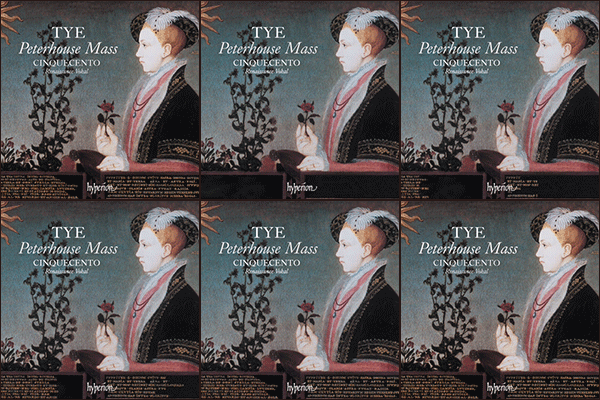

Tye’s Peterhouse Mass has survived only in an incomplete set of partbooks preserved in Peterhouse, Cambridge, and, like much music of its time, requires a good deal of creative detective work to reconstruct what has been lost in the intervening centuries. Sympathetic editing and Cinquecento’s idiomatic performances restore to life a major work from the mid-sixteenth century.


England one God, one truth, one Doctor hath
For Musicks Art, and that is Doctor Tye,
Admir’rd for skill in Musickes harmonie.
(Samuel Rowly, When you see me, you know me, 1605)
Christopher Tye was probably born to Thomas Tye and his wife Joan at Colchester, Essex, in about 1505. Thomas, who owned a pub called The Ship, was an enterprising but unscrupulous businessman. For example, in 1494/5 he was hauled before the Court of Admiralty for buying fish illegally before they came to market, and for stealing oysters from their beds and disturbing the younger shellfish as they grew to maturity. Thomas bequeathed his instinct for survival to his son. Like his contemporary Thomas Tallis, Tye successfully negotiated the shoals of mid sixteenth-century English ecclesiastical politics. During the reign of Henry VIII, Tallis and Tye had written music in the lush, tumbling style developed by Taverner and Fayrfax. When Edward VI ushered in a more restrained Protestant aesthetic, Tye and Tallis adapted their music accordingly. The reigns of Mary and Elizabeth demanded further adjustments in liturgical music to reflect the programme of each monarch.
While earlier accounts of Tye’s life were generally positive, if riven with unacknowledged contradictions, recent archival research by Jason Smart and Hugh Benham has brought Tye the man into sharper focus. A ‘Tye’ (without Christian name) is documented as a choirboy at King’s College, Cambridge, between 1508 and 1512, and between 1527 and 1528 a Tye served there as lay clerk. These may or may not have been identical with the Richard Tye, perhaps a relative of the composer, who served as a lay clerk at King’s between 1528 and 1545, but in 1536 Christopher Tye received the degree of Bachelor of Music at Cambridge, after some ten years of studying composition and training choirboys. The examination for the degree was to be based on the composition of a Mass. In 1537, Christopher Tye was employed as a lay clerk at King’s College. It was probably here that he entered the circle of Richard Cox, a Fellow of the College and early champion of Protestantism, who was elected as Archdeacon of Ely in December 1540.
Tye’s career then took him to court in London, where he was drawn into the penumbra of the Chapel Royal. Tye never appears on the rolls of paid singers of the Chapel Royal, but was probably one of its unpaid associate members, who were recorded with less precision. Attendance at court demanded that Tye dress accordingly, and in October 1541 he received cloth and a cash advance amounting to £2 from the London draper John Stokar. When Tye failed to pay his debt, Stokar sued this ‘Gentylman of the Kynges Chapell’ for redress. The court found for Stokar and fined Tye 12s, but Tye refused to pay, sending Stokar back to court for enforcement. This was only the first of many cases that reveal Tye as financially chaotic at best, and at worst as a confidence artist. Stokar evidently described Tye as a Gentleman of the Chapel Royal because this is how Tye had represented himself.
In late 1542 or 1543, Tye was appointed as Master of the Choristers at Ely Cathedral, perhaps through Cox’s influence, at an annual salary of £10. Ten years after taking his bachelor’s degree, Tye was eligible to apply for his doctorate in music. Like his bachelor’s degree, this was to be judged on the basis of a new Mass. He duly received his doctorate from Cambridge in 1545. Tye had his degree ‘incorporated’ at Oxford in 1548, which granted him the equivalence of a degree from that university and its concomitant privileges.
Steady employment was not enough to keep Tye out of trouble. Shortly after his appointment to Ely, he purchased camlet and velvet to a total value of £3 2s 1d from the London merchant William Byrde (no known relation to the composer), again on credit. When Tye refused to pay, Byrde took him to court. In 1547, Thomas Waytte, a gentleman of the Chapel Royal, sued Tye for the recovery of a debt of £3 14s. Tye failed to appear before the court, which found for Waytte and awarded him damages of 18s 9d. In 1552, William Cavendyshe sued Tye for the recovery of a debt of 20 marks, which Tye likewise sought to evade. In 1553, William Baxster sued Tye and Robert Steward jointly for recovery of a debt of £6 13s 4d, which was finally paid by Steward.
The surviving Treasurer’s Rolls from Ely (covering only the years 1534, 1547 and 1561) name Tye as choirmaster, but it is possible that he received leave of absence to attend court in years that are not documented. Literary evidence suggests that Tye served King Edward VI in some capacity, but the documentary evidence is thin. On the title page of The Actes of the Apostles (1553), a severely simplified musical setting of the first fourteen chapters of the biblical book, dedicated to Edward, Tye describes himself as ‘one of the Gentylmen of hys graces most honourable Chappell’. It is possible that Richard Cox, a powerful friend of Tye from King’s College Cambridge, who served as Edward’s tutor from 1544 until 1550, brought Tye to Edward’s attention. Tye’s elaborate antiphon Domine Deus caelestis (preserved only as a fragment), which prays for ‘our gracious prince’, was probably written during the first two years of Edward’s reign, before the English Prayer Book was introduced. In 1605, Samuel Rowly, who was probably Tye’s grandson, published a drama about Edward VI, When you see me, you know me, which includes a scene in which Tye converses with the young Edward. Edward addresses the older man as ‘Doctor Tye, Our musick’s lecturer’, and recalls the favour Tye had enjoyed from the late Henry VIII. In the scene, Tye asks Edward to accept the dedication of his ‘homely worke’, the Actes. It is difficult to determine whether this scene draws on recollections from Tye, handed down in the family, or was a literary invention intended to elevate Rowly’s own reputation. In any case, the place of music in the newly reformed English church was uncertain, but the contributions of skilled and versatile composers such as Tallis and Tye ensured that liturgical polyphony—what Tye calls the ‘pleasaunt style’ in the dedication of the Actes—would survive during Edward’s reign, even if in attenuated form.
The Actes is radically different in conception from the Latin works recorded here. Tye himself translated the first fourteen chapters of the book into English verse, and provided a single setting for each chapter, to which all the strophes for that chapter were to be sung, in the manner of the Geneva Psalms adapted for English use by Sternhold and Hopkins. Even if the literary qualities of Tye’s verse were limited, the entire production testifies to the rapid development of an English culture of evangelical devotion during Edward’s reign. Tye’s reputation as a poet was higher than we might imagine. In 1571, John Lesley, Bishop of Ross, asked Tye to translate some verses he had written about hunting from Latin into English. The restricted counterpoint of the Actes allows the words to be heard distinctly, thus addressing a central concern of humanist churchmen. Tye further developed this principle of crystalline simplicity in his English anthems, some of the first masterpieces in the genre. In the dedication of the Actes to Edward, Tye prays for the king’s half-sisters, Mary and Elizabeth, which may suggest that he also taught them music.
Besides his church music, Tye also wrote a large and varied body of music for viol consort, including thirteen In nomines. Some of these instrumental pieces bear enigmatic titles that suggest that they perhaps began as vocal pieces. Such complex works may have allowed composers to exercise and display their skills in counterpoint when this was difficult in liturgical music, as during Edward’s reign.
Despite his close identification with Edward’s religious policies, Tye received the livery of a Gentleman of the Chapel Royal for Mary’s coronation in 1553, alongside two other associate members, Robert Prynse and Robert Goldwyn. Tye’s participation in the Chapel Royal under Mary—evidently not as a full-time singer, but as furnisher of special commissions—is suggested by the inclusion of his grand six-voice Missa Euge bone in the final layer of the Forrest-Heyther partbooks, a unique survival of the music-making of Mary’s chapel. Daniel Page has connected Tye’s Missa Euge bone to sermons on the Parable of the Talents, preached in Mary’s chapel soon after her coronation by John Harpsfield and James Brooks to congratulate her on the restoration of Catholicism. In the Vulgate translation of this parable, the master exclaims ‘Well done, good servant’ (‘Euge bone serve’, Luke 19:17), which could have provided the inspiration for Tye’s composition. Page proposed furthermore that Tye’s motet Peccavimus cum patribus nostris, with its allusions to the Biblical heroine Judith as protector of true religion, is a musical glorification of Queen Mary’s mission as vindicator of a restored English Catholicism, evoked through a revival of the florid style of the 1520s. Tye’s service to Mary’s political programme is most obvious in his Domine Deus caelestis, which refers directly to the restoration of Catholicism as state policy. Tye evidently knew how to trim his sails to the prevailing political winds.
Even though Tye’s principal residence was at Ely from 1547 until at least 1556, he evidently visited London occasionally. In 1553, he entered into a bond with the London fishmonger John Dowty for £6 6s 8d. Tye refused to pay, alleging that the signature on the bond was not his. Dowty resumed the case in 1563, but the outcome is unknown. In 1553, William Brewster sued Tye for a debt of £40. In 1554, the clerk John Barker of Ely sued Tye to recover a debt of £8, but then extended him a further £6 in 1556. In 1562, after Barker died intestate, the administrator of his estate sued Tye for recovery of the unpaid debt. In 1556, John Brydgewater sued Tye for a debt of £40. Brydgewater claimed in the suit that Tye had dislodged him from the tiny parish of Yelling in Huntingdonshire, to which he had been appointed in 1554, thus leaving him without a living. This suggests that Mary rewarded Tye with this ecclesiastical benefice. Although Tye was apparently resident at Yelling at this time, he must have employed an ordained priest to celebrate the Masses required. Tye countersued Brydgewater, but appears to have dropped the action before judgment was rendered. On 2 September 1556, Tye signed a bond at Norwich to repay £10 to William Wanton, but after Wanton died with the debt still unpaid, his brother Gilbert sued Tye for recovery. Again, Tye refused to pay, and Wanton had to request a writ for recovery in 1563.
Anthony Wood—an unreliable witness, writing in the late seventeenth century—transmits the tradition that Tye, ‘a peevish and humoursome man, especially in his latter dayes’, served as organist to the chapel of Elizabeth I. The queen complained that Tye’s playing ‘contain’d much musick, but little delight to the ear’. On one occasion, when she sent the verger to tell Tye after a service that ‘he play’d out of Tune’, Tye allegedly replied that ‘her eares were out of Tune’. There may be something to Wood’s anecdote, but it is not supported by any known documentation; the Chapel Royal Check Book for Elizabeth’s reign, which begins in 1561, does not include Tye’s name. It is possible that Tye played in Elizabeth’s chapel before the Check Book begins, but it is also true that we have no other trace that Tye exercised any musical function after 1561.
In 1559, the dean and chapter of Ely explicitly reaffirmed Tye’s tenure as choirmaster and organist, which may suggest that he had been absent for some of the intervening time. It is possible that this reinstatement or confirmation of Tye’s employment is connected to the appointment of Richard Cox as Bishop of Ely in 1558.
One of Elizabeth’s first acts as queen was the religious settlement, which established the Church of England as the state church. On 7 July 1560, Cox ordained Tye as a deacon in the Church of England, and on 24 November 1560 as a priest. In 1561, Tye left his position as choirmaster at Ely and was appointed as rector of the twin parishes of Doddington and March in Cambridgeshire. It is possible that Elizabeth presented Tye with this, one of the most lucrative benefices in the kingdom, to permit him to clear his debts, for creditors were still queuing at the door. In 1562, Nicolas Luke, a Baron of the Exchequer, sued Tye for a debt of £13 6s 8d contracted in 1556, but it is not clear if the case was settled before Luke died in 1563. In 1559, Tye had promised to pay a certain Elizabeth Rich 53s 4d on the day of her wedding, on the condition that she not marry ‘Robert Stuard’, presumably the person with whom Tye was co-responsible for the debt to William Baxster in 1553. When Elizabeth married a certain Thomas North, Tye evaded his promise, and the Norths sued him for payment in 1562. In 1563, 1564 and 1567, the Cambridge linen draper John Chase sued Tye for three separate debts amounting to nearly £26. The draper Richard Rychardson sued Tye in 1567 for a debt of £5, which included a fine for default.
In 1568, Tye sued Benjamin Clere of Colchester for possession of a house there. Tye’s mother Joan had remarried to a certain Thomas Saye. After Saye died, Joan was sole occupant of the house. When she died, Tye claimed ownership of the house as Joan’s heir. However, Clere countered that since Thomas Saye had died childless, the title to the house passed to his brother, John. John Saye granted possession of the house to Jerome Songer; Songer conveyed it to Clere, who leased it to Joan. Tye’s claim to the house was thus flimsy, and he eventually dropped the claim.
In 1570, Tye’s salary for the parish of Doddington was sequestrated, since he had failed to remit the tithes and other income to the diocesan treasury as required. In 1571, Ralph Dixon sued Tye for a debt of 100 marks (£66 13s 4d), but Tye tried to avoid payment by claiming that he had signed the bond under duress, after Dixon threatened ‘his life and the mutilation of his limbs’. In 1571, Roger Gysse, who had served as Tye’s attorney in his litigation with John Chase and Richard Rychardson, sued him for defaulting on a debt for £24. In 1571, the clothworker Thomas Hopkins received judgment against Tye for a debt of £2 3s, but it is not recorded whether Tye ever paid. Finally, in 1572, the clerk Richard Lynborowe and the draper Simon Cage of Bury St Edmunds tried to sue for recovery of debts of £10 and £7 6s 8d respectively, but apparently they abandoned their cases, perhaps because Tye had died in the meantime. Over the course of his life, Tye thus accumulated debts of over £300, thirty times his annual salary as organist at Ely Cathedral.
There is little evidence that Tye was active as a musician after his ordination. His successor as choirmaster (but not as organist) at Ely was his son-in-law, the composer Robert Whyte, who completed Tye’s Actes of the Apostles. An episcopal visitation undertaken in 1561 recorded that Tye resided in his parish of Doddington with his family, but was a bad preacher. Tye’s family life at Doddington was complicated. One of his sons, Peter, was ordained as a priest after forging a letter in his father’s name and presenting it to the Archbishop of Canterbury. Peter was appointed as a chaplain at Ely, but Bishop Cox accused him of negligence in teaching the catechism, of dicing and poaching deer. Tye’s wife Katherine, all too familiar with his ways with money, asked Bishop Cox to prevent Tye from leasing out any property owned by the parish of Doddington without his consent. After Tye’s death, one of his debtors claimed that he had done exactly that—leasing the parsonage at half the value of the rent without informing the bishop or, it seems, his family. While occupying the parish of Doddington, Tye also accumulated several other benefices concurrently: the parishes of Little Wilbraham (acceded 1561, resigned 1567), Newton in the Isle (acceded 1564, resigned 1570), and Bluntisham (gained 1571, held until his death). True to form, Tye neglected to pay the annates on Wilbraham, that is, the first year’s income from a newly granted benefice, payable as a tax to the diocese. Tye was summoned before the Barons of the Exchequer at Westminster, but paid the amount before the case was heard. The date of Tye’s death is not recorded, but on 15 March 1573, the parish of Doddington, now vacated by Tye’s death, was collated on Hugh Billet.
Tye certainly composed Latin church music before the Reformation, but much of it is lost. Since the composers associated with the Chapel Royal during Mary’s reign consciously revived the style cultivated before the Reformation, it can be difficult to date Tye’s Latin church music, and we must often extrapolate dates from the manuscript tradition. Several of the pieces recorded here are preserved in one source only. Sub tuam protectionem, the Kyrie ‘Orbis factor’, Alleluia. Per te Dei genitrix and In pace are transmitted only in the Gyffard Partbooks (British Library, Add. MSS 17802-17805), a collection of small-scale works for the Sarum rite, whose first layer was probably begun for use at St Paul’s Cathedral, London, during Mary’s reign; subsequent additions to the partbooks, copied on paper from the 1570s, seem to represent a retrospective archive of pieces that could no longer be performed in the Elizabethan church, but which were considered worth preserving. The splendid Cantate Domino is transmitted in an incomplete set of partbooks now in Oxford (Christ Church College, Mus. 979-983), which John Baldwin, a singer at St George’s Chapel, Windsor, copied between about 1575 and 1581. The tenor partbook is missing, and this voice has been reconstructed here by Jason Smart. By contrast, Amavit eum Dominus survives in several manuscripts (some now only isolated partbooks) copied between the mid 1570s and the start of the seventeenth century, including an important set copied for Edward Paston (Oxford, Bodleian Library MSS Tenbury 341-344). It also survives with an English contrafact (substitute) text, ‘I lift my heart to thee’, likewise transmitted in several manuscripts with the English text, and in keyboard tablature in the Mulliner Book. The English version was also included in an important document of Archbishop Laud’s liturgical restoration, John Barnard’s First Book of Selected Church Musick (1641).
The ‘Meane Mass’ recorded here, so called because it lacks the soaring treble part typical of much Tudor liturgical polyphony, is also known as the Peterhouse Mass, since it survives in an incomplete set of partbooks long preserved in the library of Peterhouse, Cambridge (MSS 31, 32, 40, 41). This set lacks the tenor partbook; the tenor part in the Mass sung here was reconstructed by Paul Doe. The Peterhouse partbooks were compiled for use at Canterbury Cathedral between about 1540 and 1547, as Henry VIII was forging his idiosyncratic ecclesiastical policies. Although these manuscripts contain many pieces by important and widely distributed figures such as Ludford, Taverner, Fayrfax and Aston, they also contain pieces by less prominent figures active at Magdalen College, Oxford, between the late 1480s and the early 1540s. This suggests that the stock of the repertoire transmitted in these partbooks probably originated at Oxford, perhaps at Magdalen itself. Nicholas Sandon has suggested that this music was collected and copied for Canterbury Cathedral following its dissolution as a Benedictine monastery and its refoundation in 1540 as a secular cathedral, where the elaborate music included in these partbooks was now to be performed by highly trained professional singers. A likely figure in this process was Thomas Bull, documented as a lay clerk and music scribe at Magdalen between 1528 and 1539, and from 1540 at Canterbury Cathedral. These partbooks came to Peterhouse during the time of the masters Matthew Wren and John Cosin, who shared William Laud’s desire to promote high church liturgy in the Church of England, and consequently built a chapel for the college, founded a choir and procured music for its use.
The word setting in the Gloria of the Peterhouse Mass is efficient, with virtually syllabic passages yielding to more contrapuntal sections, much in the manner of Tallis. Here Tye often uses stretto, a technique in which the voices imitate each other in quick succession. As in his music for viol consort, Tye uses some daring subjects. For example, in the head motif of the phrase ‘Qui tollis peccata mundi’ in the Gloria, the first two words are separated from ‘peccata’ by a rest, producing an unusually jerky impression. As in his Missa Euge bone, the exclamation ‘Jesu’ is set off with fermatas, before another contrapuntal subject follows at ‘Christe’.
In the Credo, Tye also breaks the text into short versets, in the way that an organist might do if alternating with chorus. For example, the phrase ‘Et ex Patre natum ante omnia saecula’ is set as a discrete section in a jaunty homophonic triple rhythm, which leads directly into contrapuntal writing at ‘Deum de Deo’. Like many other Tudor Credos, the text is abbreviated, omitting the text from ‘et iterum venturus est’ to ‘remissionem peccatorum’.
In the Peterhouse Mass, we sense that Tye’s harmonic language was moving away from modes towards keys. The Mass is formally written in Dorian transposed to G, but is effectively in G minor. Here, Tye’s part-writing is sometimes more that of a keyboard player than of a singer. For example, at the words ‘consubstantialem Patri’ in the Credo, he moves from an A major to a D minor triad, causing an unsingerly leap of a diminished fourth in the second contratenor. The homophony of the final Agnus Dei is also strongly reminiscent of keyboard style.
Throughout the pieces recorded here, Tye employs a favourite feature of English composers: the use of sections for reduced forces, such as the trio of lower voices at ‘Et incarnatus’ in the Credo, in the second section of Cantate Domino, or in several sections of the Kyrie ‘Orbis factor’. Tye combines this English technique with others borrowed from Continental composers like Josquin, such as the answering duets at ‘Crucifixus etiam’ in the Credo.
Tye also employs surprising cadences that land on an unexpected degree of the scale, as at the end of the first Osanna attached to the Sanctus, at the end of the first Agnus Dei, where the predominant G minor harmony turns to G major, at the end of the first section of Cantate Domino (‘in salutem’), and in the Miserere, at the words ‘altissimum’ and ‘Exsurge, gloria mea’.
Tye displays many characteristic English melodic gestures, such as the syncopated dotted figures and arpeggios outlining a rising seventh as the words ‘peccata mundi’ in the first Agnus Dei, or the chains of triplets in the Christe section of the Kyrie ‘Orbis factor’.
Alleluia. Per te Dei genitrix was evidently composed for use during Lady Masses, since the chant is prescribed in the Sarum rite for use during various seasons connected to Mary, such as the weeks after Candlemas (2 February) and the week after the Nativity of Mary (8 September). Tye alludes to the opening of the Sarum chant at the beginning of the tenor. This is perhaps a surviving fragment of a more extensive Propers cycle. Likewise, Amavit eum Dominus is a responsory for the Common of a Martyr in the Sarum rite, though Tye’s setting is independent of chant material.
The Jesus antiphon Sub tuam protectionem was originally scored for two trebles and two means (lower sopranos) but works just as well for lower voices. It is one of the few examples of pre-Reformation English polyphony written for two pairs of equal voices. In the final section, Tye employs an old-fashioned proportion sign which produces a quick triple metre that madrigalistically suggests the tossing waves of misfortune. The first six notes of tenor I are drawn from the Marian antiphon of the same name, though the rest of the piece is free-composed.
The Kyrie recorded here is unrelated to the Peterhouse Mass. It is based on the plainsong Kyrie ‘Orbis factor’, which suggests that Tye wrote it for performance during Lady Masses.
In pace is a respond for Compline during Lent in the Sarum rite. The polyphonic versets survive in the Gyffard Partbooks, while the chant sung here has been supplied from the Sarum antiphoner printed at Paris in 1519. The bass voice traces the original chant in long note values. Since the chant moves mostly in stepwise motion, this produces a restful effect appropriate to the text. Curiously, the notation in the Gyffard Partbooks witnesses to the breakdown of the system of ligatures in mensural notation.
The splendid five-voice Miserere mei, Deus was probably written during Mary’s reign, when polyphonic settings of Psalms eclipsed votive antiphons in popularity. It exists in several sources, the earliest from the 1570s, including a complete set of five partbooks owned by the Norwich grocer John Sadler (Bodleian Library, MSS Mus. e. 1-5). Further sources in the Bodleian and Christ Church College (the latter copied by John Baldwin) specify that it is ‘for men’. It recalls many stylistic features of the older composers preserved in the Eton Choirbook, with its alternation of full textures and sections for reduced numbers of voices, such as the duet at ‘Et in umbra alarum’. The cadence at the phrase ‘confidit anima mea’ is typically English: the bass remains on the dominant rather than returning to the tonic (to use anachronistic terms), the middle voice leaps up to an octave above the bass, and the uppermost voice flutters downwards in dotted figures to land a major tenth above the bass. The presence of two bass parts of the same range, which cross continually and move largely in stepwise motion rather than serving as a harmonic bass, also gives this piece a serene, flowing intensity. Very striking is the sudden irruption of a homophonic passage at ‘cantabo et psalmum dicam’, recalling the direct style that Tye honed in the Actes.
The pieces presented here reveal many characteristics of Tye’s style. Unlike, say, Palestrina, who usually allowed his points of imitation to unfold in a leisurely way, with ample distance between them, Tye often employs stretto, as at the word ‘coronavit’ at the end of Amavit eum Dominus. This gives Tye’s writing a restless, tightly packed quality and a strong forward drive. And whereas Palestrina usually left his textures open by giving rests to one or other of the voices for long stretches, Tye often preferred to keep all the voices in motion. This approach produces a much thicker, oilier texture, as in Amavit eum. Both features—stretto and thick textures—are present in extreme form in Cantate Domino, rendering an already dense six-voice texture even more claustrophobic. At many important cadences at the ends of sections, Tye employs a signature falling scale decoration in one of the inner voices, allowing the moving voice to graze a seventh deliciously before alighting on the third of the final chord. Also typically English are the chains of ‘false-relations’, unprepared dissonances that arise through the application of the rules of hexachord theory in different ways in different voices (‘mi contra fa’), as in Cantate Domino at the words ‘et nunc et semper’. These unexpected dissonances provide a little nutmeg and ginger to an otherwise dense polyphonic pudding.
Grantley McDonald © 2026
Während frühere Berichte über Tyes Leben im Allgemeinen positiv ausfielen, auch wenn sie diverse Widersprüche aufwiesen, haben jüngere Archivforschungen von Jason Smart und Hugh Benham den Menschen Tye schärfer in den Fokus gerückt. Ein „Tye” (ohne Vornamen) ist zwischen 1508 und 1512 als Chorknabe am King’s College in Cambridge dokumentiert, und zwischen 1527 und 1528 diente dort ein Tye als Chorvikar. Es ist nicht bekannt, ob es sich dabei um denselben Richard Tye handelte, der möglicherweise ein Verwandter des Komponisten war und zwischen 1528 und 1545 als Chorvikar am King’s College tätig war. 1536 erlangte Christopher Tye nach etwa zehnjähriger Ausbildung in Komposition und Chorleitung den Bachelor of Music in Cambridge. 1537 wurde Christopher Tye als Chorvikar am King’s College angestellt. Wahrscheinlich kam er hier mit Richard Cox in Kontakt, ein Fellow des Colleges und früher Verfechter des Protestantismus, welcher im Dezember 1540 zum Erzdiakon von Ely gewählt wurde.
Darauf wechselte Tye nach London an den königlichen Hof, wo er in den Bannkreis der Chapel Royal geriet. Tye taucht nie in den Gehaltslisten der Gentlemen der Chapel Royal auf, gehörte aber wahrscheinlich zu den unbezahlten außerordentlichen Mitgliedern, die weniger genau erfasst wurden. Die Anwesenheit am Hof erforderte entsprechende Kleidung und im Oktober 1541 erhielt Tye von dem Londoner Tuchhändler John Stokar Stoff und einen Barvorschuss in Höhe von 2 Pfund. Als Tye seine Schulden nicht begleichen konnte, verklagte Stokar diesen „Gentylman of the Kynges Chapell” auf Schadensersatz. Das Gericht gab Stokar Recht und verurteilte Tye zu einer Geldstrafe von 12 Schilling, doch weigerte sich dieser zu zahlen, so dass Stokar die Vollstreckung wiederum gerichtlich erzwingen musste. Dies war nur der erste von vielen Fällen, die Tye bestenfalls als finanziell chaotisch und schlimmstenfalls als Betrüger entlarvten. Stokar beschrieb Tye offenbar als Gentleman der Chapel Royal, weil Tye sich selbst so dargestellt hatte.
Ende 1542 oder zu Beginn des Jahres 1543 wurde Tye, möglicherweise dank Cox’ Einfluss, zum Chorleiter der Kathedrale von Ely ernannt, wofür er ein Jahresgehalt von 10 Pfund erhielt. Zehn Jahre nach seinem Bachelor-Abschluss war Tye berechtigt, sich für eine Promotion in Musik zu bewerben. Wie schon sein Bachelor-Abschluss sollte auch diese Prüfung auf der Grundlage einer neuen Messe beurteilt werden. 1545 erhielt er schließlich den Doktortitel von der Universität Cambridge. 1548 ließ Tye seinen Abschluss in Oxford „inkorporieren”, wodurch er die Gleichwertigkeit eines Abschlusses dieser Universität und die damit verbundenen Privilegien erhielt.
Tye erhielt die Livree eines Gentleman of the Chapel Royal für die Krönung Marias im Jahr 1553. Tyes Mitwirken an der Chapel Royal unter Maria—wobei er dort offensichtlich Sonderaufträge erhielt und nicht hauptamtlich angestellt war—wird durch die Einbindung seiner großartigen sechsstimmigen Missa Euge bone in die Forrest-Heyther-Stimmbücher nahegelegt, eine einzigartige Überlieferung des Musizierens in der Kapelle unter Maria. Daniel Page hat Tyes Missa Euge bone mit Predigten über das Gleichnis von den anvertrauten Talenten in Verbindung gebracht, die kurz nach Marias Krönung von John Harpsfield und James Brooks in ihrer Kapelle gehalten wurden, um ihr zur Wiederherstellung des Katholizismus zu gratulieren. In der Vulgata-Übersetzung dieses Gleichnisses ruft der Herr aus: „Recht so, du guter Diener“ („Euge bone serve“, Lukas 19,17), was Tye zu seiner Komposition inspiriert haben könnte. Page vermutete außerdem, dass Tyes Motette Peccavimus cum patribus nostris mit ihren Anspielungen auf die biblische Heldin Judith als Beschützerin der wahren Religion eine musikalische Verehrung von Königin Maria als Verfechterin eines wiederhergestellten englischen Katholizismus ist, was durch eine Wiederbelebung des blumigen Stils der 1520er Jahre dargestellt wird. Tyes Beitrag zu Marias politischem Programm zeigt sich am deutlichsten in seinem Domine Deus caelestis, das sich direkt auf die Wiederherstellung des Katholizismus als Staatspolitik bezieht. Tye wusste offensichtlich, wie er sich den vorherrschenden politischen Winden anpassen musste.
Anthony Wood—ein unzuverlässiger Beobachter des späten 17. Jahrhunderts—überliefert, dass Tye, „ein mürrischer und launischer Mann, besonders in seinen späteren Jahren“, als Organist in der Kapelle von Elisabeth I. diente. Die Königin beklagte sich, dass Tyes Spiel „viel Musik, aber wenig Freude für das Ohr“ enthielte. Als sie einmal nach einem Gottesdienst den Küster zu Tye schickte, um ihm mitzuteilen, dass er „schräg gespielt“ habe, soll Tye geantwortet haben, dass „ihre Ohren schräg“ seien. Woods Anekdote mag etwas für sich haben, wird jedoch in keinen bekannten Dokumenten bestätigt; das Chapel Royal Check Book aus der Regierungszeit Elisabeths, das 1561 beginnt, enthält den Namen Tye nicht. Es ist möglich, dass Tye bereits vor Beginn des Buches in Elisabeths Kapelle spielte, aber es ist auch wahr, dass keine weiteren Hinweise darauf überliefert sind, dass Tye nach 1561 eine musikalische Funktion ausübte.
Im Jahr 1559 bestätigten der Dekan und das Domkapitel von Ely ausdrücklich Tyes Anstellung als Chorleiter und Organist, was darauf hindeuten könnte, dass er zwischenzeitlich andernorts gewesen sein mag. Es ist möglich, dass diese Wiedereinstellung oder Bestätigung von Tyes Anstellung mit der Ernennung von Richard Cox zum Bischof von Ely im Jahr 1558 zusammenhängt.
Eine der ersten Amtshandlungen Elisabeths als Königin war die Religionsreform, mit der die Church of England zur Staatskirche erklärt wurde. Am 7. Juli 1560 weihte Cox Tye zum Diakon der Church of England und am 24. November 1560 zum Pfarrer. 1561 gab Tye seine Stelle als Chorleiter in Ely auf und wurde zum Pfarrer der Gemeinden Doddington und March in Cambridgeshire ernannt. Es ist möglich, dass Elisabeth Tye diese Stelle, eine der lukrativsten Pfründen im Königreich, verschaffte, um ihm die Tilgung seiner Schulden zu ermöglichen, denn die Gläubiger standen vor seiner Tür noch immer Schlange.
Es gibt kaum Hinweise darauf, dass Tye nach seiner Ordinierung als Musiker tätig war. Sein Nachfolger als Chorleiter (jedoch nicht als Organist) in Ely war sein Schwiegersohn, der Komponist Robert Whyte, der auch Tyes Actes of the Apostles vollendete. Das Sterbedatum Tyes ist nicht überliefert, jedoch wurde am 15. März 1573 die durch Tyes Tod frei gewordene Gemeinde von Doddington Hugh Billet übertragen.
Man kann davon ausgehen, dass Tye bereits vor der Reformation lateinische Kirchenmusik komponierte, doch ist ein Großteil davon verloren gegangen. Da die Komponisten, die während der Regierungszeit von Maria mit der Chapel Royal verbunden waren, bewusst den vor der Reformation gepflegten Stil wiederbelebten, ist es schwierig, Tyes lateinische Kirchenmusik zu datieren—die Entstehungszeiträume müssen oft aus der Manuskripttradition erschlossen werden. Mehrere der hier eingespielten Stücke sind nur in einer einzigen Quelle erhalten. Sub tuam protectionem, das Kyrie „Orbis factor“, Alleluia. Per te Dei genitrix und In pace sind nur in den Gyffard-Stimmbüchern (British Library, Add. MSS 17802-17805) notiert, eine Sammlung kleinerer Werke für den Sarum-Ritus, deren erster Teil wahrscheinlich während der Regierungszeit Marias für den Gebrauch in der St. Paul’s Cathedral in London angelegt wurde. Spätere Ergänzungen, die ab den 1570er Jahren auf Papier kopiert wurden, scheinen ein retrospektives Archiv von Stücken darzustellen, die in der elisabethanischen Kirche nicht mehr aufgeführt werden konnten, aber als erhaltenswert angesehen wurden. Das prächtige Cantate Domino ist in einem unvollständigen Satz von Stimmbüchern überliefert, die sich heute in Oxford (Christ Church College, Mus. 979-983) befinden und zwischen 1575 und 1581 von John Baldwin, einem Sänger an der St. George’s Chapel in Windsor, kopiert wurden. Das Tenor-Stimmbuch fehlt, und diese Stimme wurde hier von Jason Smart rekonstruiert. Im Gegensatz dazu ist Amavit eum Dominus in mehreren Manuskripten (von denen einige heute nur noch vereinzelte Stimmbücher sind) erhalten, die zwischen Mitte der 1570er Jahre und Beginn des 17. Jahrhunderts kopiert wurden, darunter eine wichtige Sammlung, die für Edward Paston angefertigt wurde (Oxford, Bodleian Library MSS Tenbury 341-344). Es ist auch mit einem englischen Kontrafakturtext (Ersatztext) überliefert, „I lift my heart to thee“, der ebenfalls in mehreren Manuskripten mit dem englischen Text und in der Tastentabulatur im Mulliner Book überliefert ist. Die englische Fassung wurde auch in ein wichtiges Dokument der liturgischen Restauration von Erzbischof Laud aufgenommen, nämlich John Barnards First Book of Selected Church Musick (1641).
Die hier aufgezeichnete „Meane Mass“, die so genannt wird, weil ihr die für die liturgische Polyphonie der Tudor-Zeit typische hohe Sopranstimme fehlt, ist auch als Peterhouse-Messe bekannt, da sie in einem unvollständigen Satz von Stimmbüchern überliefert ist, die lange Zeit in der Bibliothek von Peterhouse [College], Cambridge (MSS 31, 32, 40, 41), aufbewahrt wurden. In diesem Stimmsatz fehlt das Tenorstimmbuch—für die hier vorliegende Version rekonstruierte Paul Doe die Tenorstimme. Die Peterhouse-Stimmbücher wurden zwischen etwa 1540 und 1547 für den Gebrauch in der Kathedrale von Canterbury zusammengestellt, als Heinrich VIII. seine eigenwillige Kirchenpolitik entwickelte. Obwohl diese Manuskripte zahlreiche Werke von bedeutenden und weithin bekannten Komponisten wie Ludford, Taverner, Fayrfax und Aston enthalten, finden sich darin auch Stücke von weniger prominenten Persönlichkeiten, die zwischen den späten 1480er und frühen 1540er Jahren am Magdalen College in Oxford tätig waren. Dies lässt vermuten, dass das in diesen Stimmbüchern überlieferte Repertoire wahrscheinlich aus Oxford stammt, möglicherweise sogar vom Magdalen College selbst. Nicholas Sandon hat vermutet, dass diese Musik für die Kathedrale von Canterbury gesammelt und kopiert wurde, nachdem diese als Benediktinerkloster aufgelöst und 1540 als weltliche Kathedrale neugegründet worden war, wo die in diesen Stimmbüchern enthaltene kunstvolle Musik nun von hochqualifizierten, professionellen Sängern aufgeführt werden sollte. Eine wichtige Rolle in diesem Prozess spielte wahrscheinlich Thomas Bull, der zwischen 1528 und 1539 als Chorvikar und Kopist am Magdalen College und ab 1540 in der Kathedrale von Canterbury dokumentiert ist. Diese Stimmbücher gelangten nach Peterhouse, als das College von Matthew Wren, bzw. John Cosin geleitet wurde, die sich beide dem Wunsch William Lauds anschlossen, die hochkirchliche Liturgie in der Church of England zu fördern, und folglich eine Kapelle für das College bauten, einen Chor gründeten und entsprechendes musikalisches Material beschafften.
Die Textvertonung im Gloria der Peterhouse-Messe ist effizient gehalten, wobei fast syllabische Passagen in kontrapunktischere Abschnitte übergehen, ganz im Stil von Tallis. Hier setzt Tye mehrere Engführungen, eine Technik, bei der sich die Stimmen in schneller Folge gegenseitig imitieren. Wie in seiner Musik für Gambenensemble verwendet Tye einige kühne Themen. Beispielsweise sind im Hauptmotiv der Phrase „Qui tollis peccata mundi” im Gloria die ersten beiden Worte durch eine Pause von „peccata” getrennt, was einen ungewöhnlich ruckartigen Eindruck erzeugt. Wie in seiner Missa Euge bone wird der Ausruf „Jesu“ mit Fermaten hervorgehoben, bevor bei „Christe“ ein weiteres kontrapunktisches Thema folgt.
Im Credo unterteilt Tye den Text ebenfalls in kurze Versetten, wie es ein Organist tun würde, wenn er mit dem Chor alterniert. So wird beispielsweise die Phrase „Et ex Patre natum ante omnia saecula“ als eigenständiger Abschnitt in einem beschwingten homophonen Dreiertakt gesetzt, der direkt in einen kontrapunktischen Satz bei „Deum de Deo“ übergeht. Wie bei vielen anderen Credos der Tudorzeit ist der Text hier gekürzt, wobei die Passage von „et iterum venturus est“ bis „remissionem peccatorum“ weggelassen wird.
In der Peterhouse-Messe spürt man, dass Tyes Harmonik sich von Modi hin zu Tonarten bewegte. Die Messe ist formal dorisch notiert und nach G transponiert, steht aber effektiv in g-Moll. Hier ähnelt Tyes Stimmführung manchmal eher der eines Tastenspielers als der eines Sängers. Beispielsweise wechselt er bei den Worten „consubstantialem Patri” im Credo von einem A-Dur- zu einem d-Moll-Dreiklang, was zu einem für Sänger unangenehmen Sprung einer verminderten Quarte im zweiten Contratenor führt. Auch die Homophonie des letzten Agnus Dei erinnert stark an Musik für Tasteninstrumente.
In allen hier vorliegenden Stücken verwendet Tye ein unter englischen Komponisten beliebtes Stilmittel, indem er Abschnitte für reduzierte Besetzungen einfügt, wie beispielsweise das Trio der tiefen Stimmen bei „Et incarnatus” im Credo, im zweiten Abschnitt von Cantate Domino sowie in mehreren Abschnitten des Kyrie „Orbis factor“. Tye kombiniert diese englische Technik mit weiteren Kunstgriffen, die er von kontinentalen Komponisten wie Josquin übernommen hatte, beispielsweise den Antwortduetten bei „Crucifixus etiam” im Credo.
Tye setzt auch überraschende Kadenzen, die auf unerwarteten Tonstufen landen, wie am Ende des ersten Osanna, das an das Sanctus angehängt ist, am Ende des ersten Agnus Dei, wo vom vorherrschenden g-Moll nach G-Dur gewechselt wird, am Ende des ersten Abschnitts von Cantate Domino („in salutem”) und im Miserere bei den Worten „altissimum” und „Exsurge, gloria mea”.
Es kommen bei Tye viele charakteristisch englische melodische Gesten vor, wie etwa die synkopierten punktierten Figuren und Arpeggien, die eine aufsteigende Septime umreißen, wie bei den Worten „peccata mundi” im ersten Agnus Dei, oder die Triolenketten im Christe-Abschnitt des Kyrie „Orbis factor“.
Alleluia. Per te Dei genitrix wurde offensichtlich für die Marienmessen komponiert, da dieser Choral im Sarum-Ritus für verschiedene Zeiten im Kirchenjahr vorgeschrieben ist, die mit Maria in Verbindung stehen, wie beispielsweise die Wochen nach Mariä Lichtmess (2. Februar) und die Woche nach Mariä Geburt (8. September). Tye spielt zu Beginn des Tenorparts auf den Anfang des Sarum-Chorals an. Dies ist möglicherweise ein erhaltenes Fragment eines umfangreicheren Messproprium-Zyklus. Ebenso ist Amavit eum Dominus ein Responsorium für das Märtyrer-Commune im Sarum-Ritus, obwohl Tyes Vertonung vom Choral unabhängig ist.
Die Jesus-Antiphon Sub tuam protectionem war ursprünglich für zwei Sopran- und zwei und zwei Meanstimmen (tiefere Soprane) komponiert, eignet sich aber ebenso gut für tiefere Stimmen. Es handelt sich dabei um eines der wenigen englischen polyphonen Werke aus der Zeit vor der Reformation, die für zwei gleichwertige Stimmpaare entstanden sind. Im letzten Abschnitt verwendet Tye ein altmodisches Prolationszeichen, das einen schnellen Dreiertakt angibt, der in madrigalartiger Weise die tosenden Wellen des Unglücks darstellt. Die ersten sechs Töne des Tenor I stammen aus der gleichnamigen Marienantiphon, während der Rest des Stücks frei komponiert ist.
Das hier aufgenommene Kyrie steht in keinem Zusammenhang mit der Peterhouse-Messe. Es basiert auf dem gregorianischen Kyrie „Orbis factor“, was darauf hindeutet, dass Tye es wohl zur Aufführung in den Marienmessen konzipiert hatte.
Das In pace ist ein Responsorium für die Komplet während der Fastenzeit, wiederum im Sarum-Ritus. Die polyphonen Versetten sind in den Gyffard-Stimmbüchern überliefert, während der hier gesungene Choral aus dem 1519 in Paris gedruckten Sarum-Antiphonar stammt. Die Bassstimme zeichnet den ursprünglichen Choral in langen Notenwerten nach. Da sich dieser meist stufenweise bewegt, hat das einen ruhigen Effekt, was zum Text passt. Interessanterweise zeugt die Notation in den Gyffard-Stimmbüchern vom Niedergang der Ligaturen in der Mensuralnotation.
Das prächtige fünfstimmige Miserere mei, Deus entstand wahrscheinlich während der Regierungszeit Marias, als polyphone Psalmvertonungen die Votivantiphonen an Popularität überholten. Es liegt in mehreren Quellen vor, wobei die früheste aus den 1570er Jahren stammt und ein vollständiger Satz von fünf Stimmbüchern aus dem Besitz des Lebensmittelhändlers John Sadler aus Norwich überliefert ist (Bodleian Library, MSS Mus. e. 1-5). In weiteren Quellen in der Bodleian Library und im Christ Church College (letztere kopiert von John Baldwin) ist angegeben, dass es „für Männer“ sei. In der Musik werden an viele stilistische Merkmale der älteren Komponisten, die im Eton Choirbook erhalten geblieben sind, erinnert, so etwa das Alternieren zwischen vollstimmigen Abschnitten und Passagen für reduzierte Stimmen, wie etwa das Duett bei „Et in umbra alarum“. Die Kadenz bei „confidit anima mea” ist typisch englisch: der Bass bleibt auf der Dominante, anstatt zur Tonika zurückzukehren (um anachronistische Begriffe zu verwenden), die Mittelstimme springt eine Oktave über den Bass, und die Oberstimme flattert in punktierten Figuren abwärts, um dann eine große Dezime über dem Bass zu landen. Indem zwei Bassstimmen im gleichen Tonumfang auftreten, die sich ständig kreuzen und sich weitgehend schrittweise bewegen, anstatt als harmonische Grundlage zu dienen, erhält das Stück eine ruhige, fließende Intensität. Das plötzliche Hereinbrechen einer homophonen Passage bei „cantabo et psalmum dicam” ist äußerst eindrucksvoll und erinnert an den direkten Stil, den Tye in den Actes perfektioniert hat.
Die hier vorliegenden Stücke illustrieren die vielen Charakteristika von Tyes Kompositionsstil. Anders als etwa Palestrina, der seine Einsätze in imitativen Passagen zumeist gemächlich und mit jeweils großen Abständen zwischen den Einsätzen entfalten ließ, verwendet Tye häufig Engführungen, wie etwa bei dem Wort „coronavit” am Ende von Amavit eum Dominus. Dies sorgt bei Tye für eine unruhige, straff geführte Atmosphäre und ein stetiges Voranstreben. Und während Palestrina seine musikalischen Texturen in der Regel offen ließ, indem er einer oder mehreren Stimmen lange Pausen gönnte, zog Tye es oft vor, alle Stimmen in Bewegung zu halten. Dieser Ansatz erzeugt eine viel dichtere, glattere Struktur, wie in Amavit eum. Beide Merkmale—Engführungen und dichte Strukturen—sind im Cantate Domino in extremer Form vorhanden und lassen einen ohnehin schon dichten sechsstimmigen Satz noch klaustrophobischer wirken. Bei vielen wichtigen Schlusskadenzen setzt Tye eine charakteristische fallende Tonleiterverzierung in einer Mittelstimme, wodurch die sich bewegende Stimme in köstlicher Weise eine Septime streift, bevor sie auf der Terz des Schlussakkords landet. Ebenfalls typisch englisch sind die Ketten von Querständen, also unvorbereitete Dissonanzen, die durch die unterschiedliche Anwendung der Regeln der Hexachordtheorie in verschiedenen Stimmen entstehen („mi contra fa”), wie im Cantate Domino bei den Worten „et nunc et semper”. Diese unerwarteten Dissonanzen verleihen der ansonsten deftigen polyphonen Speise eine gewisse Würze.
Grantley McDonald © 2026
Deutsch: Viola Scheffel