Welcome to Hyperion Records, a British classical label devoted to presenting high-quality recordings of music of all styles and from all periods from the twelfth century to the twenty-first.
Hyperion offers both CDs, and downloads in a number of formats. The site is also available in several languages.
Please use the dropdown buttons to set your preferred options, or use the checkbox to accept the defaults.
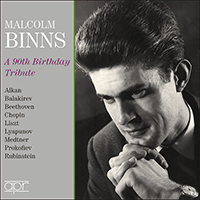

Malcolm Binns (born 29 January 1936) was for half a century one of the UK’s most significant pianists. He retired aged 80, but let’s not forget his hugely eclectic career which ranged from giving the UK premiere of Prokofiev’s Piano Concerto No 4 in 1961 to being the first pianist to record the complete Beethoven piano sonatas on original instruments. For this celebration we focus on his early career with several uniquely preserved BBC concerto recordings and a rare LP, and, from much later, two of his most acclaimed recordings from the former Pearl label.

A noted authority on British piano music, his repertoire extended way beyond just the works he recorded—for example, the concertos of Britten, Ireland, Richard Rodney Bennett, John Gardner and Edmund Rubbra. His contribution to that field of endeavour is immense. He has made solo recordings devoted wholly to the music of—take a deep breath—Beethoven, Balakirev, Debussy, Schumann, Clementi, Medtner, Liszt, Hummel, Bax, Chopin, Lyapunov, Alkan, Anton Rubinstein and Patrick Piggott (whose Eight Preludes and Second Sonata were written for Binns); other albums feature works by Ireland, Bridge, Sydney Smith, Handel, Mendelssohn and Haydn. He was the first pianist to record all thirty-two Beethoven Sonatas on period instruments. ‘I’ve never got tired of the Beethoven sonatas,’ he told me. ‘They have been my constant companions.’
His concerto recordings feature Rachmaninov No 1 and Saint-Saëns No 2 (‘the last two movements make most rivals sound clumsy and wilful’, Gramophone), Stanford (Nos 2 & 3), Harty, Sterndale Bennett (Nos 1 to 5), Balakirev, Rimsky-Korsakov, Rawsthorne (Nos 1 & 2), Gershwin (also Rhapsody in Blue) and Addinsell (Warsaw Concerto). ‘I’ve got to love a piece before I play it,’ says Binns. ‘It only becomes difficult to play if I don’t like the music.’
Away from actually playing the piano, he amassed what was arguably the finest collection of piano 78-rpm records in private hands. Indeed, since its foundation a great many releases on the APR label have featured the words ‘with thanks to Malcolm Binns’ for supplying the source material. His library of piano music was equally comprehensive, both collections now having been passed on to the next generation of pianophiles. Binns himself has an encyclopaedic knowledge matched by few others of the piano, its exponents and its repertoire. Only recently, after seven decades of public performances, has he retired (due to arthritis and mobility problems).
These then are the bare bones of a remarkable career. As he enters his tenth decade, let us flesh that out a little more with the help of some interviews I conducted with him over the years. Binns is a wonderful story teller, a fund of memories, anecdotes and opinions, delivered with a twinkle and a waspish charm, always happy to drift off piste down various rabbit holes en route. I first met him in the 1970s, purely as a fan, fascinated to talk to someone who had heard so many great pianists of the past as a young man:
Louis Kentner, Annie Fischer, Elly Ney—one of the most unforgettable concerts of my life—Backhaus, Solomon, and of course Cortot. They all had an influence on me in one way or another. I heard Cortot in the Town Hall in Leeds. I think it was his last UK tour. He played all the Studies and all the Preludes of Chopin, poor thing. The Preludes went very well, but some of the Studies he just couldn’t get round. But the sound! That was the most impressive thing of all for me. And the poetry. But just before the B minor Study with the double octaves [Op 25/10], a black cat wandered on stage. Titters all round, of course. Cortot couldn’t see it—he had bad eyesight by then. That recital had a wonderful effect on me. He had fabulous fingers but was hopeless on leaps—even the basses of the Chopin Waltzes, he couldn’t always get the bottom note right—but double thirds and anything else like that, he was superb.
Binns would have been about sixteen at the time. I asked him about his early years and how he got started:
My first serious teacher was a singer. My mother taught me for a time, but I didn’t have a proper teacher till I went to the Royal College of Music Junior School. I remember I started with Grade 8 which is the final grade of the Associated Board. I got the highest mark in the country apparently. First exam I took. That’s why they put me up for the Associated Board scholarship. Got that and started at the College when I was sixteen.
He had already begun to appear in public. One of his earliest concerts was announced as a ‘Pianoforte Recital by Leslie Moorhouse who introduces Malcolm Binns (13 year old boy prodigy)’. The teenager opened with a Chopin selection, after the interval he offered short works by Khachaturian, Albéniz, Debussy and Addinsell before being joined by Moorhouse in the ‘First Movement from Grieg’s Piano Concerto Played on Two Pianos’.
Binns’s professor at the RCM was the New Zealand-born Arthur Alexander (1891-1969):
He was not a great teacher but a lovely man—and a great mimic. I did go on to Peter Katin who helped me with my finger technique. The most help I got, in a way, was from Maria Donska [1912-1996]. She was a pupil of Schnabel. She would make me justify things if I played something in a certain way. But Arthur Alexander had been a pupil of Matthay. He knew Medtner very well, and also Bax, which is why I eventually recorded quite a lot of their stuff. Medtner died a couple of years before I arrived on the scene, but Arthur used to send me up to see Madame Medtner. I played on the old boy’s Bechstein quite a lot. She used to make me wonderful Russian cakes and I played Medtner to her. I learnt the Third Concerto—the one he wrote in London and Worcestershire during the War. I eventually broadcast it with Ray Leppard but sadly not while I was at the RCM.
A common route to establishing a career in the UK in the 1950s, before competitions were as prevalent or significant as they have now become, was to hire the Wigmore Hall for a debut recital and hope that the then-plentiful press notices would be positive and endorse the aspiring soloist. This could be quite a challenge for poorer artists, but Binns goes on to describe how his debut there came about:
I was lucky because at College I was a student with a girl who had a great aunt who was the sister of [the poet] Lascelles and [architect] Patrick Abercrombie. She was a very wealthy lady and paid for my first two Wigmore recitals [in 1958]. I remember I played the Schumann Toccata, some contemporary stuff, some Beethoven, Chopin, usual sort of fare and got very good reviews, and I remember going to see Mrs Tillett of Ibbs & Tillett [the famous music agency] with these reviews. And Mrs Tillett said, “My advice to you Mr Binns is to go home and practise.”
So when I started, I did most of my work myself. Wrote around like mad. In the end I must have infuriated George Weldon who was the assistant conductor to Barbirolli at the Hallé, and he rang up one day and said “Oh, for heaven’s sake come up and play to me.” He kept on requesting concertos and I played a bit of the Grieg concerto, a bit of Rachmaninov 2, the Tchaikovsky, the Paganini Rhapsody, and Beethoven 4. Fortunately, I knew all these tunes and in the midst of this, apparently, he phoned up the Hallé and got me some dates. This was in the late ’50s. In those days it was possible to audition for particular provincial orchestras, and I got one with [Sir Charles] Groves at Bournemouth, succeeded in that and went soon afterwards to do the Paganini Rhapsody and the Franck Variations in the same programme.
Binns goes on to describe how he made his Royal Festival Hall debut which took place with the RPO on 25 September 1961:
It took a long time to get into town. It happened because of a friend of mine at the College, Professor Kenneth V Jones [1924-2020]. He was also a conductor and wanted to do a concert in the Festival Hall. I’d heard that the Prokofiev left hand Concerto was going around. It had been premiered in Berlin by a one-armed pianist [Siegfried Rapp in 1956] and Serkin had done it in the States [in 1958]. And I wrote to Serkin because I couldn’t find the score—I thought it would be rather a nice thing to play for my first important date. It had never been played in London. Serkin was very generous, sent me a telegram and said why don’t you try Boosey & Hawkes, they’re Prokofiev’s publishers. Well, I’d never thought of that! I assumed it would only be available in Russia. So I got the music, and we did it and it went down very well. The first broadcast performance [included here] was with Norman del Mar. I did it in Sweden and one or two other places. It’s a very good piece. Should be done more often. I later did the Third and the Fifth Prokofiev as well.
Then I played for [Sir John] Pritchard—we did the Gershwin concerto in Liverpool—and he liked that so much he persuaded the London Philharmonic to do it with me in their season at the Festival Hall.
Thereafter Binns played regularly with the LPO during their season there for many years:
I had to work hard, writing round and all that, because I was only on the general list of Ibbs & Tillett and that really didn’t get you very far. After three or four years I had a phone call from Emmie Tillett and she said I think you’d better come and talk to me, Mr Binns. I think you should become exclusive with us. Then I began to get a lot of work, so much that I had to give up my professorship at the Royal College. I had a nice flat in Regent’s Park. Those were the days when I was earning!
In 1957, in parallel with his developing concert career and about the time Binns would have been planning his first Wigmore recital, he also wrote to the BBC to request the then-obligatory audition which one had to pass before being accepted as a broadcasting artist. For many pianists this could be a long, drawn-out process which could take several years of repeated attempts, but for Binns, his approval came by the end of the year. He made his first broadcast in 1958. A separate audition was required to be considered for Proms performances and, once again, Binns was fast-tracked—he auditioned in January 1960 and made the first of his seventeen appearances at the Proms that September in Franck’s Symphonic Variations. From 1960 to 1970 he played there every year, and twice during the 1966 season:
William Glock was in charge when I started and he very much liked Alan Rawsthorne’s music, although he did ask me to play other things as well, including the Liszt A major and Beethoven 2—both on the same night! That was in 1962 with the BBC SO and Sargent. The one thing I should have got [Sargent] to put in writing was when we came offstage after the Beethoven. He said: “That’s the best I’ve ever done it since I recorded it with Schnabel.” But of course, I wasn’t that sort of person. Should have had a piece of paper to hand!
In 1964, playing Rawsthorne’s Piano Concerto No 1 with Sargent for the Last Night concert, Binns suffered a memory lapse in the Chaconne:
Sargent rescued the situation by getting the orchestra to come in on cue with a big crash chord. It all went perfectly well to the end and Sargent came off shouting to everyone “He’s had a memory lapse. He’s had a memory lapse!” Rawsthorne came backstage roaring with laughter and said it was the best he’d ever heard it. No one noticed. I got wonderful reviews in The Times and Telegraph.
Three years later, he was booked to play the Rawsthorne again for the Last Night—again with Sargent—but that was the occasion when Sargent was too ill to conduct (Colin Davis deputised). He appeared in the Hall to give a now-celebrated farewell speech and died two weeks later. Binns emphasised:
I must say, Sargent was the most marvellous accompanist. You couldn’t shake him off. He could follow you anywhere—but I didn’t like him as a person. I liked Boult. I did Rach 3 with him, an ‘Emperor’, the John Gardner Concerto and the Paganini Rhapsody: that was very good. I never played with Barbirolli but lots of others—Raphael Frübeck de Burgos, Vaclav Neuman, George Weldon (always got on well with him), Maurice Handford.
In 1970, Binns played Rawsthorne’s Second Piano Concerto for the Last Night, also conducted by Davis; then Tchaikovsky 2 (1974), the Ravel left hand (1975) and Mendelssohn 2 (1982). But that was that. After Glock, Robert Ponsonby took over the Proms, succeeded by John Drummond. ‘Drummond was in,’ Binns recalled with a wry laugh, ‘and I was out.’ To the BBC’s eternal shame, he was never invited back.
Some little-known facts. In 1965 Binns entered the Warsaw Chopin Competition—or nearly. It was something he himself had forgotten until the late 1990s when he happened to pick up a programme in a second-hand bookshop:
Leafing through it on the train home, I nearly fell off the seat: there was a biography of me. Then it came back: I had entered and when some dates with the Hallé came up, and I knew Martha Argerich was in for it, I’d thought—oh well, better the bird in the hand—or something like that.
Four years earlier, Binns made his first and last film appearance. Towards the end of the 1961 thriller The Naked Edge, Deborah Kerr is pacing her apartment in the dark as would-be murderer Eric Portman stalks her with a razor. She switches on the television (black and white, of course) just in time for the end of a classical concert and the final pages of Rachmaninov’s third piano concerto, the music serving to stoke up tension before Gary Cooper arrives to save the day. The pianist is the young (and un-credited) Malcolm Binns (with a noticeably fine head of hair). Close ups of the pianist’s head, hands, and of the conductor, Muir Matheson. None of the orchestra.
More pertinent to this collection are some little-known facts regarding the other material reissued here. Malcolm Binns’s first recordings were made for the Saga label. Of the three he made, only two were issued. The one that was not issued was of the complete 24 Études of Chopin:
They’d imported Ashkenazy’s recording from Russia and that sold very well, so only a few of mine were ever issued on ‘These You Have Loved’-type compilations.
Then Binns was contracted to do three LPs with the Concert Artist label, founded and run by the now-disgraced con man William Barrington-Coupe:
What was interesting was that they were produced by his wife, Joyce Hatto. And I can vouch that every note of them was me! We recorded some things in Guildford Civic Hall (which, of course, was where Joyce recorded the Bax Symphonic Variations with Vernon Handley—that was a genuine Hatto recording). She was a very good producer too. She left me alone, we always agreed when something wasn’t quite right. One of them was an Alkan LP with the two Caprices and the finale of the Concerto for solo piano. On the other side were the six Anton Rubinstein Etudes Op 23 which are very rarely played, I think with good reason! The ‘Staccato’ étude [No 2] was played quite a bit but not the others.
Subsequently, I did Rhapsody in Blue and the Gershwin Concerto at Abbey Road and then Rach 1 and Saint-Saëns 2 with the LPO and Alexander Gibson. Those were all on Classics for Pleasure or World Record Club—all EMI companies. I loved the piano I played on for those sessions. It was a very old Steinway. I suspect from the number, it was the one they got in specially for Paderewski and his 1938 sessions. It was only thirty years on, you see, so it’s quite possible.
Recordings were a bit in abeyance then until I bought myself an 1803 Broadwood grand and had it restored and rather liked playing on it. Then word got around that I wasn’t dead and living not too far from ‘Mick’ Colt [Charles F. Colt, founder of the Colt Clavier Collection] who had the famous collection of early pianos. We became friends. Then Peter Wadland, who must have been one of the first producers to record original instruments, was making all these recordings for Decca on the L’Oiseau Lyre label called Florilegium. He signed me up to do all the Beethoven Sonatas using 14 different pianos from the Colt Collection. I did one of Liszt and another sponsored by Broadwood on various historic instruments like Prince Albert’s square and Handel’s harpsichord. Then I had a bad year with the tax man and sold my beautiful Broadwood at Sotheby’s. The amusing thing was that I was asked to go over to give some recitals for Cologne Radio—one live, one studio—on three historic instruments, one of which turned out to be my Broadwood. Cologne Radio had bought it! I still went on playing on the modern piano all over the place though.
Indeed he did, and Binns was to go on to record for several of the most important British independent labels of the later 20th century, such as Lyrita, Chandos, Hyperion and Pearl. He finally retired from the recording studio in 2007 with a wonderful set of English piano sonatas – the four of Bax, the Bridge and the Ireland.
The Medtner and Chopin albums in the present compilation were produced by Binns’s friend Stephen Plaistow. Interviewing Malcolm Binns for Gramophone magazine in 1996, Plaistow wrote: ‘There is a long and rather dishonourable tradition in this country of taking our best artists for granted … [Binns] seems to me to have been getting better and better over the last 40 years, and I wish his quality were more widely celebrated. We should be making more fuss of him I think.’
To which I say ‘Amen’. That he has not been honoured for his work as a pianist, as one of our most distinguished musicians and as a champion of his country’s music is reprehensible. This timely celebration of a great British artist may, hopefully, redress that.
Jeremy Nicholas © 2026
I was next to meet Malcolm when, working at Hyperion Records, I invited him to participate in our ‘Romantic Piano Concerto’ series, for which he recorded the concertos of Balakirev and Rimsky-Korsakov. He turned out to be a delightful person, unassuming but full of enthusiasm and a mine of information and anecdote. A decade or so later I took over the APR label from Bryan Crimp its founder, who wished to retire, and was to discover that Bryan already had a working relationship with Malcolm, whose vast collection of 78rpm discs had often been a source of material for APR issues. I was happy to be able to continue this relationship and finally got to know Malcolm properly. He was always happy to help and to share his collection so others could enjoy it, but he was strangely reticent at first about what exactly he had. If you went to him with a request he would often come up with the rarest of surprises—I remember on one of the earlier releases under my watch, the complete York Bowen 78s, he produced a disc from 1915 on the obscure Marathon label, which no one else seemed to know existed.
It was to be another fifteen years before I finally found out the full extent of Malcolm’s collection when he allowed me to catalogue it as a computer database. It turned out to be both selective and comprehensive; for those pianists he chose to collect he had almost complete runs—Cortot, Pachmann, Paderewski, Viñes, Planté, Busoni, Roger-Miclos and others all fall into that category. He also had a nearly complete run of Grünfeld, the earliest serious pianist to record. This particular collection is probably unrivalled anywhere in the world and I hope to make use of it in a future APR release. Yet there were many pianists of whom he had almost nothing.
In recent years Malcolm has had to downsize and his vast collection of records, scores and books has been sold off. I’m delighted to say APR now has custody of his 78s.
One of the more unexpected surprises in investigating Malcolm’s collection was that he had a whole series of off-air BBC recordings from early in his career transferred to private LP discs. These concerts do not appear to have been preserved by the BBC, so they are now unique documents. It was this discovery which prompted the thoughts that led to this release. From this collection we have chosen a significant Prom from August 1962 where he performed two concertos conducted by Sir Malcolm Sargent (a valuable addition to the conductor’s discography as well), a rare outing for Lyapunov’s first Piano Concerto from the previous year, and the January 1962 UK broadcast premiere of Prokofiev’s Piano Concerto No 4 for the left hand.
Malcolm’s first two LP recordings were on the Saga label, but his rarest were three discs he made for Concert Artist. A disc of Brahms and Schumann, one of Clementi (a Binns enthusiasm) and the one we have decided to reissue here, of Alkan and Rubinstein. The history of Concert Artist and its now infamous owner are best told elsewhere, but suffice to say, it’s unlikely any master tapes survive, and we have had to use copies of the LP in Malcolm’s personal collection for the transfers. Sadly, these LPs are rife with problems: surfaces were poor with a prevalent swish (even though mint copies), the discs were cut badly with much bass rolled off (this may well have been because the length of the Rubinstein side—at over 30' was rather long for an LP) and there is frequent distortion in the louder passages. On top of this, the recorded sound in the Alkan, clearly done in a completely different venue from the Rubinstein, is extremely dry, thin and boxy. Malcolm couldn’t remember details of the recording, but we have tracked down the page turner for the sessions who was able to confirm that the Alkan was recorded in Barrington-Coupe’s home. That explains a lot! (No details of Concert Artist recording sessions are known to survive. We know from Malcolm’s diaries that the Brahms/Schumann LP was recorded in Guildford Civic Hall in January 1966 and several dates are listed. The venues for the other two LPs are not certain; it is possible further material was recorded in Guildford but Sonotape Studios in Soho Square is also mentioned as a venue on February 18th, though without associated repertoire. This could be Clementi or Rubinstein. Malcolm’s diary has Alkan listed for April 26th but implies Guildford. This is contradicted by the page turner’s memory and the acoustic. In 1966 Barrington-Coupe was living at 143 Wentworth Road, London NW11, so that is the likely venue.)
We have done what we can with the sound and hope that it is now presentable. It turned out that adding a very small amount of artificial reverberation led to a much more pleasant listening experience in the Alkan. Most importantly, we have preserved some very exciting virtuoso playing from our pianist in what was pioneering repertoire at the time. None of the Alkan works and only the second of the Rubinstein etudes (the famous ‘Staccato etude’) had been recorded before. Indeed, it was only in the previous year that Raymond Lewenthal’s groundbreaking LP of Alkan had put the composer ‘on the map’ and Ronald Smith’s explorations were yet to come.
Our final two CDs need no apologies. Most of Malcolm’s later recordings are still available and are still in copyright with their original owners, however the Pearl label is no longer active and thus Malcolm’s five recordings for them are no longer available. We are delighted to have licensed his Medtner and Chopin discs from their current owner and to return to the catalogue one of the most impressive Medtner recitals ever committed to disc and a set of the Chopin studies which has received recent praise in Gramophone as amongst the best in this very crowded field, along with a plea for its reissue. We are happy to oblige!
Michael Spring © 2026




