Welcome to Hyperion Records, a British classical label devoted to presenting high-quality recordings of music of all styles and from all periods from the twelfth century to the twenty-first.
Hyperion offers both CDs, and downloads in a number of formats. The site is also available in several languages.
Please use the dropdown buttons to set your preferred options, or use the checkbox to accept the defaults.
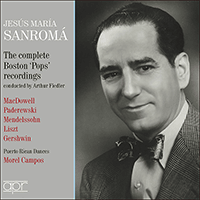


The Puerto Rican pianist Jesús María Sanromá (1902-1984) came to the USA to study and subsequently built his career there. He had a very wide repertoire and gave the US premieres of many contemporary works, including Ravel’s G major Concerto, but was equally at home in the classics or Gershwin. He had a long association with the Boston Symphony Orchestra and their summer festival brand the ‘Pops’, resulting in the series of concertos reproduced here. His Gershwin Rhapsody was a huge hit, and the MacDowell and Paderewski were first recordings.

By 1915 the family had moved to San Juan to give the boy more opportunity for performance. From the beginning, Sanromá played solos and accompanied other performers, particularly his brother who played the flute. This would continue throughout his life when he was constantly in demand as an accompanist to the greatest artists of his generation. His success was such that the Government of Puerto Rico awarded him $600 to further his musical education abroad. Due to the First World War currently tearing Europe apart, the family decided it wiser to go to the United States and chose the New England Conservatory of Music in Boston. Father and son departed the family home on New Year’s Eve 1916 arriving in New York a week later. One of the first people the boy met was Cécile Chaminade (1857-1944) who played her Pas des Amphores for him. After passing his audition at the Conservatory Sanromá was assigned David Sequeira as his piano teacher. By now the boy was fifteen and was studying more advanced repertoire including Beethoven’s ‘Pathétique’ Sonata, Cantique d’Amour by Liszt and Albéniz’s Seguidillas.
Only six months later, the family was reunited when Sanromá’s mother and brother arrived in Boston. Brother Juan (later known as John B Sanromá) joined his father to work in a factory in Ashburnham. The pianist’s workload increased with Bach Preludes and Fugues, Schumann’s Faschingsschwank aus Wien and Gounod’s Waltz from Faust in the arrangement by Liszt. In his last year at the New England Conservatory Sequeira decided to enter Sanromá for the Mason and Hamlin competition. The prize was one of the company’s pianos and jury members included Pierre Monteux and Rudolf Ganz. Seventeen-year-old Sanromá won the competition playing the required works—the Scherzo from Chopin’s Piano Sonata in B flat minor, the last movement of Brahms’s Piano Sonata Op 2 and Reflets dans l’eau by Debussy.
After graduating at the age of eighteen, Sanromá began a seven-year period of study with Antoinette Szumowska (1868-1938), a teacher at the New England Conservatory and former pupil of Ignace Jan Paderewski. Some of the music she assigned included the Piano Sonata in B minor by Chopin and the Piano Concerto in A minor by her teacher Paderewski. In order to make money and help support his family Sanromá was constantly working as soloist and accompanist to singers and instru mentalists. In April 1923 conductor of the Boston Symphony Orchestra Pierre Monteux invited Sanromá to take part in a performance of the Septet in E flat, Op 65, by Saint-Saëns. Another highlight of this year was when his teacher enticed Paderewski to give a master class at the Conservatory. Sanromá was one of the two pianists selected, and he played, amongst other things, the first movement of Chopin’s B minor Sonata and Paderewski’s Cracovienne fantastique. Monteux also helped Sanromá in another way by recommending him as accompanist for his violinist friend Jacques Thibaud. Sanromá and Thibaud toured the United States for seven weeks and some of their concerts included guest artists such as Ignaz Friedman, Wanda Landowska and Pablo Casals. The tour finished in late February 1924 with dates in Montreal and Winnipeg whence they returned to New York to make some recordings for RCA Victor, Sanromá’s first experience in the commercial recording studio. Only four sides were issued, recorded by the old acoustic process. A month later (after contracting and recovering from mumps) the 21-year-old Sanromá made his orchestral debut with the People’s Symphony Orchestra playing Paderewski’s Piano Concerto. Monteux left his post as conductor of the Boston Symphony and was replaced by Serge Koussevitzky, probably the most important figure in Sanromá’s career. The manager of the orchestra, a friend of Sanromá, recommended him to Koussevitzky as pianist for any symphonic works that had a piano part, such as Stravinsky’s Petrushka and Loeffler’s Pagan Poem. A three-year contract turned into twenty-five years!
Sanromá gave his professional debut recital at Boston’s Jordan Hall in October 1924. To give an idea of the breadth of his repertoire and abilities, Szumowska selected the first two movements from Bach’s Italian Concerto and the first movement of Schumann’s Fantasie to open the programme. The second part consisted of short works by Chadwick, Paderewski and Spanish composers while the remainder of the programme was of Chopin, ending with Liszt’s Polonaise in E major. It was a great success with critics and audience alike. Less than a month later Sanromá gave his first performance of Rachmaninov’s Piano Concerto No 2 for a radio broadcast with the New England Conservatory Student Orchestra. His role with the Boston Symphony meant that he was in great demand as an accompanist for many of the first chair musicians and as a chamber music collaborator, often learning new works at short notice, so his workload increased further. One of these soloists was violist and pianist Arthur Fiedler, who became another close friend and important person in Sanromá’s later success.
1925 saw Sanromá giving his debut with the Boston Symphony and Koussevitzky and his second recital at Jordan Hall. Centred around Chopin’s Piano Sonata in B minor it also included a work by Gian Francesco Malipiero as Sanromá was very interested in promoting new music. More performances of Petrushka followed plus the Boston premiere of the same composer’s Chant du Rossignol and a performance of Liszt’s Piano Concerto No 1 with an amateur orchestra. Another Boston premiere was Sanromá’s broadcast performance of Gershwin’s Rhapsody in Blue and it was at this time that Arthur Fiedler took over the helm of the Boston Pops—the summer orchestra formed of members of the Boston Symphony.
After six years of study with Szumowska, Sanromá decided to take a break and go to Europe. He frantically gave concerts to raise funds for his trip including his first performance of the Schumann Piano Concerto with the Boston Symphony and Koussevitzky.
In May 1927 Sanromá sailed on the RMS Mauritania for his first visit to Europe. Many doors were opened to the young pianist in Paris through Koussevitzky’s connections, including that of Alfred Cortot. During the summer of 1927 Sanromá had thirteen lessons with the great musician who was highly impressed with his interpretations of the music of Schumann. He was also afforded connections to managers and impresarios in Germany and Spain. In September he travelled to Berlin to study with Artur Schnabel and while in the city heard performances by Vladimir Horowitz and Emil von Sauer. He also met Ernest Toch and gave the premiere of his recently written Piano Concerto on his return to Paris with Koussevitzky at the Salle Pleyel. After more concerts in France and Spain, Sanromá returned to New York where he played the Toch Concerto in January 1929. In October his continuing success led to another short European tour, this time including Vienna and his first performance in London at the Wigmore Hall.
For his Vienna recital his agent agreed that he should include the Kleine Suite by Krenek and invited the composer to the performance. After further concerts in Spain, Sanromá’s hectic schedule included the Boston premiere of Stravinsky’s Capriccio for piano and orchestra, just one of many works of which he had the opportunity to give the first performance in the United States. Others included works by Ernst Bloch, Edward Hill, Vladimir Dukelsky, Arthur Honegger, Maurice Ravel and Bohuslav Martinů, sometimes under the batons of Prokofiev or Stravinsky. The performance of Stravinsky’s Capriccio in Carnegie Hall prompted Olin Downes of the New York Times to write: ‘As for Mr Sanromá, he has grown, by an industry and talent as remarkable as his modesty, from a student of a few years ago to a modern pianist whose performance yesterday could be equalled by a very few and out rivalled by no one.’ In addition to his performing activities Sanromá joined the faculty of the New England Conservatory.
Sanromá gave the US premiere of Ravel’s Piano Concerto in G major with Koussevitzky and made his first piano and orchestra recording for Victor in July 1935 when he recorded his interpretation of Gershwin’s Rhapsody in Blue. When it was released in Britain, the reviewer for Gramophone magazine was predictably dismissive:
I have only once before heard the Rhapsody. It is one of the more pretentious essays in a jazz idiom which never had much of interest to detain a musician. Those who like these mild moodinesses and are sufficiently unsophisticated to relish the dishing up of many familiar bits and pieces, will enjoy this clean presentation, in which the piano part is boldly played by Mr. J. M. Sanromá.
(Gramophone, February 1936)
Like the composer’s own recording of 1927, it is full of energy and drive, and it is interesting to hear Sanromá making many of his own additions to the score.
During the summer of 1936 Sanromá presented three composer-based programmes—one each of Debussy, Bach and Brahms, plus a French recital. Meanwhile, in early summer, rehearsals of MacDowell’s Piano Concerto No 2 were under way with Fiedler and the Boston Pops to be coupled in concert with the US premiere of Poulenc’s Concerto for Two Pianos with Leo Litwin. In December Koussevitzky presented a 75th anniversary concert for the birthday of composer Edward MacDowell (1860-1908) where the Piano Concerto No 2 was played by Howard Goding (1893-1981), but for further performances in the New York area, the conductor asked Sanromá to be the soloist. Although Koussevitzky was too ill to conduct Sanromá’s first night with this work he was well enough to be on the podium for the performance in Carnegie Hall.
The New York Times critic wrote that Koussevitzky gave ‘an enamouring performance’. Describing it as a work that has ‘vigor, thrust and manliness,’ he agreed that the concerto was rarely heard, thinking that the performance by Sanromá ‘might help, perhaps, to place it in the repertoire more frequently’. Although recorded by a few pianists in the LP era (Vivian Rivkin, Eugene List and Roberto Szidon) it has never become a popular work. Sanromá had already recorded it for Victor in July after the summer rehearsals and critic Compton Pakenham gave this recording faint praise when he said that he ‘may not be doing MacDowell complete justice, though it must be admitted that the performance is one calculated to show the work off in its best light and the recording is excellent’. Sanromá indeed gives an excellent performance of this work which was dedicated to the great Venezuelan pianist Teresa Carreño. The work must have still been of interest in the 1950s because when RCA Victor producer Charles O’Connell later went to work for Columbia he asked Sanromá to record the work again for LP in 1952 with the Eastman Orchestra and Howard Hanson.
In 1937 Koussevitzky asked Sanromá to play the Piano Concerto in G major at memorial concerts for Ravel. Meanwhile, Hindemith was invited to America for the first time by the League of Composers in New York and Sanromá began a lifelong artistic and personal friendship with the composer who wrote to his wife that ‘his playing is first class. Arrived fully practised and played, apart from a few bars, fully in the spirit of the composer.’ He gave the first performance of Hindemith’s Piano Sonata No 3 in 1936, and of his Piano Concerto in 1947 with the Cleveland Orchestra and George Szell. Sanromá and Hindemith toured together promoting the composer’s works, and Hindemith wrote a Sonata for Piano Duet for himself and Sanromá to perform, which they also recorded.
During the 1937 season Sanromá played Weber’s Concertstück, MacDowell’s Piano Concerto No 2 and the Variations on a Nursery Tune by Dohnányi. At the same time, Victor asked him to record Liszt’s Totentanz. The possible reason for this may be that they had heard that Pathé were recording the work with Edward Kilenyi, or it could have been that Victor heard a 1937 performance by Albion Metcalf with Fiedler and the ‘Pops’ but wanted Sanromá to record it as he was under contract to them. Sanromá had played the Piano Concerto No 1 and Hungarian Fantasia by Liszt in the 1932 season with Fiedler, but not Totentanz. According to Sanromá, he learnt it in four days. There was no rehearsal with the orchestra, just the side joins of the 78-rpm discs were rehearsed so they knew when to stop. Sanromá used the score for the recording, but all four sides were issued from first takes and the performance remains one of the best on record. Sanromá displays an uncommon virtuosity and makes interesting tempo relationships between the variations. As I wrote when I reviewed a previous re-issue in 2000: ‘From the menacing opening chords which Sanromá plays detached and secco, the work is driven along at a frenzied pace, building to a final climax of terrifying proportions.’ Sanromá’s father was gravely ill while he was working on the piece and died not long afterwards. Sanromá refused to play the work for five years and although the recording was a great success, he only performed it in public with Fiedler infrequently—in 1943 and thereafter in 1947, 1949 & 1951.
During the 1938 summer season with the Boston Pops, Sanromá gave thirteen performances of the Piano Concerto No 1 in G minor by Mendelssohn which he then recorded for Victor at the end of June. Sanromá told the story that a rival company got to know about the recording and issued their own version before his could be released. Victor therefore had to wait two years before his version could be released to the public. This would have to be the recording by Ania Dorfman with the London Symphony Orchestra and Walter Goehr made for Columbia, at a single recording session on 11 November 1938. It is a work that perfectly suits Sanromá, displaying his fast finger work and clarity of sound.
Sanromá had learned the Paderewski Piano Concerto with Szumowska in 1924. He played it occasionally—in the autumn of 1931—and always received favourable comments in the press on the work and his interpretation of it. When Victor decided that they wanted to make the first recording of the concerto in 1939 he and Fiedler scheduled two performances of it at the Sunday Pops Concerts on 14 and 24 May 1939 as precursors to the recording session. During one of the rehearsals the composer himself, who was in Boston to give a recital on 10th May, went to Orchestra Hall to hear the first rehearsal before the Sunday performance. According to Sanromá, Paderewski thought the third movement should be played slower. The resulting recording was the only viable version in the catalogue until the recording by Earl Wild and the London Symphony Orchestra, again with Fiedler, was issued in 1970.
After the success of his recording of Gershwin’s Rhapsody in Blue the composer asked Sanromá to play and record his Piano Concerto in F. Three years after the death of the composer, Sanromá recorded it with the Pops and Fiedler. The Concerto is a work well suited to Sanromá’s abilities. He invests his performance with enormous vigour and vitality building great excitement in the closing pages of the first movement. In the outer movements his finger independence and clarity of execution are just what is needed while in the romantic slow movement Sanromá plays with feeling but avoids sentimentality.
He was getting a name for himself as a performer of Gershwin and in 1943 was asked to play the Rhapsody and Concerto at a Gershwin Memorial concert at Lewisohn Stadium with the New York Philharmonic. Paul Whiteman also asked him to play the Rhapsody for a broadcast that same year. After joining the management of Arthur Judson, Sanromá was reaching many more people with these large gala performances, but was also becoming known as a less serious, more popular performer. In the late 1940s with Fiedler and the Pops, they were frequently expected to play the Gershwin works. As RCA Victor producer and sometime conductor Charles O’Connell wrote: ‘… he played the Gershwin Rhapsody in Blue so many times with the Boston Pops Orchestra that his association with it was becoming too close for comfort.’
Due to his exceptional sight-reading capabilities Sanromá learned and performed a great deal of new and unusual music during his career. Works as disparate as Skyscrapers for piano and orchestra by John Alden Carpenter, Constant Lambert’s Rio Grande and the Piano Quintet by Louis Vierne show the enormous range of Sanromá’s repertoire. He was always happy to learn works of the composers whom he met in person or who were promoted by Koussevitzky.
Sanromá kept up a frantic schedule of performances—solo, concerto, chamber—taught and participated as jury member at piano competitions. In the mid-1940s he played the Brahms Piano Concerto No 1 with a Koussevitzky protégé, the 26-year-old Leonard Bernstein, and the Boston Symphony Orchestra. Also with Bernstein, he played the Grieg Concerto with the San Francisco Symphony and Stravinsky’s Capriccio with the Boston Symphony in 1956.
In 1951 Sanromá was offered the post of music advisor to the chancellor of the University of Puerto Rico. So, after being based in Boston for his whole career, Sanromá returned to Puerto Rico, continuing his concert engagements in America. The following year he was joined by his wife and four daughters. He continued to perform in South and North America as well as Canada and was in constant demand by orchestras who wanted to include his Gershwin interpretations in their summer schedule.
Once settled in Puerto Rico Sanromá threw himself into an ever-rigorous schedule planning conferences and a large number of lecture recitals involving local artists. In 1957 he celebrated the centenary of Puerto Rican composer Juan Morel Campos (1857-1896). Sanromá had researched this composer’s large output of danzas for piano and recorded thirteen LPs of them for the Puerto Institute of Culture. However, he had previously recorded eight of them as Puerto Rican Dances for Victor in 1941. These are beautiful performances of charming and amusing works, but they do not have the conviction and emotional depth of the danzas by Federico Mompou.
Sanromá continued to devote his life to music and was helped in the setting up of the Puerto Rico Symphony Orchestra by his friend Pablo Casals. In 1960 the Conservatory of Music opened in Puerto Rico with Sanromá as head of the piano department until 1980. Always keen to promote his national music, at the age of 81 Sanromá wanted to record a disc of danzas by Manuel Taváres whose centenary took place the previous year. A few months later, in October 1984, Sanromá died and the disc was issued posthumously.
In his book The Other Side of the Record published in 1947, Charles O’Connell wrote:
Technically, Sanromá is at least the equal of any practitioner of the pianistic art. This is impressive, but what really interests an intelligent listener is, I believe, the sensitive musicianship, the soundness and saneness of his interpretations, and his extraordinary versatility. He has absorbed the best that his two great teachers, Artur Schnabel and the late Antoinette Szumowska, could give him: Schnabel’s scholarship, and the sense of colour and tonal values that Szumowska, one of Paderewski’s few pupils and the only one a woman, absorbed from her master.
Jonathan Summers © 2026



