Welcome to Hyperion Records, a British classical label devoted to presenting high-quality recordings of music of all styles and from all periods from the twelfth century to the twenty-first.
Hyperion offers both CDs, and downloads in a number of formats. The site is also available in several languages.
Please use the dropdown buttons to set your preferred options, or use the checkbox to accept the defaults.
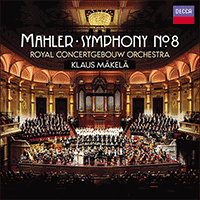


The long-awaited release of Klaus Mäkelä’s outstanding performance of Mahler’s Symphony No 8, live with the Royal Concertgebouw Orchestra from the 2025 Mahler Festival. “Conducting Mahler’s Eighth was one of the great moments of my life, which I will remember for ever. I feel those two performances really carried a very special momentum for everyone involved. I certainly felt it on stage and hopefully it was also felt in the audience” (Klaus Mäkelä).

Amsterdam’s love affair with Mahler’s music laid down a milestone in 1920 when Mengelberg conducted the nine completed symphonies, as well as Das klagende Lied, Das Lied von der Erde and the three sets of orchestral songs, over 15 days. In 1995, during Riccardo Chailly’s tenure, another Mahler Festival (marking 75 years since the first one) took place, but this time other orchestras were invited to share the music-making. A centenary Mahler Festival was planned for 2020, but the pandemic intervened, so it finally took place in May 2025.
Klaus Mäkelä and the Royal Concertgebouw Orchestra gave us Symphonies Nos 1 and 8, and the two live performances of the Eighth—one on a Friday evening, the repeat on the Sunday afternoon (May 18, the anniversary of the composer’s death, and in the presence of Marina Mahler, Gustav’s granddaughter)—together gave us this recording. ‘Conducting Mahler’s Eighth was one of the great moments of my life,’ Mäkelä recalls, ‘which I will remember forever. I feel those two performances really carried a very special momentum for everyone involved. I certainly felt it on stage and hopefully it was also felt in the audience.’
The one constant, alongside the tradition passed down from generation to generation of players, is the hall, where Mahler himself conducted on a number of occasions. For this performance of Mahler’s Eighth the substantial choral forces—five choirs, including that of the Orchestre de Paris imported from Mäkelä’s French ensemble, where he is Music Director, to sing along the Dutch choruses—rose from the stage up the choir seats behind the orchestra in a fan until level with the organ. The superb children’s choir, singing from memory, was ranged across the back of the stage, and seven of the eight soloists sang at the front. But, Mäkelä believes that Mahler ‘used all these instruments, all these incredible voices, all the counterpoint and the scale of the orchestration simply because he needed all the colours, not because he needed more power. Quite the opposite. During the rehearsals we worked hard on the transparency, something that this hall is so perfect for—it has such personality. Every note that comes from the stage, the hall gives it a colour.’
Mahler’s Eighth (1906) was the last of his works he would hear performed in his lifetime, and it was one of the greatest triumphs of his career. It is a colossal challenge for any conductor and, interestingly, Mäkelä seems to have made a point of tackling some of the largest works of the classical repertoire—this piece as well as Mahler’s Symphonies Nos 2 and 3, Bach’s B minor Mass and St Matthew Passion, Beethoven’s Missa solemnis, Richard Strauss’s Die Frau ohne Schatten—at this stage of his career, no doubt with a view to returning to them in years to come with that special kinship gained from early familiarity.
The Eighth Symphony is an unusual creation: a powerful setting of the Latin hymn, Veni creator spiritus, followed by the final scene from Goethe’s Faust (the closest Mahler came to composing an opera, perhaps). Mäkelä believes that each of Mahler’s symphonies is a way for the composer to process major concerns in his life at that time, and in the Eighth he offers us a glimpse into his spiritual life and his religious beliefs. But Mäkelä also thinks it’s Mahler’s ‘true confession of love for Alma’, to whom the work is dedicated, ‘containing some of the most beautiful music he ever wrote. It’s a peek into Mahler's inner turmoil about his very complex emotions for Alma. Yes, it’s an extremely grand gesture, but it’s also very intimate. I could never conduct this work without knowing the other symphonies,’ Mäkelä adds, and he really cherished the opportunity to conduct it in the context of the cycle, particularly the Seventh from which he feels the Eighth is a logical next step.
The Sunday afternoon performance was packed and the mood of expectancy high. Singing every word, and galvanising the hundreds of performers in front of him, Klaus Mäkelä made his mark not just on this colossal work, but also on the Amsterdam audience who are clearly looking forward to 2027 when he becomes this superb orchestra’s Chief Conductor and inaugurates a new reign in a city that knows a thing or two about great conductors.
James Jolly © 2026



