
Welcome to Hyperion Records, a British classical label devoted to presenting high-quality recordings of music of all styles and from all periods from the twelfth century to the twenty-first.
Hyperion offers both CDs, and downloads in a number of formats. The site is also available in several languages.
Please use the dropdown buttons to set your preferred options, or use the checkbox to accept the defaults.


| Edward Burrowes (treble), St Paul's Cathedral Choir, Huw Williams (organ), John Scott (conductor)» More |

Britten’s own philosophical approach to music is worth repeating:
I believe … in occasional music … almost every piece I have ever written has been composed with a certain occasion in mind, and usually for definite performers, and certainly always human ones.
I consider their voices, the range, the power, the subtlety, and the colour potentialities of them.
I consider the instruments they play—their most expressive and suitable individual sonorities … I also take note of the … circumstances of music, of its environment and conventions; for instance, I try to write dramatically effective music for the theatre … And then the best music to listen to in a great Gothic church is the polyphony which was written for it, and was calculated for its resonance.
On receiving the First Aspen Award
A speech by Benjamin Britten (Faber and Faber, London, 1964)
The Hymn to St Peter was written in 1955 and first performed in the same year at the Church of St Peter Mancroft in Norwich. The work draws on a text taken from the Gradual of the Feast of St Peter and St Paul, with its associated plainsong. The plainsong, presented at the outset, is woven into the organ pedal ostinato. The Latin text ‘Tu es Petrus’ (‘Thou art Peter’) is sung by a solo treble, with echoes of the plainsong theme, juxtaposed with Britten’s own harmonic language. This conveniently draws the ancient to the modern as the chorus translates the text the treble sings.
from notes by William McVicker © 1999
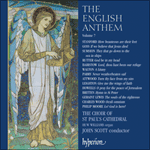 The English Anthem, Vol. 7 The English Anthem, Vol. 7CDA67087Download only  ‘All of the music is of the very highest quality. This disc will offer lasting pleasure and satisfaction to cathedral music enthusiasts and newcomers ... ‘Rewarding indeed’ (Classic FM Magazine)» More |