
Welcome to Hyperion Records, a British classical label devoted to presenting high-quality recordings of music of all styles and from all periods from the twelfth century to the twenty-first.
Hyperion offers both CDs, and downloads in a number of formats. The site is also available in several languages.
Please use the dropdown buttons to set your preferred options, or use the checkbox to accept the defaults.

| Polyphony, Stephen Layton (conductor)» More |
William Walton, originally from Oldham, arrived in Oxford at the age of nine to take up a choristership at Christ Church. There he was trained by the Organist, Henry Ley. To avoid having to return to Oldham when his voice broke, Walton decided to ‘make himself interesting’ by writing music. Parry, whilst in Oxford examining, saw some of the boy’s compositions; he told the Dean ‘There’s a lot in this chap. You must keep your eye on him’. Walton’s setting of Fletcher’s ‘Drop, drop slow tears’ may well have been among these manuscripts, since he was 15 when he wrote it. The piece shows a precocious assurance in the part writing and there are harmonic touches that are later echoed in Psalm 137 from Belshazzar’s Feast. This is not surprising, because the version that is performed today is actually Walton’s revision dating from 1930, when he was engaged on his large-scale masterpiece.
from notes by Emma Cleobury © 2019
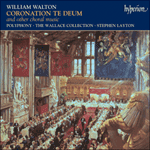 Walton: Coronation Te Deum & other choral works Walton: Coronation Te Deum & other choral worksCDA67330Temporarily out of stock  ‘An outstanding collection’ (Gramophone) ‘What a splendid work it is, especially when sung with the verve brought to it by Stephen Layton’s choir Polyphony’ (The Sunday Telegraph)» More |