Welcome to Hyperion Records, a British classical label devoted to presenting high-quality recordings of music of all styles and from all periods from the twelfth century to the twenty-first.
Hyperion offers both CDs, and downloads in a number of formats. The site is also available in several languages.
Please use the dropdown buttons to set your preferred options, or use the checkbox to accept the defaults.


 PERFORMANCE RECORDING
The death of Ivan Ilyich—a monodrama for bass-baritone, solo cello, two trombones, percussion and strings—came to me after a long illness. It was one of the first major works that I composed after that time, as though Tolstoy himself was waking me from a long creative sleep.
The text is taken from one of Tolstoy’s last and greatest novels. The story of a dying man’s excruciating physical pain and his emotional and spiritual crisis is composed architecturally in an intense and terse manner. A glimpse of light occurs towards the end of the piece, after Ivan Ilyich has examined his miserable life. The work ends with an instrumental Apotheosis. JT
Ivan Ilyich is an extraordinary piece in every way. The demands on the vocalist—involving a range extending from almost impossibly low notes to a high falsetto—are remarkable, while the solo cello, shadowing the singer almost throughout the piece, seems to represent Ivan’s subconscious. The work is a powerful statement, undisguisedly autobiographical. John struggled with extreme pain in his last years—he described it (typically) as ‘a sort of ecstasy’—and he had always been obsessed with the idea of death. Perhaps he conceived Ivan Ilyich as a last testament. But there was more …
The personal story: The story behind Ivan is an extremely personal one for me. For some time before John’s heart attack, I’m afraid that I had hardly been speaking to him. We’d had a quarrel (nothing to do with music), and I was feeling highly offended. But then a friend called to tell me that John was very ill—at death’s door, in fact. All offence forgotten (of course), I immediately called his home in Dorset, where his older daughter Theodora answered. Nervously, I asked how John was. ‘He had a bad heart attack; but he’s getting better’, she replied reassuringly. Soon afterwards, I got hold of Maryanna, and arranged to visit John in hospital. This was a bad time in my life too, because at that point my wife Pauline was undergoing chemotherapy. One afternoon, I went with Pauline to Harley Street for the session, and then went around the corner to meet Maryanna and then to see John. Having been soothed by Theodora’s news, I was expecting to find him weak, perhaps, but basically unchanged. The reality was far more shocking. The skeleton I saw lying there, tubes protruding everywhere, a hole in his throat, was a ghastly shadow of the John I knew. I spoke to him; his eyes opened and he saw me. He couldn’t make any sound, but his hand stole towards mine, grabbed it and held it. It was an indelible moment.
I remember thinking, as I left the hospital in a state of numbness, that Pauline at that point looked the picture of health by comparison. But John, thanks to Maryanna’s miraculous care, fought back; alas, Pauline could not, and died in 2010. John had of course identified with her in their concurrent illnesses, and was deeply affected by her death. He kept saying that he wanted to write something in her memory; but he had been quiet on the subject for some time, until one day I received a mysterious message from both Taveners, asking me to meet them in town. We got together for tea, and John explained that, until then, he hadn’t found a subject worthy of Pauline’s memory; but now he had: The death of Ivan Ilyich. And so the work came into being—a heartfelt memorial.
Despite the sad associations of its inception, however, the rehearsals and first performance of Ivan were hugely enjoyable. Jonathan Lemalu and I went to our first rehearsal with John at the school of his younger daughter, Sofia (the Taveners were there for an end-of-term event, and the school lent us their music room). It was a glorious summer day; arriving to the sight of John lying on the grass with his family, I was struck by how much (having been, I think it’s fair to say, a rather grouchy father during his daughters’ early years) he now belonged to them—rather like Ivan Ilyich at the end of the story. Jonathan plied us all with rather too many glasses of Pimm’s before we made our somewhat unsteady way to the music room (John’s progress was particularly shaky, since he had to get there on a wheelchair, rather erratically driven by his seven-year-old son, Orlando). But once the music started, the years rolled back, and it was like returning to the first time John and I had ever worked together, on The protecting veil. John sat at the piano, playing occasionally, making some suggestions, taking others from Jonathan and me, and the piece came to life. He needed quite a bit of reassurance before he could be certain that we really loved the piece, but eventually he believed us. A few days later we reconvened in Manchester, with full forces, and the memorable experience reached its apotheosis.
from notes by Steven Isserlis © 2020
The death of Ivan Ilyich—un monodrame pour baryton-basse, violoncelle solo, deux trombones, percussion et cordes—m’est venu après une longue maladie. C’est l’une des premières œuvres majeures que j’ai composées après cette époque, comme si Tolstoï lui-même me réveillait d’un long sommeil créatif.
Le texte est tiré de l’un des derniers et plus grands romans de Tolstoï. L’histoire de la douleur physique insoutenable d’un mourant et de sa crise émotionnelle et spirituelle est composée du point de vue architectural d’une manière intense et laconique. Un peu d’espoir survient à la fin de la pièce, après qu’Ivan Ilitch ait passé en revue sa misérable vie. L’œuvre s’achève sur une apothéose instrumentale. JT
Ivan Ilyich est une œuvre extraordinaire à tout point de vue. Ce qu’elle exige du chanteur—notamment une tessiture allant de notes graves presque impossibles à chanter jusqu’à un falsetto aigu—est remarquable, alors que le violoncelle solo, prenant en filature le chanteur d’un bout à l’autre de l’œuvre ou presque, semble représenter le subconscient d’Ivan. Cette pièce est une déclaration saisissante, indubitablement autobiographique. John a souffert de douleurs extrêmes au cours des dernières années de sa vie—il en parlait (comme à son habitude) comme d’«une sorte d’extase»—et il avait toujours été obsédé par l’idée de la mort. Il conçut peut-être Ivan Ilyich comme un dernier testament. Mais il y avait quelque chose d’autre …
L’anecdote personnelle: L’histoire d’Ivan m’est très personnelle. Pendant quelque temps avant la crise cardiaque de John, je regrette de ne lui avoir guère adressé la parole. Nous nous étions disputés (rien à voir avec la musique) et je me sentais profondément offensé. Mais ensuite un ami m’a téléphoné pour me dire que John était très malade—à l’article de la mort, en fait. Toute offense oubliée (bien sûr), j’ai immédiatement appelé chez lui dans le Dorset, où sa fille aînée Theodora a répondu. Nerveusement, je lui ai demandé comment allait John. «Il a eu une mauvaise crise cardiaque; mais il commence à aller mieux», m’a-t-elle répondu sur un ton rassurant. Peu après, j’ai réussi à joindre Maryanna et je me suis arrangé pour rendre visite à John à l’hôpital. C’était aussi une période difficile de ma vie, car ma femme Pauline était alors en plein traitement de chimiothérapie. Un après-midi, je l’ai accompagnée à Harley Street pour sa séance, puis j’ai tourné au coin de la rue à la rencontre de Maryanna pour aller voir John. Rassuré par les nouvelles de Theodora, je m’attendais à le trouver affaibli, peut-être, mais dans l’ensemble inchangé. La réalité était bien plus dramatique. Le squelette que j’ai vu gisant là, avec des tubes qui sortaient de partout, un trou dans la gorge, c’était une ombre horrible du John que je connaissais. Je lui ai parlé; il a ouvert les yeux et m’a vu. Il ne pouvait produire aucun son, mais sa main s’est approchée de la mienne, l’a saisie et gardée dans la sienne. Ce fut un moment impérissable.
Je me souviens avoir pensé, en quittant l’hôpital dans un état de torpeur, que Pauline était éclatante de santé en comparaison. Mais, grâce aux soins miraculeux de Maryanna, John se remit; Pauline, malheureusement, n’y parvint pas et mourut en 2010. John s’était bien sûr identifié à elle dans leurs maladies simultanées et il fut profondément affecté par sa mort. Il n’arrêtait pas de dire qu’il voulait écrire quelque chose à sa mémoire; mais il travaillait déjà sur ce sujet depuis quelque temps, jusqu’à ce qu’un jour je reçoive un mystérieux message des deux Tavener, me demandant de les retrouver en ville. Nous avons pris le thé ensemble et John m’a expliqué que, jusqu’alors, il n’avait pas trouvé de sujet digne de la mémoire de Pauline; mais maintenant il en avait un: The death of Ivan Ilyich. C’est ainsi que l’œuvre vit le jour—une œuvre commémorative venant du fond du cœur.
Toutefois, malgré la gravité de ses origines, les répétitions et la première exécution d’Ivan ont été très agréables. Jonathan Lemalu et moi-même sommes allés répéter avec John à l’école de sa fille cadette, Sofia (les Tavener y étaient pour un événement de fin de trimestre, et l’école nous avait prêté sa salle de musique). C’était une merveilleuse journée d’été; en arrivant, à la vue de John couché dans l’herbe avec sa famille, j’ai été frappé de constater combien il leur appartenait maintenant (après avoir été, je crois qu’il est juste de le dire, un père assez grognon quand ses filles étaient petites)—un peu comme Ivan Ilitch à la fin de l’histoire. Jonathan nous a servi à tous beaucoup trop de verres de Pimm’s avant que nous nous dirigions de manière assez chancelante vers la salle de musique (la progression de John était particulièrement hésitante, car il devait s’y rendre en fauteuil roulant, poussé de manière plutôt imprévisible par son fils de sept ans, Orlando). Mais une fois la musique lancée, nous nous sommes retrouvés plusieurs années en arrière et on avait l’impression d’être revenus à la première fois où John et moi avions travaillé ensemble, sur The protecting veil. John s’est assis au piano, jouant de temps à autre, faisant quelques suggestions, en retenant d’autres que Jonathan et moi lui proposions, et l’œuvre a pris vie. Il avait besoin d’être rassuré avant d’être sûr que nous aimions vraiment cette pièce, mais finalement il nous a cru. Quelques jours plus tard, nous nous sommes réunis à nouveau à Manchester, avec tout l’effectif, et l’expérience mémorable a atteint son apothéose.
extrait des notes rédigées par Steven Isserlis © 2020
Français: Marie-Stella Pâris
The death of Ivan Ilyich—ein Monodrama für Bass-Bariton, Solocello, zwei Posaunen, Schlagwerk und Streicher—kam mir nach langer Krankheit. Es war eins der ersten größeren Werke, die ich nach jener Zeit komponierte, als hätte Tolstoi selbst mich nach einem langen schöpferischen Schlaf geweckt.
Der Text stammt aus einer der letzten und größten Erzählungen Tolstois. Die Geschichte eines sterbenden Manns, der qualvolle körperliche Schmerzen und eine emotionale und spirituelle Krise durchlebt, ist architektonisch angelegt und wird knapp und intensiv wiedergegeben. Am Ende des Stücks, nachdem Iwan Iljitsch sein miserables Leben betrachtet hat, scheint ein Licht auf. Das Stück endet mit einer instrumentalen Apotheose. JT
Ivan Ilyich ist in jeder Hinsicht ein außergewöhnliches Werk. Die Anforderungen an den Sänger—so etwa ein Tonumfang von fast unmöglich tiefen Tönen bis zu einem hohen Falsett—sind bemerkenswert; das Solocello hingegen folgt dem Sänger fast das gesamte Werk hindurch und scheint Iwans Unterbewusstsein darzustellen. Das Werk macht eine gewaltige Aussage und ist unverblümt autobiographisch. In seinen letzten Jahren hatte John mit extremen Schmerzen zu kämpfen—die er (wie für ihn typisch) als „eine Art Ekstase“ beschrieb—und er war immer von der Idee des Todes besessen gewesen. Vielleicht hatte er Ivan Ilyich als Testament gedacht. Doch es ging noch weiter …
Der persönliche Hintergrund: Die Entstehungsgeschichte des Ivan ist sehr persönlich für mich. Vor seinem Herzinfarkt hatten wir geraume Zeit leider kaum Kontakt gehabt. Wir hatten uns gestritten (nicht über Musik) und ich fühlte mich sehr gekränkt. Doch dann rief ein Freund an um mir mitzuteilen, dass John sehr krank war—todkrank sogar. Daraufhin war natürlich aller Streit vergessen und ich rief sofort bei ihm zuhause in Dorset an, wo seine ältere Tochter Theodora ans Telefon ging. Aufgeregt fragte ich sie, wie es John ginge. „Er hatte einen schlimmen Herzinfarkt, aber es geht ihm schon wieder besser“, antwortete sie beschwichtigend. Bald darauf erreichte ich Maryanna und organisierte einen Krankenhausbesuch bei John. Für mich war das ebenfalls eine schwere Zeit, da meine Frau Pauline Chemotherapie erhielt. Eines Nachmittags fuhr ich mit ihr zu einem Termin in der Harley Street und traf dann Maryanna, um John besuchen zu gehen. Nach dem beruhigenden Gespräch mit Theodora ging ich davon aus, ihn zwar möglicherweise schwach, aber doch sonst unverändert vorzufinden. In Wirklichkeit war es viel schockierender. Das Skelett, das ich dort liegen sah, aus dem überall Schläuche heraushingen, und dazu ein Loch in seinem Hals, war ein furchtbarer Schatten des John, den ich kannte. Ich sprach mit ihm, seine Augen öffneten sich und er sah mich. Er konnte keinen Ton herausbringen, aber seine Hand streckte sich meiner entgegen, ergriff sie und hielt sie fest. Es war ein unauslöschlicher Augenblick.
Als ich das Krankenhaus wie betäubt verließ, kam mir Pauline im Vergleich zu John blendend und gesund vor. Dank der wundertätigen Fürsorge Maryannas konnte John gegen seine Krankheit kämpfen; Pauline war das leider nicht möglich und sie starb im Jahr 2010. Aufgrund ihrer gleichzeitigen Erkrankungen hatte John sich natürlich mit ihr identifiziert und war von ihrem Tod zutiefst betroffen. Er sagte immer wieder, dass er etwas zu ihrem Andenken schreiben wolle. Dann äußerte er sich zu dem Thema eine ganze Weile lang gar nicht, bis ich von den beiden Taveners eine rätselhafte Aufforderung erhielt, sie in der Stadt zu treffen. Wir gingen zusammen Tee trinken und John erklärte, dass er bis dahin kein Thema hatte finden können, das Pauline würdig gewesen wäre. Jetzt allerdings war es soweit: The death of Ivan Ilyich entstand und es ist ein tiefempfundenes Gedenkwerk.
Trotz der Schwere seines Beginns waren die Proben und erste Aufführung des Ivan jedoch sehr unterhaltsam. Jonathan Lemalu und ich trafen uns anfangs bei der Schule von Johns jüngerer Tochter Sofia (die Taveners hielten sich dort wegen einer Veranstaltung am Schuljahresende auf und die Schule stellte uns ihren Musiksaal zur Verfügung). Es war ein wunderschöner Sommertag und als ich ankam und John im Kreise seiner Familie im Gras liegen sah, fiel mir auf, wie sehr er (nachdem er, so kann man wohl zurecht behaupten, in der frühen Kindheit seiner beiden Töchter ein eher griesgrämiger Vater gewesen war) nun ihnen gehörte—ähnlich wie Iwan Iljitsch am Ende der Geschichte. Jonathan schenkte uns allen zu viele Gläser Pimm’s ein, bevor wir uns, ein wenig schwankend, zu dem Musiksaal begaben (Johns Vorankommen war besonders wackelig, da er auf einen Rollstuhl angewiesen war, der etwas unberechenbar von seinem siebenjährigen Sohn Orlando geschoben wurde). Als das Musizieren jedoch begann, schraubten sich die Jahre zurück und es war wie eine Rückkehr zu dem ersten Projekt, an dem John und ich miteinander gearbeitet hatten (The protecting veil). John saß am Klavier, spielte gelegentlich, machte einige Vorschläge und nahm andere von Jonathan und mir an, und das Werk wurde lebendig. Er benötigte viel Zuspruch, um sich zu versichern, dass wir das Stück wirklich mochten, schließlich aber glaubte er uns. Einige Tage später kamen wir in Manchester wieder zusammen, diesmal mit der vollen Besetzung, und diese denkwürdige Zusammenarbeit erreichte ihren Höhepunkt.
aus dem Begleittext von Steven Isserlis © 2020
Deutsch: Viola Scheffel
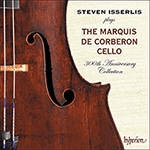 Steven Isserlis plays The Marquis de Corberon Steven Isserlis plays The Marquis de CorberonCDS44761/7010CDs Boxed set (at a special price) Available Friday 2 October 2026 Higher-value orders will be automatically discounted at check-out  Two generous, comprehensive and scholarly booklets present all the original album notes alongside special essays. In the first of these, ‘My life with the Marquis’, Steven Isserlis opens our eyes to the challenges, obstacles, and myriad joys of tr ...» More |