
Welcome to Hyperion Records, a British classical label devoted to presenting high-quality recordings of music of all styles and from all periods from the twelfth century to the twenty-first.

Hyperion offers both CDs, and downloads in a number of formats. The site is also available in several languages.

Please use the dropdown buttons to set your preferred options, or use the checkbox to accept the defaults.
Click cover art to view larger version
Track(s) taken from CDA68419

Variations on a Rococo theme, Op 33

composer
December 1876 to January 1877; dedicated to Wilhelm Fitzenhagen

Alban Gerhardt (cello), Alliage Quintett
Studio Master FLAC & ALAC downloads available
CD-Quality:
Studio Master:
CD-Quality:
Studio Master:
Deutschlandfunk Kammermusiksaal, Köln, Germany
Release date: June 2023
Total duration: 36 minutes 38 seconds

Cover artwork: Star Bird (2012) by Nancy Moniz Charalambous
© Nancy Moniz Charalambous. All Rights Reserved 2023 / Bridgeman Images
 

Other recordings available for download

Jamie Walton (cello), Royal Philharmonic Orchestra, Okko Kamu (conductor)

Reviews

‘These six supremely accomplished musicians approach the project seriously, of course, but with a welcome light touch … this is audibly a hugely enjoyable collaborative venture, the mellow warmth of the four saxophones and the contrasted tonal colouring of Jang Eun Bae’s piano providing a surprisingly convincing support for Gerhardt … the Falla suite and the three Shostakovich items [are] superbly played and most appealing’ (Gramophone)

‘The pièce de la résistance is Malzew’s arrangement of Gershwin’s Rhapsody—now Phantasyin Blue, an inspired instrumental synthesis: raucous, sassy, percussive and truly in the spirit of the jazz age. The cello steals the clarinet’s opening solo, and gradually invades the piano’s position. It works. Malzew hits the jackpot with a chamber version of a classic score to knock out a summer festival audience’ (BBC Music Magazine)

‘There’s some brilliant playing, and surprises as well—he can’t resist throwing in a ‘blues’ variation before the coda. The tonal range of four saxophones and piano can be startling, the way they imitate orchestral sounds and strings, with silky smoothness’ (BBC Record Review)
The Variations on a Rococo theme, Op 33 were written in Moscow in December 1876, while the composer’s tenure at the Conservatoire was slowly dragging to a close, and his lucrative, epistolary relationship with von Meck beginning to flower. Although he resented the hours teaching that prevented him from composing, Tchaikovsky had nevertheless made some enduring friendships at the Conservatoire, among them the cello professor Wilhelm Fitzenhagen, who had taken positions in Moscow after refusing an offer from the great Franz Liszt to remain with his orchestra in Weimar. No cellist and famously riddled with self-doubt, Tchaikovsky had agreed to a number of alterations suggested by Fitzenhagen, for whom the work was composed, and it seems to have been this ‘original’ version which was premiered in November 1877, in Moscow, under Nicolai Rubinstein, with Fitzenhagen as soloist. So far so good. However, Fitzenhagen had further ideas of his own for the piece and set about ‘improving’ the work; substantially altering the solo part, tagging endings on here and there, shuffling the movements and even omitting the final variation altogether. ‘Horrible Fitzenhagen insists on changing your cello piece…and he claims you gave him permission. Good God!’ wrote the unconvinced publisher Pyotr Jurgenson to the composer. Nevertheless, the piano score was published in 1878, presumably without the composer’s approval, and the orchestral score appeared some years later, in 1889, both ‘revised and corrected’ by Fitzenhagen. In the case of the piano score, Tchaikovsky’s seeming reluctance to get involved may have been in part due to the extensive travels undertaken to shake off the horror of his badly-judged and swiftly-aborted marriage in 1877. And in the case of the publication of the orchestral score, a furious, and either accepting or resigned Tchaikovsky famously declared, ‘The devil take it. Let it stand!’. And so the Fitzenhagen version of the Rococo Variations remains the standard version of the piece—even to this day.

Not until 50 years after Tchaikovsky’s death did the composer’s ‘original’ version come to be heard in the concert hall, its first modern performance documented as being by Daniil Shafran in 1941. The Soviet-published edition of 1956, the composer’s ‘original’ score, obviously still retains much of Fitzenhagen’s initial and, indeed, subsequent revisions to the cello part, but the variations are restored to Tchaikovsky’s original plan.

The Rococo Variations reflects Tchaikovsky’s adoration of the music of Mozart, a composer he revered above all and referred to as the ‘Christ of music’. The poise and order of the music of Mozart and his time appealed greatly to a composer we regard as representing of the heights of the so-called Romantic period. The work has a brief, almost subdued, orchestral introduction leading into the refined charm of the cello theme—not an 18th-century original, but rather Tchaikovsky’s idealised view of such a theme. Thereafter the cellist barely draws breath, the melody expanding into ever more expansive declarations, duets with the flute and the clarinet, cadenzas and a virtuoso package of classic cello cantabile, pizzicato, double-stopping, nostalgic waltzes, runs and trills until the coda brings us to an invigorating conclusion.

from notes by M Ross © 2015
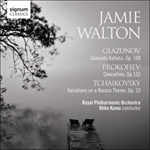
Other albums featuring this work

Glazunov, Prokofiev & Tchaikovsky: Music for cello & orchestra
Studio Master: SIGCD407Download onlyStudio Master FLAC & ALAC downloads available
Waiting for content to load...