
Welcome to Hyperion Records, a British classical label devoted to presenting high-quality recordings of music of all styles and from all periods from the twelfth century to the twenty-first.
Hyperion offers both CDs, and downloads in a number of formats. The site is also available in several languages.
Please use the dropdown buttons to set your preferred options, or use the checkbox to accept the defaults.


 PERFORMANCE RECORDING
Seven years later Mendelssohn, already the composer of a brilliant overture to Shakespeare’s play A Midsummer Night’s Dream, produced a new overture based on two poems by Goethe: Meeresstille (Calm Sea) and Glückliche Fahrt (Prosperous Voyage). The overture as a form had only recently escaped from its original theatrical function into a new concert-hall existence as a short descriptive piece, and Mendelssohn evidently found plenty to inspire him in Goethe’s contrasted verses. Though he was not the first to have been so moved (Beethoven had made a choral setting of the poems in 1815, and Schubert had set Meeresstille as a song that same year), his treatment has become the best known.
The subject of Calm Sea is not the smooth surface friendly to sufferers of seasickness, but rather the torpid, windless conditions which, in the age of sail, rendered a ship depressingly immobile. Goethe even refers to a ‘fearful and deathly stillness’, depicted by Mendelssohn in a sombre adagio, only sluggishly agitated by contrapuntal undercurrents.
Eventually a solo flute raises a breeze, the mist clears and after a rush of orchestral excitement the vessel is underway to a heroic, Beethovenian melody. There follow passages of plain sailing (‘the zephyrs are whispering’) interspersed with the nimble activity of the sailors, until, to welcoming fanfares and timpani cannonades, land is sighted. The voyage is over, and the overture ends with a contented sigh of relief.
from notes by Lindsay Kemp © 2015
Sept ans plus tard, Mendelssohn, qui avait déjà inscrit à son catalogue une brillante ouverture pour la pièce de Shakespeare Le Songe d’une nuit d’été, écrivit une nouvelle ouverture inspirée par deux poèmes de Goethe: Meeresstille (Mer calme) et Glückliche Fahrt (Heureux Voyage). L’ouverture, en tant que forme, ne s’était émancipée que récemment de sa fonction dramatique originelle pour embrasser une nouvelle existence dans les salles de concert, comme courte pièce descriptive; et, à l’évidence, Mendelssohn trouva de quoi nourrir généreusement son inspiration dans les poèmes contrastés de Goethe. Bien qu’il ne fût pas le premier touché par ces textes (Beethoven les avait mis en musique pour chœur en 1815, et Schubert avait fait un lied de Meeresstille la même année), son illustration devait s’imposer comme la plus célèbre.
Le sujet de Mer calme n’est pas la surface étale qu’apprécient les personnes sujettes au mal de mer, mais plutôt cette absence de vent torpide qui, au temps de la voile, vouaient les vaisseaux à une immobilité désespérante. Goethe fait même allusion à un «calme effrayant et mortel», que Mendelssohn traduit par un sombre adagio, animé seulement d’apathiques courants sous-marins en contrepoint.
Finalement, une brise s’élève (flûte solo), le brouillard se dissipe et, après un soudain embrasement orchestral, le vaisseau reprend sa route au son d’une mélodie héroïque, beethovénienne. Mendelssohn peint ensuite une navigation paisible («les zéphyrs murmurent»), entrecoupée par les gestes lestes des matelots, jusqu’à ce que la terre soit en vue, annoncée par des fanfares et des coups de canon aux timbales. Le voyage est terminé, et l’ouverture se conclut sur un soupir de satisfaction et de soulagement.
extrait des notes rédigées par Lindsay Kemp © 2015
Français: Claire Delamarche
Sieben Jahre später schuf Mendelssohn, der schon auf die Komposition einer brillanten Ouvertüre zu Shakespeares Theaterstück A Midsummer Night’s Dream [Ein Sommernachtstraum] verweisen konnte, eine neue Ouvertüre, diesmal auf zwei Gedichte von Goethe: Meeresstille und Glückliche Fahrt. Die Ouvertüre als Gattung hatte sich erst kurz zuvor von seiner ursprünglichen Rolle im Theater befreit und tauchte nun als kurzes illustratives Stück im Konzertsaal auf. Mendelssohn fand offenbar reichlich Inspiration in Goethes kontrastierenden Versen. Auch wenn er nicht der erste war, der so angeregt wurde (Beethoven hatte 1815 ein Chorwerk auf die Gedichte geschaffen, und Schubert vertonte im gleichen Jahr Meeresstille zu einem Lied), ist seine Fassung die bekannteste.
Das Thema Meeresstille dreht sich nicht um die glatte Fläche angenehm für Menschen, die zu Seekrankheit neigen, sondern eher um die schwülen, windstillen Bedingungen, die ein Schiff im Zeitalter der Segelfahrt zur Untätigkeit verdammten. Goethe spricht sogar von einer „Todesstille fürchterlich“, die Mendelssohn mit einem düsteren Adagio umsetzt, das nur schwerfällig durch untergründige Kontrapunktlinien in Bewegung gerät.
Schließlich haucht ein Flötensolo etwas Leben ins Geschehen, der Nebelschleier hebt sich, und nach einem Ausbruch von Aufregung im Orchester ist das Schiff auf dem Weg zu einer heroischen, an Beethoven mahnenden Melodie. Daraufhin segelt die Musik mit dem Wind („es säuseln die Winde“) mit Einschüben von behändig arbeitenden Matrosen, bis Land in Begleitung begrüßender Fanfaren und Paukendonner in Sicht kommt. Die Reise ist vorüber, und die Ouvertüre endet mit einem zufriedenen Seufzer der Erleichterung.
aus dem Begleittext von Lindsay Kemp © 2015
Deutsch: Elke Hockings
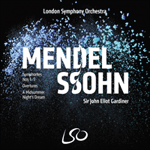 Mendelssohn: Symphonies & Overtures Mendelssohn: Symphonies & OverturesStudio Master: LSO0826-D2CDs Download onlyStudio Master FLAC & ALAC downloads available  LSO Live presents Sir John Eliot Gardiner’s award-winning Mendelssohn series together in its entirety for the first time. Captured over three seasons during critically acclaimed concerts in the Barbican Hall, this set offers listeners the definiti ...» More |