
Welcome to Hyperion Records, a British classical label devoted to presenting high-quality recordings of music of all styles and from all periods from the twelfth century to the twenty-first.
Hyperion offers both CDs, and downloads in a number of formats. The site is also available in several languages.
Please use the dropdown buttons to set your preferred options, or use the checkbox to accept the defaults.

| Philharmonia Orchestra, Sir Andrew Davis (conductor)» More |
 RECORDING PERFORMANCE
This visit has been, is, artistically a complete failure & I can do nothing: we have been perished with cold, rain & gales … The Symphony will not be written in this sunny (?) land.
That very same day, the weather cleared. The sun shone for the rest of the visit and Elgar’s imagination caught fire. A ‘Concert Overture’, In the South, was written at lightning speed and orchestrated back home in Malvern during February, delivered piecemeal to the publishers in time for its first performance at the Covent Garden festival on 16 March.
The speed with which Elgar composed In the South is all the more remarkable given its complexity. Virtually a one-movement symphony, the work is an undoubted pinnacle of the late-Romantic orchestral literature, easily comparable with the best of Richard Strauss and Mahler. On the manuscript, Elgar wrote lines from Byron’s Childe Harold’s Pilgrimage, describing Italy as ‘the garden of the world’. Though Elgar obviously viewed the work as an overture rather than a programmatic symphonic poem in the manner of the later Falstaff, a letter he wrote to the conductor Percy Pitt shortly before the premiere provided clear pointers towards the illustrative intentions, adding that ‘I wove this music in the valley of Andora during a long & lovely day al fresco & it does not attempt to go beyond the impression then received’.
The overture opens with a veritable tidal wave of exuberant invention, which Elgar suggested ‘may be the exhilarating out-of-doors feeling arising from the gloriously beautiful surroundings—streams, flowers, hills and distant snowy mountains in one direction & the blue Mediterranean in the other’.
There follow musical pictures of ‘a shepherd with his flock straying about the ruins of the old church—he piping softly & reedily & occasionally singing’, a ‘second theme proper’, as Elgar put it, adding that it ‘may be my own personal feelings—romance if you like—amongst congenial surroundings and in congenial company’, a powerful vision of ancient Rome and a shepherd ‘singing softly his Canto popolare’, magically represented by solo viola.
An extensive, though artfully shortened, recapitulation of the earlier music now follows, through which Elgar gradually increases the dramatic tension, leading to a breathtaking climactic return of the opening and a blazing coda.
from notes by John Pickard © 2016
Ce séjour a été, sur le plan artistique, un échec total & je ne peux rien faire: notre vie a été pourrie par le froid, la pluie & le vent violent … La symphonie ne sera pas écrite dans ce pays ensoleillé (?).
Le même jour, le temps s’éclaircit. Le soleil brilla pendant le reste de leur séjour et l’imagination d’Elgar s’enflamma. Une «ouverture de concert», In the South («Dans le Sud»), fut écrite en un rien de temps et orchestrée à son retour à Malvern au cours du mois de février, puis livrée en plusieurs étapes à l’éditeur, en temps voulu pour sa création au Festival de Covent Garden, le 16 mars.
La vitesse à laquelle Elgar composa In the South est d’autant plus remarquable que l’œuvre est complexe. Presque une symphonie en un seul mouvement, cette œuvre est un sommet indubitable de la littérature pour orchestre de la fin du romantisme, facilement comparable au meilleur de Richard Strauss et de Mahler. Sur le manuscrit, Elgar écrivit des vers du Pèlerinage de Childe Harold de Byron, décrivant l’Italie comme «le jardin du monde». Même si Elgar considérait manifestement cette œuvre comme une ouverture plutôt que comme un poème symphonique à programme à la manière de son Falstaff ultérieur, une lettre qu’il écrivit au chef d’orchestre Percy Pitt peu avant la première exécution donne des indications précises quant à ses intentions en matière d’illustration, ajoutant que «j’ai inventé cette musique dans la vallée d’Andora au cours d’une longue et magnifique journée al fresco & elle n’essaie pas d’aller au-delà de l’impression reçue alors».
L’ouverture commence par un véritable raz-de-marée d’invention exubérante qui, laissa entendre Elgar, «peut être le sentiment exaltant au grand air émanant du cadre magnifique—ruisseaux, fleurs, collines et lointaines montagnes enneigées dans une direction & la mer Méditerranée de l’autre».
Viennent ensuite les images musicales d’«un berger avec son troupeau errant autour des ruines d’une vieille église—jouant doucement de son chalumeau et chantant de temps en temps», un «second thème proprement dit», comme le dit Elgar, ajoutant que c’est «peut-être mes propres sentiments—un côté romantique si vous voulez—dans un environnement agréable et dans une compagnie agréable», une vision puissante de la Rome antique et d’un berger «chantant doucement son Canto popolare», représenté comme par magie par l’alto solo.
Vient ensuite une réexposition longue mais ingénieusement raccourcie de la musique précédente, par laquelle Elgar augmente peu à peu la tension dramatique, menant à un retour décisif stupéfiant du début et à une coda éclatante.
extrait des notes rédigées par John Pickard © 2016
Français: Marie-Stella Pâris
Dieser Aufenthalt hat sich in künstlerischer Hinsicht als völliger Reinfall herausgestellt und ich kann nichts machen—wir sind durchfroren und haben Regen und Windstürme erlitten … Die Symphonie wird in diesem sonnigen (?) Land nicht entstehen.
Doch genau an diesem Tag klarte das Wetter auf, die Sonne schien bis zu ihrer Abreise und Elgars Schaffenskraft entflammte. Eine „Konzertouvertüre“, In the South, wurde in Blitzesschnelle komponiert und im Februar orchestriert, als die Elgars wieder zurück in Malvern waren. Dem Verlag lieferte er das neue Werk Stück für Stück, so dass es rechtzeitig zur ersten Aufführung im Rahmen des Festivals in Covent Garden am 16. März vorlag.
Das Tempo, in dem Elgar In the South komponiert hatte, ist angesichts der Komplexität des Werks besonders bemerkenswert. Es ist sozusagen eine einsätzige Symphonie, und stellt damit zweifellos einen Gipfel im spätromantischen Repertoire der Orchestermusik dar, das sich ohne Weiteres mit den größten Werken von Richard Strauss oder Gustav Mahler messen kann. In sein Manuskript trug Elgar einige Zeilen aus Byrons Childe Harold’s Pilgrimage ein, in denen Italien als „der Garten der Welt“ beschrieben wird. Obwohl Elgar das Werk offensichtlich als Ouvertüre betrachtete und nicht als programmatische symphonische Dichtung (wie etwa das spätere Werk Falstaff), ist einem Brief an den Dirigenten Percy Pitt, den er kurz vor der Premiere schrieb, zu entnehmen, dass er durchaus illustrative Absichten darin verfolgte: „Ich habe diese Musik an einem langen und wunderschönen Tag im Freien in dem Tal von Andora gewebt, und sie versucht nicht, über jene Impression hinauszugehen.“
Die Ouvertüre beginnt mit einer regelrechten Flutwelle überschwänglicher Erfindungskraft, die Elgar mit dem „belebenden Freiluftgefühl“ erklärte, welches sich „aus der wunderschönen Umgebung ergab—Bäche, Blumen, Hügel und entfernte verschneite Berge in der einen Richtung und das blaue Mittelmeer in der anderen“.
Es folgen musikalische Bilder „eines Schäfers, dessen Herde in den Ruinen einer alten Kirche herumstreunt—er pfeift leise & näselnd & singt zuweilen“, ein „richtiges zweites Thema“, wie Elgar es formulierte, und hinzufügte, dass es „vielleicht meine eigenen Eindrücke und Gefühle—Romantik, wenn man so will—in angenehmer Umgebung und geistesverwandter Gesellschaft“ seien, eine wirkungsmächtige Vision des alten Rom und eines Schäfers, der „leise seinen Canto popolare singt“, was in zauberhafter Weise von einer Solobratsche dargestellt wird.
Eine ausgiebige, jedoch kunstvoll verkürzte, Reprise der vorherigen Musik folgt nun, in der Elgar die dramatische Spannung zunehmend steigert und auf einen atemberaubenden Höhepunkt hinführt, bei dem die Anfangsmusik wieder erklingt, gefolgt von einer gleißenden Coda.
aus dem Begleittext von John Pickard © 2016
Deutsch: Friedrich Sprondel
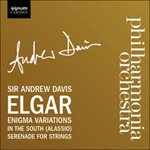 Elgar: Enigma Variations, In the South & Serenade for strings Elgar: Enigma Variations, In the South & Serenade for stringsStudio Master: SIGCD168Download onlyStudio Master FLAC & ALAC downloads available  This album features Elgar’s best-known orchestral works: the 'Enigma' Variations depicting twelve of Elgar’s family and friends in fourteen variations, the Serenade for strings, and 'In the South', a Concert Overture written for the Elgar festival ...» More |