
Welcome to Hyperion Records, a British classical label devoted to presenting high-quality recordings of music of all styles and from all periods from the twelfth century to the twenty-first.

Hyperion offers both CDs, and downloads in a number of formats. The site is also available in several languages.

Please use the dropdown buttons to set your preferred options, or use the checkbox to accept the defaults.

Click cover art to view larger version
Track(s) taken from CDA68307

Piano Trio in D minor, Op 11

composer
1846/7

The Nash Ensemble
Studio Master FLAC & ALAC downloads available
CD-Quality:
Studio Master:
Studio Master:
CD-Quality:
Studio Master:
Studio Master:
Recording details: May 2019
St Silas the Martyr, Kentish Town, London, United Kingdom
Produced by Phil Rowlands
Engineered by Phil Rowlands
Release date: May 2020
Total duration: 24 minutes 34 seconds

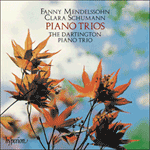
Cover artwork: Design (1778/80) by Angelica Kauffman (1741-1807)
Royal Academy of Arts, London / Photo © John Hammond
 

Other recordings available for download

The Dartington Piano Trio

Reviews

‘The impression of this music being taken seriously on its own merits only intensifies when you press play … to say this disc makes the case for Schumann and Mendelssohn standing on their own two feet, away from the music of their menfolk, is something of an understatement’ (Gramophone)

‘These well recorded and beautifully played performances get inside the musical dynamics of these enormously appealing works and in the case of the piano trios make a good case for their having an enduring presence in the repertoire’ (BBC Music Magazine)
PERFORMANCE
RECORDING

‘A really well-played recording of chamber music by Clara Schumann and Fanny Mendelssohn … a beautifully balanced performance [of the Schumann Piano Trio] from members of The Nash Ensemble … alongside equally enjoyable accounts of Fanny Mendelssohn's D minor Trio and her String Quartet’ (BBC Record Review)

‘These performances by members of the Nash Ensemble are full of fire and vigour, with no shortage of expressive nuance when called for. The recording is up to Hyperion’s high standards and the booklet has helpful notes … if you want to leave Robert Schumann and Felix Mendelssohn out of it, or simply want to explore some fine early romantic chamber music, this will do very well. I have been delighted to make the acquaintance of these fine compositions and can thoroughly recommend this coupling’ (MusicWeb International)» More

‘The performance of the Nash Ensemble is exemplary, especially the pianism of Simon Crawford-Phillips in the two trios. Indeed, this is a performance that sheds new light on this music as it exhorts the romantic nature of the music. This is a recording that makes you listen to the music for its own merits, rather than as curios by female composers. Natasha Loges's booklet essay is excellent and informative, and the recorded sound is warm and friendly whilst up to Hyperion’s usual very high standard. A recording which is highly recommended, one which offers the three works in some of the best available recordings of them, especially when presented in this generous coupling’ (MusicWeb International)» More

‘It’s not often that a Schumann-Mendelssohn release packs many surprises. Then again, it’s really not often that a Schumann-Mendelssohn release focuses on the music of Clara and Fanny (rather than Robert and Felix). To judge from the Nash Ensemble’s recent entry in Hyperion’s catalogue, maybe there should be more of these? … indeed, for all three of these works, the Nash’s are, arguably, definitive performances’ (The Arts Fuse, USA)» More
Mendelssohn’s Piano Trio in D minor was completed the year after Clara Schumann’s. Like Schumann, Mendelssohn shouldered many family worries—in this case, her son’s professional future. Nevertheless, she managed to play the piano daily, and Clara also visited her regularly throughout March 1847 (although, given the vast differences in their circumstances, their relationship was understandably complex). Fanny performed the completed work at her celebrated Sunday salon, the Sonntagsmusiken, on 11 April 1847, with Robert von Keudell playing the violin, and her brother Paul on the cello. Just over a month later she died from a series of strokes. The trio was published posthumously in 1850 as her Op 11.

Mendelssohn’s trio opens tumultuously, almost ferociously; even when she introduces lyrical material, the underlying texture shimmers with tension and energy. Her extraordinary pianistic abilities are showcased in the demanding scalic and arpeggiated textures of the opening ‘allegro molto vivace’. The move to a major key is like the sun emerging from behind the clouds, but its respite is brief; in this performance this is angry music, phenomenally assured, richly textured, roaring and raging towards the close of the first movement. The chorale-like opening of the ‘andante espressivo’ leads into a stately waltz, elegant but suffused with yearning, before moving to a resigned, tranquil ending. The third movement, entitled ‘Lied’, draws on the world of the German folk-song, and is a slighter interlude before the rhapsodic solo-piano opening of the finale, which recalls Chopin in its elegant melancholy before moving into a polka-like texture replete with the same motoric energy that characterizes the first movement. The whole work dances towards a triumphant, ebullient end in D major.

from notes by Natasha Loges © 2020

Fanny Mendelssohn écrivit son Trio avec piano en ré mineur un an après celui de Clara Schumann. Comme cette dernière, Fanny devait faire face à de nombreux soucis familiaux—dans le cas présent, l’avenir professionnel de son fils. Néanmoins, elle réussissait à jouer du piano tous les jours et Clara Schumann lui rendit visite régulièrement durant tout le mois de mars 1847 (même si, en raison des grandes différences de leurs situations respectives, leurs relations étaient naturellement complexes). Le trio, qu’elle composa à cette époque, fut publié à titre posthume en 1850 sous son op.11. Elle joua cette œuvre achevée dans son célèbre salon du dimanche, le Sonntagsmusiken, le 11 avril 1847, avec Robert von Keudell au violon et son frère Paul au violoncelle. Juste un peu plus d’un mois plus tard, elle mourut d’une série d’attaques.

Le trio de Fanny Mendelssohn commence tumultueusement, presque violemment; même lorsqu’elle introduit du matériel lyrique, la texture sous-jacente vibre de tension et d’énergie. Ses extraordinaires capacités pianistiques sont mises en valeur dans les textures ardues de gammes et arpèges de l’«allegro molto vivace» initial. Le passage en majeur est comparable au soleil émergeant derrière les nuages, mais son répit est de courte durée; dans cette exécution, c’est une musique enragée, assurée de manière phénoménale, aux textures riches, rugissant et tempêtant vers la conclusion du premier mouvement. Le début, dans le style d’un choral, de l’«andante espressivo» mène à une valse imposante, élégante mais imprégnée de désir ardent, avant de passer à une fin résignée et tranquille. Le troisième mouvement, intitulé «Lied», s’inspire de l’univers du chant traditionnel allemand et constitue un interlude plus léger avant le début rhapsodique du finale au piano seul, qui rappelle Chopin dans sa mélancolie élégante avant de passer à une texture de polka pleine de la même énergie motrice qui caractérise le premier mouvement. L’ensemble de cette œuvre danse vers une conclusion triomphale et exubérante en ré majeur.

extrait des notes rédigées par Natasha Loges © 2020
Français: Marie-Stella Pâris

Das Klaviertrio d-Moll von Fanny Mendelssohn entstand ein Jahr später als Clara Schumanns Trio. Ebenso wie Clara Schumann musste auch Fanny Mendelssohn viele Familiensorgen schultern, in diesem Falle die professionelle Zukunft ihres Sohnes. Trotzdem schaffte sie es, täglich Klavier zu spielen; im März 1847 besuchte Clara Schumann sie zudem regelmäßig (angesichts ihrer sehr unterschiedlichen Lebensumstände war ihre Beziehung allerdings verständlicherweise komplex). Das Trio, welches zu dieser Zeit entstand, wurde posthum im Jahre 1850 als ihr op. 11 herausgegeben. Sie führte das vollendete Werk zusammen mit Robert von Keudell (Geige) und ihrem Bruder Paul (Cello) am 11. April 1847 im Rahmen ihrer berühmten Sonntagsmusiken auf. Einen guten Monat später erlag sie einer Reihe von Schlaganfällen.

Fanny Mendelssohns Trio beginnt stürmisch, fast wild; auch wenn sie lyrisches Material einführt, schimmert die Spannung und Energie der darunterliegenden Struktur noch durch. Ihre außergewöhnlichen pianistischen Fähigkeiten werden mit den anspruchsvollen Läufen und Arpeggien im „Allegro molto vivace“ demonstriert. Der Wechsel nach Dur wirkt wie die Sonne, die hinter den Wolken auftaucht, doch ist die Ruhepause nur von kurzer Dauer; in der hier vorliegenden Aufführung ist dies zornige Musik, äußerst souverän ausgeführt, reichhaltig strukturiert, wütend und tobend bis zum Ende des ersten Satzes. Der choralartige Beginn des „Andante espressivo“ führt zu einem stattlichen Walzer, elegant, aber voller Sehnsucht, bevor der Satz ein resigniertes, ruhiges Ende nimmt. Der dritte Satz trägt den Titel „Lied“ und bezieht sich auf das deutsche Volksliedrepertoire und stellt eine Art schlankes Zwischenspiel dar, bevor das Finale mit einer rhapsodischen, in ihrer eleganten Melancholie an Chopin erinnernden Passage für Klavier solo beginnt. Darauf folgt ein polkaähnlicher Satz mit einer ähnlichen motorischen Energie wie im ersten Satz. Das Werk tanzt einem triumphalen, überschwänglichen Ende in D-Dur entgegen.

aus dem Begleittext von Natasha Loges © 2020
Deutsch: Viola Scheffel
Other albums featuring this work

Mendelssohn (Fanny) & Schumann (C): Piano Trios
CDA66331
Waiting for content to load...