Welcome to Hyperion Records, a British classical label devoted to presenting high-quality recordings of music of all styles and from all periods from the twelfth century to the twenty-first.

Hyperion offers both CDs, and downloads in a number of formats. The site is also available in several languages.

Please use the dropdown buttons to set your preferred options, or use the checkbox to accept the defaults.
Click cover art to view larger version
Track(s) taken from CDA68307

Piano Trio in G minor, Op 17

composer
1846

The Nash Ensemble
Studio Master FLAC & ALAC downloads available
CD-Quality:
Studio Master:
Studio Master:
CD-Quality:
Studio Master:
Studio Master:
Recording details: May 2019
St Silas the Martyr, Kentish Town, London, United Kingdom
Produced by Phil Rowlands
Engineered by Phil Rowlands
Release date: May 2020
Total duration: 28 minutes 19 seconds

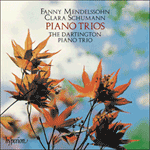
Cover artwork: Design (1778/80) by Angelica Kauffman (1741-1807)
Royal Academy of Arts, London / Photo © John Hammond
 

Other recordings available for download

The Dartington Piano Trio

Reviews

‘The impression of this music being taken seriously on its own merits only intensifies when you press play … to say this disc makes the case for Schumann and Mendelssohn standing on their own two feet, away from the music of their menfolk, is something of an understatement’ (Gramophone)

‘These well recorded and beautifully played performances get inside the musical dynamics of these enormously appealing works and in the case of the piano trios make a good case for their having an enduring presence in the repertoire’ (BBC Music Magazine)
PERFORMANCE
RECORDING

‘A really well-played recording of chamber music by Clara Schumann and Fanny Mendelssohn … a beautifully balanced performance [of the Schumann Piano Trio] from members of The Nash Ensemble … alongside equally enjoyable accounts of Fanny Mendelssohn's D minor Trio and her String Quartet’ (BBC Record Review)

‘These performances by members of the Nash Ensemble are full of fire and vigour, with no shortage of expressive nuance when called for. The recording is up to Hyperion’s high standards and the booklet has helpful notes … if you want to leave Robert Schumann and Felix Mendelssohn out of it, or simply want to explore some fine early romantic chamber music, this will do very well. I have been delighted to make the acquaintance of these fine compositions and can thoroughly recommend this coupling’ (MusicWeb International)» More

‘The performance of the Nash Ensemble is exemplary, especially the pianism of Simon Crawford-Phillips in the two trios. Indeed, this is a performance that sheds new light on this music as it exhorts the romantic nature of the music. This is a recording that makes you listen to the music for its own merits, rather than as curios by female composers. Natasha Loges's booklet essay is excellent and informative, and the recorded sound is warm and friendly whilst up to Hyperion’s usual very high standard. A recording which is highly recommended, one which offers the three works in some of the best available recordings of them, especially when presented in this generous coupling’ (MusicWeb International)» More

‘It’s not often that a Schumann-Mendelssohn release packs many surprises. Then again, it’s really not often that a Schumann-Mendelssohn release focuses on the music of Clara and Fanny (rather than Robert and Felix). To judge from the Nash Ensemble’s recent entry in Hyperion’s catalogue, maybe there should be more of these? … indeed, for all three of these works, the Nash’s are, arguably, definitive performances’ (The Arts Fuse, USA)» More
Schumann wrote her Piano Trio in G minor in 1846 during the family’s Dresden years. She had performed much piano chamber music and was the organizer of a chamber music series in which she regularly performed, but she had not actually written any piano chamber works before. This work emerged in a time of great turmoil and distress: the Schumanns’ fourth child Emil had just died, and both she and her husband were ill and had fled to the island of Norderney that summer in an attempt to cure him. Interestingly, Robert had not yet published a piano trio, and the household diary reveals that her work inspired his first foray into the genre (his Op 63). The two works were often paired in concerts and both remained within the repertoire. Some critics were so astonished at the quality of her trio that they assumed it had been written by her husband.

For her work, Schumann utilized the four-movement, classically inspired sonata form. This follows a pattern of fast large-scale outer movements sandwiching a playful scherzo and a lyrical andante (the latter has one of the most sublime melodies ever written). The final movement includes the substantial fugal passage that so impressed Joachim and Mendelssohn—a mark of seriousness that affiliates her to her Austro-German contemporaries. Pianistically it is rooted in the tradition in which she was trained, favouring transparent textures.

from notes by Natasha Loges © 2020

Clara Schumann écrivit son Trio avec piano en sol mineur en 1846 au cours des années où la famille vivait à Dresde. Elle avait joué beaucoup de musique de chambre avec piano et était l’organisatrice d’une série de musique de chambre dans laquelle elle se produisait régulièrement, mais en réalité elle n’avait composé aucune œuvre de musique de chambre avec piano auparavant. Ce trio vit le jour à une époque de grand désarroi et de détresse: le quatrième enfant des Schumann, Emil, venait de mourir, Clara et son mari étaient tous deux malades et s’étaient enfuis dans l’île de Norderney cet été-là pour essayer de guérir Robert. Chose intéressante, ce dernier n’avait encore publié aucun trio avec piano et le journal de la famille révèle que l’œuvre de Clara inspira à Robert son premier trio avec piano (son op.63). Les deux œuvres furent souvent jouées ensemble en concert et restèrent toutes les deux au répertoire. Certains critiques s’étonnèrent tant de la qualité du trio de Clara qu’ils supposèrent qu’il avait été écrit par son mari.

Pour cette œuvre, Clara Schumann privilégia la forme sonate d’inspiration classique en quatre mouvements. Celle-ci suit un modèle avec des mouvements externes rapides de grande envergure entourant un scherzo enjoué et un andante lyrique (ce dernier comporte l’une des plus sublimes mélodies jamais écrites). Le finale comprend l’important passage fugué qui impressionna tant Joachim et Mendelssohn—marque de sérieux qui affilie Clara à ses contemporains austro-allemands. Sur le plan pianistique, il s’enracine dans la tradition dans laquelle elle fut formée, privilégiant des textures transparentes.

extrait des notes rédigées par Natasha Loges © 2020
Français: Marie-Stella Pâris

Clara Schumann schrieb ihr Klaviertrio g-Moll im Jahre 1846, als die Familie in Dresden lebte. Sie hatte viel Klaviermusik aufgeführt und veranstaltete eine Konzertreihe mit Kammermusik, in der sie regelmäßig selbst mit auftrat, doch hatte sie bis dahin noch keine Kammermusik mit Klavier komponiert. Dieses Werk entstand zu einer Zeit großer Verzweiflung und Unruhe: Emil, das vierte Kind der Schumanns, war gerade verstorben und sowohl Clara als auch Robert waren krank, weshalb sie sich nach Norderney geflüchtet hatten, in der Hoffnung, dort zu genesen. Interessanterweise hatte Robert noch kein Klaviertrio veröffentlicht und dem Ehetagebuch ist zu entnehmen, dass ihr Werk die Inspirationsquelle für sein erstes Klaviertrio (op. 63) war. Die beiden Werke wurden in Konzerten oft miteinander kombiniert und hielten sich im Repertoire. Einige Kritiker waren von der Qualität ihres Trios derart überrascht, dass sie es für ein Werk ihres Mannes hielten.

In ihrem Werk hielt Clara Schumann sich an die viersätzige, klassische Sonatenform. Dabei handelt es sich um zwei schnelle, großangelegte Außensätze, die ein spielerisches Scherzo und ein lyrisches Andante (das Letztere enthält außergewöhnlich erhabene Melodien) umrahmen. Der letzte Satz enthält jene längere fugenartige Passage, von der Joachim und Mendelssohn so beeindruckt waren—ein Gütezeichen, welches sie mit ihren österreichisch-deutschen Zeitgenossen verbindet. Der Klavierpart ist in der Tradition verwurzelt, in der sie ausgebildet worden war, und weist transparente Strukturen auf.

aus dem Begleittext von Natasha Loges © 2020
Deutsch: Viola Scheffel
Other albums featuring this work

Mendelssohn (Fanny) & Schumann (C): Piano Trios
CDA66331
Waiting for content to load...