
Welcome to Hyperion Records, a British classical label devoted to presenting high-quality recordings of music of all styles and from all periods from the twelfth century to the twenty-first.
Hyperion offers both CDs, and downloads in a number of formats. The site is also available in several languages.
Please use the dropdown buttons to set your preferred options, or use the checkbox to accept the defaults.

Brahms was an excellent pianist, and his piano writing throughout his life betrays that instrument’s deep personal resonance, from the declamatory Opus 1 Sonata (1853) to the autumnal intermezzi of Opp 116–119 composed in his final years. His substantial catalogue of four-hand music, too—in addition to these Waltzes, the Variations on a theme by Schumann (1861); the Liebeslieder Waltzes and Neue Liebeslieder Waltzes (1874–75); the Hungarian Dances, Books 1–2 (1868) and 3–4 (1880); and miscellaneous arrangements of other works—captures a duality characteristic of Brahms’s language. The medium itself, placing two pianists in such close proximity, reflects the intimacy of Brahms’s most deeply felt music. (Brahms would play much of this music alongside Clara Schumann, his mentor’s widow and for whom he harbored a complicated affection.) Equally so, two pianists’ access to the full range of the keyboard in one blow allows for sonic grandeur evocative of Brahms’s symphonic writing. Charming miniatures the Opus 39 Waltzes may seem, but they are given voice with startling power.
Within the straightforward waltz genre, Brahms deftly manages to create music of great expressive depth. Their surface charm masks exquisite harmonic nuance that foreshadows the late intermezzi. Brahms’s sensitivity to key relationships lends the sequence of waltzes a satisfying narrative quality: consecutive waltzes are, through most of the set, harmonically separated by thirds or fifths. Three instances of separation by parallel major or minor are especially poignant: the melancholy fourth waltz, in E minor, casts the serenity of No 5, in E major, in sharp relief; No 14, in fiery G sharp minor, sets up the devastating tenderness of No 15, the famous Waltz in A flat.
The Waltz No 6, in C sharp major (the most daunting of key signatures: seven sharps!) and marked Vivace, is a work of delightful piquancy; thus prefaced, the sobriety of No 7, in C sharp minor, Poco più andante, is deadly. The subtle harmonic shades within these ephemeral movements further deepen their emotive power. The first phrase of the C sharp major waltz cadences piercingly in A sharp minor—but with the phrase propelled by the initial hemiola and set at such a rapid tempo, accented by the effervescent staccato pattern in the primo, and tumbling into the repeat, the ache of A sharp minor registers only post facto as a glancing blow.
Similarly, the harmonic and rhythmic ambiguity of No 7—a steady 3/4 lilt in the secondo buoys a more elastic meter in the primo—suggest the smiling-through-tears emotional complexity that colors much of Brahms’s solo and chamber music.
The Opus 39 Waltzes are rife with such moments, qualifying them, despite their seeming innocence, as the thoughtful utterances of a mature compositional voice—and, more than that, as quintessentially Brahms.
from notes by Patrick Castillo © 2013
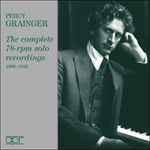 Percy Grainger - The complete 78-rpm solo recordings Percy Grainger - The complete 78-rpm solo recordingsAPR75015CDs Download only  ‘Here’s something a little bit special to mark the fiftieth anniversary of the death of Percy Grainger … Grainger was a charismatic pianist and a ... ‘The best of Grainger’s shellac efforts retain their vividness and communicative immediacy. Even if Grainger had never met and befriended Grieg, his i ...» More |
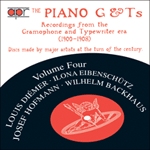 The Piano G & Ts, Vol. 4 - Diémer, Eibenschütz, Hofmann & Backhaus The Piano G & Ts, Vol. 4 - Diémer, Eibenschütz, Hofmann & BackhausAPR5534Download only |
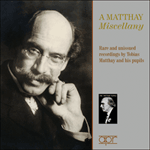 A Matthay Miscellany - Rare and unissued recordings by Tobias Matthay and his pupils A Matthay Miscellany - Rare and unissued recordings by Tobias Matthay and his pupilsAPR60142CDs for the price of 1 — Download only This final volume of 'The Matthay Pupils' presents most of his remaining students who left recordings, as well as the few discs Matthay himself made. Of particular interest is a selection from the almost unknown AFMC label which was affiliated to ...» More |
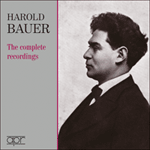 Harold Bauer - The complete recordings Harold Bauer - The complete recordingsAPR73023CDs Download only  Gramophone» More Gramophone» More |
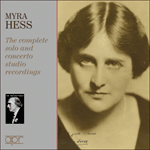 Myra Hess - The complete solo and concerto studio recordings Myra Hess - The complete solo and concerto studio recordingsAPR75045CDs Download only ‘In one disc after another you are drawn towards a deeply personal quality that endeared her to thousands … this set will prompt endless reapprai ... ‘A stunning collection of music played by one of the most talented of British pianist’ (MusicWeb International)» More |