Welcome to Hyperion Records, a British classical label devoted to presenting high-quality recordings of music of all styles and from all periods from the twelfth century to the twenty-first.
Hyperion offers both CDs, and downloads in a number of formats. The site is also available in several languages.
Please use the dropdown buttons to set your preferred options, or use the checkbox to accept the defaults.
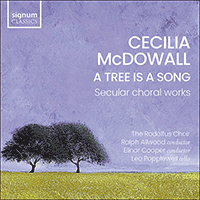


An album celebrating Cecilia McDowall’s distinctive approach to writing modern choral music—these secular works as likely to take their cue from a contemporary health emergency as from the canon of William Shakespeare—and with performances from Ralph Allwood’s exemplary Rodolfus Choir.

The title track, A tree is a song, epitomises her compositional style, which is ‘brightly cogent, freshly witty and expressive’ (Gramophone). A commission from the International Association of Music Libraries, Archives, and Documentation Centres for their 70th anniversary congress in 2023 led the composer to seek a way to bring the idea of libraries, books and music together. She commissioned Heather Lane, poet and former librarian of the Scott Polar Research Institute, to craft a text which spoke of the connections between trees, paper, books and knowledge, with wisdom being passed on ‘as a melody from tree to tree’.
McDowall’s joyous music sings ‘the heartwood’s song’ and celebrates these connections. The parts imitate and respond to each other over the scat syllables of the accompaniment, adopting a light-hearted style befitting the work’s first performance by the Fairhaven Singers on a summer’s evening.
On the air ('Dear Vaccine') adopts a similar sense of optimism, but yearns for a post-COVID world in which choirs could sing together again. The Cleveland Chamber Choir, Ohio, commissioned the work for performance in February 2022. They encouraged McDowall to explore texts from ‘Dear Vaccine’, a global community poetry project, in which people had been invited to share their thoughts and hopes for the development of COVID-19 vaccines. She then invited the British poet Seán Street to select some strands from this rich collection, shaping these extracts into his own poetic form.
The music brims with anticipation, opening with the wordless choir accompanying the narrator’s address to ‘Dear Vaccine’. The music evolves through increasingly uplifting stanzas, exploring chromatic uncertainty (‘Enough of searching strangers’ eyes’), gentle visions for the future (‘birdsong in the morning after rain’) and a vibrant jig (‘Bring me my dancing shoes’). The work culminates with the full choir invoking ‘We are the choir—unmasked, unveiled, unmuted. Breathe air … and sing!’
The first of three works featuring obbligato cello is The year of the horse, written for Polyphony: Voices of New Mexico in 2024, and commissioned by Kirste Lija Plunket in loving memory of her daughter Roan Franziska Mulholland. Kate Wakeling’s poem explores the beautiful image of a being of light, gracefully moving through time. With the support of dynamic instrumental writing for the cello, the music responds with directness to the colourful imagery of the text, with the energetic outer sections (‘music thrumming always at its heels’) contrasting with the lyricism of the slower central section (‘how soft it sings of life’). The ending is particularly poignant and timeless, with numerous looping repetitions of the word ‘again’.
Commissioned by The Wordsworth Singers to mark the choir’s 25th anniversary, The three birds sets a charming parable by P S Beales. The text depicts an encounter between God and three birds who each have a very different approach to singing praises. The composer describes how, ‘with tentative vocal flourishes and words encapsulating a modest approach, the first bird aims to ingratiate itself. The response by the basses, on behalf of God, signals failure, ‘But God said never a word.’ The second bird ups its avian flourishes with cheeky confidence but achieves no more success than the first bird. However, the third bird dispenses with all sycophantic platitudes and in its unaffected way does what a bird knows best, it sings its little heart out. ‘Sing on!’ says God.’ The text is a gift for McDowall’s evocative word-painting, and the choir soars with joy at the work’s conclusion.
The ambitious, multi-movement Night flight was commissioned by the Musique Cordiale Festival in Provence, France. The work marked the centenary of the first woman to fly across the English Channel, the pioneering American aviatrix, Harriet Quimby, who flew from Dover to Calais in 1912. Quimby received little recognition for this remarkable feat as it was overshadowed by the shocking news of the sinking of the Titanic just the day before.
The work sets beautiful poems by the British poet, Sheila Bryer. Her texts on the mysterious powers of the sea, earth, and air are coloured by challenging vocal writing and haunting solo cello lines to highlight the sense of fear, awe, and majesty experienced by an individual pitted against the elements. Much of the solo cello writing is high, and at times ethereal. The piece was awarded the 2014 British Composer Award in the Choral category.
New moon gives a sense of flying high over the sea in the light of the silver moon. After a vigorous cello introduction, repeated vocal phrases give a forward-moving urgency throughout much of this movement. Cluster chords in the still, central episode (‘And hung me high’) offer temporary relief in the middle of the movement, which ends slowly in the unresolved, mysterious coda (‘Plunging earthward Out of dream’.)
The mood is shattered by the angular, jagged opening of Crow, landing, and this powerful homophonic material recurs three times. The composer describes how the movement is ‘full of tension and resolution. The crow battles against the elements in its struggle to make a landing at the sea’s edge. In the final bars the cello solo slides downwards on to ‘the tidal runway’’.
Before dawn concludes the work with slower, more expansive music, evoking a fragrant summer’s night in the hour before dawn. Upper and lower voice chords contrast at the outset, and the narrative unfolds slowly, eventually broadening and ascending for the radiant conclusion, ‘my hands outstretched, reaching for their vast medieval heaven’.
The London Oriana Choir’s commission for Here hum the bees requested a piece to celebrate ‘one family welcoming all for the love of singing together’. This led the composer to consider the role of a honey bee in a busy hive—communicating, pollinating and co-operating—which in turn supports our vast human community.
Kate Wakeling’s poem celebrates the bee’s spell-binding qualities, whilst asking us to heed the warning that ‘Here hum the bees whose song might yet be spilled by human hand.’ The music buzzes with energy, evoking the spirit of the busy bees with dancing rhythms and imitative part-writing. Their joyful humming is a constant, and the work encourages us all (as in On the air) to ‘Sing on’.
One day walking was commissioned by the Delegates of Oxford University Press in memory of Laura Marcus, Goldsmiths’ Professor of English Literature in the Faculty of English and Fellow of New College. She was greatly admired for her influential work on Virginia Woolf. It was therefore particularly apt for the composer to select extracts from Woolf’s diaries in which she describes how walking would stimulate a burst of creativity.
The scene is set by the solo cello which, accompanied by vocal ostinatos (‘One day, one day walking’), creates a joyfully vigorous backdrop to the narrative that unfolds. The music is constantly fresh as each new creative idea emerges, tumbling out one after another with plenty of musical surprises, rhythmic interplay and harmonic twists.
The poem, Such splendor, was written by Nicholas Andreas Vrenios, a student at Syracuse University. He was one of the thirty-five students from the university who lost their lives on 21 December 1988 in the bombing of Pan Am Flight 103 over Lockerbie. The composer writes that ‘there is a chilling prescience in the poem which Nicholas wrote in 1988, the year of the tragedy. I am grateful to his mother for bringing these telling words to my attention.’
McDowall’s heartfelt music opens mysteriously and wordlessly, before colouring the opening passages of the poem with radiant harmonies and expressive dissonances. The mood shifts in the haunting final section, in which the composer adapts the final chorale from Bach’s Cantata BWV78 to offer consolation at the work’s conclusion. Yearning phrases for a solo soprano emerge over each chorale cadence, before the work ends wordlessly in respectful remembrance.
McDowall’s three Shakespeare songs, When time is broke, were first performed by the BBC Singers in 2016. The settings consciously eschew many of the Bard’s more familiar texts, but all six of the selected texts has an association with music.
The first song begins with warm and resonant homophony, asking us to Give me some music. In reply, Beatrice’s advice from Much ado about nothing suggests that marriage begins like a Scottish jig, all hot and hasty. McDowall responds in a suitably playful and fleet-footed folk style, with mouth music for the singers to emulate Scottish fiddlers. The energetic jig does not last, just as Beatrice warns that marriages eventually deteriorate, with the music becoming more sustained and expressive.
Mark how one string offers a different perspective on marriage, with Shakespeare offering encouragement to a young man to marry because matrimony brings concord. The gently shifting and rich harmonies make this a beautifully plangent central song in the set.
The final song, How sour sweet music, focuses on the need to ‘keep time’. The music is both relentless and restless, with vocal melodies woven over a wide range of ostinato accompaniment patterns. The mood shifts in the coda, initially exploring the full range of the choir (‘from my lowest note to the top of my compass’). The ending is particularly evocative, with the choir chanting ‘the rest is silence’ on a dissonant chord, before a final pitchless choral sigh leaves us in silence.
Peter Davis © 2026
Ralph Allwood © 2026

