Welcome to Hyperion Records, a British classical label devoted to presenting high-quality recordings of music of all styles and from all periods from the twelfth century to the twenty-first.
Hyperion offers both CDs, and downloads in a number of formats. The site is also available in several languages.
Please use the dropdown buttons to set your preferred options, or use the checkbox to accept the defaults.
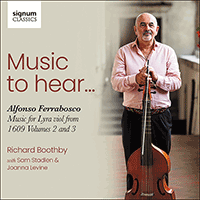


Ferrabosco’s Lessons for 1, 2 & 3 Viols were written for Henry Wriothesley, 3rd Earl of Southampton and a hugely colourful figure at the beating heart of the early 17th-century English court. Here recorded on period instruments with gut strings, Richard Boothby’s exposition fully captures this remarkable music’s depth, intimacy and quiet brilliance.

Perhaps the last significant one was the Mozart family; then we have a whole host of Bachs, several Scarlatti’s and many Couperins. I suppose the nearest to this in later years might be the Strausses, or the Wagners: Richard’s only son, Siegfried was a composer (though hardly a genius), and his grandsons were theatrical directors. The Bayreuth Festival became the family business in a way.
But the Ferraboscos were a large, important Bolognese family and, though there were several generations at the Bentivoglio court in Bologna in the 15th century, none were musicians. Until, that is, Domenico Maria, born in 1513. He was our Alfonso’s grandfather, and worked in Bologna, then sang in the papal chapel in Rome, before both he and Palestrina were ‘retired’ for being married. He was then briefly in Paris before finishing his life back in Bologna.
His son, Alfonso, father of our composer, born in Bologna in 1543, went with his father to Paris in 1558, while he was under the patronage of the powerful Charles de Guise. As a young boy of fifteen, his voice was clearly remarkable. Ronsard waxed lyrical about hearing Alfonso and his two brothers sing:
Et du geste, & du son, & de la voix ensemble
Que ton Ferabosco sur toi lyres assemble,
Quand les trois Apollons chantant divinement,
Et mariant la lyre à la voix doucement.
It’s not clear what these three lyres were, but it’s tempting to see a forerunner of the lyra viol, that was to become so important for his son. They performed for several important weddings, including for that of the Dauphin & Mary, Queen of Scots.
By 1562, still only 19 years old, he had made it across the channel and had become one of the Queen’s Musicians, receiving a salary of 100 marks. But a year later he was back in Italy, in Rome working for Cardinal Farnese; but then he wanted to return to England, and had to leave secretly, as the Cardinal wouldn’t authorise his leave.
He stayed in London, and was paid a handsome salary of £100, but left for Bologna again in 1569, and found that the Inquisition had taken an interest in his comings and goings, and would punish his family if he returned to England.
Nevertheless, this is exactly what he did, and enjoyed great favour at court, until 1577, when it seems it had been reported that he had attended mass with the French ambassador, and even that he had robbed and murdered a young man in the service of Sir Philip Sidney. It is a measure of the depth of his connections that it was Sidney himself who cleared his name.
In 1578, when he was 35, he married Susanna Symons, daughter of Balthasar de Simonises of Antwerp, who may have had Jewish roots. It seems they already had two children, our Alfonso and his sister. Soon after marrying, they left both children in the care of Gomer van Oosterwijck, also from Antwerp, who was a flute player in the queen’s flute consort.
He went initially back to Paris and to Cardinal de Guise, which was reported by the papal nuncio, to whom Ferrabosco confessed that he wasn’t going to return to London, despite his children being there, and that he had received confession while there and attended mass, and wanted the church’s pardon. But he was suspected of being a spy, and watched.
He returned to Italy and imprisoned in Rome on the orders of the Pope. He spent two years in jail, and on release obtained a position with the Duke of Savoy. In 1585 he went to Zaragoza with the Duke for his wedding, before returning to the ducal seat in Turin. Ferrabosco died a few years later, while visiting his native Bologna. He was 45 years old.
For a relatively short life, it is packed with incident and restlessness—he had hardly arrived in one place before seeking to leave for another. This is in complete contrast to his son, who was employed at Elizabeth’s court from a young age, and who, as far as we can tell, never left the country. He was born in Greenwich and died there.
We can only speculate what effect his father and mother abandoning him at an early age, but there was nothing in Alfonso the younger’s life that suggested psychological trauma. He was no more than 3 or 4 when his parents set off, so perhaps his memories of them were distant.
Yet he could hardly have been unaware of the great reputation of his father in England: Byrd, Tallis, Baldwin and Morely all praised his father’s music; yet his son’s was in many ways the greater achievement, excelling in several genres of music and being an important and fundamental member of the royal musical establishment for most of his life.
But he was nevertheless clearly proud of his father and imitated some of his works, setting of the same texts: e.g. the Lamentations of Jeremiah which took his father’s own setting as his model. He was also very aware of his Italian heritage, at a time when all things Italian were of great fascination to Elizabethan and Jacobean society.
The range of his music is wide and his musical imagination deep, something we can hear in these pieces for lyra viol: serious, lengthy, sometimes profound dances, especially Pavans, are always followed by a Coranto, that is a light and tripping parody of the former piece. Ferrabosco takes the same material and makes something popular and easy to listen to from music that he had used to construct something that was the equivalent of Shakespeare’s ‘deep-brained sonnets’.
And we see the same range throughout his career: dense and intense consort music of four, five and six parts, written no doubt for the court and his fellow musicians to play, are contrasted with entertaining music for the masques of Ben Jonson, where tickling the ear of the aristocratic audience was essential.
It seems that Ferrabosco, while employed by the court, was also close to Queen Anne, James’s Danish wife. Not only did she buy a lyra viol herself, but some of her circle also had one: the Earls of Salisbury and Cumberland are recorded as purchasing lyra viols, made to their specification. Another Earl was part of her group—Henry Wriothesley, the Earl of Southampton, but we don’t know if he played or possessed a lyra viol. But he was the dedicatee of Ferrabosco’s 1609 publication, in which Ferrabosco states that ‘I made these compositions solely for your Lordship’ which certainly suggests that Southampton played the lyra viol.
He fathered five children: three boys and two girls, all of whom went on to some kind of musical life. Alfonso (iii) and Henry were to take over two of the four positions he held at court on his death in 1628, and John, after working for the King during the Civil War, became organist and master of the choristers at Ely Cathedral after the Restoration.
Both his daughters married musicians, and Katherine, who had married Edward Coleman, son of Charles, had claim to be the first women to appear on the English stage, in the role of Ianthe in Davenant’s opera The Siege of Rhodes in 1656. When she visited Pepys in 1665 and sang some of the opera to him, he thought she sang ‘very finely, though her voice is decayed as to strength; but mighty sweet’.
Thus this dynasty of musicians span the centuries and the continent of Europe, taking us from 16th-century Bologna to Restoration England.
Richard Boothby © 2026

