Welcome to Hyperion Records, a British classical label devoted to presenting high-quality recordings of music of all styles and from all periods from the twelfth century to the twenty-first.
Hyperion offers both CDs, and downloads in a number of formats. The site is also available in several languages.
Please use the dropdown buttons to set your preferred options, or use the checkbox to accept the defaults.
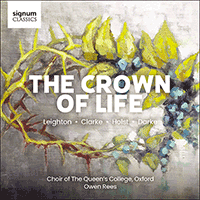

An exploration of some of the byways of the twentieth-century English choral tradition. There is some very fine singing indeed on this album, and the repertoire is every bit worthy of discovery.

Leighton noted in his final composition book that the Missa Christi—subtitled ‘Festival Mass’ in the autograph score—was to be ‘my last setting of the mass’. Commissioned by Christ Church Cathedral, Indianapolis, for its 150th anniversary, the Mass was finished in March 1988 and premiered in June that year. Leighton would complete only one more project—the anthem The Beauty of Holiness—before his death in August.
From the anguished opening of the Kyrie to the serene coda of the Agnus Dei , Leighton’s Missa Christi exemplifies the richness of his mature choral craft. These two outer movements—both of which are pleas for mercy—are duly linked through their use of the Phrygian mode, traditionally associated with laments. By contrast, the celebratory Gloria and Sanctus blaze with the brightness of the Lydian mode. The scintillating Lydian-hued rising gesture which opens the Gloria unifies the joyful sections of the movement, and returns triumphantly in the ‘amen’, while the Sanctus glitters with bell-like brightness from its Lydian raised fourth. The triumphant ‘Hosanna’ with which it ends is interrupted by a plunging baritone solo, ushering in a subdued contrapuntal setting of the Benedictus which recalls the Phrygian semitones of the Kyrie and anticipates those of the Agnus Dei. At the end of the Agnus the Phrygian semitones brighten to a whole-tone ascent for the culminating ‘Grant us peace’, and the Mass ends in mystery, the choir falling silent and the organ alone voicing the final prayer.
Leighton’s well loved and deeply poignant setting of the hymn Drop, drop, slow tears by Phineas Fletcher (1582-1650) ends the cantata Crucifixus pro nobis (Op 38, 1961). The kaleidoscopic sound-world of this miniature owes much to the juxtapositions of major chords a third apart, a colouristic device which suggest the influence of Vaughan Williams, in whose music such effects are common: while a student at Queen’s Leighton had been introduced to Vaughan Williams by his teacher Bernard Rose. Vaughan Williams died in 1958, two years before Leighton began work on Crucifixus pro nobis, and it may be that a homage was intended here. This same harmonic device is used in Leighton’s A Hymn to the Trinity, where it highlights—after the exhilarating opening fanfares—the ‘music of concord’ apt to praise the triune God; this harmonic progression recurs, again evoking the euphony of song, to conclude the piece’s opening paean at ‘with cheerful hearts, with pleasant voice’. The rhythmically energised syncopated sections—one of Leighton’s trademark styles—and the bell-peals of the final ‘amen’ featuring echoing soprano parts are in a similar vein to the musical revelry in the Gloria of the Missa Christi.
Rebecca Clarke, who was Stanford’s first woman pupil, achieved eminence as a viola player, working both in London and in America. Despite the revival of interest in her compositions, her choral music remains little known in comparison to some of her chamber music (particularly the Viola Sonata and Piano Trio) and songs, and only three of these choral works are sacred, including the two recorded here. The remarkable psalm anthem He that dwelleth in the secret place of the Most High, for eight-voice choir and soloists, was her first sacred choral work, composed in 1921. Clarke chose a text (Psalm 91) that invited dramatic and graphic treatment, and the musical result—which shows the clear influence of Ernest Bloch—is arresting, powerfully affecting, highly coloured, and haunting, mixing the opulent with the acerbic and bare, and taking the listener far abroad into the world’s dangers from the quiet refuge of the opening and closing sections, where the tenor soloist sings of abiding ‘under the shadow of the Almighty’ (at the opening) and of God’s promise of deliverance and salvation (at the end). The acerbic and tense qualities of the writing are frequently produced by the use of pedal points with which the upper-voice harmonies clash, the longest series of pedals propelling the extraordinary extended build-up to the work’s culmination at ‘because he hath known my name’, after which the opening tenor solo is recalled to lead the work to a final harmonic equanimity. A fortnight after finishing He that dwelleth Clarke made a fair copy of it to show to Gustav Holst (then working at St Paul’s Girls’ School), together with another psalm setting for voice and piano, but was dispirited by his response: ‘He was very nice, but criticized them very severely. I felt awfully depressed for the rest of the day, but suppose it is good for me.’ She never published He that dwelleth, and it did not appear in print until a quarter of a century after her death.
In contrast, Clarke’s setting of the Ave Maria is a subtle miniature. It was composed in 1937, and was the first of her choral works to appear in print. The decision to use only upper voices reflects the Marian text, as does the setting by Gustav Holst which is also on this album. Clarke’s music here projects a striking combination of humility and mystery, the latter reflecting the scene of the angelic salutation to Mary, and achieved through harmonic disjunctions, such as those which place quiet emphasis on the name ‘Jesus’ and on the petition ‘ora pro nobis’. Holst’s setting of the same text (Op 9b, 1900) was written early in his musical career when he was working as a trombonist and repetiteur for the Carl Rosa Opera Company. He dedicated the piece ‘to the memory of my mother’, who had died when Gustav was a young boy. Scored for eight-part female chorus, divided into two choirs, Holst’s setting creates a serene flowing tapestry, built from the simplest of (mainly stepwise) lines, while polyphonically rich and nuanced in its textural colours.
It was for his pupils at St Paul’s Girls’ School that in 1912 Holst composed a setting of Psalm 148 adapted by Frances Ralph Gray, the first High Mistress of the school: Lord, who hast made us for thine own. The familiar hymn melody ‘Lasst uns erfreuen’ (from the Ausserlesene Catholische Geistliche Kirchengesänge, Cologne, 1623) had been arranged—coupled with a different text—for The English Hymnal by Vaughan Williams six years previously. Holst worked this tune and text into a majestic and dramatic structure: the first verse is declaimed unaccompanied with unassuming simplicity in octaves, followed by delicately ecstatic chimes of ‘alleluia’ in sopranos, altos, and tenors decorating the tune in the organ. The tenors and basses burst in upon this scene of quiet rejoicing, displacing its C major with their magisterial E major declamation of ‘Waves, rolling in on ev’ry shore’, and this is followed by the bucolic idyll of the upper voices’ celebration of the bounties of nature (‘Sweet flow’rs that perfume all the air’). Finally, as the sun and stars are invited to join the divine praises in the last verse, the lower voices deliver the melody as a slower cantus firmus underpinning a crescendo of peals in the upper parts, the final ‘alleluias’ achieving a resplendent grandeur.
Three years later, in 1915, Holst was invited by Richard Runciman Terry, organist of Westminster Cathedral, to compose a setting of the Nunc dimittis, which was first performed by the Cathedral choir on Easter Day that year. The piece then fell into obscurity until Holst’s daughter Imogen edited it for performance and publication in the 1970s. The mastery of architecture and climax evident in Lord, who hast made us for thine own is conspicuous here too. Holst emphasises the transition within the Nunc dimittis text from the peaceful resignation of an old man welcoming the end of life to his glorious vision of the light of salvation which will be brought by the Christchild he holds in his arms: the piece moves from the serenely radiant chordal blossoming of the opening word to dynamic antiphony between high and low voices exploiting the magnificent acoustics of the new cathedral, while the polyphonically rich concluding doxology expresses the ritual exultation of Easter Day.
From 1914 Holst had rented a cottage near Thaxted in Essex, and took a strong interest in the music of the parish church, befriending the vicar, Conrad Noel. Holst created a Whitsuntide Festival at the church in 1916, using his London school pupils as performers. It was through Noel that he came across the old Cornish poem This have I done for my true love, which he set for performance in that first festival, dedicating the setting to Noel. The piece, which has become one of Holst’s best known and of which he was particularly fond, was performed at Chichester Cathedral in 1934 when his ashes were buried there. Holst was captivated by the image of sacred dance in this carol text (in which Jesus is himself the narrator, inviting ‘my true love to the dance’), devising for it a lilting tune evocative of folksong. The text is likewise representative of many medieval carols in recounting the entire narrative from Christ’s birth to his Passion and Ascension.
While Holst’s This have I done has long enjoyed a firmly established place in the repertoire, the exquisite carol Out of your sleep arise and wake by his daughter Imogen, composed in 1968, is recorded here for the first time. Holst took the anonymous fifteenth-century text—one of many carols with a ‘nowell’ refrain—from Ancient English Christmas Carols published in 1914, and the melody is based on the plainsong hymn ‘Nunc Sancte nobis Spiritus’ for the first Sunday in Advent, against which the peals of ‘Nowell’ punctuating the piece recall the ‘alleluias’ of her father’s Lord, who hast made us for thine own.
The music of Gustav Holst and Harold Darke (fourteen years Holst’s junior) has frequently been compared through the tightly focused lens of one famous controversy: the question of whose is the finer setting of Christina Rossetti’s A Christmas Carol ‘In the bleak midwinter’. Beyond this, Darke has become best (and somewhat narrowly) known for his Communion setting in F which is a staple of the Anglican repertoire. The three anthems by Darke recorded here reveal a compositional voice of great rhetorical power and imagination. The finest of these works is also the earliest: Blessed is the man that endureth temptation. This was written in 1916 as a leaving gift from Darke for the choir of St James’ Paddington, where Darke had served as organist for five years after graduating from the Royal College of Music, and which he left to take up the post he would hold for the rest of his long career, as organist of St Michael’s Cornhill. Blessed is the man remains unpublished: the autograph manuscript is preserved in the Bodleian Library in Oxford, and the piece has not previously been recorded. Darke uses the phrase that sets the text’s opening as a refrain to bind the anthem together, although it is recast on each appearance. The device recalls the periodic occurrences of the ‘Warum’ motive in the opening section of Brahms’s famous motet Warum ist das Licht gegeben (with, in both cases, silence following the initial statement of the opening word, before that word is repeated), and indeed Darke’s writing is somewhat Brahmsian in its lyricism, chromaticism, textural richness, and harmonic and tonal mobility in response to the shifting affects of its text, which begins in the troubled world of life’s temptations and trials but reaches its first ecstatic high-point at ‘the crown of life’, which gives this album its title. Darke’s teacher Stanford had employed Brahms as a principal model for his students to follow.
The other two anthems by Darke recorded here are a mid-career work from 1935, O brother man, and a late piece, Be strong and of a good courage. The first of these was dedicated to William Harris, a colleague of Darke’s at the Royal College of Music and organist at St George’s Windsor, while the latter was composed for the golden jubilee of the Diocese of Chelmsford in 1964. O brother man sets three verses from a hymn text by the nineteenth-century American Quaker poet and abolitionist John Greenleaf Whittier. Darke’s response to the poem’s pleas for an end to servitude and war (‘Then shall all shackles fall: the stormy clangor of war’s wild music in the earth shall cease’) is eloquent and passionate, and the textures—with divisi sopranos, tenors, and basses—are vibrant at climactic moments such as ‘So shall the wide world seem our Father’s temple’. The opening of Be strong and of a good courage reflects the festive occasion for which it was written with stirring organ and choral fanfares. The minor-mode first section of the piece, driven by an organ quaver ostinato, subsides via an instrumental interlude into a serene major-mode second section, the ending of which (‘be perfect with the Lord our God’) is rendered poignant through Darke’s characteristic mixing of major and minor tonality.
Owen Rees © 2026