Welcome to Hyperion Records, a British classical label devoted to presenting high-quality recordings of music of all styles and from all periods from the twelfth century to the twenty-first.
Hyperion offers both CDs, and downloads in a number of formats. The site is also available in several languages.
Please use the dropdown buttons to set your preferred options, or use the checkbox to accept the defaults.
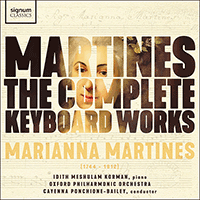


The first complete modern recording of the surviving keyboard music of an astonishing composer, keyboard virtuoso and cultural force in eighteenth-century Viennese musical life: four keyboard concertos, three sonatas, and a sinfonia, recorded from newly prepared critical editions and revealing a vital and compelling body of work.

Martines never married—a fact that may have helped her pursuit of music, but also put her in a marginalised position in marriage-obsessed eighteenth-century Vienna, where great limitations of freedom and mobility were placed on unmarried women. Women in her position were not encouraged to make their preferences known or take any steps themselves to pursue a potential husband for fear of ruining their reputation. While there is nothing to suggest that Martines bemoaned her unmarried status, Metastasio noted in his testament how fortune did not do any favours to Marianna and her sister, leaving them to rely both on his financial support and their irreproachable reputation. Martines instead kept house for her eldest brother, Joseph Martines, and cohabitated with her sister Antonia until the day she died. Joseph enjoyed a slow moving but rewarding career at the Court Library and was instrumental in securing himself and his siblings their elevation into lower-ranking nobility (Ritterstand) in 1774.
While the Martines siblings were born into a (quasi) middle-class family without great financial means, their striving for social mobility dictated much of their decision making. Indeed, Martines appears to have been a master of toeing the line between what we might nowadays term ambition and a display of demure humility; perfectly balancing educated sociability and politeness while pursuing excellence without transgressing beyond what would be deemed ‘proper’ for a woman of her station. This meant that, unlike other women who were born into middle-class families, Martines never performed publicly. Instead, she used the liminal space of her salons to inhabit her multi-role identity of a composer-performer. Her only quasi-public appearances were as a composer of sacred music, which allowed for performances of at least one of her masses or oratorios.
Martines’s academies
Martines’s academies were salon-like gatherings, though in contrast to the French-style salon, there was a greater focus on music performance, while still facilitating intelligent conversation and meeting of like-minded individuals. By the time Martines was around fifty years old, her weekly academies had become a staple in Viennese musical life. Johann Ferdinand von Schönfeld’s Yearbook of Music, which documented the musical activities of Vienna during the late eighteenth-century, reported that the ‘very large soirée[s]’ of this ‘skilful musician’ were filled with ‘a lot of singing and piano playing’ and sometimes even ‘a band of wind players […] that play throughout the whole evening’. He also praised her academies for their openness, noting that they were ‘distinguished by the fact that strangers who come here for a visit find easy entry and are received warmly’.
The eighteenth-century Viennese music scene relied heavily on these semi-private gatherings due to a relative lack of purpose-built concert halls in the city. The fact that salon concerts were not entirely public—but also not completely private—made them particularly important for upper- and upper-middleclass women who did not otherwise pursue professional musical careers. Instead, these women embraced the role of the dilettante, a term which did not reflect the quality of their work (unlike our modern-day usage), but rather their position in society. This might (partially) explain why music history, with its focus on public performances and publications as the metrics of success, has done such a poor job in recording women’s contributions. At the time there was no such reservation, indeed, as Schönfeld documents:
Martines, Fräulein Nanette von, is one of the most excellent experts among our numerous dilettantes. She reads prima vista, accompanies from the orchestral score, is an excellent singer, strictly grammatical in composition and execution, her taste is primarily in the older Italian manner. For entertainment and love for the art, she almost always has her own singing school, where she trains excellent singers […] She has composed masses and many arias, some of which resemble the style of Jommelli, and she is in every respect a great supporter of the musical arts.
Indeed, Marianna Martines’s own pianistic abilities were highly praised by many contemporaries. The famous musical travelogue author, Charles Burney, after visiting Martines and Metastasio and hearing her play one of her own sonatas, described her playing as ‘spirited and full of brilliant passages’. Burney also recounted a conversation about Martines with Johann Adolf Hasse, who said he thought Martines possessed rare talent for music, adding that she sang with great expression, played masterfully, and was very thorough in her counterpoint writing.
Michael Kelly, who came to Vienna from England in 1785, was also impressed with Martines’ skills, remarking that Wolfgang Amadeus Mozart concurred. He reported that, ‘Mozart was an almost constant attendant at her parties, and I have heard him play duets on the piano-forte with her, of his own composition. She was a great favourite of his’. Perhaps the most significant evidence that her compositional skills were acknowledged in her lifetime, was her election to the prestigious Accademia Filarmonica di Bologna in 1773. The first woman ever to be elected to the academy, it was an honour she shared with both Arcangelo Corelli and Mozart.
Martines’s instruments
Both Kelly and Schönfeld mention Martines’s instruments in their writing: the former speaks of a ‘piano-forte’ (the instrument we now refer to as a fortepiano), and Schönfeld reports that music was played on the Flügel (while a direct translation is ‘grand piano’, in a late-eighteenth-century context, this would most likely refer to a harpsichord). There is no further direct evidence whether Martines owned a fortepiano, however, we know that Metastasio bequeathed a harpsichord and clavichords to her in his will. Still, it is not hard to imagine that she may have acquired a fortepiano in later years or at least played it in other salons she was known to frequent. Nevertheless, like almost all compositions for keyboard instruments of the time, the sonatas and concertos would not have been limited to a specific instrument, but were played on whichever instrument was available.
Keyboard compositions
Though Martines’s ‘public facing’ music was generally sacred music, she published two of her keyboard sonatas with Ullrich Haffner, in his Raccolta Musicale series. These are the sonatas in E major and A major—two of three surviving sonatas (the third is in G major, existing only in manuscript form) out of 31 sonatas that she is believed to have composed. Similarly, two-thirds of her keyboard concertos are considered lost, with only four surviving as autographs or copies. The lack of printed historical editions was not unusual, especially in Vienna, and was not limited to the works of women composers like Martines. Charles Burney summed it up well when he wrote: ‘everything is very dear at Vienna, and nothing more so than music, of which nothing is printed’.
None of the (surviving) keyboard compositions bear a dedication. The two sonatas published with Haffner may or may not have been commissioned by the editor, but could just as well have been composed prior and sent to Haffner upon his request. Lacking a specific purpose beyond Martines’s own need as a composer-performer, it is relatively safe to assume that the keyboard repertoire was written with herself in mind as first intended performer. The same can be said about some of her vocal repertoire, though much of it was either dedicated to specific individuals or written for certain performers.
Performing Martines
Against the backdrop of historical ‘body culture’, Martines’s keyboard repertoire takes on a different significance, as it largely represents her own preferences, abilities, and embodied musical ideals as they are inscribed in the musical score. Playing this repertoire and ‘inhabiting’ Martines’s gestures at the keyboard give us further insight into Martines’s personal style. A particular technical strength that emerges in the concertos is Martines’s ability to play large leaps with the right hand even at a very fast tempo. In Martines’s dual role as composer-performer, the keyboard oeuvre is indicative of who she was as a performer and how she wished to engage with audiences in the liminal space of her academies. Martines’s instrumental works also blend vocal and instrumental idioms in her repertoire, especially in the slow movements where rhythmical malleability leads to a suspension of metre. An example can be found in the second movement of her G major concerto (bars 20-29), which beautifully demonstrates this amalgamation. After six bars of pure vocal cantabile transcending bar lines, she seamlessly incorporates rhythmic triplets in preparation for the transition into pianistic-virtuosic displays of chordal arpeggios, implementing ascending and descending Prinner voice leading (typical for the so-called galant style) that fortify the modulation from C to G major.
Martines’s concertos lend themselves particularly well to her project of self-fashioning a stage persona of a dilettante-virtuoso. Less concerned with the high levels of propriety that she generally adhered to in all other aspects of life, her musical scores tell a more nuanced story. Martines plays within the confines of defined norms, whether that be through sonata form, galant schemata, or implementation of personalised virtuosity. Martines deliberately toys with her listeners’ capacity of (galant) pattern recognition and appears to take all the more joy in subverting these expectations, adding unexpected twists into the schemata, or inserting sudden rests and subito modulations. Martines at the keyboard cleverly broke with the convention of upper-class women sitting demurely still. Thus, the somatic qualities of her music gain in importance, as they give account of her personal agency and the embodiment of cultivated sociability, intentionally conforming and subverting norms and expectations.
Judith Valerie Engel © 2026
There is a gorgeous timelessness to Martines’s music which transcends instruments, performance styles and concert settings. This recording on modern instruments is a testament that versatility and finds itself in good company with the Berlin Philharmonic’s recent performance of her Sinfonia in C in 2024.
Meshulam Korman writes:
In exploring her music, I not only became familiar with her unique musical language but was also introduced to the pianistic demands it presents. The repetitive patterns, intricate note passages, and the precision required in her music are at the heart of her musicality. This demanded both a light touch and agility, as well as a certain forcefulness. For this recording, we selected a C. Bechstein D model, hoping that it would capture both the brightness and lightness of her music, while also providing the grand sonority we envisioned.
Many of her works—long preserved only in manuscript and in sets of parts likely used only once—are now being brought to light, newly edited, published, and recorded for the first time. Working in collaboration with musicologist Melanie Unseld and the Denkmäler der Tonkunst in Österreich, we were able to record this album using the then in-progress critical edition of Martines’ complete surviving concerti. We hope that this recording inspires new interest in Martines’ keyboard compositions and provokes others to find new and exciting ways of performing her music.
Cayenna Ponchione-Bailey © 2026



