Welcome to Hyperion Records, a British classical label devoted to presenting high-quality recordings of music of all styles and from all periods from the twelfth century to the twenty-first.
Hyperion offers both CDs, and downloads in a number of formats. The site is also available in several languages.
Please use the dropdown buttons to set your preferred options, or use the checkbox to accept the defaults.
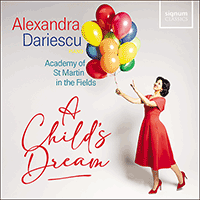

A vivid portrait of music as dream, memory, and renewal: and a rare opportunity to hear some sparkling novelties, all presented with Dariescu’s customary charm and humour.

Of course, I had no idea what such a statement really meant—not coming from a family of musicians. The years of training, the resilience and perseverance it would demand were still hidden ahead. But the curiosity and joy of performing lit the way.
Mozart wrote this sparkling Rondo in 1782 as a replacement finale for his earlier D major Concerto, K175, composed when he was just 17. It is full of brilliance, wit and youthful energy. For Mozart it was a hit with Viennese audiences. For me, it was the first step on a lifelong journey—a child’s dream that came true.
Emmy Schäfar Klein Child’s dream (Christmas Album, Op 8)
Have you ever heard of Emmy Schäfer Klein? Don’t worry, neither had I until the pandemic, when time seemed to stand still and I found myself digging deep into forgotten shelves of repertoire. Hidden among them was this sparkling miniature, Child’s dream. It has never been recorded before—which feels almost unbelievable, given its charm. Sadly, not much information exists on this composer, but Child’s dream is the first of six pieces in her Christmas Album, published in 1882. After more than 140 years, it is finally given voice.
Like a snow globe shaken gently, Emmy Schäfer Klein’s music captures the wonder of a child gazing at Christmas lights. This piece drifts between innocence and longing, between dream and reality. Almost forgotten in history, her voice returns here—fragile yet luminous—reminding us that every child’s dream deserves to be heard. For me, discovering Klein’s music in such a still, uncertain moment felt like opening a small window to joy and possibility. And now, for the first time, it gets to fly free into the world.
James Lee III Humble birth
I first met James Lee III in Detroit after performing with the Detroit Symphony Orchestra. Over dinner, we hit it off immediately—laughing, trading stories, and, before pudding, already plotting a new concerto together. Eighteen months later, that dream became reality when we premiered Shades of Unbroken Dreams with the Detroit Symphony Orchestra and the BBC Philharmonic.
Since then, James has made his BBC Proms debut and became Composer-in-Residence with the Baltimore Symphony Orchestra, testament to his visionary and original voice. James has a wonderful sense of humour in person, but his music always carries a profound message about the world we live in. He composed Humble birth in December 2021, when I launched “Alex’s Piano Advent Calendar” online. It’s a piece rooted in simplicity and sincerity—a quiet reminder of what matters most. This piece is a cradle song for the world: tender, hopeful and filled with light. It was a gift born of kindness and faith. It speaks of beginnings that may seem small, but carry within them the seeds of greatness. Every note is a reminder that even the humblest birth can change the world.
Nadia Boulanger Three 3 Pieces for Cello and Piano
I first “met” Mademoiselle Boulanger when the BBC Symphony Orchestra invited me to perform her Fantaisie variée at the Barbican. Until then, I only knew her as the legendary teacher—the wise enchantress of Paris who shaped everyone from Copland to Piazzolla, Barenboim to Dinu Lipatti and Quincy Jones. Discovering her own music was a revelation! I even gave the US premiere of her Fantaisie with the Houston Symphony Orchestra in 2022—surreal, considering she taught so many Americans and was the first woman to conduct the Boston Symphony Orchestra and the New York Philharmonic.
Her Trois Pièces, written in 1911 for organ and transcribed for cello and piano in 1914, feel like three secret postcards from Nadia herself: one dark and smoky, one full of restless questions and one bursting into dance. For once, it’s not the teacher speaking through her students—it’s Nadia, in her own unmistakable voice.
Clara Schumann Three Romances for violin and piano Op 22
Clara’s Piano Concerto was my gateway into her world. I’ve played it across Europe, the US and Australia—even giving the Melbourne premiere!—and through it I began to sense the depth of her voice. Behind the virtuosity lies something more intimate: Clara’s music is like a secret diary hidden under the pillow of a genius—full of whispers, sighs, and flashes of fiery passion.
These Romances, written in 1853 for her dear friend the violinist Joseph Joachim, sing with tenderness, mischief, and longing. They are stories of friendship and imagination, painted with the brush of one of music’s bravest heroines. Clara was not only a child prodigy and one of the greatest pianists of the 19th century, but also a pioneering composer who balanced touring, motherhood, and artistry at a time when women were expected to do anything but create. Her music dares to speak with honesty and courage, and in these Romances, we hear her heart.
Bach/Siloti Prelude in B minor BWV855a
I first learnt this Prelude as a child, never realising how much it would come to mean later in life. After my beloved professor passed away in 2006, I was asked to play it at his memorial just a few days after his death. Even now, when the Prelude begins, it feels as if he is quietly there, listening, guiding me, smiling.
Siloti’s arrangement feels like stepping into an ancient cathedral at dawn, when the first rays of sun strike the stained glass and colours spill across the stone floor. It is simple and serene, yet filled with infinite depth—a quiet prayer that carries us beyond time. The music wanders in shadow, searching in minor keys, and then—right at the end—it turns to major, as if Bach himself reminds us that there will always be light after darkness.
Missy Mazzoli A map of laughter
I first met Missy in New York over tea and cake while I was performing at the Kaufman Music Centre. She has this spark—witty, fearless and endlessly curious—and her music feels exactly the same. In 2018 she made history as one of the first women ever commissioned by the Metropolitan Opera, and her voice has been reshaping the musical landscape ever since.
Missy writes music like constellations in the night sky—dazzling, modern, alive. In A map of laughter, inspired by Schubert’s Moments musicaux No 4, she charts laughter itself: bursts, echoes, surprising shapes. It’s like the sound of a child’s imagination—unpredictable, mischievous and full of joy.
Amy Beach Harlequin (Children’s Carnival, Op 25, VI)
During the pandemic, my husband and I moved to Berlin for six months, and in those strange, uncertain days I found unexpected treasures at the piano. One of them was Amy Beach’s Children’s Carnival. Step right up to the circus tent: here comes Harlequin—nimble, cheeky, a trickster in a dazzling costume. Beach, the first great American woman composer, paints him with sparkling rhythms and witty twists.
Playing it for the first time, I could almost see him tumbling across our little Berlin flat, cartwheeling and bowing before vanishing with a wink. In the quiet of lockdown, Harlequin brought back colour, mischief and joy—a reminder that music always finds a way to make us smile.
Florence Price The goblin and the mosquito
This little gem has become one of my go-to encores around the world—and it never fails to surprise audiences, many of whom have sadly never heard of Florence Price. She was the first African American woman to have a symphony performed by a major US orchestra (the Chicago Symphony in 1933), and her voice has only recently been rediscovered after stacks of her manuscripts were found in an abandoned house.
I also play her piano concerto, which I often pair with Rachmaninov’s Rhapsody on a Theme of Paganini—both written in 1934, though one is known all over the world and the other not nearly enough.
The goblin and the mosquito is pure theatre—a fairytale duel where wit and rhythm collide in dazzling fun. The goblin stomps and blusters while the mosquito buzzes and teases, and by the end both pianist and audience are grinning.
Germaine Tailleferre Romance
I was first introduced to Germaine through the Royal Liverpool Philharmonic Orchestra, who invited me to perform her Ballade. It was a revelation—and I love pairing it in concert with Ravel’s G major concerto, since she was his student and shared so much of his elegance and sparkle. As the only woman in the famous Parisian group Les Six, she carved out her own voice with courage, wit and charm.
Her Romance is like a perfume bottle of Parisian elegance. Gentle, flowing and radiant, it whispers of twilight walks along the Seine, of laughter spilling from cafés, of dreams carried on the evening air. Grace in sound: simple, chic and utterly enchanting.
Kashperova/Griffiths Songs Without Words No 5
This truly was the discovery of the century for me. When the BBC Symphony Orchestra invited me to perform Kashperova’s Concerto, I had to confess I had never even heard of her. Imagine my surprise when I learned that she had been Stravinsky’s teacher! Kashperova (1872-1940) studied piano at the St Petersburg Conservatoire with Anton Rubinstein and composition with Rimsky-Korsakov, graduating with the highest honours. With a catalogue that includes a symphony, a piano concerto, chamber music and numerous lieder, her music has only begun to re-emerge in recent years her Symphony in B minor was featured at the BBC Proms in 2022.
Much of Kashperova’s work had been lost to history until the tireless Dr Graham Griffiths uncovered it. He has since become a dear friend—we’ve spent countless hours exploring her music together, fuelled by endless cake and conversation. This Song without Words, arranged for piano by Graham, feels like a lullaby murmured by the fire. In it, you hear a woman’s voice long silenced—at last, allowed to sing again.
Carl Filtsch Mazurka (Premières pensées musicales, Op 3)
As a child I took part in many competitions and festivals—one of them was named after Carl Filtsch and that’s how I first discovered him. Born in Transylvania, he moved to Paris and quickly became Chopin’s favourite student. He was such a prodigy that Liszt once declared: “If the kid starts to travel the world, I will have to close my shop!” Sadly, Carl’s life was heartbreakingly short—he died at just 15, most likely from tuberculosis—leaving behind only a small catalogue of works.
This Mazurka is one of those rare treasures. In it you hear both innocence and brilliance: a young boy dancing through life with Chopin’s footsteps in his ear, yet already full of his own charm. Sparkling, brief, eternal.
Tudor Ciortea Joc ţigănesc (Suite for piano on Transylvanian folk themes)
This was my party piece as a child—though back then my little hands couldn’t yet span an octave, so it always felt like climbing a mountain! Now it’s one of my favourite encores, bursting with energy and fun.
Tudor Ciortea (1903-1982) studied in Paris with Nadia Boulanger and Paul Dukas, but his music is deeply rooted in Romanian soil. In this Gypsy Dance, the sixth piece in his Suite for piano on Transylvanian folk themes, he gathers the rhythms and colours of the Carpathians, weaving them into a whirlwind of energy. It is music of earth and sky, of tradition and joy—a celebration of where I come from. Coming back to it now feels like meeting an old friend: familiar, joyful and effortless (thanks to bigger hands!)
Villa-Lobos O polichinelo (A prole do bebê No 1, W140:7)
This is my number one encore—I’ve probably played it more than any other, from New Zealand to South Africa, US to Europe. Without fail, it makes the audience grin and cheer. It’s so short that I always joke: if you blink, you’ll miss it!
Pulcinella—the mischievous puppet of commedia dell’arte—bursts to life here with Villa-Lobos’ dazzling rhythms and bright colours. It’s over in a flash, but it packs all the joy and sparkle of a carnival. It’s the perfect celebratory send-off, leaving both pianist and audience smiling from ear to ear.
I hope it brings the same smile to you, my dear listener. Thank you for dreaming alongside me in this album—until our next musical story!
Alexandra Dariescu © 2026
Alongside these landmarks are hidden gems by historically overlooked composers—voices that deserve to be heard and celebrated. With four world-premiere recordings, A Child’s Dream is both a reflection of my own story and a tribute to the inclusive, diverse world we live in today.
One of the greatest joys of this album has been recording with the Academy of St Martin in the Fields, a group of extraordinary musicians and human beings I once knew only through treasured recordings that inspired me profoundly. Never in my wildest dreams did I imagine I would one day share the stage with them, let alone record my tenth album together!
Heartfelt thanks to Tomo Keller and Richard Harwood, who joined me on this adventure with such enthusiasm, dedication and truly inspiring music-making. Much gratitude to Alexander van Ingen, who has been there from the very beginning, producing my very first album. Ever thankful to the entire KD SCHMID, Signum teams and David Taylor, whose constant support over the years has meant more than words can say.
This album is dedicated to my mum and my husband, whose love, belief and encouragement have given me the strength to dream fearlessly and follow the path that led me here.
May this music awaken wonder, inspire courage and remind us that every dream—like every musical note—holds the power to shine for a lifetime.
With gratitude,
Alexandra
Alexandra Dariescu © 2026