Welcome to Hyperion Records, a British classical label devoted to presenting high-quality recordings of music of all styles and from all periods from the twelfth century to the twenty-first.
Hyperion offers both CDs, and downloads in a number of formats. The site is also available in several languages.
Please use the dropdown buttons to set your preferred options, or use the checkbox to accept the defaults.
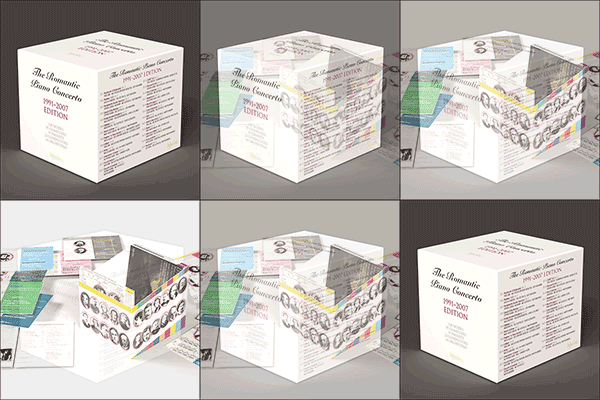


The first of two box sets celebrating one of the most ambitious, and successful, series in the history of classical recording. This volume features 130 works from 59 composers, performed by 19 different pianists, and all luxuriously presented with photographs from the recording sessions, comprehensive indexes and commentaries on the entire journey from those closest to it from the start.

Serendipity brings the birth of a series
Back in 1990 I had been working at Hyperion for two years and found myself, somewhat unexpectedly (to me at any rate), employed as their sales and marketing manager. If I may indulge in some personal background, I had discovered classical music as a listener aged about twelve, become an avid record buyer and then decided, rather late, to start playing the piano. The latter led to my musical interests being particularly fixated on pianists and piano repertoire, but still, this was all just a hobby. I was expected to do something ‘sensible’ at university but gradually I began to decide that, somehow, I would like to make my life in music and where better than the record industry? With only partially relevant qualifications (biochemistry doesn’t count!), I managed to take a post-graduate music degree which included a course in recording and producing and hoped that might lead somewhere. It didn’t really (no loss to the world—I don’t have the temperament or the ‘golden ears’ to be a great success in that field), but after some temporary work at the National Sound Archive, a job in Tower Records led to a ‘real’ job as classical label manager for a distribution company. Through that I met Ted Perry, the founder of Hyperion and already a record industry legend. A year or so later I was working for him as described above.
Ted quickly realized that I was a ‘piano nut’, and as his interests were much more towards song and choral music, he began to ask for my input when it came to pianists. One of the earliest instances was what became our recording of the complete Shostakovich Preludes & Fugues. Ted wanted to do them, but with who? He suggested Ronald Stevenson might be an interesting choice—he would have been, but he declined. I suggested trying to get hold of Tatiana Nikolayeva who had inspired the cycle and to whom it was dedicated. She had already recorded the work in the USSR, but these LPs were not available in the West. Though she had barely performed previously in the UK, we were able to arrange a recording which went on to win a Gramophone Award. A good start!
So back to 1990. I happened to be outside my office in the Hyperion warehouse (the warehouse was the only way to get between offices or to the front door) when in walked Hugh MacDonald. To me he was a university lecturer who had taught me music. Why was he here? He was as surprised to see me; he had no idea I worked at Hyperion. It turned out he was now in charge of the BBC Scottish Symphony Orchestra and had arranged to meet Ted with the idea of Hyperion making some recordings with the band. Ted quickly saw Hugh and I knew each other and said ‘well, you better come to lunch with us then’.
Over lunch it was clear Ted was ‘going through the motions’; orchestral recordings were expensive, and Hyperion was making its name in other directions—we tended to leave symphonic repertoire to our friendly rival, Chandos. There was also the fact that at this point the BBC Scottish had no commercial recording history and so was not a strong brand. What could we do with them that would look convincing to the record buyer? I had become quite a fan of the many forgotten nineteenth-century virtuoso piano concertos which had been championed by Vox and some other smaller labels, mainly in the 1970s, but these recordings were often frustratingly poor, both in performance and recording standards, and in addition they often contained cuts. I suggested this might be an interesting project: we could cover similar repertoire but do it to a much higher standard. There was also the advantage that the pianist would be the star, so usage of an orchestra little known to record buyers would not be a disadvantage. Somewhat to my surprise, this suggestion met with approval from both Ted and Hugh, and we came away with a plan to make three recordings and see how they went.
We decided to launch the series with two of the better-known ‘forgotten’ concertos, those by Moszkowski and Paderewski, both brimming with good tunes and virtuoso excitement. That the BBCSSO’s principal conductor at the time was the Pole Jerzy Maksymiuk made the choice all the more appropriate. For our first pianist I chose Piers Lane. I had recently heard him give a wonderful Queen Elizabeth Hall performance of the Strauss/Schulz-Evler ‘Arabesques on the Blue Danube’ and thought anyone who could bring that off was the right man for the job. Elsewhere, Piers recounts in detail another happy coincidence that sealed the deal. He went on to make nine volumes in total, the second biggest contributor.
Our first release sold very well and received excellent reviews; meanwhile two more were in production. Next to be recorded was a disc of Mendelssohn’s pair of concertos for two pianos which he wrote as a precocious teenager. These proved the point about cuts in earlier recordings—based on previous timings I expected there to be room for a ‘filler’ and our pianists prepared the unusual ‘Duo concertant’ for two pianos and orchestra jointly composed by Mendelssohn and Moscheles. When it came to the recording sessions it turned out the uncut versions of the Mendelssohn concertos were so long there was no room for anything else.
The third of our recordings proved difficult. Medtner’s Piano Concertos Nos 2 & 3 were given to our recently signed pianist Nikolai Demidenko. He was passionate about the composer, and these are certainly two of the most significant works in our series. None of the orchestra’s regular Glasgow venues was available and in desperation we booked Greyfriars Kirk in Edinburgh, a venue new to both the orchestra and our recording team. Balancing the sound was time consuming and the acoustic meant players had difficulty hearing each other. We completed the recording, but stressfully, and at one point Nikolai decided he wanted to veto the issue. This was out of the question with the investment we had already made and our limited means, and in any case, we were pretty happy with the results. Because the repertoire was stronger, we issued this as volume two, before the Mendelssohn, and the recording went on to win a Gramophone Award. The series was well and truly established!
Pianists and repertoire
From now on there was no question over whether the project would continue; we averaged about three recordings per year for some thirty years and through the next decade the series only increased in reputation. Each release was guaranteed to be one of our best sellers as more and more enthusiasts began to collect every volume as they were issued.
Looking back, it’s surprising how different times were then. The 1990s were boom years for the recording industry, driven by the rise of the CD and with the digital distribution of music still a distant fantasy. Hyperion grew from a small English label to one of the world’s leading independents and with that growth we could invest in new talent and more ambitious projects. The Romantic Piano Concerto series was to play its part in this. We needed a good supply of pianists to share the load of learning so much new repertoire, but this also meant we could introduce pianists through the series and then work with them on further projects. Almost all the pianists associated with the label went through this ‘rite of passage’ and in return Hyperion has built up a stable of some of the finest pianists recording today.
It’s now time to introduce Marc-André Hamelin, who has become one of Hyperion’s biggest artists and an international star. As I write, he features as cover artist on Gramophone magazine. Marc was little known in the early ’90s, just starting out on his career, but he had made a Godowsky LP for CBC Records which I had been impressed by, and I’d also been tipped off by our Canadian distributor that he was ‘one to watch’. My first chance to meet him was when he came over as part of a duo with the Canadian cellist Sophie Rolland, so on 16 March 1991 I found myself in a small venue in Bromley, introducing myself after the concert and arranging to meet him the next day for a chat. I explained the concept of the series and proposed that he record the Henselt concerto. This concerto is notorious for its extreme difficulty—of a type that is not always immediately apparent to the listener. Marc, of course, knew it, but he seemed rather reticent about the proposal, not because of the repertoire, but rather, I suspect, because he was a bit suspicious that some stranger should suddenly appear and offer him an orchestral recording. Anyway, it did come to pass as volume 7, and Marc has gone on to make five discs in the series including the longest and most demanding concerto of them all, the Busoni.
It seems appropriate to mention here that Marc was not the first to be offered the Henselt. It was originally to have been recorded by the Dutch pianist Rian de Waal, who had already made a very fine Godowsky recital for us, and indeed the concerto was scheduled for an August 1992 session with the BBC Scottish. Poor Rian, however, developed focal dystonia, an affliction which has sadly affected several pianists, and had to cancel. His career never really recovered, though he did return to playing for a short while before being struck down by cancer. That 1992 session was rescued by Stephen Coombs who agreed to learn concertos by Bortkiewicz and Arensky at very short notice. In a way, that session also rescued Stephen as he had been making his career as a duo pianist with Christopher Scott and we had planned a series of recordings with them. However, no sooner had this been agreed than Christopher decided he wanted to abandon playing professionally, leaving Stephen high and dry. He did some duo work with Ian Munro, as in the aforementioned Mendelssohn, but his first solo concerto disc led to three others in the series and some further solo piano discs and chamber music.
Unlike Marc-André, when Stephen Hough joined the series, and Hyperion, he was already a star. Stephen had won a Gramophone Award with his 1987 Chandos recording of Hummel concertos and had gone on to have a major recording career with Virgin Classics, but when that label was subsumed into EMI the inevitable rationalization of artists led to him being left without a label. I think he too had slight reservations about joining Hyperion. Virgin, with its lavish budget, had almost been seen as a ‘major’ (and indeed had become one as part of EMI). In 1994, joining Hyperion perhaps looked like a backward step. Nevertheless, Stephen did commit and his first Hyperion recording became one of the most acclaimed and commercially successful in the whole catalogue.
Stephen was already fully steeped in the kind of pianism which abounds in the typical nineteenth-century concerto. He was renowned for his brilliance and pianistic colour which harked back to the great virtuosos of the ‘golden age’. His two Piano Albums for Virgin Classics consisted of virtuoso encores which epitomized this period and, of course, his Hummel concertos confirmed he was just as happy in the early nineteenth-century repertoire. Stephen had strong ideas about how he would like to contribute to our series. His number one request was that he would like to record Xaver Scharwenka’s Concerto No 4, a work never previously recorded. That was fine with me, but normally I planned out our releases such that they were ‘sensibly’ coupled—one-composer discs if possible, or if a composer had only written one concerto, then couple that with a contemporary work from another composer who had also only written one concerto. We were creating a library edition after all, and that’s the kind of programming that appeals to record collectors. But Stephen didn’t want to record any of the other Scharwenka concertos and to make matters worse, he proposed as a coupling the first concerto by Emil von Sauer, a composer who had written two concertos! In the end Stephen got his way, and the resulting recording was so sensational that all considerations of coupling became irrelevant.
We had hoped that this might be a special event and had ‘pushed the boat out’ in hiring the CBSO, a more prestigious and expensive orchestra than those we had previously used. I well remember the sessions, and it was very clear we were making something special: excitement was in the air, and everyone was giving their all. The last movement of the Scharwenka is a coruscatingly virtuosic tarantella with an even faster coda (Stephen said he found the work more difficult even than Rachmaninov 3). It contains a fiendishly difficult upward arpeggio in right-hand octaves with leaps in the left-hand, which gave even Stephen trouble. We were just about done when Stephen decided to run the movement again for that extra bit of adrenalin. Not only did he have us on the edge of our seats in excitement, but he nailed the arpeggio, and quite a cheer went round the control room at that moment.
The disc won not only ‘Best Concerto Recording’ in the 1996 Gramophone Awards but was made ‘Record of the Year’. It went on to become Hyperion’s second-best selling record of all time. Amazingly, Stephen was to repeat the feat of winning both ‘Concerto’ and ‘Record of the Year’ awards in 2002 with his double album of the complete works for piano and orchestra by Saint-Saëns.
Steven Osborne is now one of Hyperion’s most important artists with an impressive discography and many awards to his credit, but he was certainly the most reluctant participant in the series! As a fellow Scot, I had watched Steven’s progress since hearing him at St Mary’s Music School in Edinburgh when he was eleven. He went on to win the Clara Haskil competition in 1991 and the Naumburg competition in 1997. I was keen to have him join the label and, of course, to introduce him through the Romantic Piano Concerto series. He had even performed a relevant concerto—the Edinburgh Festival had invited him to perform Sir Alexander Mackenzie’s ‘Scottish’ Concerto in 1992. Steven has many strengths—Beethoven, Schubert, Debussy, Ravel, Messiaen, even Rachmaninov—but he is not a fan of music he sees as superficial and this included much nineteenth-century virtuoso repertoire. It turned out he didn’t much like the Mackenzie, and even if he was to record it, what coupling would be both appropriate and to Steven’s liking? In the end a solution was found in the shape of the unrecorded Tovey Piano Concerto. Donald Francis Tovey was a serious, Brahmsian composer and an academic who spent most of his career as professor at Edinburgh University. Steven found the work acceptable, and with some persuasion from his agent (who told him he would be an idiot to turn down the offer of a concerto recording …) the disc was made. It’s an excellent one which shows no signs of Steven’s doubts about the Mackenzie. And as a bonus, the Edinburgh Festival, no doubt being alerted to the work by our recording, programmed the Tovey in their 1998 event, giving Steven another chance to perform it. And if anyone has ever wondered about the tartan featuring on the colour panel of our booklet design, it is the Mackenzie tartan!
There’s no space here to discuss all the many pianists who participated in the series, there are 27 of them in total, but special mention should be made of five more who not only contributed several volumes each but went on to make other recordings for the label. Jonathan Plowright joined the team in 2001 for volume 28, the concertos of Zygmunt Stojowski, and he became our Polish repertoire specialist with four further recordings featuring that country’s composers. Just behind his in number of contributions is Martin Roscoe with four. Not only did he record the Dohnányi concertos early in the series, but he went on to record the composer’s complete solo piano music. A good example of how one thing often led to another. Seta Tanyel, Hamish Milne and Markus Becker, with three volumes each are the next most prolific contributors. But I have left the pianist who has contributed most to last.
The return of Mr Shelley
Howard Shelley had been the first pianist to record for Hyperion and that disc (CDA66009) turned out to be the first in another landmark Hyperion cycle, Rachmaninov’s complete solo piano music. One of the earliest meetings with an artist which Ted took me to was with Howard; it must have been in early 1989. We met in the Royal Festival Hall for a coffee and Howard wanted to let us know he had an offer from Chandos to record the Rachmaninov concertos. He didn’t just want to jump ship and asked if Hyperion might also be interested in the same project. At that time Hyperion had barely made any orchestral recordings, and for the then small label the costs would have been prohibitive. Ted had to decline and graciously accepted that Howard would go to Chandos where he not only recorded the Rachmaninov works but many other concertos as well.
Howard also conducted, and in classical and early romantic concertos, would conduct from the keyboard. At Chandos he had recorded five discs this way to complete a cycle of Hummel concertos (the first disc of which was the one already mentioned, recorded by Stephen Hough!) and the results were spectacular. Hummel’s concertos cross the border between classical and romantic and are primarily from the 1830s—they could easily have fitted in the Hyperion series. The concerto genre fell out of fashion for the following two decades, but in that decade, they were standard fare for virtuosos of the time. Herz, Kalkbrenner and Moscheles, to name but three, churned out twenty between them and Hyperion had not yet begun to tackle these. Howard was keen to do more of this genre and Chandos were not, so twelve years after leaving he returned to Hyperion to participate in our series. He focused on this early repertoire that he could also conduct and has become by far the most recorded pianist in the series with 23 volumes to his name. His dual role brought new orchestras to the series, particularly the Tasmanian Symphony Orchestra, where Howard was long-standing guest conductor. They have now contributed to 18 volumes.
Howard has a unique ability to assimilate these demanding scores very quickly and seems to have no technical limitations. I don’t think there’s another pianist in the world who could have done what he has, and with these works, as he conducts from the keyboard, it’s not just about piano playing; it’s also deciphering hand-written orchestral scores and editing parts for the orchestral players. He seems to know exactly how to bring these early nineteenth-century concertos, with their roots in the classical period, to life. As I wrote of his first Chandos Hummel disc back in 1999 in International Piano Quarterly when asked to choose a record of the year:
Shelley is a natural Mozartean with a Rachmaninov-encompassing technique—just what’s needed to subsume the mountainous passagework into the elegant decoration it pertains to be.
Behind the scenes
We now had something akin to a production line, producing concerto recordings several times a year. What did that entail?
Generally, projects were repertoire driven and the earliest volumes featured concertos which had been recorded previously and were not hard to schedule, but as the series expanded, we covered more uncharted territory and investigating scores and evaluating them became a significant part of the process. Once again, I am reminded of how different things were back in the 1990s. Nowadays anyone can go online to IMSLP and find and download scores of most of the repertoire we recorded, but that didn’t exist thirty years ago. Back then it was very much a question of visiting libraries or buying out-of-print scores from antiquarian book dealers. I was already an inveterate score collector so for me this was a very appealing part of the process.
It’s worth making a distinction here between piano scores and orchestral parts. Piano concertos are usually published in a two-piano format, with the orchestral contribution reduced to a second piano so that the pianist can learn the work easily (in early concertos it is often just the solo part without orchestral reduction). These are much more readily available than full scores, or orchestral parts, both of which are needed to make a recording. Indeed, for many concertos, only the piano part was ever published, and any performances would have been from manuscript copies of score and parts. It was locating this orchestral material which proved the most difficult task, though there were several invaluable sources who deserve our thanks here. Top of the list must be the Edwin A Fleisher Collection of Orchestral Music in Philadelphia, a wonderful source of mainly nineteenth-century orchestral sets. Various music conservatory libraries also proved excellent resources. The Royal Academy of Music in London, having a library dating back to the 1820s, proved very useful (and helpful), and who would have guessed that the Royal College of Music had manuscript full scores of Herz’s 5th, 7th and 8th concertos! And let’s not forget publishers—though not always helpful when it comes to long out-of-print works, quite a few did turn out to have preserved rare sets of scores and parts which saved us on several proposed projects.
A specific recording would usually start by matching repertoire to pianist. Often, I would have a project in mind and propose it to a specific pianist, who would either accept or decline, but with our regular contributors, such as Piers Lane or Howard Shelley, we would get together to play through possible repertoire and come to a joint decision on what to do next. Pianists seem endlessly curious, and I am still surprised how many were happy to take on the task of learning a disc’s worth of difficult repertoire they may never have the chance to play again.
The BBC Scottish became stalwarts of the series and in the end, at forty volumes, contributed to nearly half of it. Conductors were usually proposed by the orchestra from amongst those they regularly worked with. Martyn Brabbins, with seventeen discs to his credit, is the champion here. As time went on more orchestras became involved and we even went overseas, usually pairing country with composer, so we recorded Vianna da Motta in Portugal, Alnæs and Sinding in Norway, Stenhammar and Wiklund in Sweden and Reger, Strauss, Pfitzner, Braunfels, Draeseke and Jadassohn in Germany.
When a project was finally settled on it was then time to coordinate orchestra, soloist, producer, engineer and venue in the normal way. Like almost all labels, Hyperion uses freelance engineers and producers (though all are Hyperion regulars), so their availability was another factor in the mix. While many have contributed, special mention should go to Andrew Keener who has produced more volumes than anyone else. He is a perfectionist who leaves no stone unturned in getting the best results, even if that means some hair-raising finishes as he squeezes ‘one final take’ into the straitjacket of a three-hour orchestral session! I attended most of the recordings (though sadly not those in Tasmania!) as Hyperion representative and usually took on the task of page turner. It was a privilege to enjoy so much great pianism from that ringside seat.
All participants in the sessions were seasoned professionals who knew what they were doing, so generally everything went to plan but we did have our fair share of incidents, which in retrospect we can look back on with amusement. Here are just a few.
Back in the day when one could still legally smoke within public buildings, we were making a recording in Glasgow’s Henry Wood Hall using an engineer who tended to chain smoke. Despite the control room having ‘No Smoking’ signs prominently displayed, our engineer pursued his habit, seemingly without consequences, until sometime in the second session when the hall’s fire alarms went off. Cue evacuation of a whole orchestra mid-session combined with the arrival of three fire engines outside, whose occupants streamed inside to find the fire. It turned out our engineer’s cigarette smoke had set off the alarm in the control room! When each hour is costing you more than £1000, that’s not a good use of session time. In that same venue we were working with a Russian conductor who was new to us when the mixing desk developed some electronic problem that delayed proceedings. Rather than being sympathetic, the conductor railed that this would never happen in Russia and that we were a bunch of amateurs. We did lose some time but in the end the recording was completed, though the conductor made his contribution with very bad grace. Needless to say, we never worked with him again.
A problem of a different kind beset poor Piers Lane when in Bergen to record the Sinding piano concerto. I arrived to find him rather distressed; he had had a first rehearsal the previous day when he discovered that the version of the concerto he had learnt was very different to that in the full score and parts that the orchestra had, and this included major rewrites in the piano part. He spent the day frantically relearning the piece and thankfully all went well when sessions commenced the next day.
Finally, which concerto recording utilizes two different pianos? Answer, Litolff’s Concerto symphonique No 5; and the intended piano plays only one chord, the very first of the piano’s opening entry. I shall explain. Unless we know there is a perfect instrument that our pianist is happy with in a venue, we will hire a piano (usually from Steinway) that our artist has chosen. In this instance we were recording the BBC Scottish in the Caird Hall, Dundee (their regular Glasgow venue being closed for refurbishment), and the piano was due to be delivered the day prior to recording. Unfortunately, the piano arrived too late from London to be delivered into the hall, so it sat in the van over a cold wintery night. When it was brought in just before the session it did not sound good at all, being far too cold, and it was also not holding its tuning. Nevertheless, we commenced the recording hoping it would settle down. It didn’t, and in desperation we tried to find another solution. Hidden backstage we found the Caird Hall’s resident piano, and it turned out to be an excellent Steinway D which Peter Donohoe was happy with. We swapped pianos and that’s the piano that appears on the recording. Except for that first chord. We had already recorded the long opening tutti that leads to the piano’s first entry with the hire instrument, and it turned out we couldn’t edit in the new piano on that chord because of the orchestra’s overhanging ambience. So, there you have it!
There are many more tales, but I hope these give a flavour of the complexities and pitfalls that can beset an orchestral recording.
In conclusion
Back in 2010 as we celebrated the release of our fiftieth volume, Stephen Hough’s recording of the complete works for piano and orchestra by Tchaikovsky, I wrote the following:
In our wildest dreams, none of us involved then could ever have imagined that the series would still be going strong twenty years later, and with fifty volumes to its credit …
What has made this series such a success with our public? Broadly, I think, two things: first, the music, and secondly, the performances of it which we have managed to capture on disc.
Looking first at the music, it is no secret that the language of the nineteenth century is still the most popular with lovers of classical music—this was also the heyday of the piano concerto. And there is another bonus; the virtuoso display element of a concerto can mean that a work can be satisfying without being profound. Put crudely, a less than ‘great’ symphony is likely to be dull, whereas a concerto need not aspire to greatness to be, at least, entertaining. This simple fact is the key to the enjoyment of the many concertos written by virtuosi who had no ambition to be the next Beethoven.
But of course, without the highest standards of performance even the greatest music can sound dull. From the outset we have always tried to create an environment where inspiration can flourish—unknown works are given rehearsal time (and, frequently, public performances as well), we use the best producers and engineers in the best venues, and most of all, we work with orchestras, conductors and pianists who have shown time and again that they are fully committed to these projects. The results speak for themselves.
I still think this stands up well today as a summary, and the series was to continue for another ten years.
But all good things come to an end. There is not an endless supply of forgotten concertos, and by the time we passed volume 60 there were few undiscovered works whose recording could be regarded as a major event. Recording concertos is also expensive, with an orchestra, soloist and piano hire to be added to the standard costs of engineer, producer and venue. This did not sit well with the rise of streaming in the 2010s which meant that income was not what it had been in the boom years of the 1990s. I also left Hyperion in 2014. The last session I attended was the Różycki, though I was particularly pleased to have arranged the recording of the following volume, the recently discovered unpublished concerto which Moszkowski had written in his youth. Several further releases which had been tentatively planned did appear, along with some others that had been suggested by the various pianists Hyperion was working with, but in the end, it has proved best to stop while ahead.
That’s not quite the end of the story though. Not all piano concertos which Hyperion recorded ended up in the Romantic Concerto series and indeed it was the most popular ones, such as those of Chopin, Grieg, Schumann, Brahms, Liszt and Rachmaninov, all recorded by our most important artists, which we had excluded on the grounds that including them in such a specialist series might have constrained their sales. So those of you buying the 100 CDs contained in these two boxes will not just find the Romantic Piano Concerto series but every other great concerto from that period there is!
The Romantic Concerto Series includes 235 works for piano and orchestra, 170 of which are titled ‘Concerto’, the remainder being generally shorter single-movement works or sets of variations. 121 of these works were premiere recordings and many of the other featured works have only been recorded once before, often in clearly inferior versions and frequently cut.
A further 22 works, of which 15 are concertos, are included from recordings outwith the series, giving a grand total across the two boxes of 257 works for piano and orchestra of which 185 are concertos. I think it’s safe to say there will never be a more comprehensive survey of this repertoire.
Michael Spring © 2026
Ein glücklicher Zufall und eine neue Reihe
1990, nach zwei Jahren bei Hyperion, fand ich mich unverhofft—zumindest für mich—in der Rolle des Vertriebs- und Marketingmanager des Labels. Kurz zu meiner Person: Ich hatte mit vielleicht zwölf Jahren die klassische Musik für mich entdeckt, wurde eifriger Plattensammler und entschloss mich recht spät, Klavierspielen zu lernen. Das führte dazu, dass ich mich besonders für Pianisten und das Klavierrepertoire interessierte—immer bloß als Hobby. Ich sollte etwas Vernünftiges studieren, doch nach und nach kam ich zu dem Entschluss, dass ich mein Brot mit Musik verdienen wollte—was lag also näher als die Schallplattenindustrie? Meine Abschlüsse passten nicht so ganz—Biochemie zählt nicht!—, doch konnte ich ein Graduiertenstudium in Musik ergattern einschließlich eines Kurses in Aufnahme- und Produktionstechnik, in der Hoffnung, dass mich das weiterbrächte. Zum Aufnahmeprofi allerdings fehlten mir das Temperament und das extrascharfe Gehör. Doch nach einiger Zeit beim National Sound Archive führte mich die Arbeit bei Tower Records zu meiner ersten „richtigen“ Anstellung als Klassik-Labelmanager bei einer Vertriebsfirma. So traf ich auf Hyperion-Gründer Ted Perry, damals bereits eine Branchenlegende. Ein Jahr darauf arbeitete ich für ihn in der genannten Rolle.
Ted bekam bald mit, dass ich Klavierfan war, und weil er sich mehr für Lied und Chormusik interessierte, suchte er meinen Rat in Sachen Pianisten. Zu den ersten Beispielen zählt unsere Einspielung aller Präludien und Fugen von Schostakowitsch. Ted wollte sie machen—aber mit wem? Interessant dafür fand er Ronald Stevenson—zu recht—, doch der lehnte ab. Ich schlug vor zu versuchen, Kontakt zu Tatjana Nikolajewa aufzunehmen; sie hatte die Komposition angeregt, und ihr sind die Stücke gewidmet. In der UdSSR hatte sie den Zyklus bereits eingespielt, doch diese LPs waren im Westen nicht zu bekommen. Obwohl sie zuvor nur selten in Großbritannien aufgetreten war, konnten wir eine Aufnahme organisieren—die dann einen Gramophone Award erhielt. Ein guter Anfang also.
Zurück zu 1990. Ich war gerade im Hyperion-Lager—der Weg zu den anderen Büros und zum Eingang führe durch das Lager—, als Hugh MacDonald hereinkam. Er war in der Uni mein Musik-Dozent gewesen. Was führte ihn her? Er wusste nicht, dass ich bei Hyperion arbeitete, und war überrascht, mich zu sehen. Es stellte sich heraus, dass er nun das BBC Scottish Symphony Orchestra leitete und mit Ted über mögliche gemeinsame Produktionen sprechen wollte. Als Ted sah, dass wir uns kannten, schlug er vor, ich könnte doch mit zum Mittagessen kommen.
Beim Essen sang Ted erst einmal übliche Lied. Orchesteraufnahmen seien kostspielig, Hyperion stehe für eine andere Richtung—das Feld des Orchesters überließen wir eher unseren Freunden bei Chandos. Hinzu kam, dass damals das BBC Scottish Symphony Orchestra noch keine Aufnahmen auf dem Markt hatte, es war keine starke Marke. Wie also konnten wir mit dem Orchester bei Plattenkäufern Eindruck machen? Mir waren die zahllosen virtuosen Klavierkonzerte aus dem 19. Jahrhundert ans Herz gewachsen, für die sich vor allem in den Siebzigerjahren Vox und andere Kleinlabel eingesetzt hatten—wobei diese Aufnahmen oft musikalisch und technisch schwach und durch Kürzungen entstellt waren. Das könnte doch, schlug ich vor, ein interessantes Projekt werden: das gleiche Repertoire auf ungleich höherem Niveau. Ein weiterer Vorteil: Im Mittelpunkt stünde der Pianist, da fiel es nicht so ins Gewicht, wenn das Orchester den Plattenkäufern kaum bekannt war. Zu meiner Überraschung fanden beide, dass an meiner Idee etwas dran war. Wir beschlossen, drei Aufnahmen zu produzieren und dann zu schauen, wie die Sache sich entwickeln würde.
Zum Einstand der Reihe entschieden wir uns für zwei der etwas bekannteren „vergessenen“ Konzerte: die von Moszkowski und Paderewski, beide voller eingängiger Melodien und virtuosem Feuerwerk. Dass an der Spitze des Orchesters damals mit Jerzy Maksymiuk ein Pole stand, passte nur umso besser. Der erste Pianist wurde Piers Lane. Ich hatte ihn gerade in der Queen Elizabeth Hall erlebt, wie er die „Arabesken über ‹An der schönen, blauen Donau›“ von Adolf Schulz-Evler ganz herrlich gespielt hatte—wer das konnte, dachte ich, war unser Mann. Piers erzählt an andere Stelle, wie ein glücklicher Zufall seine Mitwirkung besiegelte. Er sollte neun Folgen bestreiten und damit den zweiten Rang einnehmen.
Die erste Folge verkaufte sich sehr gut, die Kritiken waren fabelhaft—und zwei weitere waren auf dem Weg. Folgen sollte eine Platte mit den beiden Konzerten für zwei Klaviere, die Mendelssohn als frühreifer Jüngling geschrieben hatte. Hier rächten sich die Kürzungen in älteren Aufnahmen: Dank deren Spieldauer-Angaben nahm ich an, es wäre Zeit für einen „Filler“, und die Pianisten studierten das „Duo concertant“ für zwei Klaviere und Orchester ein, das Mendelssohn und Moscheles gemeinsam komponiert hatten. Bei den Aufnahmen stellte sich heraus: Die ungekürzten Mendelssohn-Konzerte waren so lang, dass dafür keine Spielzeit blieb.
Als schwierig erwies sich unsere dritte Aufnahme. Die Klavierkonzerte Nr. 2 und 3 von Medtner übernahm der gerade erst unter Vertrag genommene Nikolai Demidenko. Er glühte für den Komponisten, und diese beiden Werke zählen zweifellos zu den bedeutendsten der ganzen Reihe. In Glasgow war allerdings keine der üblichen Spielstätten des Orchesters verfügbar. In der Not mieteten wir die Greyfriars Kirk in Edinburgh, die weder das Orchester noch unser Team kannten. Es war zeitraubend, eine gute Klangbalance zu finden, und in der Akustik konnten sich die Musiker kaum gegenseitig hören. Wir brachten die Aufnahmen unter solchen Schwierigkeiten zu Ende, dass Nikolai einmal sogar die Freigabe verweigern wollte. Angesichts unseres hohen Einsatzes und der begrenzten Mittel stand das allerdings außer Frage. Am Ende waren wir mit dem Ergebnis auch zufrieden. Wegen des stärkeren Programms brachten wir die Platte als Folge 2 heraus, noch vor den Mendelssohn-Konzerten—und auch sie gewann einen Gramophone Award. Damit war die Serie endgültig etabliert.
Pianisten und Stücke
Nun war klar: Das Projekt würde weitergehen. Über dreißig Jahre hinweg produzierten wir im Durchschnitt drei Folgen pro Jahr, und über das anschließende Jahrzehnt gewann die Reihe noch an Ansehen. Jede Folge war ein sicherer Bestseller: Die Zahl der begeisterten Sammler wuchs, sie ließen keine Folge aus.
Im Rückblick fällt auf, wie sich die Zeiten geändert haben. In den Neunzigern boomte die Schallplattenindustrie, die CD war im Aufstieg begriffen, digitale Verbreitung noch in weiter Ferne. Hyperion entwickelte sich von einem kleinen britischen Label zu einem der weltweit führenden Klassik-Independents. Damit konnten wir in junge Künstler und anspruchsvollere Projekte investieren. Die Reihe „The Romantic Piano Concerto“ sollte auch dabei eine Rolle spielen. Die Aufgabe, so viel Musik neu einzustudieren, mussten wir auf viele Schultern verteilen; doch so konnten wir Pianisten debütieren lassen, die in späteren Projekten erneut zur Geltung kommen sollten. Fast alle „unsere“ Pianisten durchliefen diesen Initiationsritus, und heute schmückt sich Hyperion mit den Namen einiger der besten Pianisten.
Damit kommen wir zu Marc-André Hamelin, einem der größten Hyperion-Musiker und Star von internationalem Format. Während ich dies schreibe, prangt er auf dem Cover des Gramophone-Magazins. In den frühen Neunzigern war er kaum bekannt, seine Laufbahn begann gerade erst. Für CBC Records hatte er eine Godowsky-LP eingespielt, die mich beeindruckte, und auch unser kanadischer Vertrieb meinte, wir sollten ihn im Auge behalten. Die erste Gelegenheit, ihn zu treffen, ergab sich, als er mit der kanadischen Cellistin Sophie Rolland auf Konzertreise war. So fand ich mich am 16. März 1991 in einem kleinen Saal in Bromley wieder. Nach dem Konzert stellte ich mich vor, und wir verabredeten uns für den kommenden Tag. Ich erläuterte ihm das Konzept der Serie und schlug ihm vor, das Henselt-Konzert einzuspielen. Marc kannte es natürlich, doch schien er noch zu zögern. Nicht wegen des Repertoires, sondern—so glaube ich—weil es ihm merkwürdig vorkam, dass da ein Unbekannter auftauchte und ihm eine Klavierkonzert-Aufnahme anbot. Jedenfalls wurde daraus die siebte Folge, und Marc steuerte insgesamt fünf Folgen bei, darunter das längste und schwierigste Konzert von allen: den Busoni.
Hier muss ich anmerken, dass Marc nicht der erste war, dem wir das Henselt-Konzert anboten. Ursprünglich sollte es der niederländische Pianist Rian de Waal einspielen, der für uns schon eine sehr gelungene Godowsky-Aufnahme gemacht hatte. Es gab auch schon einen Aufnahmetermin mit dem BBC Scottish Symphony Orchestra im August 1992. Doch entwickelte er eine fokale Dystonie, eine Erkrankung, an der leider einige Pianisten erkrankten, und musste leider absagen. Seine Konzertkarriere kam nie wieder richtig in Schwung; er sollte kurz wieder auftreten, bevor der Krebs dem ein Ende setzte. Der Aufnahmetermin 1992 wurde von Stephen Coombs gerettet, der bereit war, sehr kurzfristig Konzerte von Bortkiewicz und Arenksy einzustudieren. In gewissem Sinn rettete die Aufnahme auch Stephen: Er war bisher im Duo mit dem Pianisten Christopher Scott aufgetreten, und wir planten eine Reihe von Aufnahmen mit beiden. Doch kurz nach dieser Abmachung gab Christopher den Pianistenberuf auf, und Stephen stand plötzlich allein da. Er arbeitete eine Zeitlang mit Ian Munro, etwa für die erwähnte Mendelssohn-Aufnahme. Doch seine erste Solo-Konzertaufnahme führte zu drei weiteren in der Serie und danach zu Solo- und Kammermusikalben.
Anders als Marc-André Hamelin war Stephen Hough bereits ein Star, als er zur Reihe stieß. Seine Chandos-Einspielung mit Hummel-Konzerten 1987 hatte einen Gramophone Award gewonnen, und er hatte begonnen, mit Virgin Classics zu arbeiten. Als allerdings das Label von EMI übernommen wurde, führte das unvermeidliche Zusammenstreichen des Künstlerpools dazu, dass er ohne Label dastand. Finanziell gut ausgestattet, galt Virgin fast als „Major“ und wurde dann als Teil von EMI auch zu einem solchen. Als Stephen deshalb 1994 zu Hyperion kam, mochte das wie ein Rückschritt ausgesehen haben. Doch er stand zu seiner Entscheidung, und seine erste Hyperion-Aufnahme sollte bei Kritik und Käufern zu den erfolgreichsten des ganzen Katalogs werden.
In der besonderen Pianistik, die das typische Klavierkonzert im 19. Jahrhundert prägt, war Stephen vollkommen zuhause. Er war berühmt für seine Brillanz und jenen Farbreichtum, der an die großen Virtuosen des „goldenen Zeitalters“ anknüpfte. Die beiden bei Virgin erschienenen Piano Albums enthielten Brillierstücke vom Höhepunkt jener Ära; seine Einspielung der Hummel-Konzerte wiederum zeigte, dass ihm das Repertoire des frühen 19. Jahrhunderts genauso lag. Stephen hatte eine genaue Vorstellung von seinem Beitrag zu unserer Reihe. Sein erster Aufnahmewunsch: das Klavierkonzert Nr. 4 von Xaver Scharwenka, das noch nie eingespielt worden war. Ich hatte nichts dagegen—allerdings achtete ich normalerweise darauf, dass unsere Alben sinnvoll zusammengestellt waren: Musik von einem einzigen Komponisten, wenn möglich; hatte ein Komponist nur ein Konzert geschrieben, so sollte daneben eines von einem Komponisten stehen, bei dem das auch der Fall war. Wir arbeiteten an einer Sammelreihe, und Sammler schätzten solche Programme. Stephen wollte aber nicht noch ein Scharwenka-Konzert danebenstellen—schlimmer noch: Er wollte das 1. Klavierkonzert von Emil von Sauer dazu aufnehmen, und der hatte zwei komponiert. Stephen bekam schließlich seinen Willen, und die Aufnahme geriet derart sensationell, dass sich niemand mehr über das Programm den Kopf zerbrach.
Wir hofften auf ein ganz besonderes Ereignis und gingen so weit, dafür ein angeseheneres und teureres Orchester als bisher unter Vertrag zu nehmen: das City of Birmingham Symphony Orchestra. Ich erinnere mich gut an die Aufnahmen. Allen war klar, dass wir hier etwas Besonderes produzierten, Spannung lag in der Luft, jeder gab alles. Das Finale ist eine Tarantella von funkelnder Virtuosität mit einer Coda, die noch einmal beschleunigt; Stephen meinte, für ihn sei das Stück schwieriger als Rachmaninows 3. Klavierkonzert. Es gibt da ein extrem schwieriges Arpeggio in Oktaven für die rechte Hand über Sprüngen der linken Hand, mit dem selbst Stephen kämpfte. Wir waren fast fertig, doch Stephen wollte den Satz noch einmal spielen, für den Extraschuss Adrenalin. Nicht nur saßen wir alle auf der Stuhlkante vor Anspannung—er fegte das Arpeggio nur so hin, und der Kontrollraum brach in Jubel aus.
Das Album bekam 1996 nicht nur die Auszeichnung „Best Concerto Recording“ verliehen, es wurde auch „Record of the Year“. Unter den meistverkauften Hyperion-Aufnahmen errang es den zweiten Platz. Und es gelang Stephen sogar, die Doppelauszeichnung 2002 zu wiederholen: mit seinem Doppelalbum sämtlicher Werken für Klavier und Orchester von Saint-Saëns.
Steven Osborne zählt heute zu den wichtigsten Hyperion-Musikern überhaupt, seine Diskografie ist ebenso lang wie die Liste seiner Auszeichnungen. Aber es kostete auch die meiste Überzeugungsarbeit, bis er sich auf die Reihe einließ. Ein Schotte wie er, hatte ich seinen Werdegang verfolgt, seit er mit elf Jahren an der St. Mary’s Music School in Edinburgh aufgetreten war. Er gewann 1991 den Clara-Haskil-Wettbewerb, 1997 den Naumburg-Wettbewerb in New York. Ich wollte ihn unbedingt an unser Label binden, und sein Einstand sollte natürlich „The Romantic Piano Concerto“ werden. Er war auch schon mit einem passenden Stück aufgetreten: mit Sir Alexander Mackenzies „Schottischem“ Konzert beim Edinburgh Festival. Steven hat viele Stärken: Beethoven, Schubert, Ravel, Messiaen, ja Rachmaninow; aber er ist kein Freund von Musik, die ihm oberflächlich vorkommt, und dazu zählt nun mal vieles im Virtuosenrepertoire des 19. Jahrhunderts. Wie sich zeigte, mochte er das Mackenzie-Stück nicht besonders—und selbst wenn er es einspielte: Welches andere Stück passte dazu und lag ihm überdies? Die Lösung war schließlich das Klavierkonzert von Tovey, das noch nie eingespielt worden war. Donald Francis Tovey war ein ernster Komponist in der Brahms-Tradition, er hatte als Musikforscher lange Jahre an der Universität Edinburgh gelehrt. Das Stück fand Stevens Zustimmung, und mit etwas Hilfe von seinem Agenten—der ihm sagte, es wäre idiotisch, das Angebot einer Konzertaufnahme auszuschlagen—kam es zur Einspielung. Sie gelang ausgezeichnet, von Stevens Reserve dem Mackenzie gegenüber ist nichts zu spüren. Und darüber hinaus setzte das Edinburgh Festival, zweifellos auf unsere Aufnahme hin, den Tovey 1998 aufs Programm und gab Steven so eine weitere Gelegenheit, es zu spielen. Das Schottenkaro auf dem Cover unseres Booklets übrigens ist nichts Geringeres als der Tartan der Familie Mackenzie.
Es fehlt hier der Raum, alle insgesamt 27 Pianisten zu würdigen, die zur Serie beigetragen haben. Doch weitere fünf verdienen besondere Erwähnung, denn sie spielten nicht nur jeweils mehrere Folgen ein, sondern nahmen später auch weiter für das Label auf. Jonathan Plowright stieß 2001 für Folge 28 dazu, die Konzerte von Zygmunt Stojowski; er wurde unser Spezialist für polnisches Repertoire, vier weitere Alben folgten. Gleich danach folgt Martin Roscoe mit vier Aufnahmen. Er spielte nicht nur für die noch junge Reihe die Dohnányi-Konzerte ein, sondern später auch das gesamte Solo-Klavierschaffen des Komponisten—ein schönes Beispiel, wie häufig eines zum anderen führt. Mit jeweils drei Alben sind Seta Tanyel, Hamish Milne und Markus Becker die nächsten in der Reihe. Doch zu guter Letzt sei der Pianist genannt, der am meisten zur Reihe beigesteuert hat.
Die Rückkehr des Mr. Shelley
Howard Shelley hatte die erste Klavieraufnahme des Labels eingespielt (CDA66009), den Auftakt zu einer weiteren prominenten Hyperion-Reihe: den Soloklavierwerken von Rachmaninow. Ein Treffen mit Howard zählte zu den ersten Künstlergesprächen, zu denen Ted mich mitnahm; es muss im Frühjahr 1989 gewesen sein. Bei einem Kaffee in der Royal Festival Hall teilte Howard uns mit, dass Chandos ihm angeboten hatte, die Rachmaninow-Konzerte einzuspielen. Er wollte nicht einfach so das Label wechseln und fragte, ob Hyperion auch Interesse daran hätte. Damals hatte Hyperion noch kaum Orchesteraufnahmen produziert, und das kleine Label hätte die Kosten nicht stemmen können. So musste Ted ablehnen. Er nahm es mit Gelassenheit, dass Howard zu Chandos ging und dort nicht nur Rachmaninow aufnahm, sondern auch etliche weitere Konzerte.
In klassischen und frühromantischen Klavierkonzerten dirigierte Howard vom Klavier aus. Bei Chandos hatte er fünf Alben so aufgenommen und damit den Zyklus der Hummel-Konzerte komplettiert; das erste Album davon hatte übrigens Stephen Hough eingespielt. Die Alben waren spektakulär. Die Hummel-Konzerte markieren die Grenze von Klassik zu Romantik, sie entstanden überwiegend in den 1830er-Jahren und hätten damit gut zur Hyperion-Reihe gepasst. Als Gattung kamen Konzerte in den zwei Jahrzehnten danach aus der Mode, doch bis dahin waren sie die üblichen Konzertvehikel der Virtuosen. Herz, Kalkbrenner und Moscheles, um nur diese drei zu nennen, kamen zusammen auf zwanzig, und mit diesem Repertoire hatte Hyperion noch gar nicht angefangen. Howard wollte nun unbedingt hier weitermachen, Chandos aber nicht—so kam er nach zwölf Jahren zurück zu Hyperion, um in unsere Reihe einzusteigen. Er widmete sich ganz dem frühromantischen Repertoire, in dem er auch dirigieren konnte, und wurde mit 23 Folgen der bei weitem meistaufgenommene Pianist der Reihe. Seine Doppelrolle brachte auch neue Orchester in die Reihe, besonders das Tasmanian Symphony Orchestra, dem Howard schon länger als Gastdirigent verbunden war. Es ist in 18 Folgen zu hören.
Howard hat die ungewöhnliche Gabe, sich diese schwierigen Stücke rasch anzueignen; seine Technik scheint keine Grenze zu kennen. Ich glaube nicht, dass irgendein anderer Pianist hätte schaffen können, was er vollbracht hat; und bei solchen Stücken geht es nicht nur ums Klavierspiel, sondern auch um das Entziffern von Partiturmanuskripten und das Erstellen von Orchesterstimmen. Er scheint genau zu wissen, wie man diese Konzerte aus dem frühen 19. Jahrhundert, mit tiefen Wurzeln in der Klassik, zum Leben erweckt. Schon über seine erste Hummel-Aufnahme bei Chandos schrieb ich 1999 im International Piano Quarterly: „Shelley ist ein Mozart-Pianist mit einer Technik, die bis hin zu Rachmaninow reicht—genau richtig, um die Gebirge von Passagen als jenes elegante Zierwerk erscheinen zu lassen, als das sie sich ausgeben.“
Hinter den Kulissen
Nun hatten wir eine Art Fertigungsstraße, aus der jedes Jahr mehrere Aufnahmen hervorgingen. Was brachte das mit sich?
Ganz allgemein ging es bei den Projekten um das Repertoire. Die ersten Folgen enthielten Konzerte, von denen es bereits Aufnahmen gab und die in der Planung unkompliziert waren. Doch im Verlauf der Reihe stießen wir auf immer weniger bekanntes Gebiet vor; es galt, Partituren aufzustöbern und aufführbar zu machen. Wieder wird mir klar, wie anders die Umstände in den Neunzigern waren. Heute findet man im Internet auf IMSLP einen Großteil der Stücke, die wir aufgenommen haben—vor dreißig Jahren gab es das nicht. Man musste Bibliotheken aufsuchen oder vergriffene Partituren aus dem Notenantiquariat kaufen. Weil ich ein eingefleischter Notensammler war, hatte das für mich auch seinen Reiz.
Es lohnt sich, kurz den Blick auf den Unterschied zwischen Klavierauszügen und Orchesterstimmen zu lenken. Klavierkonzerte erscheinen meist als Auszüge für zwei Klaviere. Dabei wird das Orchester auf den zweiten Klavierpart reduziert, damit es für den Solisten leichter einzustudieren ist; ältere Konzerte kamen sogar nur als Solostimme ohne Auszug des Orchesterparts heraus. Solche Auszüge sind viel leichter zu finden als Orchesterpartituren oder -stimmen—aber genau die braucht man für die Aufnahme. Zu manchen Konzerten wurde gar nur die Klavierstimme gedruckt, bei Aufführungen wurde aus Abschriften von Partitur und Stimmen musiziert. Solches Material aufzutreiben, erwies sich als die schwierigste Aufgabe. Hier gilt es einigen unschätzbaren Quellen zu danken. Zuallererst ist die Edwin-A.-Fleisher-Sammlung für Orchestermusik in Philadelphia zu nennen, eine hervorragende Quelle für Orchestermaterial aus dem 19. Jahrhundert. Die Bibliotheken mancher Konservatorien erwiesen sich ebenfalls als sehr ergiebig und hilfreich, ebenso wie die Royal Academy of Music in London, deren Bibliothek bis zurück in die 1820er-Jahre reicht—und wer hätte erwartet, im Royal College of Music handschriftliche Partituren der Konzert Nr. 5, 7 und 8 von Henri Herz zu finden? Auch die Verlage seien nicht vergessen. Nicht immer konnten sie uns bei vergriffenen Stücken helfen, doch einige hatten schwer erhältliches Orchestermaterial aufbewahrt, das uns bei so manchem Wunschprojekt rettete.
Am Anfang einer Aufnahme stand meist die Aufgabe, Stücke und Spieler aufeinander abzustimmen. Oft trat ich mit einem Projekt im Sinn an einen Pianisten heran, der dann zu- oder absagen würde. Mit Stammmusikern wie Piers Lane oder Howard Shelley trafen wir uns, um Stücke durchzuspielen, die in Frage kamen, und uns dann über die nächsten Schritte einig zu werden. Die Neugier von Pianisten scheint unerschöpflich. Ich staune noch immer, wie viele bereit waren, ein ganzes Albumprogramm mit schwierigem Repertoire zu lernen, das noch einmal zu spielen sie wohl keine Gelegenheit bekämen.
Als treuer Begleiter erwies sich das BBC Scottish Symphony Orchestra, das 40 Folgen und damit fast die Hälfte der Serie bestritt. Die Orchester schlugen meist auch die Dirigenten vor, für gewöhnlich solche, mit denen sie auch sonst arbeiteten. Hier trägt mit 17 CDs Martyn Brabbins den Sieg davon. Mit der Zeit kamen weitere Orchester hinzu, und wir gingen sogar auf Reisen, um Komponisten in ihrem Heimatland aufzunehmen: Vianna da Motta in Portugal, Alnæs und Sinding in Norwegen, Stenhammar und Wiklund in Schweden sowie Reger, Strauss, Pfitzner, Braunfels, Draeseke and Jadassohn in Deutschland.
War ein Projekt beschlossen, so mussten Orchester, Solist, Produzent, Toningenieur und Aufnahmeort zusammengebracht werden. Wie fast alle Labels arbeitet Hyperion mit freiberuflichen Toningenieuren und Produzenten, da allerdings mit bewährten Teams; auch die mussten also gerade Zeit haben. Viele haben mitgewirkt, aber besonders genannt sei Andrew Keener, der die meisten Aufnahmen geleitet hat. Als Perfektionist lässt er nichts unversucht, um das bestmögliche Ergebnis zu bekommen, auch wenn das heißt, noch die letzten Sekunden einer dreistündigen Aufnahmesitzung für „noch diesen einen Take“ auszunutzen. An den meisten Aufnahmen nahm ich als Verteter von Hyperion teil, wobei ich gewöhnlich als Umblätterer zum Einsatz kam. Es war schon etwas Besonderes, solche pianistischen Leistungen aus nächster Nähe mitzuerleben.
Alle Beteiligten waren erfahrene Profis und wussten genau, was sie taten; und meistens ging alles seinen geplanten Gang. Aber hin und wieder kam es doch zu Vorfällen, auf die man heute mit einem Schmunzeln zurückblickt. Einige seien hier genannt.
Seinerzeit, als das Rauchen in öffentlichen Gebäuden noch erlaubt war, machten wir in der Henry Wood Hall in Glasgow eine Aufnahme mit einem Toningenieur, der Kettenraucher war. Obwohl überall im Kontrollraum gut sichtbar Rauchen-verboten-Schilder angebracht waren, frönte er seinem Laster—zunächst folgenlos. Doch bei der zweiten Aufnahmesitzung ging der Feueralarm los. Also musste das Orchester mitten in der Aufnahme evakuiert werden, während drei Feuerwehrfahrzeuge eintrafen und die Feuerwehrleute auf der Suche nach dem Brandherd ins Gebäude rannten. Wie sich herausstellte, war es der Zigarettenqualm im Kontrollraum gewesen, der den Alarm ausgelöst hatte—bei Kosten von mehr als 1000 britischen Pfund pro Nutzungsstunde kein besonders effizientes Vorgehen. Am selben Ort arbeiteten wir einmal mit einem uns neuen russischen Dirigenten, als ein elektronischer Defekt am Mischpult die Aufnahme ausbremste. Statt Verständnis zu zeigen, zürnte der Dirigent, so etwas käme in Russland nie und nimmer vor, und wir wären alle Amateure. Es kostete uns etwas Zeit, doch schließlich konnten wir die Aufnahme abschließen, wobei er allerdings aus seiner Missstimmung keinen Hehl machte. Es erübrigt sich zu sagen, dass wir nie wieder mit ihm zusammenarbeiteten.
Mit einem anderen Problem bekam es Piers Lane zu tun, als wir in Bergen das Konzert von Sinding aufnahmen. Als ich eintraf, war er sehr besorgt: Am Vortag hatte er bei der ersten Probe bemerkt, dass die von ihm einstudierte Fassung des Konzerts eine ganz andere war als jene in der Partitur und in den Stimmen; lange Strecken der Solopartie waren geändert. Den ganzen Tag lang lernte er unter hohem Druck das Stück neu. Zum Glück ging alles gut, als am Tag darauf die Aufnahmen begannen.
Und schließlich—Frage: Welche Aufnahme eines Klavierkonzerts verwendet zwei verschiedene Klaviere? Antwort: das Concerto symphonique Nr. 5 von Litolff. Und das Klavier, das wir anmieteten, spielt nur einen einzigen Akkord, nämlich den allerersten im Eingang des Soloklaviers. Und das kam so: Wenn wir nicht sicher sind, dass unser Solist mit dem Instrument am Aufnahmeort zufrieden sein wird, mieten wir einen Flügel—meistens von Steinway—, den unser Solist aussuchte. Einmal nahmen wir mit dem BBC Scottish Symphony Orchestra in Dundee in der Caird Hall auf—der übliche Saal des Orchesters in Glasgow wurde gerade renoviert—, und der Flügel sollte einen Tag vor der Aufnahme eintreffen. Leider kam das Instrument so spät an, dass es nicht mehr in den Saal gebracht werden konnte, und verbrachte eine frostige Winternacht im Transporter. Als es vor der Aufnahme hereingebracht wurde, war es eiskalt, klang gar nicht gut und hielt die Stimmung nicht. Trotzdem fingen wir an aufzunehmen, in der Hoffnung, dass der Flügel sich stabilisieren werde—was er nicht tat. Also suchten wir verzweifelt nach einer Lösung. Hinter der Bühne fanden wir den Flügel der Caird Hall, der sich als ausgezeichneter Steinway D herausstellte, und er sagte Peter Donohoe zu. Wir tauschten die Flügel aus, und so ist es nun dieser, der in der Aufnahme erklingt—bis auf jenen ersten Akkord. Die lange Tutti-Einleitung hatten wir bereits mit dem Leihflügel aufgenommen, und wir konnten das neue Instrument nicht hineinschneiden, weil der Nachklang des Orchesters bis in den Akkord hineinreichte.
Es gäbe noch vieles zu erzählen, aber diese Geschichten sollen reichen, um einen Eindruck davon zu geben, was bei Orchesteraufnahmen so alles passieren kann.
Zum Schluss
Als wir 2010 unsere 50. Folge feierten, das Gesamtwerk für Klavier und Orchester von Tschaikowsky mit Stephen Hough, schrieb ich:
Niemand von uns hätte sich damals träumen lassen, dass die Aufnahmereihe 20 Jahre und 50 CDs später immer noch laufen würde.
Warum ist diese Aufnahmereihe bei unserem Publikum so beliebt? Ich glaube, dass es dafür zwei Hauptgründe gibt: erstens die Musik und zweitens die Aufführungen dieser Musik, die wir auf CD festgehalten haben.
Was die Musik anbetrifft, so ist es kein Geheimnis, dass die musikalische Sprache des 19. Jahrhunderts immer noch die populärste unter den Liebhabern der klassischen Musik ist—genauso wie es in der Blütezeit des Klavierkonzerts der Fall war. Und ein weiterer Bonus ist, dass das virtuose Element eines Konzerts dafür sorgt, dass ein Werk befriedigend sein kann, ohne emotionalen Tiefgang haben zu müssen. Grob ausgedrückt sind Symphonien, die nicht „groß“ sind, oft etwas langweilig, während ein Solokonzert mindestens unterhaltsam sein kann, auch wenn es nicht „groß“ ist. Diese einfache Tatsache ist der Schlüssel zu dem Genuss, den viele Solokonzerte bieten, komponiert von Virtuosen, die gar nicht den Ehrgeiz hatten, der nächste Beethoven zu werden.
Doch natürlich kann selbst die größte Musik langweilig klingen, wenn die Ausführung nicht das höchste Niveau hat. Wir haben uns von Anfang an stets darum bemüht, für eine Umgebung zu sorgen, in der die Inspiration aufblühen kann—für unbekannte Werke wird entsprechend mehr Probenzeit kalkuliert (und oft werden auch öffentliche Aufführungen arrangiert), wir engagieren die besten Tonmeister und Toningenieure an den besten Aufnahmeorten und wir arbeiten nicht zuletzt mit Orchestern, Dirigenten und Pianisten zusammen, die immer wieder ihr außerordentliches Engagement für diese Projekte beweisen. Die Ergebnisse sprechen für sich selbst.
Ich meine, das kann so immer noch gelten. Die Reihe wurde noch zehn Jahre fortgesetzt.
Doch alles hat ein Ende. Der Schatz an vergessenen Konzerten ist nicht unerschöpflich, und als wir Folge 60 hinter uns hatten, blieben nur noch wenige unentdeckte Konzerte übrig, bei denen eine Einspielung Aufsehen erwecken würde. Zudem ist es teuer, Solokonzerte aufzunehmen: Zu den Grundkosten für Toningenieur, Produzent und Studio kommen das Orchester, der Solist und die Flügelmiete. Als schließlich in den 2010er-Jahren das Audio-Streaming aufkam, passte ein solcher Aufwand einfach nicht mehr dazu; die Einnahmen waren mit denen im Boom der Neunziger nicht zu vergleichen. Außerdem verließ ich Hyperion 2014. Meine letzte Aufnahme war das Różycki-Album; allerdings war ich stolz darauf, noch die folgende Aufnahme des unveröffentlichten Jugendkonzerts von Moszkowski organisiert zu haben. Einige Alben, die damals erst umrisshaft geplant waren, kamen zustande, dazu einige, die von unseren Pianisten vorgeschlagen wurden. Doch schließlich erwies es sich als das Beste, aufzuhören, solange wir noch die Nase vorn hatten.
Alles ist damit dennoch nicht gesagt. Nicht alle Klavierkonzerte, die für Hyperion eingespielt wurden, erschienen in der Reihe „The Romantic Piano Concerto“. Gerade die bekanntesten, die Konzerte von Chopin, Grieg, Schumann, Brahms, Liszt und Rachmaninow in Aufnahmen mit unseren bedeutendsten Musikern hatten wir aus der Reihe herausgenommen, weil es wohl den Verkaufserfolg beeinträchtigt hätte, wenn sie in einer solchen Spezialserie erschienen wären. Wer sich nun also die beiden Boxen mit insgesamt 100 CDs anschafft, wird darin nicht nur die Reihe „The Romantic Piano Concerto“ finden, sondern auch alle anderen großen romantischen Konzerte.
Die Reihe „The Romantic Piano Concerto“ umfasst 235 Werke für Klavier und Orchester. 170 davon tragen den Titel „Konzert“, die übrigen sind in der Regel einsätzige Stücke oder Variationszyklen. 121 der Werke wurden in der Reihe erstmals eingespielt, von vielen weiteren gab es zuvor nur eine einzige Aufnahme, häufig in weniger überzeugenden und gekürzten Fassungen.
Von außerhalb der Reihe kommen weitere 22 Werke hinzu, 15 davon Konzerte, insgesamt also 257 Werke, 185 davon Klavierkonzerte. Ich meine, es lässt sich mit einiger Sicherheit behaupten, dass dieses Repertoire nicht noch einmal auf solche Weise abgebildet werden wird.
Michael Spring © 2026
I also asked Mike why he had thought of me to begin the series and it seemed he’d first heard me in a week of 1979 masterclasses during the Edinburgh Festival with Jorge Bolet, but then remembered me finishing a recital in London’s Queen Elizabeth Hall on 16 April 1986 with Schulz-Evler’s ‘Arabesques on the Beautiful Blue Danube’. An interest in that sort of repertoire and style was what he was seeking for out-of-the-way Romantic concertos. You just never know who is listening at concerts, nor what may result even a few years later! It all seemed ‘knit to fit’ and I was delighted to accept the challenge. I remember being surprised by the somewhat quixotic Polish conductor Jerzy Maksymiuk during the first day of recording: the BBC Scottish Symphony and I played through the first movement of the first concerto and he said with great enthusiasm ‘Right, we record!’ We plunged in and that was the start of this extraordinary adventure. Who knew it would result in 87 volumes of far-ranging concertos—or that I would get to record a further eight discs for the series? Funnily, out of all the concertos I learned for it, it is the Moszkowski I’ve been most often invited to perform publicly.
This epic series of recordings is a glorious testament to Hyperion’s curatorial and archaeological approach to lesser-known repertoire, and also to Mike Spring’s boundless enthusiasm, instinct, knowledge and curiosity about all things piano. On behalf of all piano lovers, a huge thank you to both …
Piers Lane © 2026