Welcome to Hyperion Records, a British classical label devoted to presenting high-quality recordings of music of all styles and from all periods from the twelfth century to the twenty-first.
Hyperion offers both CDs, and downloads in a number of formats. The site is also available in several languages.
Please use the dropdown buttons to set your preferred options, or use the checkbox to accept the defaults.
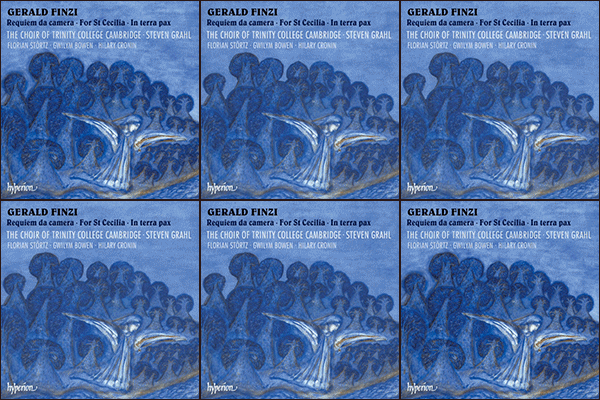


Three major works by Gerald Finzi—ones which have yet to achieve the recognition they deserve—are here presented in more accessible versions, the organ deftly replacing the original orchestration. This choir’s previous all-Finzi album was praised by Gramophone as ‘a beautifully crafted disc … Trinity at their absolute best’.

For St Cecilia is a work of Finzi’s maturity, commissioned by the St Cecilia’s Festival Committee for a Royal Albert Hall performance on St Cecilia’s Day 1947. Finzi was obliged to accept a text which he had been unable to choose for himself. Happily, the poet Edmund Blunden was one whom he had long admired. An important friendship developed, probably enhanced by the fact that Blunden had written a book on Hardy. Blunden had also seen active service in the First World War and had been awarded the Military Cross for conspicuous gallantry under fire. The mental scars which he bore for the rest of his life doubtless resonated with Finzi’s fervent pacifism.
Blunden’s St Cecilia’s Day text did not immediately appeal to Finzi, and its final version was the product of extensive negotiation between the two. Banfield tells us of a letter to Finzi’s friend and fellow composer, Cedric Thorpe Davie, in which Finzi stated that ‘the more I got to know it [Blunden’s poem] the more I grew to love it, though I was very dubious at a first reading’. An obvious compositional model for Finzi’s Blunden setting was Sir Hubert Parry’s Blest pair of sirens, commissioned by the Bach Choir to mark Queen Victoria’s Jubilee in 1887. Parry had set Milton’s Ode At a Solemn Music with notable success, and the manner of his doing so demonstrated the potential for an imaginative modern response to seventeenth-century poetic language. Blunden’s poem was to be heard alongside St Cecilia texts by Dryden and Pope. His approach loosely emulated these, but that brought its own problems: Banfield notes ‘a dearth of short, exclamatory phrases … such as would enable a composer to build with small, variegated textual blocks rather than have to break down larger, homogeneous ones’. It was perhaps for this reason that Finzi’s letter to Thorpe Davie cautioned him, ‘Don’t pass the poem over as a piece of 18th-century artifice’.
Banfield’s judicious view offers one explanation why the passages of soaring counterpoint conjured by Parry in response to Milton are absent from Finzi’s score; but another is that Finzi was not an innate contrapuntist. Rather, he was one who—if at all—deployed counterpoint less for rigorously architectural than for lyrically episodic purposes. The dramatic impact of For St Cecilia resides therefore in forceful homophony and long-breathed secondary melodic lines; not in motivic development. Scored originally for chorus with full orchestra, it is heard on this recording with the orchestral contribution transcribed for organ by Robert Gower. The work opens with a stately organ solo whose first bar is taken up by the chorus, recurring as a unifying device in subsequent instrumental interludes. The march-like, quasi-processional harmonic bass is carried almost entirely by the organ, leaving the choral bass line free to combine in other ways with the voices above it. The music subsides and halts before the first entry of the tenor soloist, who interacts first with the choral basses, then successively with altos and sopranos. Finzi’s habitual approach to word-setting holds sway, espousing the one-note-per-syllable principle predominating also in the French mélodie tradition of Chausson, Duparc, Fauré and others. The advantage of this lies in its partial preservation of speech rhythms (and, in purely practical terms, in enabling a commissioned composer to work through a lengthy text within a prescribed time limit). It also reserves ‘melismas’ (expressive extensions of a single vowel over several notes) for special moments of heightened intensity. An arguable drawback is that it rules out an important means of building gradually towards climactic points; and the listener to For St Cecilia may feel that the music is seldom far from another abrupt escalation towards boiling point. ‘The last verse must build up’, Finzi insisted in a letter to Blunden, but the work as a whole is replete with climaxes; and, in making this demand, the composer cannot be said to have made life easier for himself. In the event, however, the music becomes introspectively reverential for the name-call of past composers (track 4), escalating again only late in the work. The lengthy tenor solo passage ‘How smilingly the saint among her friends / Sits’ seems to retreat into the world of Finzi’s songs, breathing a more wistful air that serves as a touching counterpoise to the ebullience of earlier tutti passages. With the eventual peroration, the music’s opening motif is reintroduced, effectively book-ending the work and providing an emphatic conclusion.
In 1922 Finzi’s widowed mother had moved to a house outside the small town of Painswick, in the middle of Gloucestershire. Two years earlier, she and he had enjoyed a holiday at Churchdown, a few miles north of Painswick. The local landmark of Chosen Hill afforded views over the Severn Vale, the Cotswolds and the Malvern Hills. The area was a lure for poets and composers, including Ivor Gurney and Herbert Howells, the latter of whom had dedicated his 1916 Piano Quartet ‘To the Hill at Chosen and Ivor Gurney who knows it’.
As 1925 drew to a close, Finzi walked up to the church on the top of Chosen, where bellringers were seeing in the New Year. An idyllic period in his life was about to end in a move to London, whose environment he disliked. Ever the outsider looking inward, he was to remember and store up this moment of solitude and valediction beneath the stars, returning to it in 1951 as he contemplated a new Christmas work for chorus and orchestra. His choral output by now included the Seven poems of Robert Bridges, published separately between 1931 and 1937 but grouped together as the composer’s Opus 17 (see Hyperion CDA68222). In 1951 he turned to Bridges again; specifically, to his poem Noel: Christmas Eve, 1913. Its superscription ‘Pax hominibus bonae voluntatis’ suggested Finzi’s title of In terra pax; while, as a poet of the first person singular, Bridges presented ideal material, the identity of the autobiographical ‘I’ in the Noel poem being appropriated by the composer in his musical response, rooted in his own memories of New Year 1925/6. Finzi omitted Bridges’ central verse, which drew back from reminiscence on Chosen Hill to ruminate more widely upon ‘… the tow’rs / that crown England so fair / That stand up strong in prayer / unto God for our souls’. In its place he added St Luke’s account of the angels’ appearance to the Bethlehem shepherds, allowing the English translation of the score’s Latin inscription to recur retrospectively at the end.
In terra pax bears the subtitle ‘Christmas Scene’. ‘Then sped my thoughts to keep / that first Christmas of all’, wrote Bridges, and Finzi acknowledges those words in recurrent references to the carol melody of The First Noel. This is first heard in the opening bars, along with a descending figure which both evokes the repetitive clamour of the church bells and presents an anticipatory wordless setting of ‘Glory to God in the highest’. In other works Finzi had cultivated the use of ‘head motifs’—whereby themes which evolved as variants of one another began with a recognizable note pattern common to all of them. Responding to the narrative thread of In terra pax, he modified this approach by absorbing crucial motifs into passages of seamless continuity. There are frequent but unobtrusive adjustments of time signature, so that the listener remains aware only of a natural, contemplative unfolding; but this is offset by occasional modulations of key which serve to delineate punctuating points within Finzi’s chosen texts. The image of ‘the bright stars singing’ calls forth a rare, and therefore striking, instance of an extended melisma in Finzi’s writing, the endless song being evoked by three whole bars of music on the syllable ‘sing’.
The first dramatic intervention occurs with the apparition of ‘the angel of the Lord’, narrated by the chorus. The composer’s attentiveness to minutiae of word-setting shows in his use of the same distinctive chord (the second time, in transposed form) to mirror the assonance of ‘and the glory of the Lord …’ and ‘… they were sore afraid’. The apex of the work arrives with the ‘multitude of the heavenly host’, their paean of praise to God bringing verbal form to the refrain of the church bells heard in the opening bars. In due course the reiterated word ‘peace’ causes the music to ebb again, and a lengthy interlude serves to distance the solitary listener on Chosen Hill. The chorus has the last word, however, and the music dies away with a final, incomplete reference to the two motifs with which it began.
Finzi began planning In terra pax shortly before he became ill with the Hodgkin’s Disease that was to claim his life five years later. The score in its earlier incarnation, with chamber forces, was first heard as a BBC broadcast in February 1955. In 1956 Finzi rescored the music for full orchestra, working on it even when confined to hospital. He conducted the new version that summer, at the Three Choirs Festival in Gloucester. As with For St Cecilia, the work is heard here with the orchestral material arranged for organ by Robert Gower.
The much earlier Requiem da camera underwent a somewhat haphazard evolution, and only the opening Prelude was performed during Finzi’s lifetime, in 1925. In 1923 Finzi had written a song setting of Hardy’s poem ‘Only a man harrowing clods’ (entitled by the poet In time of ‘The breaking of nations’—a phrase taken from the prophet Jeremiah). In 1924 this song had become the (solo) third movement of a secular Requiem scored for baritone, chorus (or solo voices) and small orchestra. It was placed after a choral setting of selected verses (1-8 and 10) from John Masefield’s August, 1914, the whole of which runs to nineteen rhyming quatrains. In the late 1920s Finzi decided to dispense with the Hardy poem; but in the early 1930s he changed his mind, to the extent that he substantially recomposed his setting, in the process altering its key from D minor to B flat minor. He then inserted this new version back into the Requiem, which already ended with another choral setting, this time of Wilfrid Wilson Gibson’s Lament, from his collection Whin (1918).
Finzi made only a rough draft of his revised Hardy setting, the orchestration of which was left unfinished. In 1984 Philip Thomas made a completion, and the Requiem da camera was performed in his edition on 7 June 1990. In 2013 Christian Alexander made a new complete edition, working directly from Finzi’s manuscripts without reference to Thomas. In his editorial preface Alexander wrote that ‘the first twenty bars of the third movement were completed by Finzi in full score, …[but] far more editorial input was required from bar 21 to the end of the third movement [bar 58] in order to bring the music to a completed form …Enough information exists in Finzi’s unfinished score (particularly when viewed alongside his more precise piano reduction) to provide strong clues as to the composer’s intentions’. Alexander’s edition for Boosey & Hawkes was used by the baritone soloist and chorus for the present recording, alongside an earlier organ transcription of the orchestral material by the late Francis Jackson.
The choral movements of the Requiem da camera deploy significantly more free counterpoint than the later works featured in this recording, with Finzi’s sometimes gently dissonant instrumental bass lines occasionally desisting from their characteristic processional tread to engage in loosely imitative interaction with the vocal lines. Philip Thomas sounded a critical note in accusing the whole work of ‘one-paced, elegiac sweetness’; but this music by a young composer at a formative stage in his development remains faithful to its poetic texts. In Finzi’s hands the Masefield stanzas evoke a countryside depopulated, ominously still in anticipation of human loss on an unimaginable scale; just as, in his Pastoral Symphony (No 3, 1922), Ralph Vaughan Williams conjured not a portrait of rural England, but music emanating from a landscape bereft, calling out for its lost generation. The lonely figure on Chosen Hill in the dying moments of 1925 may well have had this in mind, just as one assumes that Finzi also thought then of his brother Edgar and his teacher, Ernest Farrar, who had departed for France never to return. In his book, citing the final words of the Bridges poem, Banfield memorably refers to ‘the great, agnostic gulf of “th’ eternal silence”’. We return, perhaps, to the image of the outsider gazing inward, and to a composer who may always have sensed that his time on earth was to be short.
Francis Pott © 2026