Welcome to Hyperion Records, a British classical label devoted to presenting high-quality recordings of music of all styles and from all periods from the twelfth century to the twenty-first.
Hyperion offers both CDs, and downloads in a number of formats. The site is also available in several languages.
Please use the dropdown buttons to set your preferred options, or use the checkbox to accept the defaults.
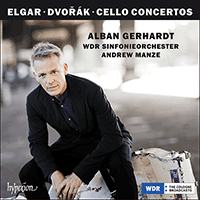


Alban Gerhardt has been performing Elgar’s iconic cello concerto for over thirty years, but this is the first time he has committed his interpretation to record. And quite an interpretation it is, discarding inherited conventions and returning to the detailed instructions left by the composer in the score. The results both here and in Dvořák’s B minor concerto (composed some 15 years earlier) are revelatory.

In 1891 Dvořák had been invited to become Director of the National Conservatory of Music in New York. He arrived in America for the start of the new academic year in September 1892 and stayed until April 1895. Between January and May 1893 he composed his Symphony No 9 in E minor, ‘From the New World’. That summer, Dvořák and his family spent a holiday in the village of Spillville, Iowa, where there was an enclave of Czech emigrant families. Here he composed his String Quartet No 12 in F major, the ‘American’, its pentatonic (‘black note’) melodies, straightforward textures and artless expressive candour marking it out as an extension of the inspiration that had driven his ninth symphony. Back in New York, the triumphant premiere of what became universally known as the ‘New World Symphony’ took place at Carnegie Hall in December 1893. Between November 1894 and February 1895, during the last year of his stay in America, Dvořák completed his B minor cello concerto. The work was written swiftly and appears to have been largely unpremeditated. There has been speculation that Dvořák may have been influenced by hearing a concerto by Victor Herbert, Irish-American principal cellist of the New York Philharmonic Orchestra: presumably the 1894 premiere of his Concerto No 2 , Op 30; but the soloist in Herbert’s relatively compact piece enters almost immediately, whereas in Dvořák’s the grand scale of the enterprise becomes exponentially apparent in a lengthy orchestral exposition which is then reprised by the accompanied soloist. Dvořák’s first-hand insight into string writing probably meant that he had little to learn from Herbert in that regard; but judicious balancing of a solo cello part against a full orchestra presents a different order of challenge. The passage of thirteen years since Dvořák’s violin concerto may owe something to a letter from the violin virtuoso Joseph Joachim in August 1882. This tactfully praised that work’s many felicities, before commenting: ‘… I still do not think the violin concerto … ready for public presentation, particularly on account of the orchestral part, which is rather heavily scored.’ By the time of the cello concerto Dvořák seems to have heeded Joachim’s wisdom; for the economy of its instrumentation is notably successful in not obscuring the solo part, and it may have been partly to this that Brahms referred in his approving comment, above.
The concerto’s first movement begins in a subdued fashion comparable with the opening of Tchaikovsky’s fifth symphony. Its succinctly memorable and recognizable opening motif permeates the movement as a whole, recurring either in purely rhythmic form or with its melodic contours intact; its first three notes also appear within the lyrical, major-key secondary subject, having already achieved more heroic guise within the work’s opening passage. A pendant to this theme occurs in the form of a more martial, but short-lived, interruption by the full orchestra. This subsides to make way for the soloist’s first entry, leading to a solo-dominated reprise of the exposition thus far, but with modified transitional material between the principal themes. A discursive central development includes tutti restatement of the movement’s opening bars, but with altered harmonic and tonal underpinnings, and also a plangent solo statement of the same theme in the key of A flat minor, its note values doubled to lend it some of the character of the lyrical secondary subject. The principal themes are recapitulated in reverse order, interspersed with pyrotechnics from the soloist and leading to a concluding affirmation of the tonic major key.
The G major slow movement begins with an idyllic, though wistful, clarinet melody which is soon taken up by the cello soloist. The music leans generally towards a chamber-like intimacy, but is interrupted after some forty bars by a fortissimo outcry, as brief as it is sudden. During the mid-1860s Dvořák had been in love with his pupil, Josefina Kaunitzová. He had retained a special bond with her, despite marrying her younger sister, Anna, eight years after Josefina’s rejection of his matrimonial proposal. He was therefore greatly distressed by news of his sister-in-law’s worsening heart condition, which reached him in America in November 1894, while he was beginning work on the concerto. Dvořák’s song Leave me alone with my dreams, Op 82 No 1, had long been an especial favourite of Josefina, and accordingly he made references to its melody in the concerto’s adagio, although the concerto movement was in triple time and the song in quadruple. Shortly after Dvořák’s return to his homeland, Josefina died, and the composer’s grief was expressed by his adding a new passage towards the end of the concerto’s rondo third movement. This, too, evoked the song, its time signature rendering the quotation more direct. The valedictory closing stages of the work also make reference back to its very opening, and musical ‘anagrams’ of that motif are a continual, if discreet, presence throughout the finale. The last movement’s succinctly energetic conclusion does not dispel a vein of melancholic introspection that permeates the entire composition.
Elgar is known to have commented approvingly on Dvořák’s cello concerto; in particular, on the deceptive economy of its orchestration. However, direct influence is apparent less in Elgar’s Cello Concerto in E minor, Op 85 (1919), than in his violin concerto (1910), which shares Dvořák’s chosen key of B minor and is on an even grander scale. Between Elgar’s two concertos fell the grim shadow of the First World War, with its apocalyptic loss of life and its sweeping away of the old order. A generation younger than Elgar, the composer Frank Bridge transformed his musical language to express harsh new realities—and, in doing so, alienated himself from an audience unready to confront them. Elgar never recovered from the loss of his wife in April 1920, when the appetite for major compositional undertakings seems largely to have ebbed away. In posterity, his cello concerto of the preceding year has taken on the valedictory air of making an end to a life’s work, but this seems misleading. Elgar was profoundly troubled in spirit by the Great War and its aftermath, but the signals and messages emanating from the concerto are complex and, as ever with this composer, elusive. Many of the composer’s friendships had arisen professionally, and were with German citizens, including Richard Strauss, whom he had known since 1897. The War had opened a chasm between the respective sides of these relationships, leaving Elgar conflicted in his national and personal loyalties and making him feel cut off from a compositional heritage that was largely Teutonic in origin. Grief and depression over the loss of life were understandable and widely shared, but Elgar’s contemporaneous letters reveal additional anxiety over the future of music in general, and a questioning of any purpose underlying his own. These circumstances laid the ground for a concerto that seems to have puzzled the audience at its (admittedly under-rehearsed) first performance in October 1919, and that continues to invite definition largely in terms of what it is not. For one thing, it is little over half the length of the violin concerto. For another, its form is unconventional and its few moments of joie de vivre or heroic elevation are transient, perhaps illusory.
In marked contrast with Dvořák’s cello concerto and its lengthy exposition, Elgar’s soloist enters at the very beginning; but the initial mood of noble aspiration is almost immediately subdued by an answering phrase of introverted melancholy. This leads into a wan, ashen unaccompanied melody for the orchestral violas alone, soon passed to the cellos. The movement as a whole barely deviates from the home key of E minor or—in the central stages—from its major equivalent. The feeling of an introductory prelude is reinforced when the music subsides onto a low monotone and leads directly into the second movement. This begins with a reference to the concerto’s opening, before launching into what feels like a hectic scherzo. However, the music almost instantly proves reluctant or unable to settle purposefully to anything, desisting in a brief solo cadenza. The subsequent restarting of the rapid music therefore feels untrustworthy, and a more skittish secondary idea, arranged as a respective call and response for soloist and then orchestra, rings hollow. This movement confounds any expectation that its predecessor might have served to introduce a weightier, more substantial statement, and this primes the listener’s receptivity to what follows. In the event, though, the third movement recedes to the remote key of B flat major, replacing skittering, quicksilver agility with a stilled introspection bordering on numbness. Covering under fifty bars and a mere four pages in full score, this sorrowing adagio all but banishes any sense of meter or rhythmic continuity. Scored for a reduced complement of clarinets, bassoons, two of the four horns and strings, the music gives full rein to the solo cello’s capacity for singing inwardness.
The adagio leads cadentially straight into the finale, in effect dividing the concerto into two pairs of movements. Beginning transitionally in the remote key of B flat minor, the finale initially proceeds with much the same type of rhythmic momentum as the celebrated first of the Pomp and Circumstance marches (1901); but any expectation of a triumphally noble secondary theme to match what became known as ‘Land of hope and glory’ is confounded. Once again there is a false start, with the music stopped in its tracks by an appassionato solo cadenza which seems already to threaten a lapse back into melancholy introspection and solitude. The ensuing, ostensibly jaunty allegro ma non troppo unfolds at some length, but its activity feels like that of a man trying to stay busy in order to keep his inner shadows at bay. Their eventual return comes with a sense of inevitability. The laden chromaticism of the slow music that follows seems to inhabit the same world as the Prelude to Act One of Wagner’s Tristan, possibly in conscious acknowledgement of an artistic world previously animated by friendships across the divide of nations. The lamenting heart of the concerto arrives with an ineffably poignant thematic regression to the tranced tenderness of the third movement. Full circle is achieved in a recurrence of the work’s opening, before the terse concluding allegro molto is deliberately outweighed and outlasted by a grief that rises again whenever distraction abates.
In the eloquent words of Elgar’s biographer, the late Michael Kennedy: ‘It is sometimes said that this concerto is Elgar’s war requiem[,] but … he was an egocentric artist, and the requiem here is not so much for the dead in Flanders fields as for the destruction of a way of life … Here … is the elegy for an age.’
Francis Pott © 2026
En 1891, Dvořák avait été invité à devenir directeur du Conservatoire national de musique de New York. Il arriva en Amérique pour le début de la nouvelle année académique, en septembre 1892, et y resta jusqu’en avril 1895. Entre janvier et mai 1893, il composa sa symphonie nº 9 en mi mineur, «du Nouveau Monde». Cet été là, Dvořák et sa famille passèrent des vacances dans le village de Spillville, dans l’Iowa, où il y avait une enclave de familles d’émigrés tchèques. Il y composa son quatuor à cordes nº 12 en fa majeur, «Américain», dont les mélodies pentatoniques («note noire»), les textures simples et la sincérité expressive naturelle le situent dans le prolongement de l’inspiration qui avait motivé sa neuvième symphonie. De retour à New York, la première exécution triomphale de ce qui allait devenir dans le monde entier la «Symphonie du Nouveau Monde» eut lieu à Carnegie Hall en décembre 1893. Entre novembre 1894 et février 1895, au cours de la dernière année de son séjour en Amérique, Dvořák acheva son concerto pour violoncelle en si mineur. Cette œuvre fut écrite rapidement et ne semble pas avoir été beaucoup préméditée. Certaines spéculations ont laissé supposer que Dvořák avait pu être influencé par l’écoute d’un concerto de Victor Herbert, un Américain d’origine irlandaise, violoncelle solo de l’Orchestre philharmonique de New York: sans doute la création en 1894 de son concerto nº 2, op.30; mais dans la pièce relativement compacte de Herbert, le soliste entre presque d’emblée, alors que dans celui de Dvořák l’ampleur du projet prend corps de manière exponentielle au fil d’une assez longue exposition orchestrale, reprise ensuite par le soliste avec accompagnement. L’intuition naturelle de Dvořák en matière d’écriture pour cordes impliquait à l’évidence qu’il n’avait pas grand-chose à apprendre de Herbert à cet égard; mais l’équilibre judicieux d’une partie de violoncelle solo face à un grand orchestre constitue une autre sorte de défi. Le chemin parcouru pendant les trente ans qui le sépare du concerto pour violon de Dvořák doit peut-être quelque chose à une lettre du virtuose du violon Joseph Joachim d’août 1882. Celle-ci faisait avec diplomatie l’éloge des nombreuses qualités de cette œuvre, avant de faire remarquer: «… Je ne pense toujours pas que le concerto pour violon soit prêt à être présenté au public, en particulier à cause de la partie d’orchestre qui est assez lourdement instrumentée.» À l’époque du concerto pour violoncelle, Dvořák semble avoir tenu compte de la sagesse de Joachim; car l’économie de son instrumentation est remarquablement réussie, sans obscurcir la partie soliste, et c’est peut-être un peu à ceci que Brahms faisait référence dans son commentaire approbateur, mentionné ci-dessus.
Le premier mouvement du concerto commence d’une manière contenue qui ressemble au début de la symphonie nº 5 de Tchaïkovski. Son motif initial succinctement mémorable et reconnaissable imprègne l’ensemble du mouvement, réapparaissant soit sous une forme purement rythmique soit avec ses contours mélodiques intacts; ses trois premières notes apparaissent aussi au sein du second sujet lyrique en tonalité majeure, ayant déjà pris un aspect plus héroïque dans le passage initial de l’œuvre. Un pendant à ce thème se présente sous la forme d’une interruption plus martiale, mais de courte durée, par tout l’orchestre, qui s’apaise pour ouvrir la voie à la première entrée du soliste, menant à une reprise de l’exposition dominée par ce dernier pour l’instant, mais avec un matériel de transition modifié entre les principaux thèmes. Un développement central discursif comprend une réexposition tutti des premières mesures du mouvement, mais sur des bases harmoniques et tonales modifiées et aussi une exposition plaintive du même thème par le soliste dans la tonalité de la bémol mineur, avec des valeurs de notes doublées pour lui prêter quelque chose du caractère du second sujet lyrique. Les principaux thèmes sont réexposés en ordre inverse, parsemés de feux d’artifice du soliste et menant à une affirmation finale de la tonalité à la tonique majeure.
Le mouvement lent en sol majeur commence par une mélodie idyllique mais mélancolique de la clarinette, bientôt reprise par le violoncelle solo. La musique penche généralement vers une intimité de musique de chambre, mais est interrompue après une quarantaine de mesures par un tollé fortissimo, aussi bref que soudain. Au milieu des années 1860, Dvořák avait été amoureux de son élève, Josefina Kaunitzová. Il avait conservé des liens étroits avec elle, bien qu’il ait épousé sa sœur cadette, Anna, huit ans après que Josefina ait rejeté sa proposition de mariage. Il fut donc très bouleversé en apprenant l’aggravation des problèmes cardiaques de sa belle-sœur, nouvelle qui lui parvint en Amérique en novembre 1894, lorsqu’il commençait à travailler à son concerto. La mélodie de Dvořák Laisse moi seul avec mes rêves, op.82 nº 1, avait longtemps été l’une des préférées de Josefina et il fit donc référence à sa mélodie dans l’adagio du concerto, même si le mouvement du concerto était écrit à trois temps et la mélodie à quatre temps. Peu après le retour de Dvořák dans son pays natal, Josefina mourut et le compositeur exprima son chagrin en ajoutant un nouveau passage à la fin du rondo, troisième mouvement du concerto. Celui-ci évoquait aussi la mélodie, le chiffrage de la clef rendant la citation plus directe. Les derniers stades d’adieu de l’œuvre font aussi référence à son tout début et les «anagrammes» musicaux de ce motif sont une présence continue, voire discrète, tout au long du finale. La conclusion du dernier mouvement, d’une énergie succincte, ne dissipe pas la veine d’introspection mélancolique qui imprègne toute la composition.
On sait qu’Elgar porta un jugement positif sur le concerto pour violoncelle de Dvořák; en particulier, sur l’apparente économie de moyens de son orchestration. Toutefois, il y a une influence directe moins perceptible dans le Concerto pour violoncelle en mi mineur, op.85 (1919) d’Elgar, que dans son concerto pour violon (1910), qui partage la tonalité de si mineur choisie par Dvořák et est écrit à une plus vaste échelle encore. Entre les deux concertos d’Elgar tomba l’ombre lugubre de la Première Guerre mondiale, avec sa perte apocalyptique de vies humaines et la disparition de l’ordre ancien. Une génération après Elgar, le compositeur Frank Bridge transforma son langage musical pour exprimer de nouvelles et dures réalités—et, ce faisant, il perdit un auditoire qui n’était pas prêt à y faire face. Elgar ne se remit jamais de la perte de sa femme en avril 1920, qui correspond au grand déclin de son penchant pour la composition d’œuvres majeures. Pour la postérité, son concerto pour violoncelle, qui date de l’année précédente, a pris un air d’adieu: la fin de l’œuvre d’une vie, mais c’est trompeur. L’esprit d’Elgar fut profondément tourmenté par la Grande Guerre et ses conséquences, mais les signaux et messages émanant du concerto sont complexes et, comme toujours chez ce compositeur, insaisissables. Il entretenait beaucoup de liens amicaux professionnels avec des citoyens allemands, notamment Richard Strauss, qu’il connaissait depuis 1897. La guerre avait ouvert un abîme entre les côtés respectifs de ces relations, créant chez Elgar un conflit entre ses loyautés nationales et personnelles et lui donnant un sentiment de rupture avec un héritage en matière de composition d’origine largement germanique. Le chagrin et la dépression causés par la perte de vies humaines étaient compréhensibles et largement partagés, mais les lettres écrites par Elgar à cette époque révèlent davantage d’anxiété quant à l’avenir de la musique en général, et une remise en question de toute finalité sous-jacente à la sienne. Ces circonstances ouvrirent la voie à un concerto qui semble avoir déconcerté les auditeurs lors de sa première exécution (qui n’avait pas bénéficié de suffisamment de répétitions, il faut en convenir) en octobre 1919, et qui continue à faire l’objet de commentaires en grande partie en termes de ce qu’il n’est pas. D’une part, il dure à peine plus de la moitié du concerto pour violon. De l’autre, sa forme n’est pas conventionnelle et ses rares moments de joie de vivre ou d’élévation héroïque sont éphémères, peut-être illusoires.
En net contraste avec le concerto pour violoncelle de Dvořák et son assez longue exposition, le soliste d’Elgar entre au tout début; mais l’atmosphère initiale de noble aspiration est presque aussitôt contenue par une réponse d’une mélancolie introvertie. Cette phrase mène à une mélodie blême, couleur de cendre pour les altos de l’orchestre seuls, bientôt passée aux violoncelles. L’ensemble du mouvement s’écarte à peine de la tonalité d’origine de mi mineur ou—dans les phases centrales—de son équivalent majeur. L’impression de prélude préliminaire est renforcée lorsque la musique retombe dans un ton monotone grave et mène directement au deuxième mouvement. Celui-ci commence par une référence au début du concerto, avant de se lancer dans ce qui ressemble à un scherzo agité. Cependant, la musique rechigne presque d’emblée à s’installer résolument dans quoi que ce soit ou en est dans l’incapacité, interrompue par une courte cadence du soliste. Le redémarrage de la musique rapide qui suit semble donc peu fiable et une idée secondaire plus capricieuse sous forme de questions-réponses pour le soliste et ensuite l’orchestre, sonne faux. Ce mouvement déjoue toute attente selon laquelle son prédécesseur aurait pu servir à introduire une exposition plus lourde, plus importante, et prépare ainsi la réceptivité de l’auditeur à ce qui suit. Toutefois, en l’occurrence, le troisième mouvement s’écarte vers la tonalité éloignée de si bémol majeur, remplaçant l’agilité voltigeante et très vive par une introspection calme frisant la torpeur. Couvrant moins de cinquante mesures et juste quatre pages de la partition d’orchestre, cet adagio éploré bannit presque toute impression de mesure ou de continuité rythmique. Écrite pour un effectif réduit de clarinettes, bassons, deux des quatre cors et cordes, la musique donne libre cours à la capacité du violoncelle solo de chanter l’intériorité.
L’adagio mène directement au finale par une transition cadentielle, divisant de fait le concerto en deux paires de mouvements. Commençant de manière transitoire dans la tonalité éloignée de si bémol mineur, le finale procède au départ avec un peu le même genre d’élan rythmique que la célèbre première marche des Pomp and Circumstances (1901); mais on attend en vain un thème secondaire d’une noblesse triomphale correspondant à ce que l’on appelle «Land of hope and glory» («Terre d’espoir et de gloire»). Une fois encore, il y a un faux départ, avec la musique arrêtée nette par une cadence appassionato du soliste qui semble déjà menacer un retour dans l’introspection mélancolique et la solitude. L’allegro ma non troppo qui suit se déroule assez longuement, mais son activité ressemble à celle d’un homme essayant de garder son énergie pour tenir à distance ses ombres intérieures. Leur retour final survient comme quelque chose d’inévitable. Le chromatisme chargé de la musique lente qui suit semble issu du même univers que le Prélude de l’acte I de Tristan de Wagner, peut-être une reconnaissance consciente d’un monde artistique animé auparavant par des amitiés surmontant la division des nations. Le cœur pleurant du concerto arrive avec une poignante et ineffable régression thématique à la tendresse extatique du troisième mouvement. Avec une réapparition du début de l’œuvre, on réalise un tour complet avant le retour du sentiment de tristesse qui prend le pas sur le laconique allegro molto conclusif et renait chaque fois que la diversion s’atténue.
Selon les propos éloquents du biographe d’Elgar, le regretté Michael Kennedy: «On dit parfois que ce concerto est le requiem de guerre d’Elgar, mais … c’était un artiste égocentrique, et le requiem n’est pas tant pour les morts dans les Flandres que pour la destruction d’un mode de vie … Ici … est l’élégie d’une époque.»
Francis Pott © 2026
Français: Marie-Stella Pâris
1891 erging die Einladung an Dvořák, Direktor des National Conservatory of Music in New York zu werden. Er kam mit Beginn des akademischen Jahrs im September 1892 in Amerika an und blieb bis April 1895. Zwischen Januar und Mai 1893 komponierte er seine Sinfonie Nr 9 e-Moll „Aus der neuen Welt“. Den folgenden Sommer verbrachten Dvořák und seine Familie im Dorf Spillville in Iowa, wo es eine Enklave tschechischer Auswanderer gab. Dort schrieb er sein Streichquartett Nr. 12 F-Dur, das „Amerikanische“. Dessen pentatonische Melodien, klare Satzweisen und Geradlinigkeit im Ausdruck weisen es als Fortsetzung jenes Denkens aus, dem schon seine 9. Sinfonie entsprungen war. Nach Dvořáks Rückkehr nach New York folgte die triumphale Uraufführung der Sinfonie „Aus der neuen Welt“ im Dezember 1893 in der Carnegie Hall. Zwischen November 1894 und Februar 1895, im letzten Jahr in Amerika, vollendete Dvořák sein h-Moll-Cellokonzert. Komponiert wurde es offenbar rasch und ohne viele Vorüberlegungen. Es gibt die Annahme, dass Dvořák dabei durch ein Konzert von Victor Herbert beeinflusst gewesen sein könnte, des irisch-amerikanischen ersten Cellisten der New Yorker Philharmoniker; gemeint ist wohl die Premiere von dessen Cellokonzert Nr. 2 op. 30 1894. Doch während in Herberts eher kurzem Stück der Solist nahezu sofort einsetzt, wird in Dvořáks Konzert der große Maßstab des Werks sogleich deutlich durch die umfangreiche Orchesterexposition, die dann von Solist und Orchester gemeinsam wiederholt wird. Das Komponieren für Streicher war Dvořák wohlvertraut, da brauchte er keine Anregung durch Herbert; eine ganz andere Frage ist die nach der Balance zwischen dem Solocello und dem großen Orchester. Dass seit dem Violinkonzert 13 Jahre vergangen waren, mag auch an einem Brief des Geigenvirtuosen Joseph Joachim vom August 1882 gelegen haben. Der hatte geschrieben, dass er „das Violin-Concert in seiner jetzigen Gestalt noch nicht reif für die Öffentlichkeit halte, hauptsächlich der überaus orchestralen, dicken Begleitung wegen“. Beim Cellokonzert scheint Dvořák dem Rat Joachims gefolgt zu sein: Dank sparsamer Instrumentation wird die Solostimme nie verdeckt. Vielleicht war es auch dieser Umstand, der Brahms zu seiner eingangs zitierten Bemerkung veranlasste.
Der erste Satz des Konzerts beginnt in verhaltener Stimmung, ähnlich wie Tschaikowskys 5. Sinfonie. Sein einprägsames Kopfmotiv durchdringt den gesamten ersten Satz, sei es nur durch seinen Rhythmus oder auch in seiner melodischen Gestalt; die ersten drei Töne erscheinen auch im lyrischen, in Dur gehaltenen zweiten Thema, das schon zu Beginn des Werks heroischen Gestus entwickelt. Kontrastierend folgt ihm, wenn auch kurz, ein beinahe martialischer Einwurf des vollen Orchesters. Doch dann macht dieses dem Auftritt des Solisten Platz. Dessen Eingang leitet eine Wiederholung der bisherigen Exposition ein, dominiert vom Solo und mit neu gestalteten Übergängen zwischen den Hauptthemen. Die dialogisch gehaltene Durchführung beginnt mit einer Tuttiversion der Eröffnungstakte des Werks, allerdings harmonisch und tonartlich neu gefasst; sie enthält auch eine vom Solisten vorgetragene klagende Variante desselben Themas in as-Moll und doppelten Notenwerten, was es in die Nähe der Stimmung des zweiten Themas rückt. Die Reprise bringt die Hauptthemen in umgekehrter Reihenfolge, unterbrochen von virtuosen Passagen des Solisten, und leitet über zum bekräftigenden Schluss in H-Dur.
Der langsame Satz in G-Dur beginnt mit einer idyllischen, zugleich schwermütigen Melodie der Klarinette, die das Solocello bald aufgreift. Neigt die Musik zunächst zu geradezu kammermusikalischer Intimität, so wird sie nach 40 Takten unterbrochen von einem unvermittelten, kurzen Tutti-Aufbäumen. Mitte der 1860er-Jahre hatte sich Dvořák in seine Schülern Josefina Kaunitzová verliebt. Auch nachdem sie seinen Heiratsantrag zurückgewiesen und er acht Jahre später ihre jüngere Schwester Anna geheiratet hatte, bewahrte er ihr besondere Zuneigung. Deswegen war er tief betroffen, als ihn im November 1894 die Nachricht erreichte, dass sich die Herzkrankheit seiner Schwägerin verschlimmert hatte. Sein Lied Lasst mich allein in meinen Träumen gehen op. 82 Nr. 1 gehörte zu Josefinas Lieblingsstücken, und in der Melodie des Adagios spielt er darauf an, obgleich diese im Dreiertakt geschrieben ist, das Lied im Vierertakt. Kurz nach Dvořáks Rückkehr in seine Heimat starb Josefina. Der Komponist gab seiner Trauer dadurch Ausdruck, dass er dem Schluss des dritten Rondosatzes eine Passage anfügte. Auch diese erinnert an das Lied, hier direkter dank der geraden Taktart. Die gleichsam Abschied nehmenden Schlusstakte des Werks beziehen sich ganz zurück auf dessen Anfang; musikalische „Anagramme“ dieses Motivs finden sich, wenn auch diskret, über den gesamten Finalsatz hinweg. Auch der kraftvolle Schluss des letzten Satzes vermag nicht den Zug melancholischer Innerlichkeit zu vertreiben, der sich durch die gesamte Komposition zieht.
Wir wissen, dass Elgar lobend über Dvořáks Cellokonzert sprach, besonders über die sparsame Instrumentation, die doch Klangfülle vortäuscht. Direkter Einfluss ist allerdings weniger in Elgars Cellokonzert e-Moll op. 85 (1919) zu spüren als in seinem Violinkonzert (1910). Es steht, wie Dvořáks Konzert, in h-Moll und ist noch größer angelegt. Zwischen die beiden Konzerte Elgars fällt der Schatten des 1. Weltkriegs mit seinen katastrophalen Verlusten, der die alte Ordnung hinwegfegte. Der Komponist Frank Bridge, eine Generation jünger als Elgar, fand eine neue Tonsprache, um die neue, härtere Wirklichkeit auszudrücken—er traf auf das Unverständnis eines Publikums, das noch nicht bereit war, sich ihr zu stellen. Elgar sollte sich nie vom Tod seiner Frau 1920 erholen; sein Drang zu großen Werken schien so gut wie abgestorben zu sein. Im Nachhinein wirkt sein Cellokonzert aus dem Jahr zuvor wie der Schlussstein zu einem Lebenswerk, doch hier mag der Anschein trügen. Der „Great War“ und seine Nachwirkungen hatten Elgar zutiefst erschüttert; aus seinem Cellokonzert klingen jedoch Botschaften heraus, die komplexer und—wie stets bei Elgar—schwer greifbar sind. Viele Freundschaften hatte der Komponist mit Kollegen geschlossen, auch mit Deutschen wie Richard Strauss, den er seit 1897 kannte. Der Krieg hatte nun eine Kluft dazwischen aufgerissen, und Elgar war hin- und hergerissen zwischen der Treue zu seinem Land und der zu seinen Freunden; er fühlte sich wie abgeschnitten von einer kompositorischen Tradition, die in der deutschen Kultur wurzelte. So verständlich und verbreitet die Niedergeschlagenheit über die Verluste an Menschenleben waren: Aus Elgars Briefen klingt Sorge um die Zukunft der Musik im Allgemeinen heraus—und Ratlosigkeit über die eigene. Diese Umstände liegen einem Konzert zugrunde, das bei seiner—freilich schlecht vorbereiteten—Uraufführung im Oktober 1919 sein Publikum verwundert zurückließ. Bis heute wird es gern durch all das beschrieben, was es nicht ist. Es ist kaum mehr als halb so lang wie das Violinkonzert; seine Form ist unkonventionell, und die wenigen Ausbrüche von Lebensfreude oder Heldenmut gehen rasch und fast wie ein Spuk vorüber.
Ganz anders als in Dvořáks Cellokonzert mit seiner ausführlichen Exposition setzt bei Elgar der Solist ganz zu Anfang ein; die eingangs noble Haltung trübt sich fast sofort ein durch eine Phrase in sich gekehrter Melancholie. Sie leitet über zu einer fahlen, unbegleiteten Melodie der Bratschen, die sie an die Celli weiterreichen. Insgesamt verlässt der Satz kaum einmal die Grundtonart e-Moll oder—in seinem Mittelteil—E-Dur. Der Charakter eines bloßen Vorspiels verstärkt sich, wenn die Musik auf einem Einzelton zum Stehen kommt und direkt in den zweiten Satz übergeht. Er beginnt mit einem Rückgriff auf den Anfang des Konzerts und stürzt sich dann in so etwas wie ein hektisches Scherzo. Doch stellt sich rasch heraus, dass die Musik sich auf nichts Bestimmtes festlegen will oder kann; kurz weicht sie in eine Solokadenz aus. Wenig verlässlich erscheint das erneute Aufkommen des raschen Tempos; auch ein sprunghafter Nebengedanke, ausgebreitet im Dialog zwischen Solist und Orchester, wirkt trügerisch. Dieser Satz zerstreut jegliche Hoffnung, dass sein Vorgänger Einleitung zu einer gewichtigeren Aussage gewesen sein könnte; umso gespannter mag der Zuhörer auf das sein, was nun folgt. Der dritte Satz jedoch zieht sich zurück auf ein entlegenes B-Dur, und an die Stelle jagender, ruheloser Geschwindigkeit tritt eine tiefe Verinnerlichung, die an Erstarrung grenzt. Mit weniger als fünfzig Takten und gerade einmal vier Partiturseiten lässt dieses Adagio jeden Anschein von Taktschlag und Rhythmus fahren. Das Orchester ist reduziert auf Klarinetten, Fagotte, zwei der vier Hörner und die Streicher; die Musik überlässt sich ganz dem innigen Gesang des Cellos.
Das Adagio leitet mit einer Kadenz direkt ins Finale über; so entsteht der Eindruck, dass das Konzert aus zwei Satzpaaren besteht. Von seinem Anfang im entlegenen b-Moll ausgehend, schreitet der Satz zunächst mit jenem rhythmischen Schwung voran, der auch den berühmten ersten Marsch aus Pomp and Circumstance (1901) kennzeichnet; doch die Erwartung eines edlen zweiten Themas wie jenes, aus dem „Land of hope and glory“ werden sollte, wird enttäuscht. Erneut ereignet sich ein trügerischer Aufbruch, doch die Musik kommt bald zum Stehen in einer appassionato-Solokadenz, die abermals droht, sich einsam nach innen zu kehren. Es schließt sich ein demonstrativ fröhliches Allegro ma non troppo an, das auch eine Weile lang durchhält—wobei es eher an jemanden erinnert, der Geschäftigkeit sucht, um seine innere Dunkelheit in Schach zu halten. Wenn sie dann wiederkehrt, wirkt das unausweichlich. Die lastende Chromatik der nun folgenden langsamen Musik scheint derselben Sphäre anzugehören wie Wagners Tristan-Vorspiel—vielleicht der bewusste Verweis auf eine künstlerische Welt, in der Freundschaften über nationale Grenzen hinweg Raum hatten. Mit dem schmerzlichen Rückzug in die traumverlorene Zartheit des dritten Satzes offenbart sich das klagende Herz des Konzerts. Der Kreis schließt sich, wenn der Beginn des Werks wiederkehrt. Selbst das straffe Allegro molto, welches das Konzert beschließt, vermag nicht den Eindruck von Trauer zu vertreiben, der noch jedes Ablenkungsmanöver überdauert.
Elgars verstorbener Biograf Michael Kennedy fand dazu die Worte: „Es heißt manchmal, dieses Konzert sei Elgars ‘War Requiem’. Doch war er … ein egozentrischer Künstler, und dieses Requiem gilt weniger den in Flandern Gefallenen als der Vernichtung einer Lebenswelt … Es ist … der Abgesang auf ein Zeitalter.“
Francis Pott © 2026
Deutsch: Friedrich Sprondel
While I have always admired both artists for their intensity and individuality, I found myself questioning certain interpretative choices from early on. When I began performing these works some 35 years ago, I felt a growing need to look beyond inherited conventions and return to the sources: the scores themselves.
Both Antonín Dvořák and Edward Elgar left us remarkably detailed musical texts, full of character, precision and expressive clarity. Trusting these instructions—rather than later traditions—became the foundation of my approach. This often leads to tempi and proportions that differ noticeably from what has become customary, but for me they feel not only closer to the composers’ intentions, but also more alive.
There is a widely held belief that the slower one plays, the more profound the result must be. I have never been entirely convinced. It is not always clear at what point additional time necessarily deepens the musical argument. In my experience, music can lose as much as it gains when it lingers too long; it may become heavier, but not necessarily more intense. Quite the opposite: when the music follows its natural pulse, it can gain urgency, direction and, above all, passion.
For this recording, I have tried to follow that instinct consistently. The resulting durations may come as a surprise, yet they are not the result of seeking novelty, but of trusting what is written and allowing the music to breathe and move.
Gustav Mahler’s own practice offers a telling perspective: during his performances of the Fifth Symphony, the famous Adagietto became noticeably more flowing over time, gaining clarity and direction rather than losing depth. As he put it: ‘Tradition must not be the adoration of ashes but the preservation of fire.’ For me, that ‘fire’ lies not in recreating iconic recordings, but in rediscovering the immediacy, clarity and emotional directness of the music as it stands on the page.
Alban Gerhardt © 2026