Welcome to Hyperion Records, a British classical label devoted to presenting high-quality recordings of music of all styles and from all periods from the twelfth century to the twenty-first.
Hyperion offers both CDs, and downloads in a number of formats. The site is also available in several languages.
Please use the dropdown buttons to set your preferred options, or use the checkbox to accept the defaults.
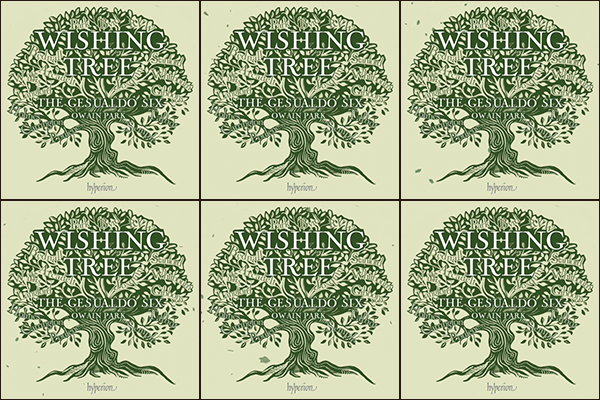

A bold new recording from The Gesualdo Six incorporating Poulenc, nursery rhymes, Italian madrigal and folksong pastiche. As ever, the listener throughout can expect to be captivated by the vocal skill and programming intuition of these popular performers.


Listen to how the composer portrays birds calling to one another, as if from branch to branch, with short, lively melismas, or how the ‘beasts do play’ through dancing syncopation. Of note, too, is the conventional praise of Elizabeth in the text, reflected here in a stretching of the harmonic pulse and a high tessitura for the upper voices, creating a sense of grandeur.
Bristol-based composer David Bednall chose a passage from the Gospel of St Luke to set for his commission from Opus Anglicanum, the five-voice British group notable for commissioning many new works. The story describes Jesus filling the doubtful fishermen’s nets, empty from the previous night’s efforts. Put out into the deep is carefully crafted, beginning with a chant-inspired melody which develops as the voices are gently revealed. Plainchant laces the work, even appearing as two Latin phrases while the English text is suspended—the characters taking a break from their work—with rippling scalic melodies. The harmonies reflect the influence of twentieth-century British composers such as Edward Bairstow and Herbert Howells.
The term ‘folk song’ was first coined in the mid-nineteenth century to describe songs that were widely known and sung for entertainment, pleasure, and communal sharing. Their origins were diverse: some came from professional or amateur songwriters, others from plays, song sheets, or printed collections, but the majority survived through oral tradition, passed from singer to singer across generations. Our first two settings explore English folk tradition, beginning with the poignant song Bushes and briars, arranged by Ralph Vaughan Williams. During this tale of love and longing, the speaker reflects on lost affection amid the beauty of the natural world. Vaughan Williams enhances the emotional resonance by shifting textures: from rich four-part harmony through to subtle duetting lines, allowing the story to be sometimes declaimed to a crowded room, and at others gently whispered in your ear. The music flows with the natural pulse of the countryside, its ebb and swell reflecting the cycles of life and memory.
The oak and the ash is a traditional English ballad dating back to the seventh century, believed to have first been printed on a broadside—an early form of newspaper. Its story follows a young girl who moves from the ‘North Country’ to London, expressing homesickness and longing for the familiar landscapes and rhythms of her earlier life. This arrangement by Gordon Langford has long been one of our favourites, particularly for how he allows the undulating melody to glide through a variety of vocal scorings. My personal highlight is at ‘No doubt, did I please, I could marry with ease’ as the uncertainty in the text is mirrored by a shift to a neighbouring key, followed by a clever escape manoeuvre to allow us to return home.
Then, we travel to Ireland with The lark in the clear air, here in an arrangement by James Whitbourn. This cherished folk song celebrates the beauty of the natural world. Whitbourn’s arrangement preserves the simplicity of the original melody, as it soars like a bird above the fields, looking down over gentle harmonies which paint a vivid musical portrait of a sunlit landscape.
At the end of the eighteenth century, Robert Burns brought My love is like a red, red rose to public attention, though not quite in the way he intended. In his final years, Burns worked extensively on traditional Scottish songs and requested that these words appear in a publication by his friend James Thomson. Before that could happen, another collaborator, Pietro Urbani, published them first, ending their friendship in the process. The now-popular tune, Low Down in the Broom, was paired with Burns’s text decades later, its arching melody allowing the soloist to convey a determined devotion as it continuously reaches upwards. The words have inspired settings by composers including Robert Schumann and Amy Beach, and the song also holds special personal significance for me: the ensemble sang it during the signing of the register at my wedding. The soloist was Michael Craddock, who sings it again here and appears on several tracks on this album, marking his final recording with the ensemble/group after singing with us since our first concert.
The wind’s warning by Alison Willis was the winning entry in the 21-and-over category of The Gesualdo Six’s second composition competition. Willis set The Wind, believed to be the final poem written by Ivor Gurney. According to the editor of the collection in which it appears, the poem was penned on the back of an Oxford University Press letterhead, dated 6 March 1929 and signed ‘Valentine Fane’—one of the many pseudonyms Gurney used in his later manuscripts. The text is a stark meditation on the flow of time and lost opportunities. Willis’s setting evokes the poem’s restless atmosphere through delicate vocalizations that suggest the wind itself, layered over dissonant clusters that shift and shimmer. Melodies drift in and out like fleeting gusts until the middle section, ‘At dawn a thin rain wept’, where the music opens into a more lyrical space. The work then gradually returns to the original wind-laden soundscape, closing as it began, with an almost imperceptible sigh. The piece is a miniature of tension and release, capturing both the fragility and the persistence of memory.
The wishing tree, from which this programme takes its name, was composed by Joby Talbot in 2002 and was first performed in that year by the BBC and King’s Singers. Talbot plays games with texture, splitting the text up syllable-by-syllable between voices, and using a rhythmic ostinato in an irregular time signature to virtuosic effect. The composer notes:
The feeling I would most readily associate with the Elizabethan madrigalists is a sense of perpetual yearning. Kathleen Jamie’s poem expresses just such a sense of longing but bypasses the Arcadian idyll to link people’s expectations and desires more directly to the natural world. My music is accordingly punchy and angular—a sense of desperation creeping in as words and syllables are bounced from one side of the ensemble to the other.
As with most long-surviving melodies passed down by ear, the origins of My bonny lies over the ocean are a mystery. Perhaps it was written about Charles Edward Stuart—erstwhile claimant to the thrones of England, Scotland, and Ireland—known as ‘Bonnie Prince Charlie’, following his defeat at the Battle of Culloden. Anna Semple bookends her arrangement with a dreamy aleatoric passage, which gives way to a series of duets in the middle of the work.
El grillo (‘The cricket’) is composed in the style of a frottola, a type of secular Italian song that flourished around the turn of the sixteenth century. Frottole favoured clear harmonies, catchy rhythms, and an immediacy that made them ideal for convivial, courtly entertainment, and El grillo is among the most charming examples of the genre. Its music alternates between long, sustained notes and bursts of quick, chattering syllables, delightfully mimicking the cricket’s incessant song. The piece is often linked to a certain Carlo Grillo, a singer at the Milanese court whose surname conveniently matches the insect and who was known for grumbling about his patron’s casual approach to paying wages. Its quirky style has led some scholars to question Josquin’s authorship, yet it remains an irresistibly vivid miniature: witty, bright, and brimming with personality.
The US-based composer Christen Taylor Holmes sets Emily Dickinson’s Summer shower for four voices, with each line bringing out elements of the text through sensitive and delicate writing. Holmes creates textures that often feel as if they are unfolding organically from the poetry itself. The result is a piece with the timeless quality of a folk song, where subtle harmonic colours illuminate Dickinson’s imagery.
Il bianco e dolce cigno by Jacques Arcadelt is one of the most celebrated madrigals of the Renaissance, epitomizing the elegance and emotional subtlety of Italian secular vocal music in the mid-sixteenth century. The poem evokes the swan’s fabled dying song, intertwining images of love and mortality in language that is at once tender and sensuous. Arcadelt mirrors this poetic ambiguity with music of gentle rise and fall: phrases glide and settle like the bird itself upon the water, while moments of harmonic warmth and suspension linger poignantly on words of sighing and release. Beneath the surface calm lies a knowing play of double meanings, typical of the madrigal tradition, in which death becomes a metaphor for sexual fulfilment.
Orlando Gibbons was among the most versatile English composers of his generation, equally at home in keyboard music, consort works for viols, verse anthems, and the flourishing world of the English madrigal. The silver swan, published in 1612, is his most famous contribution to the genre, again inspired by the ancient legend that swans sing only at the moment of death. The text is generally regarded as ‘anonymous’, but may have been Gibbons’s own and has also been attributed to his patron, Sir Christopher Hatton. Whatever its origin, the poem is perfectly matched to Gibbons’s spare, luminous style: the music unfolds with quiet restraint, its clarity lending the swan’s final utterance an air of inevitability. The closing line—‘More geese than swans now live, more fools than wise’—has long invited interpretation, whether as a wistful comment on the waning of the English madrigal or, more broadly, as a reflection on the passing of the late Elizabethan musical world. In its brevity and poise, The silver swan feels like a farewell not only to the bird, but to an entire artistic moment.
Sir Charles Villiers Stanford’s setting of The blue bird is his most beloved part-song, a miniature of exquisite stillness. It forms the third of his Eight Part-Songs, all drawn from texts by Mary Coleridge, who in her lifetime was better known as a novelist than as a poet. Yet her verse—fresh, lucid, and imaginative—was held in high esteem by a discerning few. Stanford was among her most devoted champions, joined by figures such as Frank Bridge and Hubert Parry, even if many of his contemporaries remained unconvinced. The spell of The blue bird lies in its hushed serenity: Stanford’s unorthodox use of unresolved harmony allows the music to hover, while long, suspended notes smooth the surface, permitting no ripples on this imagined lake. The piece fades away on an open-ended chord, as though the bird itself has vanished from view, leaving only a lingering sense of wonder in its wake.
Fantasia on English children’s songs was commissioned by Opus Anglicanum in September 2014 and first performed later that year. From the outset, I imagined a piece animated by a sense of play, in which a children’s choir would occasionally join the chorus. Out of a more dream-like opening, fragments of familiar tunes begin to surface: Sing a song of sixpence, Old MacDonald had a farm, Mary, Mary, quite contrary, and Oranges and lemons, framed by the call of Boys and girls come out to play. These melodies are overlapped and gently reshaped, often sounding at the same time. My hope was to preserve something of their innocence, while layering them to create soft, unexpected dissonances. Elsewhere the songs move together, forming a brighter, more animated texture.
Poulenc’s visit in 1936 to the shrine of the Black Virgin at Rocamadour marked a profound turning point in his creative life. The remote pilgrimage site—set high in the limestone cliffs of the region from which his father’s family hailed—reawakened a sense of faith that would place choral music at the heart of his output for the rest of his career. In the months that followed, he composed two sacred choral works in quick succession, plus the Petites voix, setting of poems by Madeleine Ley for three-part children’s voices. Poulenc keeps the writing deliberately simple, letting the freshness of the poetry and the natural colour of children’s voices lead the way. Melodies are often shaped in small, supple arches, gently rocking back and forth, while the harmony remains largely diatonic, illuminated by those unmistakable Poulenc turns of phrase: sudden shifts of colour, a wistful modal inflection, or a chord that briefly darkens the light. The three parts frequently move in close parallel motion, before peeling away into more independent lines. Moments of stillness, where time seems to suspend on a single sonority, are as telling as the more animated passages.
Owain Park © 2026
This programme explores a more secular repertoire than our previous albums, moving from Renaissance works that celebrate nature and love to contemporary settings, in which composers breathe fresh life into the verses of Christina Rossetti and Kathleen Jamie. A number of pieces cast light on childhood, conjuring moments of innocence which are lost and then found. Interwoven throughout are re-imaginings of traditional British folk songs, arranged by musicians continuing a longstanding tradition of developing and reshaping existing material—a tradition championed by Ralph Vaughan Williams and Lucy Broadwood in the late nineteenth century.
We wanted this collection to sit comfortably alongside our other recordings, both in spirit and in sound. To that end, we returned to the Church of All Hallows in Gospel Oak, a space whose acoustic allows the voices to bloom with clarity, capturing the colour and detail that this repertoire demands. Wishing Tree is the culmination of these threads: a journey through time, poetry, and song, rooted in tradition yet alive with contemporary expression.
Owain Park © 2026