Welcome to Hyperion Records, a British classical label devoted to presenting high-quality recordings of music of all styles and from all periods from the twelfth century to the twenty-first.
Hyperion offers both CDs, and downloads in a number of formats. The site is also available in several languages.
Please use the dropdown buttons to set your preferred options, or use the checkbox to accept the defaults.
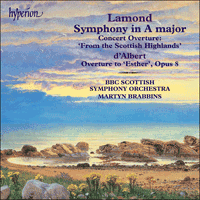



Hyperion’s Record of the Month for March takes us to Scotland in pursuit of two Scottish-born piano virtuosi whose compositions have languished beneath the highland mists for too long. Born prematurely as a result of a steamboat collision on the Clyde, Frederic Lamond lived a short walk from Eugen d’Albert in Glasgow. The two became Liszt pupils and their musical abilities were admired by Richard Strauss, Hans von Bülow and Johannes Brahms.
Lamond’s Symphony in A major, his only symphony, was begun in 1885 – the composer was just twenty-one – and published in 1893. In four movements, a sense of generous assurance flows through this work which sits comfortably between Beethoven, looking backward, and Mahler in the future. Perhaps one should think of Brahms, yet Lamond adds a refreshing breath of Scottish air into an otherwise-Germanic climate.
The Overture from the Scottish Highlands tells the story of one Quentin Durward, a stalwart of Louis XI’s Scottish bodyguard. His Burgundian adventures betray a sense of homesickness; Scottish themes and droned bass lines prevail. Sword Dance, taken from Lamond’s opera A life in the Scottish Highlands, presents a scene of bucolic exuberance, fancy footwork and Scotch-snap rhythms combining in a work of irresistible panache.
The disc opens with Eugen d’Albert’s Overture to Esther. The Biblical Esther had little time for honour, or even religion come to that, and d’Albert’s overture similarly throw caution to the wind, before eventually she, and he, are won back to the arms of King Ahasuerus.

My father, Archibald Lamond, was a humble weaver in what was then the village of Cambuslang, near Glasgow. He never had a teacher, but by poring over some old Church music which by accident had come his way, he soon found out the difference in notation between the treble and bass clefs. In the ’fifties of the last century, there was no organ in the Parish Church in Cambuslang. My father got hold of a clarinet; set to work, and in a comparatively short time, mastered its mechanism.
Thus Frederic Archibald Lamond opens his Memoirs: and by such determination on the part of individuals in the face of circumstance have people like Lamond and Eugen d’Albert risen to fame. Comparative fame. Lamond is remembered by the cognoscenti as a pianist who was renowned for his Beethoven playing, or as a pupil of Liszt’s with interesting memories. But who remembers him as a composer? A like fate befell his contemporary d’Albert, also a virtuoso pianist, also a pupil of Liszt’s and born in Glasgow of a Scottish mother and French father, though Hyperion (with Piers Lane) have rescued his piano concertos and piano music (Hyperion CDA66747 and CDA66945).
D’Albert was born on 10 April 1864 on Sauchiehall Street, in the heart of Glasgow, and so has priority by birth, for Lamond arrived on 28 January 1868 at Lynedoch Place, a short walk to the west. Lamond’s older brother, Archie, died of tuberculosis in his seventeenth year. Their mother died after giving birth prematurely – brought on by an injury in a steamboat collision on the Clyde when Frederic was eight. Their father held the fort with his older surviving children, David and Barbara, until his own death in 1891. It was not easy. There had been no financial gain from founding an orchestra and a choir, self-taught, as Lamond’s father had done, and he thereby lost the initiative in the weaving trade. He was reduced to becoming a clerk in a cotton mill and the Lamonds learned to live in dire poverty.
From this environment came the young man who, in 1885 and aged only twenty-one, was to be one of an audience of three for a first run-through by the Meiningen orchestra, under Hans von Bülow, of the third and fourth movements of Brahms’s Fourth Symphony. The other two persons permitted to attend were the Landgraf of Hesse and Richard Strauss. Strauss and Lamond were often together thereafter.
As for young d’Albert, in the 1880s he lodged with Hans Richter’s family in Vienna and performed both of the Brahms piano concertos with Brahms himself conducting. Little wonder, then, that the genial figure of Brahms has cast an inspiring shadow over the music of these two men. They met first in St Petersburg, and Lamond held d’Albert’s playing and compositions in the highest esteem.
It would be easy to leave it at that: two minor acolytes, worthy but unmemorable. But it will not do. The music on this premiere recording may derive many of its good qualities from the example of Brahms – and what better example? – but there is technical skill a-plenty, and strength, character and beauty, and these things are not lightly won. Nor was musical understanding to be acquired only in Germany. The name Lamond was a famous one in Scottish music, for the Lamonds were luters and harpers, and the beautiful fifteenth-century Lamond harp, now in the National Museum of Scotland, is named after them. Music was in the blood. As for d’Albert, his father was a dancing master and composer ‘of no mean merit’, according to Lamond.
The d’Albert family soon moved from Glasgow to Newcastle and young Eugen then went on to London. But his tuition at the precursor of the Royal College of Music was not a source of satisfaction. His piano teacher, Pauer, gave his own son, Max, all the best openings; and his composition teacher, Sir Arthur Sullivan, was liable to appear hung-over. Only Prout stood up for d’Albert. But when d’Albert visited Liszt in Weimar and Liszt remarked that he played ‘remarkably well for a composer’, d’Albert asked whether he might not become a pianist. ‘Certainly’, came the reply; ‘I never heard a better’. Brahms particularly admired his playing.
These encouragements were to determine the first half of d’Albert’s life, which was primarily that of a concert pianist, though in 1907 he succeeded Joachim as director of the Musik Hochschule in Berlin – a position of considerable responsibility and status. But composition gradually took over, the medium of opera being perhaps congenial to a man who had six marriages, all apparently of the stormy variety. His second wife married four times; his third was dismissed when after thirteen years she was careless enough to produce a child; and his fourth was described by a previous husband as a beautiful landscape with an impossible climate.
D’Albert’s reputation in Britain suffered from a published letter in which he gave vent to his feelings about his education in London, along with pro-German and anti-British sentiments. How he would have dealt with the rise of Nazism is a nice question. He died in Riga in 1932. Lamond’s own opposition to the Nazis forced him to leave Germany in 1940.
D’Albert’s Overture to ‘Esther’, Opus 8 is one of a small group of orchestral works, including a symphony Opus 4 and two piano concertos (Opus 2 and Opus 12). By Lamond’s standards this is a considerable output, but d’Albert composed twenty operas besides (some of which were highly successful), two string quartets, and several piano works, not to mention a number of transcriptions, including a demanding version of the great early Bach organ Prelude and Fugue in D major.
The Overture was intended for Grillparzer’s fragmentary poetic drama of the same name, published in 1861. Esther is one of those books in the Bible in which religion has no place, and honour but a trifling one. It commences with the putting aside of Queen Vashti for disobedience – a course which might well have had appeal to d’Albert – and with the successful petitioning by Esther, the new Queen, for the right of her own Jewish people to avenge a plot against them. The background, then, is of the charm and discretion of Esther in the context of courtly magnificence, intrigue and violence.
The Overture opens with a striking declamatory statement in A major, but is countered by a gentle woodwind passage. On the repeat of this process, a solo horn announces an appealing contrasting subject in C major. The pace quickens to a climax, and a calmer section follows, eventually ushering in a new theme, making its elegant curtseys on the woodwind in the dominant key, in which the oboe also announces a rustic variant of the second subject.
D’Albert, however, is skilful in his use of the shifting perspectives offered by frequent modulation and by a recapitulation which substantially reverses the order of the material; and in the end Esther’s charms yield to (or win, depending upon your perspective) the magnificent condescension of her husband King Ahasuerus.
Frederic Lamond made little attempt to promote himself as a composer, and he only refers to his own compositions in a passing comment in his Memoirs. But the works on this disc reveal a talent which deserved better treatment from its possessor. In addition to the Symphony, the Overture and the opera from which the Sword Dance is taken, there are the eight Clavierstücke Opus 1 published in two volumes in Leipzig – beautiful fluid sophisticated music, without a hint of the showmanship that he could readily have employed. The D major Cello Sonata and the B minor Piano Trio Opus 2 exhibit the same skill and refinement. The Sonata was first performed by Lamond and Piatti in St James’s Hall, London, in 1889 and the Rose Quartett gave the Trio in the Bösendorfer Saal in Vienna on 25 November 1890. But that seems to be the sum total of his output, for Lamond devoted himself with the deepest artistic humility to the realization of the works of others.
Perhaps his sense of just how privileged he was was fostered by the family’s initial poverty and by the fact that his brother and sisters moved with him to Germany in order to support his studies, the elder sister doing so from her earnings from running a boarding-house. His brother David became a music teacher in Glasgow in later years and promoted Frederic’s first solo recitals in their home city.
Ever-generous in his acknowledgment of the skills of his fellow-pianists, Lamond sought the best from, but not for, himself. His performances of late Beethoven, particularly the ‘Hammerklavier’ Sonata Op 106, were legendary; but he was also one of the first to introduce Brahms to those parts of Austria and Germany which were still in the Wagner camp. Lamond took no sides in the shameful behaviour of those composers’ fans, and records Wagner sitting beside the piano where Brahms had just finished playing his Handel Variations, and saying to Brahms ‘I would never have thought it possible to compose such variations after Beethoven’.
It was in such circles that Lamond constantly moved, and his own great contribution was acknowledged by his appointment to a professorship in the Hague Conservatory in 1917. He gave master classes in Sondershausen, where his compatriot, Alexander Mackenzie, had studied some fifty years before, and in the 1920s he regularly toured the Unites States. The University of Glasgow awarded him an LL.D in 1937, which no doubt made up for the hostility of the London press who resented his artistic preference for Germany. In 1904 he had married Irene Triesch, a leading German actress who maintained that she owed everything to Lamond’s advice, claiming that he could have been a fine actor himself. In contrast to d’Albert’s relationships, theirs was a life-long and profound mutual love. When he died in Bridge of Allan on 21 February 1948 she wrote:
I lived in ‘his world’ for 46 years – a blessing for which I thank Heaven. I remember our unison in music. As the companion of such a man, who was an artist to the very depths of his soul, I learned to honour Beethoven’s magnificent music … ‘Continuing to learn’ was Frederic Lamond’s principle. With what patience did he work at the handicraft of his art! Work began for him in the morning, and at night work still lived in the quivering of his hands when he slept. ‘If I work continuously, my conscience is clear.’
Lamond’s Symphony in A major, Opus 3 is his first and only symphony, probably commenced around 1885 when he was seventeen years old and still awaiting that recognition as a pianist which would soon lead him away from composition. It went through at least two revisions before its publication in Frankfurt in 1893. It was performed at the famous Court Theatre at Meiningen where Lamond was greeted by the orchestra with a Tusch, or flourish, of trumpets and drums. Manns conducted it in Glasgow on 23 December 1889 and again at the Crystal Palace, London in 1890. There are four movements.
From the very start of the opening Allegro moderato there is a sense of generous assurance, yet nothing here is overstated. The warm cello and clarinet melody rises from the major third and, passing up through the strings to a fortissimo, asserts an inherent strength with a rugged exchange of 6/8 for 3/4. It is followed immediately by the second subject, in a lilting waltz tempo that eventually leads to a beautiful yielding codetta to the exposition. The development is brief, the second subject dancing lightly amongst the more dramatic gestures derived from the first subject. The recapitulation is regular, and the coda, which briefly threatens to be portentous, is no such thing, and ends unassumingly.
The Allegro vivace, quasi presto follows on entirely naturally. It is a scherzo, bursting with energy and fun, looking back to Beethoven and, in the odd moment, forward to Mahler. Woven into its brilliant contrasts of texture is a gentle slightly modal theme over a drone bass, like a tiny breath of Scottish air in the otherwise Germanic climate of the movement. The trio section, Molto moderato e quieto, has a ländler-like lilt, though others have heard Scotland in its rural charm. The scherzo returns, modified, but as bucolic as before and, in homage to Beethoven’s own ploys, ends teasingly with a brief recollection of the trio section.
A glorious melody opens the Andante moderato, but there is also a very real unease in this movement, with heavy-paced tuttis in slow march tempo and sections of dark thoughtfulness. Relief is brought with the return of the opening theme, beautifully embellished by flowing quavers; but they are insufficient wholly to dispel the agitation, and though the coda eventually subsides gently, it does so over a bass line which retains much of the darkness of the earlier slow march. The concluding ‘amen’ cadence, so simply stated, sounds here with a true sense of gratitude for deliverance from some trouble only partly disguised.
The sure hand of Brahms guides the start of the Allegro con spirito in both rhythm and texture, but Lamond is so at home in this idiom, and his material is so lovely in itself – notably the second subject – that it should earn nothing but a welcome for the pleasure with which it walks in familiar fields.
Lamond’s Ouvertüre Aus Dem Schottischen Hochlande, Opus 4 was originally titled ‘Quentin Durward: Charakterbild in Form einer Ouvertüre’. In Sir Walter Scott’s novel, Quentin Durward, the hero of the title is a young Scot who becomes a member of the French King Louis XI’s Scottish bodyguards. The loyalty and courage of his conduct eventually lead to his winning the hand of a Burgundian heiress, despite the enmity between King Louis and the Burgundians. It is a story of love, intrigue, bravery and chivalry which might well have served as a model for Dumas; and Lamond’s music might have served that author equally well, were it not so clearly imprinted with the character of Scotland. On his first meeting with Brahms, Lamond found himself explaining the etymological significance of the Gaelic name Aran – a mountainous island in the Clyde estuary. Clearly the landscape of his homeland was often in his mind. Lamond never lost his Glasgow accent.
The fresh lyricism of the opening theme, largely pentatonic and set against a drone bass, is the most obvious evidence of its Scottishness, and it is this theme from which nearly all the subsequent material is derived. Not even a change of key from F to A major, and time signature from 6/8 to 2/4, can disguise the close relationship between it and the second subject.
But the warmth of this lyricism is soon interrupted by an element of adventurous mischief which in turn seems to generate more serious consequences. A climax drawn from the opening theme subsides into doubts, ending with a solo for bass clarinet which leads to the recapitulation. As the piece nears its end, the heraldic versions of the main theme become more prominent and, despite a brief reminder of mischief, build powerfully on a grinding ostinato to the final climax. Just as one thinks that all is going to end in splendour, the woodwind reclaim the beautiful flowing lyricism of the main Scottish theme, as Lamond returns in spirit to the rivers and glens of Scotland whence the subject of his portrait came.
The Sword Dance from Lamond’s opera Eine Liebe im Schottischen Hochlande is a reel – a dance form attested in Scotland as early as 1525, of which the sword dance is probably the oldest example. Lamond has produced a little classic of the genre. Here are the drone fifths, the proud, assertive melody and the rich scoring proper to a show-piece dance. But it also allows for those delicate touches that remind one that fancy footwork is required of the dancers who dance in stocking or bare feet over crossed razor-sharp swords.
The dance is led off by Lamond’s father’s instrument, the clarinet, and followed by the oboe, which Frederic himself played to a high standard. The bucolic atmosphere is helped along by horn calls, all over a sustained pedal A – the drone note of the Highland bagpipes. A brief section in D minor soon reverts to the major with trumpets and trombones on a tune characterized by its use of the Scotch-snap rhythm, at which point the Scottish flag is unfolded and the clans gather, as Lamond’s note in the score informs us. The pace gathers towards a final presto and prestissimo full of triumphant flourishes which, in the opera, are accompanied by the chorus – in this concert form the work is equally irresistible.
John Purser © 2004
Mon père, Archibald Lamond, était un humble tisserand à Cambuslang, qui n’était alors qu’un village près de Glasgow. Il n’a jamais eu de professeur de musique, mais en se plongeant dans quelque vieille musique religieuse qu’il avait dénichée par hasard, il comprit rapidement la différence de notation entre les clés de sol et de fa. Dans les années ‘50’ du siècle dernier, l’église paroissiale de Cambuslang ne disposait d’aucun orgue. Mon père mit la main sur une clarinette, commença à travailler et en relativement peu de temps, parvint à en maîtriser le mécanisme.
Ainsi débutent les Mémoires de Frederic Archibald Lamond. Face à des circonstances difficiles, c’est en faisant montre d’une pareille détermination que des individus comme Lamond et Eugen d’Albert se sont hissés jusqu’à la célébrité. Une célébrité toute relative cependant. Ce sont surtout les érudits qui se souviennent de Lamond comme d’un pianiste renommé pour son interprétation de Beethoven, ou comme d’un élève de Liszt qui laissa des Mémoires captivants. Mais qui se souvient de lui comme d’un compositeur ? Pianiste virtuose et élève de Liszt comme Lamond, né à Glasgow d’une mère écossaise et d’un père français, Eugen d’Albert, son contemporain, connut un destin similaire, même si grâce à Hyperion (et Piers Lane) ses concertos et sa musique pour piano sont ressuscités (Hyperion CDA66747 et CDA66945).
D’Albert vit le jour le 10 avril 1864 à Sauchiehall Street, au cœur de Glasgow. Sa naissance lui donne donc priorité sur Lamond qui vint au monde le 28 janvier 1868 à Lynedoch Place, situé non loin de là, un peu plus à l’ouest. Le frère aîné de Lamond, Archie, succomba à la tuberculose dans sa dix-septième année. Leur mère mourut en donnant naissance prématurément – l’accouchement avait été déclenché par un accident lors d’une collision d’un bateau à vapeur sur la Clyde alors que Frédéric n’avait que huit ans. Leur père porta le flambeau avec ses aînés, David et Barbara, jusqu’à sa propre disparition en 1891. La vie n’était guère aisée. Du point de vue financier, la création d’un orchestre et d’un chœur, aussi autodidacte puisse-t-il être, ne lui apporta aucun revenu, si bien qu’il délaissa toute initiative pour le tissage. Il en fut réduit à devenir employé dans une filature et les Lamond durent apprendre à vivre dans la pauvreté.
C’est dans ce milieu que grandit le jeune homme qui en 1885, à vingt-et-un ans, faisait partie du parterre de trois personnes seulement venues assister à une lecture des troisième et quatrième mouvements de la Quatrième Symphonie de Brahms que donnait l’orchestre de Meiningen dirigé par Hans von Bülow. Les deux autres qui avaient eu le droit d’y assister n’étaient autres que le Landgrave de Hesse et Richard Strauss. Par la suite, on vit souvent Strauss et Lamond ensemble.
En ce qui concerne le jeune d’Albert, il logeait avec la famille de Hans Richter à Vienne au milieu des années 1880 et exécuta les deux Concertos pour piano de Brahms sous la direction de Brahms même. Il n’est donc guère surprenant que la personnalité géniale de Brahms ait jeté son ombre sur la musique de ces deux hommes. Ils se rencontrèrent pour la première fois à Saint-Pétersbourg. Lamond tenait le jeu de d’Albert et ses compositions en haute estime.
Il serait aisé de s’en arrêter là : deux acolytes mineurs, méritants mais guère mémorables. Si ce n’est que c’est totalement inexact. La musique de cette première discographique peut certes tirer une grande partie de ses qualités de l’exemple de Brahms – et y a-t-il un meilleur exemple ? Pourtant, les facultés techniques abondent tout comme la force, le tempérament, le caractère et la beauté. Et ces qualités ne coulent pas de source. L’entendement musical ne s’acquérait pas uniquement en Allemagne. Le nom de Lamond était célèbre dans la musique écossaise, car les Lamond étaient des luthiers et harpistes. La superbe harpe Lamond du XVe siècle conservée actuellement au Musée national d’Écosse leur doit son nom. La musique coulait dans leur veine. En ce qui concerne d’Albert, son père était un maître de danse et un compositeur « doué d’un véritable mérite » selon Lamond.
La famille d’Albert partit rapidement de Glasgow pour Newcastle. Le jeune Eugen s’établit ensuite à Londres. Les cours qu’il prenait dans l’établissement qui allait devenir le Royal College of Music ne lui apportaient guère de satisfaction. Son professeur de piano, Pauer, avait lui-même un fils, Max, qui recevait les meilleures opportunités. Quant à son professeur de composition, Sir Arthur Sullivan, il faisait preuve d’une propension à venir donner ses cours les lendemains d’ivresse. Seul Prout lui prêta attention. Lorsque d’Albert se rendit à Weimar pour voir Liszt, celui-ci remarqua qu’il « jouait remarquablement bien pour un compositeur ». D’Albert lui demanda s’il ne pouvait pas devenir un pianiste. « Certainement » fut la réponse ; « je n’en ai jamais entendu de meilleure ». Brahms admirait particulièrement son jeu.
Ces encouragements décidèrent de la première moitié de la vie que d’Albert mena, à savoir celle d’un pianiste de concert, même si en 1907, il prit la succession de Joachim comme directeur de la Musik Hochschule de Berlin – un poste d’une responsabilité et d’un statut considérables. Peu à peu cependant, la composition accapara tout son temps. L’opéra se trouva peut-être plus en symbiose avec un homme qui avait eu six mariages, appartenant apparemment tous à la catégorie sulfureuse. Sa seconde épouse se maria quatre fois, sa troisième fut renvoyée quand après treize ans, elle fut assez négligente pour produire un enfant ; et sa quatrième fut décrite par un époux précédent comme un magnifique paysage au climat impossible.
La renommée de d’Albert en Grande-Bretagne souffrit d’une lettre ouverte où il laissait libre cours aux sentiments qu’il éprouvait quant à l’éducation londonienne, dévoilant des sympathies pro-allemandes et anti-anglaises. Il aurait été intéressant de pouvoir apprécier son attitude face à la montée du nazisme. D’Albert mourut à Riga en 1932. Quant à Lamond, il s’opposa aux Nazis, ce qui le contraignit à quitter l’Allemagne en 1940.
L’Ouverture d’« Esther », opus 8 de d’Albert appartient à un corpus restreint d’œuvres orchestrales, qui comprend aussi une Symphonie opus 4 et deux Concertos pour piano (respectivement opus 2 et opus 12). A comparer avec le catalogue de Lamond, il s’agit d’une production considérable, mais d’Albert écrivit aussi vingt opéras (dont certains connurent un franc succès), deux quatuors à cordes et plusieurs œuvres pour le piano, sans parler des transcriptions qui comprennent une version difficile du superbe Prélude et fugue en ré majeur du grand Bach de la première période.
L’Ouverture était destinée au drame poétique fragmentaire de Grillparzer du même nom publié en 1861. Esther est un de ces livres bibliques où aucune place n’est accordée à la religion, et une insignifiante à l’honneur. Le récit débute par la mise au ban de la Reine Vashti pour désobéissance – une situation qui a pu séduire d’Albert – et avec les requêtes d’Esther, la nouvelle reine, pour le droit de son propre peuple juif à venger un complot contre lui. L’atmosphère générale est donc celle du charme et de la discrétion d’Esther face à la pompe, l’intrigue et la violence qui règnent à la cour.
L’Ouverture débute par un énoncé déclamatoire saisissant en la majeur disputé par un doux passage aux bois. Lors de la reprise de ce procédé, un solo de cor annonce un thème contrastant séduisant en do majeur. L’allure s’accélère jusqu’à l’apogée. S’ensuit une section plus calme, puis arrive un nouveau thème, avec ses élégantes révérences aux bois à la dominante. Le hautbois y annonce aussi une variante rustique du second thème.
D’Albert exploite avec habilité les changements de perspectives offerts par des modulations fréquentes et par la réexposition qui intervertit largement l’ordre des éléments thématiques. Pour finir, les charmes d’Esther font céder (ou s’assurent selon votre point de vue) la condescendance superbe de son époux, le roi Assuérus.
Frederic Lamond ne chercha guère à se faire connaître comme compositeur. S’il fait parfois référence à ses propres compositions dans ses Mémoires, ce n’est qu’en passant. Pourtant les œuvres que l’on pourra découvrir sur ce disque révèlent un talent véritable qui méritait d’être mieux traité par celui qui le possédait. Outre la Symphonie, l’Ouverture et l’opéra dont est tirée cette Danse du sabre, sa production comprend huit Clavierstücke opus 1 publiées en deux cahiers à Leipzig – une musique belle, fluide et sophistiquée, sans aucune trace de spectaculaire aisément exploitable. La Sonate pour violoncelle en ré majeur et le Trio avec piano en si mineur opus 2 font preuve de ce même raffinement. La Sonate fut créée par Lamond et Piatti au St James’s Hall, à Londres, en 1889, et le Quatuor Rose donna le Trio à la Salle Bösendorfer de Vienne le 25 novembre 1890. Voici apparemment le catalogue complet de sa production car Lamond se consacra avec l’humilité artistique la plus profonde à la réalisation des œuvres d’autres compositeurs.
Peut-être ce sentiment d’être privilégié avait-il grandi de la pauvreté initiale de sa famille. Il s’était nourri du fait que son frère et ses sœurs s’étaient établis en Allemagne afin de l’aider dans ses études. Sa sœur aînée lui permit de subsister grâce aux revenus qu’elle tirait de la pension de famille qu’elle tenait. Son frère David devint plus tard professeur de musique à Glasgow. Il assura la promotion des premiers récitals que Frederic donna en soliste dans leur ville natale.
Toujours généreux envers les talents de ses collègues pianistes, Lamond recherchait ce qu’il y avait de mieux, mais pas pour lui-même. Ses exécutions du Beethoven dernière période, notamment la Sonate « Hammerklavier » opus 106 sont légendaires. Il fut aussi celui qui présenta Brahms à ces régions autrichiennes ou allemandes qui demeuraient dans le camp wagnérien. Lamond ne prit nullement part au comportement honteux des partisans des deux compositeurs. Il évoque Wagner, assis à côté du piano où Brahms venait tout juste de jouer ses Variations sur un thème de Haendel, disant à Brahms « Je n’aurais jamais cru qu’il soit possible de composer de telles variations après Beethoven. »
C’est dans de tels cercles que Lamond évoluait en permanence. Son immense contribution fut reconnue par sa nomination au poste de professeur au Conservatoire de La Hayes en 1917. Il donna des masterclasses à Sondershausen où son compatriote, Alexandre Mackenzie avait étudié cinquante ans auparavant. Dans les années 1920, il fit régulièrement des tournées aux Etats-Unis. L’Université de Glasgow lui octroya un LL.D (Doctorat de droit) en 1937, ce qui accentua certainement l’hostilité de la presse londonienne qui n’appréciait pas du tout sa préférence artistique pour l’Allemagne. En 1904, il avait épousé Irene Triesch, une actrice allemande de premier plan qui a maintenu qu’elle devait tout aux conseils de Lamond, affirmant que lui-même aurait pu être un superbe acteur. Contrairement à la vie amoureuse de d’Albert, leur relation fut celle d’un amour profond, mutuel, qui dura toute leur vie. Lorsqu’il s’éteignit à Bridge of Allan le 21 février 1948, elle écrivait :
J’ai vécu dans « son monde » pendant 46 ans – un bonheur pour lequel je remercie le Ciel. Je me souviens de nos unissons en musique. En tant que compagne d’un tel homme, un artiste jusqu’aux tréfonds de son âme, j’ai appris à honorer la musique magnifique de Beethoven … « Continuer à apprendre », tel était le principe de Frederic Lamond. Avec quelle patience ne s’est-il consacré au travail de son art ! Le travail débutait pour lui le matin et, la nuit, il se poursuivait dans le frémissement de ses mains lorsqu’il dormait. « Si je travaille constamment, ma conscience est tranquille. »
La Symphonie en la majeur opus 3 est la première et unique symphonie de Lamond. Il en commença la composition probablement vers 1885 alors qu’il n’avait que dix-sept ans et qu’il n’était pas encore connu comme pianiste, ce qui allait par la suite l’éloigner de l’écriture. Révisée à deux reprises avant d’être publiée à Frankfurt en 1893, elle fut exécutée au célèbre Théâtre de la Cour à Meiningen où Lamond fut accueilli par un Tusch de l’orchestre, une fanfare de trompettes et percussions. Manns la dirigea à Glasgow le 23 décembre 1889 et de nouveau au Crystal Palace, à Londres, en 1890. Elle comprend quatre mouvements.
Dès le début de l’Allegro moderato, on perçoit un sentiment de confiance généreuse, sans que rien ne soit pour autant exagéré. La mélodie chaleureuse du violoncelle et de la clarinette s’élève d’une tierce majeure et, atteignant via les cordes un fortissimo, elle confère une force inhérente avec un changement vigoureux de mesure, de 6/8 à 3/4. Elle est immédiatement suivie d’un second thème dans un tempo de valse enjouée qui conduit à la belle codetta tout en retenue de l’exposition. Le développement est concis. Le second élément thématique danse légèrement parmi les gestes plus dramatiques dérivés du premier. La réexposition est régulière et la coda, qui menace brièvement d’être solennelle, évite l’écueil et se conclut avec modestie.
L’Allegro vivace, quasi presto coule ensuite de source. Il s’agit d’un scherzo éclatant d’énergie et d’entrain qui renoue avec Beethoven tout en anticipant parfois Mahler. Entrelacé dans de brillants contrastes de texture, le thème légèrement modal est énoncé sur un bourdon à la basse, à la manière d’une bouffée d’air écossais soufflant dans le climat autrement germanique du mouvement. La section en trio Molto moderato e quieto possède une allure de Ländler même si d’autres ont perçu l’Écosse à travers son charme rustique. Tout aussi bucolique qu’auparavant, le scherzo reprend sous une forme modifiée. Véritable hommage aux ruses beethovéniennes, il se conclut sur une courte évocation taquine de la section en trio.
C’est par une mélodie glorieuse que débute l’Andante moderato. Cependant, on y trouve aussi un véritable trouble avec ses tutti d’allure pesante dans le lent tempo de marche et ses sections embuées de noires pensées. La reprise du thème initial magnifiquement brodée de croches fluides apporte une accalmie qui ne suffit pourtant pas à chasser l’agitation. Si la coda parvient finalement à la dissiper doucement, c’est sur une ligne de basse qui conserve en partie la sombre affliction de la marche lente précédente. Enoncée avec une réelle simplicité, la cadence aux allures d’« amen » conclusif donne l’impression d’un véritable sentiment de gratitude pour être délivré d’un tourment qui n’était que partiellement dissimulé.
La main assurée de Brahms guide le début de l’Allegro con spirito aussi bien dans son rythme que dans sa texture. Lamond est tout aussi à l’aise dans cet idiome. Ce matériau thématique est si intrinsèquement charmant – notamment le second thème – qu’il ne devrait rien gagner d’autre que l’accueil chaleureux réservé au plaisir avec lequel il marche en des terres aussi connues.
L’Ouvertüre Aus Dem Schottischen Hochlande opus 4 de Lamond portait initialement le titre de « Quentin Durward : Charakterbild in Form einer Ouvertüre ». Dans le roman de Sir Walter Scott, Quentin Durward, le héros éponyme est un jeune Écossais qui est devenu membre des gardes du corps du roi Louis XI de France. La loyauté et le courage de sa conduite l’amènent à remporter la main de l’héritière du trône de Bourgogne, malgré l’inimité qui règne entre le roi Louis et les Bourguignons. C’est une histoire d’amour, d’intrigue, de bravoure et de chevalerie qui aurait très bien pu servir de modèle à Dumas. La musique de Lamond aurait aussi très bien pu seconder cet écrivain si ce n’était pour son caractère fondamentalement écossais. Lors de sa première rencontre avec Brahms, Lamond se retrouva en train de lui expliquer la signification étymologique du nom gaélique Aran – une île montagneuse de l’estuaire de la Clyde. Il est clair que les paysages de sa terre natale n’étaient jamais très loin. Jamais Lamond ne perdit son accent écossais.
Le lyrisme frais du thème initial largement pentatonique qui est réalisé sur un bourdon à la basse, incarne clairement le caractère écossais. Et c’est de ce thème que dérive presque tout le matériau thématique utilisé par la suite. Pas même une modulation de fa majeur vers la majeur, ni un changement de mesure de 6/8 à 2/4, ne peut déguiser le lien de parenté étroit avec le second thème.
Le lyrisme chaleureux est brusquement interrompu par un élément d’espièglerie aventureuse qui semble avoir des répercussions plus sérieuses. Le paroxysme né du thème initial fait place au doute, et se conclut par un solo de clarinette basse conduisant à la réexposition. Alors que la pièce touche à sa fin, les versions héraldiques du thème principal deviennent de plus en plus présentes. Malgré une courte évocation espiègle, elles élaborent avec force l’apogée final sur un ostinato écrasant. Alors que l’on pense que tout va s’achever sur cette impression grandiose, les bois rappellent le beau lyrisme fluide du thème principal écossais, Lamond évoquant de nouveau les rivières et vallées de son Écosse d’où est tiré le personnage.
Extraite de Eine Liebe im Schottischen Hochlande, la Danse du Sabre de Lamond est bien réelle : il s’agit d’une forme de danse attestée en Écosse dès 1525 dont la danse du sabre est probablement l’exemple le plus ancien. Lamond a produit un petit classique du genre. Les bourdons de quintes, la mélodie fière et affirmative, la richesse de l’orchestration font de cette danse un véritable petit bijou. Elle laisse aussi transparaître ces touches délicates qui nous rappellent la légèreté de pas requises chez des danseurs qui dansaient en bas ou pieds nus autour de sabres entrecroisés aux lames affûtées.
Cette danse est entonnée par l’instrument du père de Lamond, la clarinette, et reprise par le hautbois dont Frederic jouait très bien. L’atmosphère bucolique est accentuée par les appels des cors, le tout énoncé sur une pédale de la – la note de bourdon des cornemuses des Highlands. Une courte section en ré mineur retrouve rapidement le majeur avec des trompettes et des trombones énonçant une mélodie caractérisée par l’emploi du rythme de « Scotch-snap » (double-croche – croche pointée). C’est alors que le drapeau écossais est déployé et que le clan se réunit ainsi que nous l’apprend une annotation de Lamond portée dans la partition. L’allure s’accélère jusqu’à atteindre les presto et prestissimo finals, pleins d’élans triomphaux lesquels sont, dans l’opéra, accompagnés par le chœur. Dans sa version orchestrale, cette œuvre est tout aussi irrésistible.
John Purser © 2004
Français: Isabelle Battioni
Mein Vater, Archibald Lamond, war ein bescheidener Weber in dem damaligen Dorf Cambuslang in der Nähe von Glasgow. Unterricht hat er nie erhalten, jedoch gelang es ihm durch das Studium von alter Kirchenmusik, die irgendwie in seinen Besitz geraten war, den Notationsunterschied zwischen Bass- und Violinschlüssel herauszufinden. In den fünfziger Jahren des letzten Jahrhunderts gab es in der Dorfkirche von Cambuslang keine Orgel. Mein Vater trieb jedoch eine Klarinette auf, machte sich an die Arbeit und meisterte ihre Mechanik nach relativ kurzer Zeit.
So beginnt Frederic Archibald Lamond seine Memoiren, und mit solch fester Entschlossenheit erlangten Menschen wie Lamond und Eugen d’Albert trotz ihrer bescheidenen Herkunft ein gewisses Ansehen. Lamond ist heute unter Kennern als Liszt-Schüler mit interessanten Erinnerungen bekannt, beziehungsweise als Pianist, der für seine Beethoven-Interpretationen berühmt war. Wer entsinnt sich jedoch seines kompositorischen Werks? Ein ähnliches Schicksal wurde seinem Zeitgenossen d’Albert zuteil, der ebenfalls ein virtuoser Pianist und Liszt-Schüler war, der in Glasgow geboren wurde und dessen Mutter Schottin und Vater Franzose war. Seine Klavierkonzerte und Klaviermusik wurden jedoch von Hyperion (mit Piers Lane) geborgen (Hyperion CDA66747 und CDA66945).
D’Albert wurde am 10. April 1864 in der Sauchiehall Street im Herzen Glasgows geboren und hat damit den Vortritt, da Lamond am 28. Januar 1868 in Lynedoch Place, etwas westlicher, zur Welt kam. Lamonds älterer Bruder, Archie, starb in seinem 17. Lebensjahr an Tuberkulose. Seine Mutter starb nach einer Frühgeburt, die durch eine Verletzung bei einer Dampfschiff-Kollision auf dem Clyde ausgelöst wurde, als Frederic acht Jahre alt war. Der Vater kümmerte sich fortan um ihn und seine älteren Geschwister, David und Barbara, bis er selbst im Jahre 1891 starb. Sie hatten es nicht leicht. Lamonds Vater hatte – als Autodidakt – ein Orchester und Chor gegründet, was finanziell kein Gewinn war. Gleichzeitig hatte er sein Interesse an der Weberei verloren und sah sich daher gezwungen, als Büroangestellter in einer Baumwollweberei zu arbeiten. Die Lamonds lernten es, in bitterer Armut zu leben.
Aus diesem Umfeld kam also der junge Mann, der 1885 im Alter von 21 Jahren im Publikum von insgesamt nur drei Zuhörern saß, als das Meiningener Orchester unter der Leitung von Hans von Bülow den dritten und vierten Satz von Brahms’ Vierter Symphonie zum ersten Mal durchspielte. Die anderen beiden Personen waren der Landgraf von Hessen und Richard Strauss. Strauss und Lamond trafen sich darauf noch viele Male.
Der junge d’Albert hingegen wohnte in den 1880er Jahre im Hause der Familie von Hans Richter in Wien und führte beide Klavierkonzerte von Brahms unter der Leitung des Komponisten selbst auf. Es ist wohl kaum überraschend, dass das Genie Brahms einen inspirierenden Schatten über die beiden Männer warf. Sie lernten sich in St. Petersburg kennen und Lamond schätzte d’Alberts Spiel und Kompositionen sehr hoch ein.
Hierbei könnte man es belassen: zwei zweitrangige Jünger, ehrenwert, aber nicht weiter denkwürdig. Damit würde man es sich jedoch zu leicht machen. Die Qualität der Musik der vorliegenden Erstaufnahme mag sich auf Brahms berufen – und wer könnte ein besseres Vorbild sein? Daneben sind jedoch auch das technische Können, der Charakter, die Kraft und Schönheit hervorzuheben – und es ist nicht leicht, diese Eigenschaften zu erwerben. Zudem konnte das musikalische Verständnis auch außerhalb Deutschlands erworben werden. Der Name Lamond war in der schottischen Musik berühmt: die Lamonds waren Lauten- und Harfenspieler und die wunderschöne Lamond-Harfe aus dem 15. Jahrhundert, die heute im Schottischen Nationalmuseum aufbewahrt wird, wurde nach ihnen benannt. Sie hatten die Musik im Blut. D’Alberts Vater war seinerseits Tanzmeister und Komponist „von keinem geringen Rang“, wie Lamond es ausdrückte.
Die Familie d’Albert zog bald von Glasgow nach Newcastle und der junge Eugen nach London. Jedoch war sein Unterricht an dem Vorläufer des Royal College of Music nicht befriedigend. D’Alberts Klavierlehrer, Pauer, war hauptsächlich an der Förderung seines eigenen Sohnes Max interessiert und sein Kompositionslehrer, Sir Arthur Sullivan, erschien des öfteren verkatert. Lediglich Prout setzte sich für seinen Schüler ein. Als d’Albert jedoch Liszt in Weimar aufsuchte und Liszt bemerkte, dass er „für einen Komponisten bemerkenswert gut“ spiele, fragte d’Albert, ob er nicht Pianist werden könne. „Selbstverständlich“, hieß die Antwort, „ich habe nie einen Besseren gehört“. Auch Brahms schätzte sein Spiel sehr.
Diese Aufmunterungen sollten die erste Hälfte von d’Alberts Leben bestimmen, die er hauptsächlich als Konzertpianist verbrachte. Im Jahre 1907 trat er als Direktor der Musikhochschule Berlins die Nachfolge Joachims an und übernahm damit einen Posten von bedeutender Verantwortung und großem Prestige. Jedoch wurde das Komponieren für ihn zunehmend wichtiger und vielleicht war das Medium Oper in gewisser Weise geistesverwandt mit dem Mann, der sechsmal (offenbar immer recht „stürmisch“) verheiratet war. Seine zweite Frau heiratete viermal, die dritte wurde nach 13 Jahren „entlassen“, nachdem sie so leichtfertig gewesen war und ein Kind zur Welt gebracht hatte, und die vierte war von einem früheren Ehemann als wunderschöne Landschaft mit einem unmöglichen Klima beschrieben worden.
D’Alberts Ruf in Großbritannien litt unter einem veröffentlichten Brief, in dem er sich über seine Ausbildung in London beschwerte und auch seine pro-deutschen und anti-britischen Ansichten kundtat. Wie er sich mit dem Aufkommen des Nationalsozialismus auseinandergesetzt hätte, wäre eine interessante Frage. Er starb in Riga im Jahre 1932. Lamond war ein Gegner der Nazis und musste Deutschland deshalb 1940 verlassen.
D’Alberts Ouvertüre zu „Esther“, op. 8 ist Teil einer kleinen Gruppe von Orchesterwerken, zu der außerdem eine Symphonie (op. 4) und zwei Klavierkonzerte (op. 2 und op. 12) gehören. Für Lamond wäre dies eine beträchtliche Anzahl gewesen, d’Albert hingegen komponierte daneben 20 Opern (von denen einige sehr erfolgreich waren), zwei Streichquartette, mehrere Klavierwerke sowie eine ganze Reihe von Bearbeitungen, darunter eine anspruchsvolle Fassung des großen frühen Orgelpräludiums und Fuge in D-Dur von Bach.
Die Ouvertüre war für Grillparzers Dramenfragment mit demselben Titel geplant, das 1861 herausgegeben wurde. Esther ist eines jener Bücher der Bibel, in dem Religion keinen Platz hat und Ehre nur einen geringfügigen. Es beginnt damit, dass Königin Vashti wegen Ungehorsams abgesetzt wird – eine Maßnahme, die d’Albert möglicherweise ansprechend fand – und dass Esther, die neue Königin, das Recht ihres eigenen jüdischen Volkes, gegen das eine Intrige geplant ist, erfolgreich verteidigt. Der Hintergrund ist also der Charme und die Diskretion der Esther im Kontext der höfischen Grandezza, Gewalt und Intrigen.
Die Ouvertüre beginnt mit einem eindrucksvollen, deklamatorischen A-Dur, das dann aber einer zarten Holzbläser-Passage gegenübergestellt wird. Diese Abfolge wird wiederholt und ein Solohorn kündigt ein gewinnendes Thema in C-Dur an. Das Tempo wird beschleunigt und es erfolgt ein Höhepunkt. Darauf folgt ein ruhigerer Teil, in dem schließlich ein neues Thema erklingt. Die Holzbläser vollführen elegante Verbeugungen in der Dominante, in der die Oboe ebenfalls eine rustikale Variante des zweiten Themas anspielt.
D’Albert setzt die Perspektivenwechsel, die sich durch mehrere Modulationen ergeben und auch durch die Reprise, in der das Material in umgekehrter Reihenfolge erscheint, sehr gekonnt ein. Am Ende unterliegt (oder gewinnt, je nach Auffassung) der Charme Esthers der großartigen Herablassung ihres Gatten, König Ahasuerus.
Frederic Lamond unternahm recht halbherzige Versuche, sich als Komponist zu etablieren und in seinen Memoiren erwähnt er seine Kompositionen nur beiläufig. Jedoch enthüllen die Werke auf der vorliegenden CD ein Talent, dass mehr Aufmerksamkeit verdient hätte, als sein Besitzer ihm zuteil werden ließ. Neben der Symphonie, der Ouvertüre und der Oper, aus der der Schwerttanz stammt, existieren noch acht Clavierstücke op. 1, die in Leipzig in zwei Bänden herausgegeben wurden: wunderschöne, fließende und kunstvolle Musik, die keinerlei Effekthascherei aufzeigt, obwohl er gut davon Gebrauch hätte machen können. Die Cellosonate in D-Dur und das Klaviertrio in h-Moll op. 2 sind ebenso kunstfertig gearbeitet. Die Sonate wurde erstmals von Lamond und Piatti in der Londoner St. James’s Hall im Jahre 1889 aufgeführt und das Rose Quartett führte das Trio im Bösendorfer-Saal in Wien am 25. November 1890 auf. Es scheint dies jedoch sein gesamtes kompositorisches Oeuvre zu sein, da Lamond sich mit der tiefsten künstlerischen Demut der Ausführung von Werken anderer Komponisten widmete.
Möglicherweise konnte er durch die Armut, die er als Kind und Jugendlicher erfahren hatte, besonders gut einschätzen, wie privilegiert er war. Sein Bruder und seine Schwestern zogen mit ihm nach Deutschland, um ihn bei seinem Studium zu unterstützen: die ältere Schwester verdiente Geld, indem sie eine Pension führte. Sein Bruder David wurde einige Jahre später Musiklehrer in Glasgow und veranstaltete Frederics erste Klavierabende in ihrer Heimatstadt.
Lamond erkannte die Fähigkeiten seiner Pianisten-Kollegen großzügig und selbstlos an und strebte stets danach, sein Bestes zu geben. Seine Interpretationen des Spätwerks Beethovens, insbesondere der „Hammerklaviersonate“ op. 106, waren legendär. Gleichzeitig war er einer der ersten, die die Werke Brahms’ in den Teilen Österreichs und Deutschlands einführten, die noch dem Lager Wagners angehörten. Lamond schloss sich keinem der beiden Lager an und nahm auch nicht das schändliche Benehmen der jeweiligen Anhänger der beiden Komponisten an, sondern erinnerte sich daran, wie Wagner neben dem Klavier saß, an dem Brahms gerade seine Händel-Variationen gespielt hatte, und zu Brahms sagte: „Ich hätte es nie für möglich gehalten, dass nach Beethoven solche Variationen komponiert werden könnten“.
Lamond bewegte sich stets in Zirkeln wie diesem und sein eigener Beitrag zum Musikleben wurde in Form von einer Professur am Konservatorium von Den Haag im Jahre 1917 anerkannt. Er gab Meisterklassen in Sondershausen, wo sein Landsmann, Alexander Mackenzie, etwa fünfzig Jahre vorher studiert hatte, und in den 1920er Jahren unternahm er regelmäßig Konzertreisen in den USA. Die Universität Glasgow verlieh ihm 1937 einen Ehrendoktortitel, was sicherlich die Feindseligkeit der Londoner Presse wettmachte, die wenig Verständnis für seine Präferenz Deutschlands in künstlerischer Hinsicht zeigte. 1904 hatte er Irene Triesch geheiratet, eine führende deutsche Schauspielerin, die stets erklärte, dass sie ihr ganzes Können den Ratschlägen Lamonds verdanke und dass er selbst ein guter Schauspieler hätte gewesen sein können. Im Gegensatz zu den Beziehungen d’Alberts war ihre Ehe auf einer lebenslangen, tiefgehenden gegenseitigen Liebe begründet. Als er am 21. Februar 1948 in Bridge of Allan starb, schrieb sie:
Ich habe 46 Jahre lang in „seiner Welt“ gelebt – ein Segen, für den ich dem Himmel danke. Ich erinnere mich an unsere Einheit in der Musik. Als Gefährtin eines solchen Mannes, der aus seiner tiefsten Seele Künstler war, lernte ich die großartige Musik Beethovens zu schätzen ... „Immer weiterlernen“ war die Devise Frederic Lamonds. Mit welcher Geduld arbeitete er an dem Handwerk seiner Kunst! Die Arbeit fing für ihn am Morgen an und lebte nachts im Zucken seiner Hände weiter, wenn er schlief. „Wenn ich fortwährend arbeite, ist mein Gewissen rein.“
Lamonds Symphonie in A-Dur, op. 3 ist seine erste und einzige Symphonie, die er wahrscheinlich um 1885 begann, als er 17 Jahre alt war und noch auf die Anerkennung als Pianist wartete, die ihn bald von dem Komponieren wegführen sollte. Das Werk wurde mindestens zweimal überarbeitet, bevor es 1893 in Frankfurt veröffentlicht wurde. Die Uraufführung fand in dem berühmten Hoftheater von Meiningen statt, wo Lamond von dem Orchester mit einem Tusch begrüßt wurde. Manns dirigierte das viersätzige Werk in Glasgow am 23. Dezember 1889 und 1890 im Crystal Palace in London.
Der erste Satz, Allegro moderato, strahlt von Anfang an eine großzügige Zuversicht aus, jedoch ohne jede Übertreibung. Die warme Cello- und Klarinettenmelodie erhebt sich von der großen Terz und bewegt sich durch die Streicher, bis sie ein Fortissimo erreicht; ein etwas rauer Wechsel von 6/8 zu 3/4 drückt die innere Stärke aus. Sofort darauf folgt das zweite Thema mit einem tänzerischen Walzer-Tempo, das schließlich zu einer wunderschönen, nachgiebigen, kurzen Coda der Exposition führt. Die Durchführung ist kurz, das zweite Thema bewegt sich tänzerisch durch die eher dramatischen Gesten des ersten Themas. Die Reprise verläuft auf traditionelle Weise und die Coda droht für einen Moment lang bombastisch zu werden, beendet das Stück dann aber auf bescheidene Art und Weise.
Das Allegro vivace, quasi presto folgt ganz natürlich. Es ist ein energiegeladenes und heiteres Scherzo, in dem an Beethoven erinnert und zuweilen auch Mahler antizipiert wird. Ein zartes, leicht modales Thema erklingt über einem bordunartigen Bass in einem Geflecht brillanter Kontraste wie ein sanfter schottischer Lufthauch in einem sonst deutschen Klima. Das Trio, Molto moderato e quieto, hat einen Ländler-artigen Gestus, obwohl andere darin auch den ländlichen Charme Schottlands gehört haben. Das Scherzo kehrt leicht verändert wieder, ist jedoch immer noch so bukolisch wie zuvor und endet leicht spöttisch mit einer kurzen Erinnerung an den Trio-Teil, auf ein Stilmittel Beethovens anspielend.
Eine großartige Melodie eröffnet das Andante moderato, gleichzeitig ist dieser Satz jedoch von einer deutlichen Beklommenheit gezeichnet: es erklingen schwere Tuttis im langsamen Marsch-Tempo und Passagen düsterer Nachdenklichkeit. Die Rückkehr des Anfangsthemas, das mit fließenden Achteln wunderschön verziert ist, sorgt für Erleichterung, jedoch reicht es nicht aus, um die Erregung vollständig zu zerstreuen. Obwohl die Coda schließlich abflaut, geschieht dies über einer Bassmelodie, in der das Düstere des vorangehenden langsamen Marsches noch deutlich hörbar ist. Die abschließende „Amen-Kadenz“ ist sehr schlicht und erklingt hier mit wahrer Dankbarkeit für die Erlösung von dem nur teilweise verschleierten Unheil.
Die sichere Hand Brahms’ leitet den Anfang des Allegro con spirito, sowohl was den Rhythmus als auch was die Textur angeht. Lamond ist jedoch in dieser Tonsprache so zu Hause und das Material selbst ist so schön – besonders das zweite Thema – dass es in der vertrauten Umgebung, in der es sich bewegt, willkommen geheißen werden sollte.
Lamonds Ouvertüre Aus Dem Schottischen Hochlande, op. 4 trug ursprünglich den Titel: „Quentin Durward: Charakterbild in Form einer Ouvertüre“. In Sir Walter Scotts Roman Quentin Durward ist der Titelheld ein junger Schotte, der ein Leibwächter des französischen Königs Ludwig XI. wird. Aufgrund seiner Treue und seines mutigen Verhaltens gewinnt er schließlich die Hand einer burgundischen Erbin, trotz der Animositäten zwischen der Krone und Burgund. Es ist eine Geschichte der Liebe, Intrige, Ritterlichkeit und Tapferkeit und hätte gut als Vorbild für Dumas fungieren können. Die Musik Lamonds hätte dem Autor ebenso gut dienen können, wenn sie nicht einen so offensichtlich schottischen Charakter gehabt hätte. Bei seiner ersten Zusammenkunft mit Brahms erklärte Lamond ihm die etymologische Bedeutung des gälischen Namen Aran – eine bergige Insel in der Clyde-Mündung. Offensichtlich dachte er oft an die Landschaft seines Heimatlandes. Lamond behielt auch stets seinen Glasgower Akzent.
Das lyrische erste Thema, größtenteils pentatonisch angelegt und gegen einen Bordunbass gesetzt, ist besonders schottisch. Aus diesem Thema heraus ist auch fast das gesamte folgende Material entwickelt. Nicht einmal ein Tonartenwechsel von F nach A-Dur und ein Tempowechsel von 6/8 nach 2/4 können die enge Beziehung zwischen diesem und dem zweiten Thema verschleiern.
Die Wärme dieser Lyrik wird jedoch bald durch ein Element abenteuerlichen Unsinns unterbrochen, das für ernstere Folgen zu sorgen scheint. Ein Höhepunkt, der sich aus dem Anfangsthema entwickelt, geht in Zweifeln unter und endet mit einem Solo für Bassklarinette, das zur Reprise hinüberleitet. Gegen Ende des Stückes treten die heraldischen Versionen des Hauptthemas immer mehr in den Vordergrund, trotz einer kurzen Erinnerung an den „Unsinn“, und arbeiten mit einem zermürbenden Ostinato wirkungsvoll auf den letzten Höhepunkt zu. Genau wenn man denkt, dass alles zu einem glorreichen Schluss kommen wird, greifen die Holzbläser das wundervoll fließende, lyrische, schottische Hauptthema noch einmal auf und Lamond kehrt zu den Flüssen und Tälern Schottlands zurück, der Inspirationsquelle seines Themas.
Der Schwerttanz aus Lamonds Oper Eine Liebe im Schottischen Hochlande ist ein Reel – ein Tanz, der in Schottland bereits 1525 beschrieben wurde, dessen älteste Form wahrscheinlich der Schwerttanz ist. Lamond hat mit seinem Werk einen kleinen Klassiker des Genres geschaffen. Es erklingen die Bordun-Quinten, die stolze, ausdrucksstarke Melodie und die reichhaltige Komposition, die das Tanz-Schaustück präsentieren. Daneben erscheinen jedoch auch feinere Stilmittel, die an die Behändigkeit der Beine und Füße erinnern, über die die Tänzer verfügen müssen, wenn sie in Strümpfen oder barfüßig über gekreuzte, rasierklingenscharfe Schwerter tanzen.
Der Tanz wird von dem Instrument von Lamonds Vater, der Klarinette, angeführt, gefolgt von der Oboe, die Frederic Lamond selbst gut beherrschte. Die bukolische Atmosphäre wird durch Hornsignale verstärkt, die über einem ausgehaltenen tiefen A erklingen – der Bordunton der Dudelsäcke des schottischen Hochlands. Eine kurze Passage in d-Moll wechselt bald nach Dur zurück und die Trompeten und Posaunen spielen eine Melodie, die den „Scotch-snap-Rhythmus“ (umgekehrte Punktierungen, Anm. d. Ü.) hat. Lamond bemerkt in einer Notiz in der Partitur, dass bei dieser Melodie die schottische Flagge ausgefaltet wird und die Clans sich versammeln. Das Tempo zieht an und das abschließende Presto und Prestissimo ist voller triumphierender Fanfaren, die in der Oper vom Chor begleitet werden – in der hier vorliegenden Konzertfassung ist das Werk jedoch ebenso unwiderstehlich.
John Purser © 2004
Deutsch: Viola Scheffel