Welcome to Hyperion Records, a British classical label devoted to presenting high-quality recordings of music of all styles and from all periods from the twelfth century to the twenty-first.
Hyperion offers both CDs, and downloads in a number of formats. The site is also available in several languages.
Please use the dropdown buttons to set your preferred options, or use the checkbox to accept the defaults.
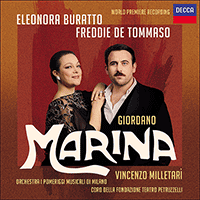


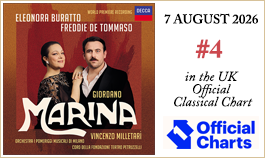
For nearly 140 years, Umberto Giordano’s first opera was considered lost. With this first recording of Marina, this early work by the composer steps back into the spotlight. The recording was made in February 2026 during the world premiere performances at Milan’s historic Teatro Dal Verme. The album thus documents not only a rediscovery of great significance in music history but also the very moment this work takes its place on stage for the first time.


Incredibly, Giordano’s debut opera was only heard for the first time on 12 February 2026 at Teatro Dal Verme in Milan. The composer himself did not pursue any plans for a production, partly because he had incorporated some of its music into Mala vita (later revised and renamed Il voto). Even though it is less shocking in tone and content than the latter work, Marina is verista in style, echoing the naturalism of much French and Italian literature of this period, with a searing slice-of-life plot, in which—as in Cavalleria rusticana and Pagliacci—reckless, violent emotions rule and events unfold with brutal suddenness. Again, like those works, Giordano’s opera is set not in some distant past but in a slightly exoticised near-present. The action takes place in a real, if not very distinctively characterised, Montenegro (light years away from the fictitious Pontevedro of Lehár’s The Merry Widow), during a conflict with Serbia. The characters represent the two opposing factions: Marina, her brother Daniele and her suitor Lambro are Montenegrin, Giorgio is a Serb. Against the backdrop of armed conflict, the arrival of the wounded Giorgio, the care given him by Marina, and the mutual infatuation experienced by the two young protagonists all combine to act as a trigger for an explosion of violence from Lambro. To him, and to Daniele, nothing matters more than loyalty to one’s homeland.
The libretto is by the Neapolitan Enrico Golisciani (1848-1918), a friend of Giordano’s composition teacher Paolo Serrao. A cultivated and experienced librettist, Golisciani was active throughout the first half century after Italian unification, writing the texts for works ranging from Ponchielli’s Marion Delorme (1885) to Wolf-Ferrari’s Il segreto di Susanna (1909) and I gioielli della Madonna (1911), to name just those still well-known today. In Marina, the only prominent character is the eponymous heroine, who has grown up motherless and unhappy—as too, it turns out, has Giorgio. Her existence as a woman in a patriarchal family of implacable ideals has extinguished any spark of inner life she might have had. When Giorgio appears, that spark is unexpectedly rekindled, and her initial compassion for a wounded soldier blossoms into love. She is both vulnerable and strong, capable of saving the life of a stranger at the risk of her own future by giving into a sudden emotional impulse. The characterisation of the three male roles is key to this work—the two baritones, Daniele and Lambro, are painted in a negative light (especially the latter, blinded by his thirst for vengeance and desire to possess Marina), while a sense of melancholy defines Giorgio (tenor).
The opera is cast in a single act, divided into two parts, and has a clear, effective musico-dramatic structure. After an off-stage chorus, Marina is introduced through a scena and aria, then sings a duet with the wounded Giorgio. The arrival of Daniele and Lambro gives rise to an extended scena featuring the chorus in a brindisi, or toasting song, and a Montenegrin song, reminiscent of the carter Alfio’s number with chorus in Cavalleria. A heated ensemble episode ensues when Giorgio emerges from his hiding-place and is arrested, before Part One concludes with a duet for Marina and her brother, who decrees she must witness their enemy’s execution. After an orchestral interlude, Part Two begins, symmetrically, with a scena and aria for Giorgio, now imprisoned in a cave. This is followed by a second, pivotal duet with Marina, in which she reluctantly, like Amelia in Un ballo in maschera, confesses her true feelings. In keeping with the new verismo style, the epilogue is swift and brutal: Marina helps Giorgio escape, but Lambro first shoots his rival dead, then stabs Marina, an act of femicide for which he claims full responsibility when a distraught Daniele arrives on the scene.
Having identified Giordano’s autograph score in the Koch Collection (housed in the Beinecke Library at Yale University), for which it was acquired at auction in 1986, Andreas Gies was able to prepare a critical edition of Marina. The score proved to be a very reliable source not only for the music but for the sung text and indeed the stage directions (crucially so, since no copy of the libretto, here restored by Emanuele d’Angelo, has survived). The young Giordano employs a modern musical idiom—harmonically advanced and richly inventive—and reveals a gift for flexible word setting. A master of theatrical devices, he adopts an interesting compositional approach—rather than slavishly following the libretto he handles the text in accordance with his own dramatic logic, elaborating on the episodes he deems more significant and establishing purely musical connections between the various numbers. On the one hand, he engages with the existing works that he takes as his models: there are echoes of Ponchielli’s La Gioconda here, as well as of late Verdi—the ink was barely dry on Otello at this point (and Verdi had asked Giordano’s teacher, Serrao, to conduct the Neapolitan premieres of Don Carlo and Aida in 1872/73). On the other, he brings such a distinctly personal touch to the opera, thanks to a series of strategies he has already mastered by this point and successfully realises here, that he avoids the trap of mere imitation. He observes the conventions of opera to perfection, with a finely calibrated sense of dramatic effect: the contrast between the military atmosphere established by the off-stage fanfare and chorus and Marina’s gentle, elegiac monologue; the way in which the orchestra falls silent as Daniele levels accusations at his sister; the concluding moments of Part One, as Marina steels herself to defy her brother; and the use of the chorus as a character in its own right. The relentless rhythmic pulse that energises the entire work is very important: it sets things in motion with the insistent anapaestic metre (two short notes followed by one long) of the opening Allegro con fuoco, provides constant tension in the ensemble number at the end of Part One, and injects life into the Montenegrin song. Equally effective, however, at the opposite end of the creative spectrum, is the wonderful lyricism that Giordano pours into the lovers’ two romanzas, as well as into some of the music sung by Lambro. Last but not least, we have to praise the sophistication of his orchestral writing, with its deft and intricate interplay between individual parts, and miniature solos for violin, cello, oboe, clarinet and, most notably, cor anglais, an instrument that had recently played a key role in Verdi’s Otello, and is central to the interlude between Parts One and Two here. Unquestionably an original 'affirmation of a brilliant mind', Marina has all the fresh charm of a debut work, and all the promise of a composer destined to leave his mark on the world of opera.
Raffaele Mellace © 2026
Incredibilmente, soltanto il 12 febbraio 2026 è stato possibile ascoltare per la prima volta, al Teatro Dal Verme di Milano, quel lavoro d’esordio cui Giordano non diede mai seguito, anche perché parte della musica era confluita nella citata Mala vita (poi rivista come Il voto). Anche se meno scandaloso di quest’ultima, Marina indica senza tentennamenti un orientamento verista coerente con la letteratura francese e italiana coeva: la messa in scena d’una tranche de vie, cruda e violenta, in cui le azioni, come in Cavalleria o Pagliacci, irrompono repentine e brutali, dando sfogo a passioni cieche e violente. Come nei titoli citati il soggetto non è storico ma contemporaneo, benché vagamente colorato d’esotismo. La vicenda si svolge infatti in un Montenegro reale per quanto poco connotato (anni luce dal Pontevedro fasullo della Vedova allegra ) durante un conflitto con la Serbia. I personaggi appartengono ai due fronti opposti: montenegrini sono la protagonista, il fratello Daniele e lo spasimante Lambro, serbo è Giorgio. Sullo sfondo d’un conflitto armato, l’arrivo di Giorgio ferito, le cure che gli presta Marina e l’infatuazione reciproca dei due giovani fungono da detonatore della violenza di Lambro, per il quale, al pari di Daniele, conta soltanto la contrapposizione tra schieramenti in armi.
Del testo si fece carico una conoscenza di Paolo Serrao, maestro di composizione di Giordano, il napoletano Enrico Golisciani (1848-1918), librettista colto e di lungo corso, attivo per tutto il primo mezzo secolo dell’Italia unita, cui contribuì con titoli dalla Marion Delorme (1885) di Ponchielli al Segreto di Susanna (1909) e ai Gioielli della Madonna (1911) di Wolf-Ferrari, per citare quelli restati negli annali. Unica figura di spicco del dramma è la protagonista, orfana di madre e infelice, come d’altra parte l’eroe Giorgio, cresciuta oppressa in una famiglia patriarcale che in nome di ideali feroci ne ha soffocato la vita interiore, la quale all’apparire del giovane ferito si ridesta violenta, facendo sbocciare inaspettato, dalla compassione l’amore. Una donna a un tempo fragile e forte, capace di prendere in mano il proprio destino per salvare un giovane sconosciuto, assecondando con trasporto l’impulso d’un momento. Essenziale la caratterizzazione dei tre uomini, negativa per i due baritoni (specie Lambro, accecato dalla smania di possesso e vendetta), malinconica per il tenore.
L’articolazione drammatico-musicale dell’atto unico bipartito è chiara ed efficace. Introdotta da un coro dietro le quinte, la protagonista si presenta con una scena e aria cui segue il duetto con Giorgio ferito; l’arrivo degli altri due personaggi dà vita a una grande scena con brindisi e canzone montenegrina con coro, analoga alla canzone del carrettiere Compar Alfio in Cavalleria. La prima parte culmina nel concertato concitato innescato dall’uscita allo scoperto di Giorgio, che viene arrestato, e coronato dal duetto tra Marina e il fratello, che le impone di assistere all’esecuzione del giovane nemico. Un intermezzo sinfonico conduce, simmetricamente, alla scena e aria di Giorgio prigioniero in una grotta, e a un secondo, cruciale duetto con Marina, che, come Amelia in Un ballo in maschera, confessa pur reticente di amarlo. L’epilogo, in ossequio all’incipiente drammaturgia verista, è rapido e brutale: se Marina tenta di far fuggire Giorgio, Lambro prima spara al nemico rivale, poi pugnala al petto Marina, rivendicando il femminicidio di fronte al fratello disperato.
L’individuazione da parte di Andreas Gies della partitura autografa presso la Koch Collection della Beinecke Library di Yale, che l’aveva acquistata a un’asta nel 1986, fonte accuratissima anche nella restituzione del testo cantato e persino delle didascalie sceniche (cruciale, poiché non è giunta fino a noi alcuna copia del libretto, qui ripristinato da Emanuele d’Angelo), ha permesso allo stesso Gies di preparare l’edizione critica. Il giovanissimo Giordano vi adotta un linguaggio musicale al passo con i tempi, armonicamente avanzato, dall’invenzione suadente, flessibile nell’adesione alla parola. Padrone dei meccanismi melodrammatici, mette in atto una progettualità interessante, che non segue pedissequamente il libretto ma gestisce il testo secondo una logica drammatica propria, sviluppandone le porzioni che reputa più rilevanti e attivando connessioni puramente musicali tra i diversi numeri. Da un lato Giordano dialoga con i suoi modelli: risuonano echi della Gioconda, così come del Verdi maturo il cui Otello è allora ancora fresco d’inchiostro (al maestro di Giordano, Serrao, lo stesso Verdi aveva affidato la concertazione del Don Carlo e dell’Aida al San Carlo di Napoli nel 1872/73). D’altra parte risuona in Marina una cifra schiettamente personale che mantiene il compositore in erba lontano da un ruolo di epigono grazie a una serie di strategie padroneggiate e messe in atto con successo. Tutte le convenzioni melodrammatiche sono rispettate alla perfezione, con un senso assai ben calibrato degli effetti: il contrasto tra l’atmosferica bellica imposta da fanfara e coro fuori scena e il delicato monologo elegiaco di Marina, le accuse di Daniele alla sorella sul drammatico silenzio dell’orchestra, la decisione presa da Marina con cui culmina la Parte I, l’impiego del coro come personaggio. Decisiva è la pulsazione ritmica inesorabile che innerva l’atto unico: ne avvia l’azione con l’incalzante ritmo anapestico (due note brevi seguite da una lunga) dell’Allegro con fuoco d’apertura, conferisce tensione costante al concertato che chiude la Parte I, infiamma la canzone montenegrina, senza peraltro dimenticare l’altro polo dell’invenzione di Giordano: l’afflato lirico di qualità profuso nelle romanze dei due amanti ma anche nella parte pregevole dello spasimante Lambro. Non sarà possibile infine passare sotto silenzio la raffinatezza dell’orchestrazione, accurata e sofisticata negli interventi delle singole voci individuali, assoli miniaturistici di violino, violoncello, oboe e clarinetto, e soprattutto del corno inglese, cui tanto peso anche Verdi aveva di recente attribuito in Otello, cruciale nell’intermezzo sinfonico tra le due Parti. Davvero l’originale «affermazione di un ingegno brillantissimo»: freschezza d’un avvio e caparra d’un talento drammatico destinato a lasciare il segno.
Raffaele Mellace © 2026
Decca Classics © 2026
Decca Classics © 2026