Welcome to Hyperion Records, a British classical label devoted to presenting high-quality recordings of music of all styles and from all periods from the twelfth century to the twenty-first.
Hyperion offers both CDs, and downloads in a number of formats. The site is also available in several languages.
Please use the dropdown buttons to set your preferred options, or use the checkbox to accept the defaults.
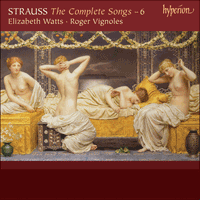


Hyperion’s Strauss Lieder series continues to demonstrate that the composer’s achievements in this genre are among the most fascinating and accomplished of his works. This latest volume includes, for instance, the delicious Schlechtes Wetter from Op 69, and the lovely—and unknown—Waldesfahrt from the same group. The delicately beautiful Malven (never published in Strauss’s lifetime, and first performed by Kiri Te Kanawa in 1985), with which the recital ends, is known as Strauss’s ‘Fifth Last Song’.
The central work recorded here, Krämerspiegel, owes its genesis to Strauss’s long-lasting and bitter dispute with the German music publishing industry. A Berlin literary critic, Alfred Kerr, wrote him a witty set of satirical verses lampooning music publishers, mentioning many of Strauss’s principal enemies by name. Strauss set all twelve poems to music, and this practical joke finally saw the light of day in 1921. It is easy to understand why the cycle is now rarely performed, given that the texts consist entirely of in-jokes, and that the lion’s share of the music is given to the pianist. But Strauss’s music is well worth savouring, not least for its humorous references to Strauss’s own works, such as Der Rosenkavalier and Ein Heldenleben, and especially for the beautiful prelude to the eighth song and its reprise as the final extended postlude—used by the composer nearly a quarter of a century later, in his opera Capriccio.
Roger Vignoles is the curator and pianist of this series, and also writes the informative booklet notes. Making her Hyperion debut is soprano Elizabeth Watts, of whom The Guardian commented at a recent Strauss Lieder recital: ‘Watts, winner of the Lieder prize at Cardiff Singer of the World in 2007, is already a major artist, but this struck me as making a transformation into a great one, as well as allowing us to hear her in music she seems to have been born to sing. Watts has the right tonal glamour for Strauss along with that tricky combination of vocal ease and immaculate control that his work requires.’

Roger Vignoles © 2012
Roger Vignoles © 2012
Français: Marie-Stella Pâris
Roger Vignoles © 2012
Deutsch: Arne Muus